Showing posts with label Avengers vs. X-Men. Show all posts

Monday, August 29, 2016

Ranking Marvel's Modern Events

Since the Avengers disassembled in 2004, Marvel has published over 20 major crossover events including line-wide events, franchise events (cosmic, Avengers, etc.), and family mini-events (X-Men, most usually). That said, there are 12 major line-wide events that define the overall tone of the Marvel universe beginning with House of M through the current Civil War II. I've ranked each event from worst to best, (SO SPOILERS!) starting with the practice in self-loathing called...


---

12. Avengers & X-Men: AXIS
In One Word: Unreadable.

Simply put, AXIS is a train wreck from beginning to end, a story originally meant for the pages of Uncanny Avengers that Marvel more-or-less forced Rick Remender to expand into a crossover event that was neither wanted, necessary, or well-liked. AXIS is a prime example of event fatigue, not only for the consumer, but also for the publisher who only wrapped up Original Sin one month before the March to AXIS branded-titles began. The entire premise was ridiculous – the Red Skull becomes Onslaught and a plan to defeat him backfires which inverts all the heroes and villains – and the expounding plotlines about the X-Men and Apocalypse, Sabertooth’s redemption, and an alliance of villains all very much fell flat. It’s not fun.


11. Fear Itself
In One Word: Frustrating
Writer Matt Fraction relies far too much on contemporary motivations to inform Fear Itself, a narrative about the civil unrest in America post-economic collapse that turned into Occupy Wall Street and other similar movements. While it’s admirable of Fraction to want to incorporate real life situations in a comic book universe, connecting a nihilistic America to the rise of a Nordic god of fear is a flimsy premise at best, and the whole bit about evil hammers possessing Marvel heroes is just stupid. We get it: Thor has a hammer and this is about Asgard, so there are more hammers! Fear Itself begins with a bang and no context, then expects readers to know far more than they would unless they've followed Thor for quite some time. The entire event feels convoluted and disjointed, like there’s so much story yet no cohesive way to tie it all together.


10. Original Sin
In One Word: Boring
Honestly, Jason Aaron’s Original Sin isn’t all that bad – I just happen to think it’s rather boring. The main, eight-issue series is a murder mystery featuring various weird team-ups between Marvel heroes as they investigate the murder of the Watcher. Early in the series, Z-list villain the Orb ‘detonates’ (I guess?) one of the Watchers’ eyes removed post-mortem, which results in various secrets of the Marvel U being revealed to the affected parties. The corresponding mini-series and tie-in issues are WAY more enjoyable than the main series because those tie-ins delve into the animosity between various heroes and how they deal with these new revelations. Unfortunately, AXIS came about soon after, so much of the status quo set by Original Sin was either ignored or replaced rather quickly.


9. Civil War II
In One Word: Disjointed

Alright, I know it’s not the greatest and there’s a lot more talking than there is war-ing in the pages of the main series, but given all its flaws, Civil War II has actually been more enjoyable than I imagined it would be. The premise is still shaky because Iron Man is obviously in the right while Captain Marvel sounds more and more like a fascist every issue, the dynamics of future crime prevention are being presented in different ways by different writers which has allowed the concept to breathe outside Brian Michael Bendis’ rather rudimentary explanation in the main series. Could it be better? Of course. Is it necessary? Probably not in the long run. Am I having fun with it while it’s happening? Definitely.


8. Age of Ultron
In One Word: Misunderstood
The misunderstood little event that didn’t have a home. This crossover was seeded in 2011 with a Free Comic Book Day issue, yet the event itself didn’t appear until 2013. Originally, writer Brian Michael Bendis had it planned to come out much sooner, but the development of AvX and the succeeding ‘Marvel NOW!’ initiative meant too many different plans were in play, and Age of Ultron was pushed to the side until it just felt awkward. That said, this crazy time-travel story that starts with Ultron having already won comes with a fun House of M style alternate timeline and finishes with a major shake-up that ties into Jonathan Hickman’s Avengers saga that eventually led to Secret Wars.


7. Avengers vs. X-Men
In One Word: Chaotic

Yes, it feels disjointed sometimes because five different writer scripted issues round robin-style, and yes, twelve issues was way too long for what could have been done in eight, but Avengers vs. X-Men is still an explosive, engaging crossover that comes close to lampooning itself with the tie-in mini-series AvX: VS. As a natural conclusion to a number of plotlines as well as an organic evolution of the tensions between the Avengers and the endangered mutant species, Avenger vs. X-Men succeeded in bringing about real and lasting change to the Marvel universe (Charles Xavier is still dead, Cyclops is/was? still a radical revolutionary, the Unity Squad is still a thing) and doing so with an air of fun and whimsy that doesn’t detract from the nature of the story.


6. Civil War
In One Word: Dramatic

I like Mark Millar and Steve McNiven’s Civil War. I know it’s not a complete story in seven issues, but I also recognize that almost no event tells the entire story in just the main series. Secret Wars and Age of Ultron aside, every event on this list either benefits from tie-ins and mini-series, or requires them for a full understanding of the event. Civil War pits Captain America against Iron Man over their political ideologies concerning the Superhero Registration Act meant to unmask superheroes and make them accountable by becoming agents of S.H.I.E.L.D. Iron Man represents the US government in supporting the bill, while Captain America believes it infringes on personal liberties. Each Avenger rallies other heroes to his respective cause, then they all fight a lot. It’s not perfect, but it’s a damn fun story.


5. Siege
In One Word: Shocking
This reads a lot better if you’ve read J. Michael Straczynski’s Thor run because it sets up the entire “Asgard floating over Oklahoma” angle that makes Siege such an emotionally-impactful tale. The Asgardian gods have taken refuge in the floating city of Asgardia over Broxton, Oklahoma, and current head of international security and peacekeeping, Norman “Green Goblin” Osborn needs a major win to make his job and his various machinations more legitimate. He stages an attack that mirrors the catastrophe from Civil War that catalyzes the SRA and pits the death of hundreds on the Asgardians. Osborn lays siege upon Asgard and uses the full might of his army of villains masked as heroes to rain destruction upon the benevolent gods. It’s a short read at four issues, but the effects are many and the “Dark Reign” of the Marvel universe comes to an end.


4. Infinity
In One Word: Epic
Infinity doesn’t get nearly as much love as it deserves. Granted, no one much sh!ts on Jonathan Hickman’s cosmic event, but no one much talks about it either, which I think is a shame. Infinity presents a war on two fronts: The Avengers take to space to assist a coalition of galactic empires to stave off the threat of the Universal Builders, while the remaining heroes on Earth must contend with an invasion force led by the Mad Titan Thanos. This is a crossover that lives up to that name, as Hickman’s corresponding Avengers and New Avengers tie-in issues are essential to getting the full story. And what a story it is: what Infinity lacks in character development, it more than makes up for in all-out epic space battles, an insane Thanos/Inhumans story, and a huge conclusion that sets the stage for…


3. Secret Wars
In One Word: Everything

Jonathan Hickman’s insane, over-the-top, game-changing mega-series is a testament not only to his, Esad Ribic, and Ive Svorcina’s skill as storytellers, but also to Marvel’s overall gambit with a year-long event that ended the Marvel universe that had stayed in-tact since 1961. Secret Wars was an endgame literally years in the making (and for real; not like, say, Siege, which was really only in the making for two years) and paid off quite handsomely with a series that received critical and commercial success even under duress of heavy delays and a pre-empted ‘All-New, All-Different’ Marvel universe. This is how a crossover event is done – a phenomenal story, incredible art by a consistent team, and real consequences.


2. Secret Invasion
In One Word: Explosive
For some reason, I just love Secret Invasion. I wasn’t actively reading comics in 2008 when this event was being published, so I didn’t get the experience of reading it as it came out. That said, I read all the pertinent tie-in issues in the order they were published because a friend explained that was the best way. Boy was he right – getting the secret history behind the Skrull invasion while I read a story about the Skrulls making their final gambit and taking the world hostage before the planet’s heroes have time to react. Secret Invasion is non-stop action and one of the few crossover events not directly tied to any one Marvel hero or team, a rarity in this day and age. The distrust and paranoia already deeply ingrained after Civil War was exacerbated by Skrulls revealing they had been acting as some of the most recognizable heroes in the Marvel universe for years.


1. House of M
In One Word: Fun


There’s something about House of M that stands the test of time. Yes, it’s a plot-heavy book, but it also takes place over the course of just a single day in the House of M reality, so most of the heroes are reacting and not “growing” in the traditional sense. Logistics aside, House of M was amazing because it worked as both a stand-alone main series and as a gateway into this new world the Scarlet Witch conjured into existence – while Bendis didn’t spend much time exploring the world controlled by Magneto, the bannered mini-series and tie-in issues brought a resonance to House of M that still makes the main series by itself feel much bigger than it is even though none of it was required reading. Marvel took this concept to its natural conclusion with Secret Wars in 2015 where the dozens of mini-series set on Battleworld had literally no influence on the main series (outside a few off-hand remarks and one conversation in the Siege mini). But House of M did it first and is still my favorite modern Marvel crossover event.

Monday, October 15, 2012

EXTRA! EXTRA! (OCT 10-16, 2012)

Avengers vs. X-Men: Consequences #1 of 5
(w) Kieron Gillen
(p) Tom Raney
Because every Marvel event requires a series focusing on its aftermath, Avengers vs. X-Men: Consequences exists to give us readers a bridge between the world of AvX (that we've been living in for the past seven months) and the 'Marvel NOW!' era that started concurrently this week with Uncanny Avengers. Kieron Gillen does the most with what he's given, but unfortunately, the script simply falls short because there's no cohesive plot thread holding the various stories together beyond the fact that they all take place after Cyclops falls. I guess the closest thing to a 'main story' is the one with Cyclops and Wolverine, but if you're trying to look at the big picture, there's not much to see. I'm sensing this just might be a hiccup for Gillen, whose done fantastic work on Uncanny X-Men and his creator-owned Phonogram.

GRADE: 7.2/10


Before Watchmen: Doctor Manhattan #2 of 4

(w) J. Michael Straczynski
(p) Adam Hughes

I don't know why, but both issues of Doctor Manhattan have been very lackluster. Sure, the Doc is a quantum-based entity capable of expanding his consciousness across unknown distance and time, so why does it feel like a chore to read? I've struggled to understand J. Michael Straczynski's hyper-detailed style (remember when Spider-Man met Ezekiel? I want to forget, too) for years now, and giving him Doctor Manhattan was like asking a rocket scientist to explain a coffee maker. Granted, it can be complex, but it constantly feels like Straczynski makes his writing more complicated than it needs to be, and that gets boring quickly.


GRADE: 6/10

Demon Knights #13
(w) Paul Cornell
(p) Bernard Chang

Being one of the sleeper hits of the 'New 52', Demon Knights has given a lot to the DCnU mythology in it's 14 current issues - readers get the history of characters like Etrigan and Vandal Savage, are introduced to new ones like Exoristos, Al Jabr, and the Horsewoman, and get fresh takes on the Shining Knight and Madame Xanadu. Demon Knights #13 sends the team literally into Hell when Etrigan betrays them to curry favor with Lucifer in hopes of freeing himself from the bond he shares with Jason Blood. Unfortunately, Lucifer isn't very impressed and just commands his demons to torture the team. Most of the issue surrounds each team member's individual hell, but the weather starts clearing when Shining Knight realizes his blood vaporizes demons - a strong weapon in the pits of hell.

GRADE: 8.5/10


The First X-Men #3 of 5

(w) Neal Adams and Christos Gage
(p) Neal Adams

I seriously don't like this series. I don't know why I keep reading it beyond the fact that I started reading it and feel a need to complete it. The writing is godawful, the artwork is typical 90s fare with little more than 'real' colors to let you know it was produced this decade, and the fact that Neal Adams and Christos Gage are so giddy about totally changing established continuity boggles my mind. Don't buy this comic book, and don't expect any more reviews of The First X-Men, a series I'm simply done paying money to let disappoint me each month.


GRADE: 1/10

Green Lantern Corps #13
(w) Peter J. Tomasi
(p) CAFU

This is where "Rise of the Third Army" really starts off - lots of Third Armiers (I seriously don't know what to call them; how about Guardian Soliders?), lots of Guardian malarkey, and a clear direction for both Guy and John. Mogo is rebuilding himself, but his origin point must be located for the process to succeed, so the Guardians ask a ready and willing John Steward to take point. Meanwhile, Guy and his hand-picked cew are charged with escorting an important delegation to Oa for peace talks - Guy gets word that one of his old enemies has escaped the Sciencells, and he's is worried the escapee is going after his family. Guy leaves only half his men with the delegation and takes the other half to Earth, even though the Guardians have sent Guy's enemy to kill the entire delegation - it's a pretty good bait and switch, plus the Guardian Soldiers show up to take one of Guy's GLs, showing themselves to the GLC for the first time.

GRADE: 8/10


The Phantom Stranger #1

(w) Dan Didio
(p) Brent Anderson

It's hard to know where Dan Didio is going with The Phantom Stranger - there aren't any clear signs as to what the overall purpose of the series is supposed to be. Is the Stranger supposed to be an agent of good, or is it less direct than that? Traditionally, the Stranger's motives are his own and nothing else, but to feature him in his own ongoing series, there needs to be more than simply mysterious circumstances and unknown meanings - that's fun for a while, but it doesn't make for a lasting narrative style. This month, Stranger finds Rachel, a girl with shadow-controlling powers and no clue how to control them. After a quick duel, Rachel lets the Stranger guide her to someone who can train her, when he takes her straight to her demon father, Trigon, the one being she was trying to stay away from - it's a haunting sight to see the Stranger so removed from humanity, serving only the "higher good" in exchange for his penance.


GRADE: 7/10

Red She-Hulk #58
(w) Jeff Parker
(p) Carlo Pagulayan and Wellinton Alves

'Marvel NOW!' may have officially kicked-off with Uncanny Avengers, but Hulk has changed it's name to Red She-Hulk to coincide with the new Marvel line-wide movement. Jeff Parker brings Betty Ross front and center to star in this 'Marvel NOW!' iteration of the series, which starts off with Betty facing the results of Project Echelon, the government's newest attempt at super soldiers for the future. The Hulk Family has never been too much on my radar, but I'm willing to give any 'Marvel NOW!' series a chance, as that's kind of the point of the whole initiative. Red She-Hulk #58 doesn't do much in the way of direct character development, but Parker does do a fantastic job building up a mythology around her so as to make me more interested in what's happening going forward.

GRADE: 7.1/10


Team 7 #1

(w) Justin Jordan
(p) Jesus Merino

Well, Team 7 #1 is basically just a rehash of Team 7 #0, which is exactly what I predicted - why introduce all the characters in the zero issue when you could have planted seeds for future issues seeing as issue one was literally just around the corner? That being said, Team 7 #1 is surprisingly good for it's plot that takes the team to a floating prison that's supposed to be inescapable. Because this is a comic book and these things happen in comic books, A.R.G.U.S. loses contact with the facility and sends the team up to investigate. I have extremely high hopes for this series, as it has the potential to give readers a lot of secret history of the DCnU, like getting a new "Issue Zero" each month.


GRADE: 7/10

Wednesday, October 10, 2012

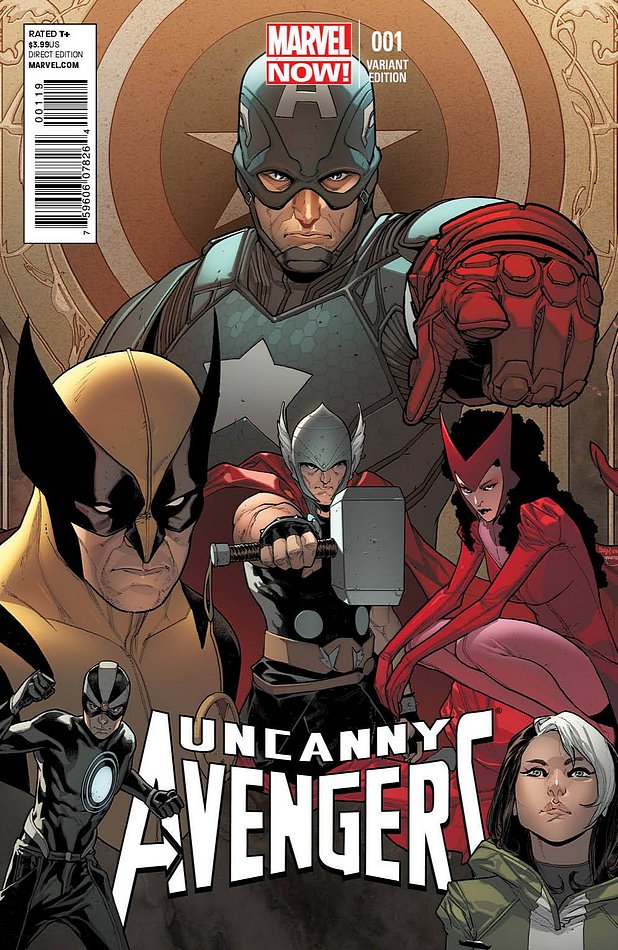
UNCANNY AVENGERS #1

(W) Rick Remender
(P/I) John Cassaday

Thought I'd throw up one of the 20 variants for this issue.
If beauty is in the eye of the beholder, than we're all currently holding. Uncanny Avengers #1 is, simply put, an achievement. Rick Remender has taken all the convoluted tension between the Avengers and X-Men and brought it to the surface, making these characters actually talk about it instead of beating the crap out of each other on a whim. That might sound less-than-interesting, but it's actually the one type of confrontation that hasn't been done to death in comic books, and it's absolutely refreshing.

Fittingly, the funeral for Professor Charles Xavier begins the tale of these Uncanny Avengers, with a speech by Wolverine that has enough gruff to make it seem believable, but still conveys the fact that Logan is an intelligent person. This segues into Captain America's meeting with Alex Summers (a.k.a. Havok), the brother of Scott Summers. While not the biggest name in the X-Men roster, Havok has put in his time and paid his dues. Steve Rogers sees that and wants to make Alex the leader of a new Avengers/X-Men hybrid team. In years passed, this book would have been made to take a more natural-sounding path to it's inception. Remember the first arc of The New Avengers, when Brian Michael Bendis wanted so much for the team to feel natural that he set up a massive prison break out that was supposed to be the basis of the series, but was quickly forgotten. Rick Remender isn't beating around the bush, not with his writing style or with these characters' motivations. Steve Rogers comes out and explains his intentions to Alex Summers, explaining that there needs to be something more inclusive.

It may come as a surprise, but many writers like to dumb down their characters and turn them into simple action-and-fight props used to propagate ridiculously complicated plots. It is actually very rare to get a writer who understands that these characters are just like real people when they aren't fighting crime, which means they think like real people and have real people solutions to problems. Instead of using adamantium claws or vibranium shields to solve their problems, these heroes are talking, explaining their feelings to one another and hoping they can work together to make the world a better place. Remender's dialogue comes from a place of unfettered sincerity, and it's what's going to make this series a delight to read.

I can't say enough good things about Uncanny Avengers #1. Rick Remender's plot and scripts are just magnificent - there's no deep connections to continuity, there's no huge revelations about characters we didn't already know (how many issues can depict Cyclops be transported to his cell?) and the characters used are either largely identifiable, or get amazingly organic profiling through character dialogue. All of these elements make Uncanny Avengers one hell of a read. Marvel is really striving to bring in new readers with 'Marvel NOW!', and if this first issue of concept is an example of the quality we'll be getting going forward, then it will be tremendously successful.

GRADE
9/10

Tuesday, October 9, 2012

EXTRA! EXTRA! (OCT 3-9, 2012)


AvX: VS. #6 of 6
(W) Kieron Gillen
(P) Jim Cheung
(I) Jim Cheung, Mark Roslan, and Mark Morales

As an experiment, AvX: VS was a learning experience more than anything - it showed what creators could do under a different set of rules, some more freeing, others more strict. AvX: VS #6 showcases the best of what the series has to offer, with the main event between Scarlet Witch and Hope Summers not only taking the prize for most interesting duel in the entire run, but also giving readers more than just a fight, which is what we wanted all along. The latter half is filled with awesome one-page bouts that we didn't get to see throughout the Avengers vs. X-Men event, but in a humorous light (like showdowns between Jeeves and Toad, the science-y characters in the Marvel U, Red Hulk and Domino, Iceman and Iron Fist, and lastly, Squirrel Girl and Pixie, whose magic dice may have caused more damage than they anticipated). This was a strong finish for a tumultuous series.

GRADE: 8/10


Before Watchmen: Rorschach #2 of 4
(W) Brian Azzarello
(P/I) Lee Bermejo

While I very much enjoyed Rorschach #1, this second issue has really mutated into something I now don't want to read - somewhere along the line, Brian Azzarello decided it would be good sport to make Rorschach as much like Batman as possible, except here, Rorschach talks in two-to-three word sentences exclusively. I seem to remember that good ol' Inky Face didn't like prostitutes that much - going so far as to kill them - yet here, he's readily defending a woman of the night against her pimp, albeit to get to a bigger catch, but it's hypocritical nonetheless.  Azzarello is now batting zero for two with Rorschach and Comedian, the two least enjoyable books of the entire Before Watchmen line. Seriously, just stick to the other four (and upcoming Moloch) series because these two are simply unnecessary and silly.


GRADE: 4/10


Stormwatch #13
(W) Peter Milligan
(P/I) Will Conrad and Cliff Richards


I love me some Stormwatch - it's a series that, so far, has been set literally and figuratively at the fringe of DC's 'New 52' universe. Stormwatch #13 starts a new arc for the title, as Peter Milligan gives us more and more connections between the Stormwatch organization and the group of heroes banded together in Medieval times over in Demon Knights. There has already been a lot of foreshadowing that the Demon's Knights eventually become that era's Stormwatch, but here, Milligan finally brings Etrigan the Demon into current day continuity! Demon Knights has been one of my favorite titles from DC's 'New 52', and Stormwatch has been getting better and better ever since Milligan took over and stared planting the seeds of this awesome crossover.

GRADE: 7.5/10


Uncanny X-Force #32
(W) Rick Remender
(P/I) Phil Noto

Uncanny X-Force is so good, it makes me excited and worried for Rick Remender's upcoming 'Marvel NOW!' titles - I know Uncanny Avengers will be good, but I'm concerned Captain America will suffer because Remender seems to only be able to focus on one title at a time, as evidenced by his lackluster arc on Secret Avengers. Uncanny X-Force #32 is another brilliant chapter in possibly the best series Marvel currently publishes each month. "Final Execution" heats up as Deadpool and Evan (clone of Apocalypse) are confronted by the Evil Brotherhood of Mutants as Deadpool tries to break Evan out of their stronghold. Wolverine and Psylocke offer back-up, but times are looking grim for X-Force, as the premonition of Evan's ascension to the Apocalypse throne seems to be getting closer and closer.


GRADE: 9.5/10


Uncanny X-Men #19
(W) Kieron Gillen
(P/I) Dale Eaglesham


Uncanny X-Men #19 is "The Passion of Scott Summers", a look at what the leader of the X-Men was going through - internally - as he amassed the cosmic power and became the Dark Phoenix, ravaging the world before being defeated by the Scarlet Witch and Hope Summers. I typically don't like stories being told exclusively in formulaic first person perspective, but Kieron Gillen does an apt job convincing me that Scott Summers (of all people) is actually thinking these thoughts. It's incredibly hard to convey the idea of omnipotence (obviously), but Gillen somehow finds a way to come close by showing that even with all his power, Scott is still just a person, mostly unable to control or understand how that power actually works. It's sad knowing that Gillen is moving off UXM (due, mostly, to it's cancellation), but he's moving on to the newly announced Young Avengers, which gives me high hopes for the series.

GRADE: 8/10

Wednesday, October 3, 2012

AVENGERS vs. X-MEN #12 of 12

(W) Jason Aaron
(P) Adam Kubert
(I) John Dell, Mark Morales, and Adam Kubert

So that's it. Avengers vs. X-Men finally comes to a close after six months of nearly non-stop melodrama, crazy battles, cosmic death gods, and general mayhem. And while the event - as a whole - had its missteps along the way, it managed to right the boat and finish strong with Scott Summers' ascension as the new Dark Phoenix, the death of Charles Xavier, and the incredible new developments contained in the pages of Avengers vs. X-Men #12.

It's do or die time at the opening of the issue: Cyclops has totally flown the coop and has become the Dark Phoenix, corrupted by absolute power. Flash back 72 hours, and Tony Stark is giving one of the most candid (yet still somehow snarky) speeches of his life because he finally doesn't know what to do. Science, in all it's know forms and manipulations, has failed, and now the Iron Man cites 'faith' as the next step for the Avengers. I'm usually critical of religious overtones bleeding into mainstream comics, mostly because it's often done clumsily and awkwardly, but Jason Aaron's decision to give THE man of science a sense of belief in a higher power is spot on. The Avengers have been waging a literal war against a cosmic god (in whichever of it's forms) with no real plan, no way of actually knowing what they're doing, of if it will work at all. In a world where a mortal man (however evolved) can make decisions that could literally change the face of the planet, faith doesn't seem like such a nonsensical idea. But is it Tony's faith in his plan? Or his faith in Hope Summers and Wanda Maximoff? Perhaps it's faith in faith itself.

The first big moment of the issue is when Hope and Wanda attack Dark Phoenix directly. Wanda's chaos magic is the only thing that can harm the Phoenix, and Hope can mimic that power, meaning that for the first time since the Phoenix came back to Earth, the Avengers have a fighting chance. Soon, Scott breaks through the Phoenix power, begging the Avengers to kill him before he's consumed once again. It doesn't happen, and the Scarlet Witch and Mutant Messiah go H.A.M. on Dark Phoenix until it leaves Scott. Of course, it immediately sets its sights on Hope. For the short amount of time Hope wields the Phoenix force, she undoes all that Cyclops has done to ravage the world, setting out fires, calming volcanoes, extinguishing the ocean, and generally making sure the entirety of humanity wasn't swallowed by it's own planet. It's remarkable, even in it's inevitability. This is when the second big moment hits.

Hope is in full control: she's seen what the Phoenix is capable of in the wrong hands, and with the life she's had, Hope understands the need to keep the power of a death god on a tight leash. "No. That wasn't why you were chosen," explains Wanda. "It's because you're the only one with the strength to let it go." Hope's destiny, ironically, is completely shaped by the events of Avengers vs. X-Men, as opposed to being the cause or the result of. Without seeing what the Phoenix could actually do when it's host is corrupted, Hope would never have had the strength or the wisdom to withstand the power. In the end, she let's the Phoenix force go. Then, as the fire bird dissipates into space, Hope and Wanda take things one step further. They send the bits and pieces of the Phoenix down to Earth and use it to create new mutants all over the globe.

While I usually see these things coming, I'll admit I was taken aback by "No More Phoenix". It shocked me before it made complete sense: Avengers vs. X-Men is the bookend to an era at Marvel that began with House of M when Wanda declared "No More Mutants", decimating the homo-superior population down to less than 200. And while I seriously enjoyed this issue from beginning to end, I felt a bit unsatisfied by the event as a whole.

My main issue with Avengers vs. X-Men - one I've had since it started - is that the Avengers are the real bad guys here, and no one wants to admit it. What if the Phoenix Five were right? What if Captain America had just laid off a little bit, watched what happened with unbiased eyes, and seen the beauty that came from the power of the Phoenix? Instead, Marvel was content with making Cyclops, Emma Frost, Colossus, Namor, and Magik all out to be mastermind criminals who simply decided that they would become dictators. Nowhere is there underlying subtext that hints at the Avengers being the symbolic destructive force that unleashed the literal destructive force.

If Marvel had made more of an effort to include layered meanings throughout Avengers vs. X-Men, the entire event would have been damn near perfect. In reality, it's still one of the best crossovers of the past decade, but without more than surface-layer meanings and forced misunderstandings, everything just seems silly in the end. But I try not to think like this. I try to see this story for what it was; a narrative intended to bring years of resentment and anger to a close with a conflict that tore them apart, both literally and symbolically.

GRADE
A