(w) Mark Waid (a) Walter Simonson
One of the best elements of Mark Waid's Indestructible Hulk is Bruce Banner. In fact, Hulk himself has taken a back seat to Banner's personal journey towards reconciling his inner green monster with his scientific genius and duty to work toward a prosperous future. Scientific exposition might sound boring, but Waid does it in such a way that presents Banner and his hand-picked team of assistants as explorers of the unknown instead of pencil-pushing researchers. The Hulk only comes out when absolutely necessary.
There's not a lot to complain about in Indestructible Hulk #6. Waid begins a new arc that focuses on Banner and his team journeying to Jotunheim -- mystical realm of the frost giants -- and enlisting the help of the Mighty Thor whilst doing so. Though, not everything is exactly how it seems. The series, so far, has been written a solo book that happens includes a group of tertiary characters who are quickly becoming more and more important. Waid's narrative style lends itself nicely to this setup after a long stint of solo and duo titles.
This issue also really sold me on Walter Simonson's artwork. It's never spoken to me before, and always felt like an attempt at satire that wasn't actually an attempt at satire, and that didn't make much sense to me. Simonson's stye hasn't changed, per se, but it feels more crisp here and less frantic than usual, which is refreshing.
Overall, Indestructible Hulk #6 is the introductory chapter of this story, which means there are some big questions that are left unanswered at issue's end, but the big revelation teased on the cover is somewhat overshadowed by other mysteries Waid planted along the way. There's nothing wrong with that, but it dulls the excitement of the final page, for sure.
GRADE
8/10
 (w) Frank Cho
(a) Frank Cho
(w) Frank Cho
(a) Frank Cho
One of the biggest debates of the comic book community in 2012 surrounded the idea of 'fake geek girls'. An alarmingly misogynistic Internet rant from a generally well-respected creator triggered numerous discussions about the nature of sexism in the world of comic books, and how that viewpoint holds back the industry in general. This trend of double standards for male and female characters in comic books was emphasized by The Hawkeye Project, a blog that posts original art of Marvel's avenging archer in traditionally female poses to point out the absurdity of how women are portrayed in mainstream comics.
Apparently, Frank Cho didn't get the memo. Savage Wolverine #1 confounds me. Putting aside the overwhelmingly flamboyant use of Shanna the She-Devil's barely-covered, Cho's storyline leaves a lot to be desired, while character development is non-existent. If a solid Wolverine story is what you're looking for, you're not going to find it here.
My biggest issue with Savage Wolverine #1 is the flimsy plot surrounding an inept group of S.H.I.E.L.D. agents. Off the coast of the Savage Land is an island where nobody has ventured before. For some reason, this S.H.I.E.L.D. team decides to investigate because oh yeah, Shanna is on board with them so it's okay. After failing to adequately scan island or assess the situation beyond Shanna's proposal that it's haunted by "black magic", the S.H.I.E.L.D. team swoops in only to have their aircraft grounded by a weird energy buildup. Why would a fully-trained S.H.I.E.L.D. outfit behave so nonchalantly about an island of which they have no information? In most every other Marvel book out there, S.H.I.E.L.D. is a hyper-vigilant organization that has protocols on top of protocols for how to deal with every conceivable situation possible. Why didn't anyone send coordinates or contact a S.H.I.E.L.D. Hellicarrier or base before heading into unknown territory? If all of this were background information, it might be acceptable, but the narrative trajectory of this S.H.I.E.L.D. team is the basis for the entire series of events throughout this issue. Later on, the crashed airship is attacked by native neanderthals who somehow get the one-up on extensively trained and armed operatives of an international police force that's intimately familiar with larger-than-life situations on a regular basis.
Frank Cho's artwork is fantastic. He uses the slower sequences to build up anticipation then allows himself to cut lose with the violence and facial expressions that have defined his artistic career. Wolverine is the perfect character for an artist like Cho, and it's evident from the brutal yet beautiful images of Wolverine beheading violent native hunters and being impaled by Shanna's spear. Unfortunately, Shanna's ever shifting breasts kind of ruin everything. As I mentioned earlier, sexism is an ever-present problem with the comic book industry and Frank Cho's scantily-clad Shanna does about everything it can to prove that all male comic book readers want is to see sexy women bouncing around. The core issue with Shanna's appearance is that she's an intelligent woman who would, under any other circumstances, understand that while a leopard bikini might be fine and dandy for the jungle, but that pants can be acceptable as well. Of course, that's not even to mention that Shanna is a character that's been around long enough to have deserved a costume change of some sort; she's been sporting the same TNA-exposing scraps of cloth since 1972.
What about Wolverine? For some reason that even he doesn't know, Logan has been conveniently transported to the same forbidden island that the S.H.I.E.L.D. crew crashed upon. He then proceeds to butcher some natives even though he's on their land and they were most likely acting to protect their people. But really, I don't know because Cho never really gives a whole lot of explanation. Logan guts the natives without remorse, but takes the time to build a grave for the fallen S.H.I.E.L.D. agent the natives had prisoner. I'm not saying Wolverine shouldn't have honored a fallen soldier, it's just interesting that he's got no issues with literally slaughtering the people who live there while getting emotional over an agent he'd never met.
In the end, Savage Wolverine #1 really only serves to highlight Cho's talent as an artist. The visual element of this issue is astounding and vibrant, if not overly-sexualized by an overuse and focus on Shanna's body. Otherwise, Cho fails at delivering a cohesive narrative that captures the attention. In fact, by drawing the reader's attention to Shanna's boobs, the S.H.I.E.L.D. team's conundrum, and Wolverine's violent rampages, Cho is left little space for a true plot. There's a mystery on the island of some sort? Maybe?
GRADE
6.5/10
(w) Nick Spencer, Brian Bendis, Jeph Loeb, Kieron Gillen, Matt Fraction, and Dennis Hopeless
(p) Luke Ross, Steve McNiven, Ed McGuinness, Jamie McElvie with Mike Norton, Mike Allred, Gabriel Hernandez Walta
Last year's Marvel Point One was a fun introduction to coming year's storylines, though it retroactively suffered from unfulfilled promises. Why did Scarlet Spider get a solo series but not Nova? Where is the X-Terminated team? Of course, that was the first issue in a series, it seems, so it makes sense that MPO was more of a work in progress than anything else. And at the end of the day, it's still a really fun one shot full of interesting stories. Marve NOW! Point One is the more polished version of the concept - each story included in this issue is evolving into an ongoing series. This anthology format is fun because it's not necessary to know decades of continuity to still enjoy what's going on. In fact, that's the whole idea behind 'Marvel NOW!'
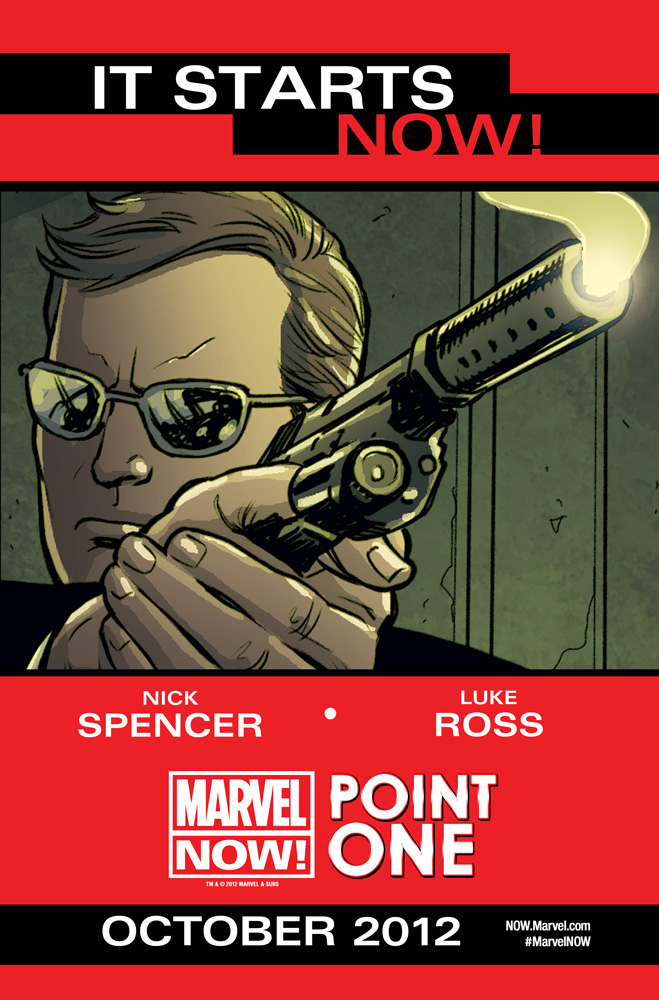
Marvel NOW! Point One is framed by the story following S.H.I.E.L.D. Agents Nick Fury, Phil Coulson, and Director Maria Hill. They've come across a gentleman who monetarily wiped out the New York Stock Exchange within a matter of hours and claims to be from the future. Being from the future obviously has it's advantages when cavorting in the past, and the man basically just wants to give S.H.I.E.L.D. a heads-up about what's coming. It's a strained plot, one that feels forced and underdeveloped. Nick Spencer is obviously trying for some mystery in the man's identity, but it just comes across as unfinished or poorly edited. It made sense for the Watcher in Marvel Point One to have visions of the future surrounding it's supernatural existence, so this scenario feels a bit silly. Then again, these are the kind of things Fury and Coulson will be dealing with in the pages of Secret Avengers, set to debut in February.
Brian (Michael) Bendis and Steve McNiven kick things off with the origin of Star-Lord, leader of the Guardians of the Galaxy. Marvel is making a big push for their cosmic characters, and putting Bendis front and center for a team getting a cinematic movie next year is a stellar choice. And while Bendis' long-form writing style means "Guardians of the Galaxy" feels incomplete, Steve McNiven's amazing artwork pretty much makes up for it.
Next up is Jeph Loeb and Ed McGuinness bringing us "Diamondhead" featuring the new Nova - Sam Alexander - the team introduced in Marvel Point One. While Sam's last adventure was all about the return of the Phoenix, this tale gives readers a bit more insight as to Sam's situation without giving much away in terms of concrete details. The eponymous villain is one of Richard Rider Nova's old enemies, so he confronts the new Nova. A few choice sentences of dialogue reveal that the Nova Corps is gone, and that Sam is apparently the last one...maybe. Dropping hints that answer questions by bringing up more questions is one of Jeph Loeb's strong suits, so it works well here. Ed McGuinness is one of those artists who draws comics like they're perceived by the non-comic book reading population - big, expressive, and colorful. I'm already a fan of Sam Alexander - especially his re-designed Nova uniform - so Nova is one of the series I'm most excited about.
 Oh, Young Avengers. If you read this blog on any sort of regular basis, you're probably aware that I absolutely LOVE the Young Avengers. I collected the entire 12-issue original run (dubbed "Season One" in recent years), I've read every YA tie-in issue for Marvel's major events, and I even stuck it out and bought every issue of Avengers: The Children's Crusade. So when Marvel announced they were bringing back the Young Avengers under the watch of Kieron Gillen and Jamie McElvie, I was ecstatic. "The New World" features "Miss" America Chavez, first introduced in 2011's Vengeance mini-series as part of the new Teen Brigade. Kid Loki has decided to put a new Young Avengers team together, and first goes after America (that's her real name, hence the pun) who's taking refuge on Earth-212. Because this is a comic book and heroes tend to fight each other before getting along, a brawl ensues. Even though Miss America basically just beats Loki down then flies away, the whole sequence is meant to develop America and give readers a preview of her social skills, something that will obviously come into play once she joins the team. Breaking the fourth wall is always fun in my book, so Loki's 'wanted' ad was a pleasant surprise and an awesome way to close this chapter.
 Matt Fraction and Mike Allred's "It's Art!" is next, featuring Scott Lang as Ant-Man in a prologue to the creative team's upcoming FF. Mike Allred is such a fantastic and wonky artist that it fits Matt Fraction's whimsically poignant writing almost perfectly. Scott Lang is also a great character for Fraction, who specializes in taking somewhat formless characters and giving them direction and focus (Clint Barton, anyone?). "It's Art!" features what I hope will be the norm for FF, which is a stylized narrative structure, consisting of a fantastic balance of inner monologue and dialogue, as well as inventive and innovative panel flow. Seeing Scott's whereabouts through special enlarged panels with arrows is genius, and Fraction's breaking of the fourth wall is so subtle, it smacks you in the face before you even realize.
The final story - before the conclusion of Spencer's S.H.I.E.L.D. bookend - is about Forge. Specifically, a mentally disturbed, manic Forge who stumbles upon a lab he built with a huge machine he didn't build. For a mutant whose ability consists of creating and fixing nearly any machine he can work on, it's a perfect set up. Unlike his counterparts who might give too little, Dennis Hopeless tries for a bit too much with "Crazy Enough". The psychological implications surrounding a techno-manipulator are many, apparently, and Hopeless just digs the hole a bit too big, then doesn't have time to have anything make sense before it ends with a cameo from Cable, foreshadowing Cable and X-Force coming in December.
It's difficult to review a prologue anthology simply by it's definition. These stories and their format are unique. Unlike back-up stories of similar length, these aren't multi-part or even one-shot tales. Each of these small stories is like a "Zero Issue" of sorts. While DC made a whole month of it in September, Marvel NOW! Point One could be considered 'ground zero' for all six featured series. It's a fun issue - simple as that. Knowing that all six series are starting soon gives more weight to these six prologues, and that's part of the charm. If this were just another short story anthology, it would be a bit lacking. But it's not. And we know it. Get ready, because if the level of quality seen in NOW! Point One continues through the next five months of new launches and into the future, Marvel might just have the upper hand on DC.
GRADE
8.5/10
 (w) Mark Waid (a) Walter Simonson