Showing posts with label Dan Jurgens. Show all posts

Wednesday, August 1, 2012

JUSTICE LEAGUE INTERNATIONAL #12

STORY: Dan Jurgens
ART: Aaron Lopresti and Matt Ryan

It's the beginning of the end for the JLI. Save for Justice League International Annual #1 - being released in this month's fifth week, along with a slew of other Annuals - Dan Jurgens' seminal series has come to a close with the "Funeral of Rocket Red". While the story title itself is a bit of a misnomer, this month's issue takes the team to Russia to visit Gavril Ivanovich's grave for a proper send-off by the teammates that stood by him in the end.

As the end of a series, Justice League International #12 has a lot of loose ends to tie up. Fortunately, Jurgens takes the time to bring proper conclusions to the plot points that matter. Last month, the late Lightweaver's twin brother, Malik, vowed to destroy the JLI, whom he believes was the responsible party in Lightweaver's death. If you read JLI #11, you saw that it was actually the government-ordered strike that killed Lightweaver. The fight between Malik and the JLI serves mostly to symbolize the team's position as the most accessible and relatable Justice League team. The League proper deals with situations that are so big, so dire that the end nearly always justifies their means, while the 'Justice League Dark' operates outside the public eye - their methods kept secret due to their controversial nature. The JLI sits in the middle of this spectrum as the Justice League that isn't quite perfect, yet are still accountable for their actions. In this sense, Malik's ambush works on both a technical and narrative level.

The group's trip to Russia to honor their fallen friend also points to their humanity. The death of a teammate is never taken lightly in the pages of DC's comic books, but rarely is it given the respect it deserves. Often, whole slews of characters will be killed off in major events, only to be noted in a mass-funeral or memorial wall in a later issue. Very often, death is taken lightly in comic books. Going against that trend, Dan Jurgens sees the importance of grieving and finding closure after the death of a friend and uses these emotions to weave a tale that brings the JLI full-circle and looks forward to the future and the potential it holds.

While Guy Gardner uses his GL ring to transmit a live feed from the hospital room of Ice and Vixen, Fire is inexplicably left in her induced coma, unable to even remotely attend the funeral. Jurgens doesn't give any reason for this story choice beyond the medical decision, which is a total cop-out. Knowing this would be the last issue, it would have been nice if Jurgens had brought everyone together. Perhaps I'll get my wish in JLI Annual #1 later this month.

Batwing resigns from the team for no other reason than he was barely on it to begin with; he cites "too many duties elsewhere", but he was never really all that interesting anyway. Batman's reasons for leaving are a bit more poignant. Bruce takes the time to explain that he's no longer needed, that Booster Gold is more than qualified to lead the team, and that their old headquarters and bankroll had been reinstated. Much in the vein of the JLI's history within the DCU, Batman sees the potential in this rag-tag group and gives them a chance - the chance no one else was willing to give them after a less-than-perfect inaugural outing.

GRADE
A

Thursday, July 5, 2012

JUSTICE LEAGUE INTERNATIONAL #11

STORY: Dan Jurgens
ART: Aaron Lopresti and Matt Ryan

Dan Jurgens has done an excellent job with Justice League International in the 'New 52'; it's one of my favorite titles out right now. Each issue adds more character development that has taken a group of misfits that couldn't make it in the Justice League proper and turned them into a formidable team that sheds their original United Nations sanction to take care of themselves.

As a whole, Justice League International is a classic 'rags to riches' story for each member in their own way. Unlike the major Leaguers - who aren't depicted as having a need for adoration or praise - the members of the JLI are characters who are much more grounded, and thus more relatable. Booster Gold pretty much a joke in the superhero community, Godiva's a small-time street hero with no worldly experience, August General in Iron attempts to make a better name for himself and his country, Red Rocket wants to honor the legacy of his title, Batwing works to make himself a better hero for his home and for Batman, and O.M.A.C. just wants to be normal. It's this sense of making oneself better that makes JLI so enjoyable. Everyone has wanted or needed to prove themselves at some point in their lives, and these characters need to prove themselves to the superhero community and the world at large.


Guy Gardner narrates Justice League International #11 as the team has their final stand against Breakdown and his anti-superhero agenda.  The eponymous villain wants to see the end of superheroes because of in the inequality in both physical ability and social hierarchy. With the help of a few small-time villains and growing animosity from a civilian mob, Breakdown manages to put up a good fight against the JLI. It's not often than writers feel the need to delve into the personal lives of villains - unless that's the point of the story, in which case most tend to flub it up - Dan Jurgens uses minor criminal Lightweaver as the emotional core of the "Breakdown" arc. 


We've already seen interactions between Lightweaver and his younger brother debating the nature of good and evil, and this month, Breakdown's right-hand man is murdered during the final fight, only his younger brother at his side in his final minutes. Obviously, Lightweaver's brother acted as a physical conscious, encouraging him to end his current life of crime, but Lightweaver consistently ignored these warnings until it was too late. It's a sub-plot that deals in emotional ramifications, familial issues, and a desire to be something greater.


O.M.A.C. presents a similar situation, as Kevin - the boy stuck in the big, blue body - has to fight himself to take control of the overwhelming power and drive than comes with being a One Man Army Corps. The team must first incite O.M.A.C.'s rage to help free them from Lightweaver's energy prison, then later calm him down when he loses control and starts rampaging through the city, even though the fight is over. O.M.A.C. is such an interesting character, it's a shame DC cancelled not only his self-titled series, but has now doomed Justice League International to the chopping block. Here's hoping Boy Blue can make a third, successul comeback.


Dan Jurgens loves the JLI. He's nurtured this book since day one, and it's been a slowly evolving tale that just gets better and more cohesive with each issue. It really is a shame that such an excellent series is ending so soon.


GRADE
A

Saturday, June 30, 2012

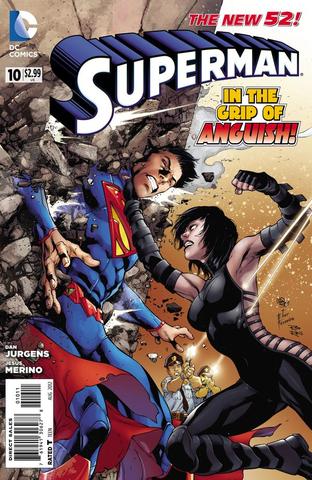
(COMIC) SUPERMAN #10

STORY: Dan Jurgens
ART: Dan Jurgens and Jesus Marino

Creating a cohesive, meaningful comic book universe isn't always glamorous. Sure, DC and Marvel would have you believe that these superheroes literally spend 24/7 fending off aliens, mad scientists, or other world-conquering threats. And these days, it wouldn't be a far reach to say that these heroes really are burning at both ends of the candle. But to really make a narrative world that readers can relate to and want to read about, un-amazing things must happen as well. Dan Jurgens understands the this basic ideal and works to make sure his stories are grounded in some sort of reality. Superman #10 finishes up the fight between Superman and Anguish while having that narrative intersect with Lois and Jimmy's attempt to debunk the claim that Spence Becker is Superman's alter-ego near the end.


Last month, I was sorely disappointed with Anguish as a Superman villain. She seemed, for lack of better words, weak. Her only characterization was her ability to shift the density of her own mass when necessary. It's a cool ability, but Anguish didn't have much else going on for her until this month. We come to find out that this woman is only really after a locket, nothing more. She's made a mess out of buildings and cars nearby, but that seems more like a cry for help than a criminal mastermind executing a robbery. And while Jurgens usually does a great job telling stories without telling stories, he makes Anguish explain her own powers simply for the sake of describing them, which is a bit narrative "no no" for me. Then, we get a big expository dump about Anguish's stepfather and how horrible he was. Yes, it's less exciting than, say, a battle with Helspont, but using a minor, fairly low-powered character is a good thing: if 'epic' was the standard, all these heroes would be dead from exhaustion by 30. We need characters like Anguish to flesh out rogue galleries and give these heroes something to do when magic is going crazy or owls aren't infesting cities.

Lois and Jimmy's task involves proving that Spence Becker is not Superman. Last month, paranoid blogger Victor Barnes went on national television to claim he knew the true identity of the Man of Steel. As the fight between Superman and Anguish winds down, Anguish hears about the 'true identity' of Superman and takes off for the suburbs to kill (or at least hurt badly) the Becker family. Obviously, Supes shows up and saves the day, but Anguish escapes at the end, pointing to a future for the character, something writers of the 'New 52' haven't been thinking about a whole lot as a lot of initial villains are getting taken out of the game pretty early.

Superman may not be the flashiest series, or the most interesting book in DC's 'New 52' lineup, but it serves a greater purpose. While titles like Aquaman and Batman are creating major villains and story elements that will resonate for years, Jurgens is making sure Superman won't burn out; there will always be someone for Big Boy Blue to fight, they just might not be cosmic-level threats every month.

GRADE
B-

Monday, June 4, 2012

(COMIC) 4-SENTENCE REVIEWS! #2


4-Sentence Reviews come about when I've gotten lazy or something unavoidable comes up and I'm not able to cover all the regularly scheduled issues for the past week. These reviews cover normally-reviewed issues of the comics I read each week, but condense the information down to four sentences. Enjoy!


Wonder Woman #9

STORY: Brian Azzarello
ART: Tony Akins and Dan Green

Diana is engaged to Hades and she's actually pretty alright with the whole situation, at least, that's what Brian Azzarello would like us to believe. Now that Zola is out of Hell, the other gods - Hermes, Apollo, and Hephaestus - have to figure out a way to rescue the Amazonian princess, even if it means going straight back into the Underworld! Azzarello and Tony Akins have a good, minimalistic rhythm that only gives out crucial information, and only when you need it. While some might criticize the book as 'slow moving' or 'too simple', Wonder Woman is actually doing a fantastic job reinventing a character who became stale back in the 1970s.

GRADE: B+


Superman #9

STORY: Keith Giffen and Dan Jurgens
ART: Jesus Marino

Ol' Supes has been thrown around quite a bit in his eponymous title, and it's just getting worse in Superman #9, which sees the Man of Steel up against Anguish, a villainess who can touch but not be touched - basically, she's immaterial when she wants to be. Meanwhile, an obsessed blogger named Victor Barnes is out to reveal Superman's identity through deduction and circumstance. Keith Giffen and Dan Jurgens are doing a great job setting up narratives that have the potential to carry on for years to come. Overall, Superman hasn't been an essential read in the 'New 52' thus far, but it's looking to become one with these more intricate plots and build-ups for bigger things in the future.

GRADE: B

Monday, April 30, 2012

(COMIC) SUPERMAN #8

STORY: Keith Giffen and Dan Jurgens
ART: Dan Jurgens and Jesus Marino

Superman is a complex character that's often harder to write for than other, less powerful heroes. When the hero has almost no weaknesses and a whole arsenal of superhuman abilities, their stories can quickly become stale and repetitive. Fortunately, Keith Giffen and Dan Jurgens are incorporating Helspont and the Daemonites - from the Wildstorm imprint - into Superman's mythos, giving him an enemy that isn't as readily 'hit-able' as Metallo or Parasite. One of the best ways to tell a Superman story - at least these days - is to invoke Clark's demi-god status. While all of Earth's other heroes have enough humanity to give them weaknesses, Superman is so far above them, in terms of raw power, that the true meat of his stories come from the psychological implications behind Clark's actions.

Superman #8 explores this with a conversation between Superman and the warlord Helspont. The Daemonite warrior tells Clark his tale, one of fear and betrayal from his peers. He was one the pride and glory of the Daemonite empire, until those in power saw Helspont as a liability against the empire itself. He was cast out, exiled from his culture. Helspont sees Clark as a conqueror; it's all he can see, really. Helspont's culture is one of dominion, and Clark is the most powerful being on the planet, so why wouldn't he rule? Helspont makes Clark on offer to leave Earth if Clark will help him reclaim his place in the Daemonite Empire. Clark, of course, refuses, and Helspont shows Clark just how powerful he is.

Unfortunately, our favorite Daemonite pretty much just disappears before the brawl can really get underway. Ol' Supes chalks it up to a strategical retreat, but it comes off as a lame way of ending this particular confrontation - nothing is answered and Clark simply goes back to his life. With a villain like Helspont making his debut in the DC universe, I expected a little more pomp and circumstance.

GRADE:
B-

Saturday, April 7, 2012

(COMIC) JUSTICE LEAGUE INTERNATIONAL #8

STORY: Dan Jurgens
ARTWORK: Aaron Lopresti, Matt Ryan

This month heralds the arrival of Batwing as the newest member of the JLI. Though Batman's African counterpart is an obvious - and easy - choice for a team made of up of international heroes, Dan Jurgens seriously flubs this introduction. Justice League International #8 is the least cohesive and most scatterbrained issue of the series thus far. Jurgens tries to interweave too many plots and after a few pages, it becomes difficult to understand exactly what it happening. Also, Batman keeps changing his tune concerning the JLI; one month he wants them to disband, and now he's recruiting members.

The team is still reeling from the bombing at the end of issue six; Booster Gold is facing off against the new Lightweaver, Fire and Ice are still in the hospital, Red Rocket is still dead, and Jurgens another villain who somehow fits into the scheme of the story. Roland Norcutt is a new character (at least I think he is) whose ability lets him break anything down to it's basest of forms, then repurpose that raw matter into whatever he likes. Taking the name Breakdown, Roland escapes from his prison transport and convenes with Lightweaver and some other villains.

I understand that Jurgens is building towards something. It's obvious that this issue is a 'filler' issue meant to introduce some characters and little else. The story doesn't advance at all from last month, and the only real exciting part about this issue is the arrival of Batwing, which itself is pretty lackluster. I've been extremely happy with Justice League International every month, and one hiccup isn't enough to turn me off of a great, great book.

GRADE:
C+

Saturday, March 31, 2012

(COMIC) SUPERMAN #7

Written by Keith Griffin and Dan Jurgens
Artwork by Dan Jurgens and Jesus Marino

One of my favorite parts of the 'New 52' relaunch was the potential to make Superman great again. After decades of learning to hone his powers, good ol' Supes was literally unstoppable. God complex stories are nice, but they too can get old after a while. Over in Action Comics, Grant Morrison's origin story has explained that, in his early days as a superhero, couldn't fly or lift more than a car. Also, toning down the boy scout routine was essential; trying to convey a character like Superman into the 21st century meant shedding the "Aww, gee golly shucks!" attitude that was popular when the character was first developed.

Last time, Clark defeated his daemonite doppelgänger after it went on a villain killing spree. This month, the cause of all Superman's worries in the last six issues comes to light. After a couple of run-ins with what looks like a minotaur robot, Supes is teleported to a fortress in the Himalayas where he comes face to face with Helspont, a long-time Wildstorm Comics super villain. One of the reasons for DC relaunching everything under the 'New 52' header was to bring in characters from the Wildstorm and Vertigo imprints that DC owns. Helspont and the dameonites represent this aesthetic. It's nice that the first arc of this new Superman series wasn't a Lex Luthor or Brainiac encounter. The encounter between Superman and Helspont is great. The daemonite warlord doesn't understand, as a Kryptonian far more powerful than anyone else on the planet, why Superman hasn't conquered Earth yet. It's fantastic writing because Helspont is 'technically' new to the planet, so he logically reached out to the most powerful being.  The new creative team of Keith Griffin, Dan Jurgens and Jesus Marino is fantastic. The artwork is solid, with some jagged edges that convey Helspont's authoritative presence, and the writing is still as solid as George Perez's work on the first six issues. The end of the issue sets up next month's the main event: Superman Vs. Helspont.


GRADE:
B+


Sunday, February 5, 2012

(REVIEW) Justice League International #6

Written by Dan Jurgens
Artwork by Marco Castiello and Vincenzo Acunzo

Dan Jurgens' work on Justice League International has been simply stunning. For a title that could have (and by all rights should have) been a huge disappointment, Jurgens has instead taken a more intimate route with the team of misfit superheroes. With Booster Gold under his belt of creator trademarks, Jurgens understands the social and political implications of superheroes and their place in the grander scheme of the universe. Instead of attempting to make JLI as much of a hard-hitter as, say, Justice League-proper, Jurgens knows where these characters exist on the popularity scale. That's why he's crafted such an excellent tale for them, with Booster Gold at the center.

The alien Peraxxus and his attack on Earth are secondary elements of Justice League Internationl's first arc. While three issues are dedicated to their various skirmishes, the true meat of the this story comes from the character relationships. Andre Briggs is trying to create a team of heroes that the United Nations - and by extension the world - can trust and hold accountable, something they cannot do with the Justice League. The heroes he's chosen are not the best; he knows it, they all know it and his superiors know it.

This sixth issue has been my favorite yet. Heavy on dialogue, most of the issue focuses on Booster convincing the UN Security Council that the JLI is worth it, that they have worth and value to the world. By the end, Booster is ready to solider on as team leader, with or without the UN behind them. It's a pretty great couple of pages with some great character development for Booster Gold. I've always liked Booster (and Blue Beetle Ted Kord) because they're the underdogs. They try so hard and fall so much harder each time. Fortunately, Jurgens is able to somewhat 're-invent' Booster in the pages of Justice League International, giving him a bit more selflessness and making him less silly.


GRADE:
B+