(w) Matt Fraction
 (a) Michael Allred
I've read both issues of Matt Fraction and Mike Allred's FF, and after getting through each, I find myself taking a few moments to reflect on the sheer quality in this series. Fraction and Allred are crafting something extremely special, something that might well be remembered in the same way as Chris Claremont's Uncanny X-Men in the 1980s, Grant Morrison's JLA run in the mid-90s, or Frank Miller's The Dark Knight Returns. FF #2 gets the ball rolling by finally bidding farewell to the Fantastic Four and getting the new team into action with one of Marvel's First Family's oldest villains, Mole Man.
Much like John Romita Jr. or Lenil Francis Yu, Mike Allred produces artwork you either love or you hate--in my experience, there isn't much middle ground. I happen to think Allred's work is fascinating and hearkens back to the 1960s in terms of tone, yet manages to keep a modern style and sensibility. She-Hulk's eyebrow raise is a testament to Allred's ability to completely convey an emotion without having to rely on words. Fraction's laid back, relaxed dialogue fits perfectly with Allred's art because both are rooted in minimalism.
As predicted, the Fantastic Four end up not returning at the four minute mark as promised. But who didn't see that coming? So it's up to Ant-Man and his team to make sure the Earth is safe and the Future Foundation keeps operating. And just like any new job, the replacements are taking a little time to get used to the new office. Scott Lang is forced to explain the meaning of 'ex-con' to the students when a rather unflattering article about the temporary Fantastic Four surfaces describing him as unfit to lead the Fantastic Four, let alone run a school. She-Hulk has to figure out a way to keep a wardrobe without destroying all her clothes each time the team gets into a kerfuffle. Medusa doesn't have servants waiting on her hand and foot like in her kingdom of the Inhumans. And Darla Deering--Johnny Storm's celebrity girlfriend who possesses no superpowers of her own--simply can't wrap her head around what's been asked of her. Somehow, Fraction manages to fit character development for four main characters into a single issue and it's, quite honestly, brilliant.
The choice to use Mole Man as this issue's villain carries a lot more weight than it would seem after a first read. Mole Man's repugnance at the idea of "impostors" calling themselves the Fantastic Four prompts his attack on the Future Foundation, but the encounter really shows how Fraction and Allred are turning the tables on traditional comic book tropes. In almost every subset of mainstream, superhero comics, villains are attached to certain heroes, even if they branch out and come into conflict with other heroes. Joker has terrorized most of the DC universe at one point or another, but he's a Batman villain through and through. Darkseid threatens Earth as a whole, but he's designated a Superman baddy, and the actions of the Guardians of the Universe affect the Earth on a daily basis, but they're rarely seen outside Green Lantern comics. With a new roster of heroes populating the Fantastic Four, traditional villains of Marvel's First Family have a whole new set of powers to contend with. Mole Man's been fighting Mr. Fantastic, the Invisible Woman, the Human Torch, and the Thing for decades, so he doesn't really know what to do when he's confronted with a shrinking man, a woman with tentacle hair, a super-strong berserker, and a pink-haired girl that kind of looks like the Thing. And that's not even mentioning the gamut of villains the Fantastic Four have racked up through the years. If Superman suddenly woke up with a totally new power set, his enemies wouldn't know how to fight him.
If you're not reading FF, you should. Fraction and Allred have crafted a series with a near-perfect balance of plot-based, superhero action and organic, character-driven story. Potential is the name of the game here because a new Fantastic Four means a whole new way to tell Fantastic Four stories.
GRADE
9.7/10
(w) Matt Fraction
(p) Mike Allred
Basically, FF is the spiritual successor to Peter Milligan and Mike Allred's X-Statix. So, if you're a fan of meta-humor and satire, you're going to love Matt Fraction's quirky, off-handed take on the Future Foundation. As we learned a few weeks ago in Fantastic Four #1, Marvel's First Family is taking a pan-dimensional vacation that will take them away from Earth (and our space-time continuum) for a year, though it will only really be about four minutes of real time. And, as Reed Richards says, the Fantastic Four "do[es] not leave the Earth unprotected," so they decide to recruit temporary replacements. And thus, FF #1 is all about preparation -- the Fantastic Four getting ready for their trip, the replacement heroes being briefed on their responsibilities, and the audience getting a first-person account of the Future Foundation and it's members as an effective jumping-on point for new readers.
FF #1 is not a comic book that will WOW and AMAZE most. Though it's quirky in setting, the story of the Fantastic Four finding their replacements is subtle and given depth by emotional ramifications. Scott Lang, the recently resurrected former Ant-Man, is the first to be scouted by Reed. Fraction doesn't beat around the bush concerning the reason Lang was chosen to be the temporary head of the Future Foundation -- he's a father who lost his daughter and could probably use some direction. Scott sees it as somewhat presumptuous after the death of Cassie at the hands of Doctor Doom. "I don't want anything to do with those kids Reed!" Scott explains to Reed in a rather kurt manner. "You need to respect that and open that door and let me go home!" For Scott, the pain is too fresh and being asked to be take responsibility for an whole group of kids is like a big slap in the face. Fraction does an amazing job conveying the intense conversation between the two men, and Mike Allred's phenomenal artwork only helps to push the point across -- when Scott is in utter anguish, the entire panel shifts perspective.
Of course, this series wouldn't last long if the main character wasn't on board, so Reed comes clean and admits that he chose Scott because it would be good for him. Ant-Man definitely hasn't been seen much since Avengers: The Children's Crusade, wherein Cassie Lang was murdered, so it's not a far stretch to assume he's been wasting away in grief and self-pity for a few months. Reed sees this and thinks being around kids will not only help Scott, but it will provide the members of the Future Foundation with a new role model and paternal figure. It's a win-win situation in Reed's mind.
Fraction and Allred have struck some gold with this series. Fraction's relatable, grounded writing coupled with Allred's signature art style is a match made in heaven and this first issue is the evidence. There's a lot to love about FF #1, but unfortunately, a lot of that comes from knowing who these characters are and what's happened to them. Fraction does an apt job covering his bases when it comes to integral backstory, but it's still FF, which is named after the Future Foundation, which is an offshoot of the Fantastic Four, who wont actually be in the series at all in an issue or two -- it's a bit wonky. Other than that, FF #1 is a fantastic issue that has left me wanting more...now...seriously.
GRADE
9.5/10
(w) Nick Spencer, Brian Bendis, Jeph Loeb, Kieron Gillen, Matt Fraction, and Dennis Hopeless
(p) Luke Ross, Steve McNiven, Ed McGuinness, Jamie McElvie with Mike Norton, Mike Allred, Gabriel Hernandez Walta
Last year's Marvel Point One was a fun introduction to coming year's storylines, though it retroactively suffered from unfulfilled promises. Why did Scarlet Spider get a solo series but not Nova? Where is the X-Terminated team? Of course, that was the first issue in a series, it seems, so it makes sense that MPO was more of a work in progress than anything else. And at the end of the day, it's still a really fun one shot full of interesting stories. Marve NOW! Point One is the more polished version of the concept - each story included in this issue is evolving into an ongoing series. This anthology format is fun because it's not necessary to know decades of continuity to still enjoy what's going on. In fact, that's the whole idea behind 'Marvel NOW!'
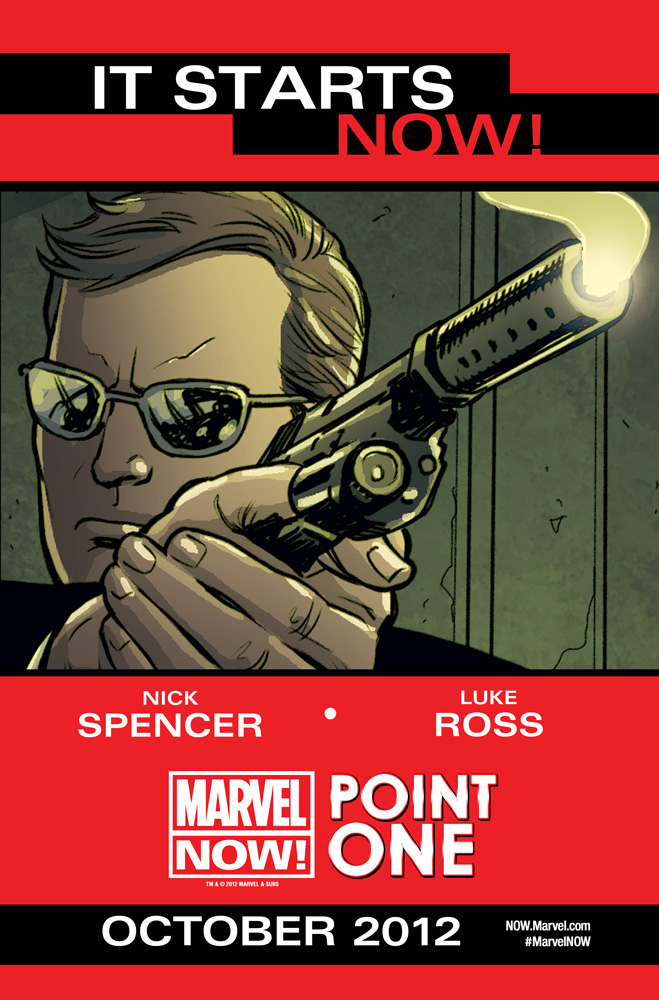
Marvel NOW! Point One is framed by the story following S.H.I.E.L.D. Agents Nick Fury, Phil Coulson, and Director Maria Hill. They've come across a gentleman who monetarily wiped out the New York Stock Exchange within a matter of hours and claims to be from the future. Being from the future obviously has it's advantages when cavorting in the past, and the man basically just wants to give S.H.I.E.L.D. a heads-up about what's coming. It's a strained plot, one that feels forced and underdeveloped. Nick Spencer is obviously trying for some mystery in the man's identity, but it just comes across as unfinished or poorly edited. It made sense for the Watcher in Marvel Point One to have visions of the future surrounding it's supernatural existence, so this scenario feels a bit silly. Then again, these are the kind of things Fury and Coulson will be dealing with in the pages of Secret Avengers, set to debut in February.
Brian (Michael) Bendis and Steve McNiven kick things off with the origin of Star-Lord, leader of the Guardians of the Galaxy. Marvel is making a big push for their cosmic characters, and putting Bendis front and center for a team getting a cinematic movie next year is a stellar choice. And while Bendis' long-form writing style means "Guardians of the Galaxy" feels incomplete, Steve McNiven's amazing artwork pretty much makes up for it.
Next up is Jeph Loeb and Ed McGuinness bringing us "Diamondhead" featuring the new Nova - Sam Alexander - the team introduced in Marvel Point One. While Sam's last adventure was all about the return of the Phoenix, this tale gives readers a bit more insight as to Sam's situation without giving much away in terms of concrete details. The eponymous villain is one of Richard Rider Nova's old enemies, so he confronts the new Nova. A few choice sentences of dialogue reveal that the Nova Corps is gone, and that Sam is apparently the last one...maybe. Dropping hints that answer questions by bringing up more questions is one of Jeph Loeb's strong suits, so it works well here. Ed McGuinness is one of those artists who draws comics like they're perceived by the non-comic book reading population - big, expressive, and colorful. I'm already a fan of Sam Alexander - especially his re-designed Nova uniform - so Nova is one of the series I'm most excited about.
 Oh, Young Avengers. If you read this blog on any sort of regular basis, you're probably aware that I absolutely LOVE the Young Avengers. I collected the entire 12-issue original run (dubbed "Season One" in recent years), I've read every YA tie-in issue for Marvel's major events, and I even stuck it out and bought every issue of Avengers: The Children's Crusade. So when Marvel announced they were bringing back the Young Avengers under the watch of Kieron Gillen and Jamie McElvie, I was ecstatic. "The New World" features "Miss" America Chavez, first introduced in 2011's Vengeance mini-series as part of the new Teen Brigade. Kid Loki has decided to put a new Young Avengers team together, and first goes after America (that's her real name, hence the pun) who's taking refuge on Earth-212. Because this is a comic book and heroes tend to fight each other before getting along, a brawl ensues. Even though Miss America basically just beats Loki down then flies away, the whole sequence is meant to develop America and give readers a preview of her social skills, something that will obviously come into play once she joins the team. Breaking the fourth wall is always fun in my book, so Loki's 'wanted' ad was a pleasant surprise and an awesome way to close this chapter.
 Matt Fraction and Mike Allred's "It's Art!" is next, featuring Scott Lang as Ant-Man in a prologue to the creative team's upcoming FF. Mike Allred is such a fantastic and wonky artist that it fits Matt Fraction's whimsically poignant writing almost perfectly. Scott Lang is also a great character for Fraction, who specializes in taking somewhat formless characters and giving them direction and focus (Clint Barton, anyone?). "It's Art!" features what I hope will be the norm for FF, which is a stylized narrative structure, consisting of a fantastic balance of inner monologue and dialogue, as well as inventive and innovative panel flow. Seeing Scott's whereabouts through special enlarged panels with arrows is genius, and Fraction's breaking of the fourth wall is so subtle, it smacks you in the face before you even realize.
The final story - before the conclusion of Spencer's S.H.I.E.L.D. bookend - is about Forge. Specifically, a mentally disturbed, manic Forge who stumbles upon a lab he built with a huge machine he didn't build. For a mutant whose ability consists of creating and fixing nearly any machine he can work on, it's a perfect set up. Unlike his counterparts who might give too little, Dennis Hopeless tries for a bit too much with "Crazy Enough". The psychological implications surrounding a techno-manipulator are many, apparently, and Hopeless just digs the hole a bit too big, then doesn't have time to have anything make sense before it ends with a cameo from Cable, foreshadowing Cable and X-Force coming in December.
It's difficult to review a prologue anthology simply by it's definition. These stories and their format are unique. Unlike back-up stories of similar length, these aren't multi-part or even one-shot tales. Each of these small stories is like a "Zero Issue" of sorts. While DC made a whole month of it in September, Marvel NOW! Point One could be considered 'ground zero' for all six featured series. It's a fun issue - simple as that. Knowing that all six series are starting soon gives more weight to these six prologues, and that's part of the charm. If this were just another short story anthology, it would be a bit lacking. But it's not. And we know it. Get ready, because if the level of quality seen in NOW! Point One continues through the next five months of new launches and into the future, Marvel might just have the upper hand on DC.
GRADE
8.5/10
 (a) Michael Allred