Showing posts with label Young Avengers. Show all posts

Tuesday, July 12, 2016

The Young Avengers: A Juxtaposition of Legacy


I wrote a piece on the Internet’s negativity towards new Marvel character Riri Williams and it got me to thinking about legacy characters, a trope DC Comics has been pulling off to varying degrees of success since the 1950s (for the sake of generality – it could be argued that Robin has always been a legacy character, and he’s been around since the 40s) yet Marvel has often shied away from, even when the components necessary are sitting right there in front of them. The House of Ideas has a long history of introducing new characters, though mostly through the X-Men franchise’s Xavier School, a perfect mechanism to allow new generations of characters to develop. That said, a handful of new mutants every few years is different than the concept of ‘legacy’ characters; younger heroes that answer the call when the original either steps down, dies, or is no longer able.

Allan Heinberg and Jim Cheung’s Young Avengers was a deconstruction of the legacy trope – a team of teenage heroes with relevant connections to preexisting Marvel heroes but who were also fervent Avengers fanboys and girls (think Kamala Khan, only ten years earlier). Elijah Bradley was retconned as the grandson of the original, African-American Captain America who suffered brain trauma. Billy Kaplan and Tommy Shephard – though born thousands of miles away to different parents – are the lost twins of the Scarlet Witch when she had a nervous breakdown and inadvertently created children. Cassie Lang is the daughter of the second Ant-Man, Scott Lang. The new Vision (at the time) was based partly from the remains of the original. Teddy Altman is a half-Kree/half-Skrull prince of both worlds. And then there was Kate Bishop, a brand new character with no ingrained connection to the standing shared universe. All of these young heroes were created as a legacy characters, yet their journeys have all diverged in interesting ways.


Wiccan and Hulkling
Billy and Teddy’s romantic relationship developed into a core tenet of their respective characterizations. Kieron Gillen and Jaime McKelvie understood this dynamic and nearly broke the couple up in their second volume of Young Avengers, a watershed moment in their commitment to each other. Even now, Billy and Teddy are members of the New Avengers, still together through thick and thin. Though they started out as homages to Thor and the Hulk, Billy and Teddy have been thoroughly established as their own characters whose ‘legacy’ components have been relegated to secondary traits. Yes, Billy is Scarlet Witch’s son, but his road to becoming the fated Demiurge is all his own as he arguably symbolizes “ordered” magic as juxtaposed to Wanda Maximoff’s “chaos” magic. Teddy – whose Hulk connection is the thinnest fiber to an established hero of any Young Avenger – had the most wiggle room, and though he is absolutely royalty of both the Kree and Skrull empires, both cosmic civilizations have had larger problems than melodramatic monarchy disputes for many years now, allowing Teddy to develop aside from his heritage into a truly realized character. Even during the insidious Skrull occupation during Secret Invasion, Teddy’s background is less prominent than his dedication to his planet and his team.


Patriot
One of the most unfortunate moves in Marvel’s recent history was to completely shelf Eli Bradley, A.K.A. Patriot. Heinberg and Cheung’s incredible characterization was rarely matched by other writers who handled the team for event tie-in mini-series, yet Eli represented a perspective not often seen in superheroes let alone younger ones: moral relativism. Eli was an original character deeply rooted in Marvel mythos whose relatable development offered a unique take on the challenges of being a superhero in a world full of living legends. Eli is incredibly stubborn and passionate about his convictions, an aggressive pragmatist that wants nothing more than to live up to his grandfather’s legacy, and that sometimes causes him to falter when his sense of responsibility overtakes his moral compass. In Heinberg and Cheung’s second, two-issue arc of Young Avengers, Eli’s “Speedy moment” comes when the team finds him shooting up MGH (mutant growth hormone) to maintain his Super Soldier-esque strength and agility. Eli lied to the team about inheriting his grandfather’s powers and struggles with an addiction that leads him to commit crimes in order to maintain the charade; that’s a supervillain in the making if I’ve ever seen it.

Yet, Heinberg and Cheung deftly navigate the situation, reminding readers that Eli is a 16 years old kid, and that the combined pressure of his sense of duty to honor the past and the drive to succeed in his position as the spiritual leader of his team becomes overwhelming. Eli is a complex character with real issues that walk the line between heroism and obsession, a perfectionist that struggles with intense self-doubt and anxiety about his role in the world. When Eli all but disappeared from the Marvel universe, there didn’t seem to be a reason until it was announced that Sam Wilson would take the shield as the all-new Captain America when Steve Rogers was de-aged and stripped of the Super Soldier formula in Rick Remender’s Captain America run. The “Black Captain America” angle wouldn’t be as shocking and exciting if Eli Bradley – and by extension, his grandfather’s place in history as the actual first Black Captain America – was there poised to step into that role. I’m not saying Sam didn’t deserve the promotion, only that Marvel had a phenomenal character already positioned to become the next Captain America, and he was a Black teenager with relatable issues, established connections to Marvel lore, and years of organic development.


Stature
Cassie Lang grew into her own after she sided with Tony Stark and his Superhero Registration Act during Civil War. Most of the Young Avengers agreed with Steve Rogers, the face of the anti-registration Secret Avengers unconvinced more governmental oversight would benefit the superhero community. It made sense, especially considering the team’s previous run-ins the with the adult Avengers concerning their right to be active superheroes in the first place. That said, Cassie is a realist that sees the necessity of training and staying accountable in a world full of chaos and uncertainty. Much like Eli, Cassie’s sense of responsibility along with her uncertainty and doubt concerning her own ability to do more good than harm puts her in a position to respect authority and the sense of structure it brings. Cassie just wants to be a better, more effective hero, and that means obeying the law by working within the system to make the world a safer place. Eventually, Cassie rejoins the Young Avengers before her death in The Children’s Crusade, the same story in which she earlier successfully goes back in time and saves her father from being murdered by the Scarlet Witch in Avengers: Disassembled. Five years later, during Avengers & X-Men: AXIS, an inverted Doctor Doom looks to make amends for his past misdeeds and successfully brings Cassie back to life.

Cassie’s tenure as Stature was not a legacy to the ideals Hank Pym and Scott Lang had spent years developing, but rather a redefining of the Ant-Man/Giant-Man trope. Yes, Cassie has the exact same powers of size manipulation as her father and Hank Pym, but the name Stature has no solvent connection to ants or bees or insects or anything else like that – Cassie made her own identity and made her own decisions based on her personal ethics and motivations, even if that put her at odds with her team. Since her resurrection, Cassie has been a supporting player in The Astonishing Ant-Man where her early retirement from superhero-ing, a disconnect from her father, and a suffocating sense of duty leads her to get back in the game, even if that means defying everyone around her and breaking bad. When the devious Power Broker re-gifts Cassie with her size-changing powers and a brand new outfit, she becomes the criminal Stinger, a reference to her alternate universe MC2 counterpart, but also a direct connection to the Ant-Man franchise, further removing her from the Stature moniker and her days as a Young Avenger. Cassie Lang was Ant-Man’s daughter for years, Stature of the Young Avengers and the Initiative for years more, dead then resurrected (a very, very common comic book trope), and is now stepping into a more concrete legacy role as Stinger. Unlike most of the other Young Avengers, Cassie’s is an evolution of character, not superhero title. Even the name she pioneered, Stature, is no longer hers, and that was by choice.


Hawkeye
Arguably the most interesting and fun growth of any Young Avenger was in Kate Bishop, a creation of Heinberg and Cheung’s for their original team in 2005. Kate’s father is a prominent member of New York’s criminal underworld, but when the original Young Avengers attempts to stop a hostage situation at her sister’s wedding, Kate steps into action when they can’t get the job done themselves. The Bishop family’s lavish lifestyle affords Kate the opportunity to train and study with the best, and she handles a bow with grace and elegance not seen since Clint Barton, who at the time was dead at the same hands that took Cassie’s father during Avengers: Disassembled. Kate becomes a Young Avenger and eventually meets a resurrected Clint Barton (now calling himself Ronin) who offers her the name Hawkeye. That potential was not mined until years later in Matt Fraction, David Aja, and Annie Wu’s incredible Hawkeyes run, a series that began about Clint Barton’s street-level, non-Avenger trials and tribulations, but evolved into a character study of Clint and Kate, two Hawkeyes who depend on one another yet have wholly different worldviews and perspectives on what it means to be a hero.

Kate was a member of Gillen and McKelvie’s Young Avengers along with fellow founding members Wiccan and Hulkling where she faced relationship issues with Noh-Varr (Marvel Boy) and his literally-alien concepts of sex, love, and passion. Kate has her heart broken when the boy chooses his ex, but she doesn’t relent when Noh comes back begging for forgiveness because her defining moment in Young Avengers (Vol. 2) is the realization that she has trust issues based on very real circumstances, but that she won’t let those issues define her. Kate’s time with Kid Loki’s Young Avengers is an excellent segue into her adventures with Clint in Hawkeye and All-New Hawkeye, the subsequent follow-up series by Jeff Lemire and Ramon Perez that goes even deeper into Kate’s character.

The dichotomy between these Hawkeyes isn’t subtle; Clint is an aloof, flippant, impulsive social warrior while Kate is a centered, emotionally-stable, pragmatic hero and they each bring something different to the table. Clint’s longtime stake to the name and his eagerness to mete out justice – even if he’s ill-suited for the task, in over his head, or impulsive to the point of overzealousness – makes him a truly active voice of the people, while Kate’s family history and nuanced perspective on good vs. evil gives her a defiance and perseverance that reins in Clint’s hurried behavior and offers strategy and elegance in its place. Kate Bishop has grown into an incredible character that whose personality is defined by her actions instead of clever connections or retconned statuses. Kate was a wholly original creation that multiple creators have built into a character absolutely worthy of the Hawkeye title. Yes, Clint Barton will always be synonymous with the name (especially with his place in the ever-popular Marvel Cinematic Universe), but Kate Bishop is as much Hawkeye as Clint, and Marvel was incredibly wise to put her in the starring role of this fall’s Hawkeye ongoing.


Today, legacy characters have become more commonplace in the Marvel universe. Sam Alexander stepped into the role of Nova in 2013, and though he did so in a rather roundabout way (Secret Wars and all that), Miles Morales is an exemplary legacy to Peter Parker’s Spider-Man. Kamala Khan is the new Ms. Marvel, and Moon Boy has a legacy in Lunella Lafayette, the Moon Girl with her Devil Dinosaur.

The Young Avengers began as possibly legacies to the Avengers, a group of teenagers wrestling with the struggles of growing up while protecting New York City as members of a superhero team. Each of Allan Heinberg and Jim Cheung’s Young Avengers has gone through trials and tribulations that have helped them grow into roles beyond their original purview, to evolve into fully-developed heroes in their own right without the shadows of their supposed predecessors hanging over their heads. With Patriot being the only (egregious) exception, the Young Avengers paid homage to the ideals of the legacy character trope while simultaneously deconstructing the concept for a new era.

Tuesday, June 25, 2013

The Week in Revue (June 26 - July 2, 2013)

------- Spotlight
Batman/Superman #1
(w) Greg Pak
(a) Jae Lee

------- DC Reviews
The Flash #21
(w) Francis Manapul and Brian Buccellato
(a) Francis Manapul

Justice League #21 
(w) Geoff Johns
(a) Gary Frank
CHECK OUT THIS REVIEW ON DC COMICS NEWS!

Justice League of America #21
(w) Geoff Johns
(a) David Finch
CHECK OUT THIS REVIEW ON DC COMICS NEWS!

------- Marvel Reviews
Age of Ultron #10A.I.
(w) Mark Waid
(a) Andre Araujo

X-Men #2
(w) Brian Wood
(a) Olivier Coipel

Young Avengers #6
(w) Kieron Gillen
(a) Kate Brown

Thursday, May 23, 2013

Young Avengers #5

(w) Kieron Gillen     (a) Jamie McKelvie

Origin stories tend to either be very, very cool, or very, very lame. I don't know why, nor do I pretend to understand why. It just seems to happen that way.

Even before this conclusion issue, it was evident that Kieron Gillen's team of Young Avengers was a whole different beast from Alan Heinberg's from back in the day. And I was prepared for that. I was ready for my favorite franchise to look and feel completely unique from what I'd come to love. But I'd read Phonogram so again, I knew I was in for something different. I wasn't, however, ready for just how awesome it could be. 

Gillen's opening arc for the second volume of Young Avengers is one of the most intriguing and interesting takes on the "getting the band together" comic book trope I've ever read. These characters are teenagers and they act like it. What kids are voluntarily putting their lives on the line instead of being glued to their cell phones and tablets? Well, if any would, it would be the ones who are superheroes. Gillen understands that normal teenage behavior doesn't go away when the superheroics kick in. These kids are always thinking about who they are and what they want, just like any other normal kid, The difference is that the Young Avengers have to juggle interdimensional monstrosities.


** SPOILERS AHEAD **

These kids don't want to be a team. This simple fact is what makes this vision of the Young Avengers so appealing -- by the end of Young Avengers #5, the only reason they all decide to stay together is to physically prevent an otherworldly invasion. It's not because they all necessarily like each other. In fact, everyone hates Loki mostly, and Miss America doesn't trust anyone else. Just like normal teenagers, their relationships are complicated. And just like eighteen-year-olds in real life, they have to recognize when to grow and step up to the challenge. This is as good at time as any.

GRADE
9.5/10

Tuesday, May 21, 2013

The Week in Revue (May 22-28, 2013)

------- Spotlight
The Green Team #1
(w) Art Baltazar and Franco     (a) Ig Guara
THE FOIL TO GAIL SIMONE'S THE MOVEMENT, THIS SERIES FEATURES THE SUPER-RICH TEENAGERS WHO INHABIT THE DCnU!

------- DC Reviews
Justice League Dark #20
(w) Jeff Lemire     (a) Mikel Janin
HOW DO THE JUSTICE LEAGUE DARK, THE FLASH, AND SWAMP THING ALL CONNECT? ONLY JEFF LEMIRE KNOWS!

Teen Titans #20
(w) Scott Lobdell     (a) Eddy Barrows)
WILL SCOTT LOBDELL ACTUALLY DELIVER A SEMI-COGENT ISSUES THIS MONTH? I'M NOT HOLDING MY BREATH!

------- Marvel Reviews
Uncanny Avengers #8AU
(w) Rick Remender     (a) Andy Kubert
THE "AGE OF ULTRON" TIE-IN FEATURING KANG AND THE APOCALYPSE TWINS!

Young Avengers #5
(w) Kieron Gillen     (a) Jaime McKelvie
THE FINAL ISSUE OF KIERON GILLEN'S FIRST AMAZING ARC!

Tuesday, April 23, 2013

The Week in Revue (Apr 24-31, 2013)

------- DC Reviews
The Flash #19
(w) Brian Buccellato     (a) Marcio Takara
DC'S "WTF" MONTH CONTINUES WITH A BRAND NEW VILLAIN FOR THE FLASH!

Batman Incorporated #10
(w) Grant Morrison     (a) Chris Burnham
MORRISON'S EPIC BATMAN SAGA IS WINDING DOWN!

I, Vampire #19
(w) Joshua Hale Fialkov     (a) Fernando Blanco and Andrea Sorrentino
FINAL ISSUE! AND REALLY, FIALKOV'S FINAL ISSUE FOR DC! DANG.

------- Marvel Reviews
Young Avengers #4
(w) Kieron Gillen     (a) Jaime McKelvie
LOVE ME SOME YOUNG AVENGERS! 

Avengers #10
(w) Jonathan Hickman     (a) Dustin Weaver
HONESTLY, IT'S SUPER HARD TO KNOW WHAT HICKMAN IS GOING TO THROW AT US NEXT WITH THIS SERIES. WHATEVER IT IS, THOUGH, IT'LL BE GREAT.

Uncanny X-Men #5
(w) Brian Michael Bendis     (a) Fraiser Irving
IT'S THE ORIGINAL COMIC BOOK WITH 'UNCANNY' IN THE TITLE, NOW THAT THERE ARE, LIKE, 30.

Tuesday, March 26, 2013

The Week in Revue (Mar 27-Apr 2, 2013)

------- Spotlight
Guardians of the Galaxy #1
(w) Brian Michael Bendis     (a) Steve McNiven
THE GUARDIANS RETURN TO THE MARVEL UNIVERSE!

------- DC Reviews
Batman Incorporated #9
(w) Grant Morrison     (a) Chris Burnham
WHAT HAPPENS IN THE MOMENTS AFTER THE DEATH OF DAMIAN WAYNE?

The Flash #18
(w) Brian Buccellato     (a) Marcio Takara
THE TRICKSTER ACCUSED OF MURDER? AND A SPECIAL CROSSOVER WITH...DIAL H!

Justice League Dark #18
(w) Jeff Lemire and Ray Fawkes     (a) Mikel Janin
THE CONCLUSION TO "THE DEATH OF MAGIC!"


---------- mini reviews
Aquaman #18
(w) Geoff Johns     (a) Paul Pelletier
"DEATH OF A KING" BEGINS HERE! A NEW ARC IN THIS ACCLAIMED SERIES!

Superman #18
(w) Scott Lobdell     (a) Kenneth Rocafort
H.I.V.E. MAKES IT'S NEW 52 DEBUT AS THEY TRY TO TAKE OVER METROPOLIS!

Teen Titans #18
(w) Scott Lobdell     (a) Eddy Barrows
FALLOUT FROM "DEATH OF THE FAMILY" AND THE DEATH OF DAMIAN WAYNE! GUEST STARRING THE SUICIDE SQUAD!

------- Marvel Reviews
Age of Ultron #3 of 10
(w) Brian Michael Bendis     (a) Bryan Hitch
MARVEL'S POST-APOCALYPTIC EVENT CONTINUES!

Uncanny Avengers #5
(w) Rick Remender     (a) Olivier Coipel
WONDER MAN, WASP, AND SUNFIRE JOIN THE UNCANNY AVENGERS!

Young Avengers #3
(w) Kieron Gillen     (a) Jaime McKelvie
MORE AMAZINGNESS FROM GILLEN AND MCKELVIE ON THE LANDMARK SERIES!

---------- mini reviews
Fantastic Four #5AU
(w) Matt Fraction     (a) Andre Araujo
AN "AGE OF ULTRON" TIE-IN ISSUE!

The Superior Spider-Man #6AU
(w) Christos Gage     (a) Dexter Soy
AN "AGE OF ULTRON" TIE-IN ISSUE!

Wednesday, January 23, 2013

FEATURED REVIEW: YOUNG AVENGERS #1

(w) Kieron Gillen
(p) Jamie McKelvie
(i) Mike Norton

What do you call it when the stars align, when everything goes exactly as planned, when all the pieces effortlessly fall into place? Usually, it's called perfection. Now, we can add Young Avengers...again.

Alan Heinberg and Jim Cheung's seminal 2005 Young Avengers was one of the most fascinating instances in modern comics history. Mercilessly pigeonholed before it even debuted, Young Avengers #1 was all it took to sway a vast majority of the skeptics. I say this because, logically, there is bound to be a small subset of readers who won't like something for one reason or another, but to be honest, I've never met a single Marvel comics fan (in person or on the internetz) who didn't not only like, but love the original run. Heinberg and Cheung bottled lightning with those original 12 issues. It's testament is the rabid anticipation that's been brewing for a new ongoing Young Avengers ever since the original ended. Sure, we got The Children's Crusade, but that was Heinberg and Cheung's swan song -- an ending with the potential for new beginnings.

Enter Kieron Gillen and Jamie McKelvie, a writer and artist respectively who have worked together numerous times in the past, most notably on their Image series, Phonogram. Gillen and McKelvie's subtle world of music as magic conveyed an idea of youth and popularity as a tiresome barometer of desire, along with the emotional resonance of music through the lens of supernatural pastiche. There's a lot of layers to PhonogramSo what do you get when you put a wildly successful youth-oriented superhero squad with a creative team that somehow perfectly captures the idea of being young? You get Young Avengers by Kieron Gillen and Jamie McKelvie. And now I've used the same literary device twice in the same review. 

That's how good Young Avengers #1 is.

'Marvel NOW!' has been a mostly successful venture with a few outlying exceptions. Titles like Avengers, All-New X-Men, and Captain America are good because they commit to they commit to a clear narrative direction. Jonathan Hickman makes the Avengers feel bigger that ever before, Brian Michael Bendis has shifted the entire landscape of the X-Men corner of the Marvel universe, and Rick Remender took the Sentinel of Liberty out of our universe in order to find a bold new frontier for Steve Rogers. Young Avengers #1 does magnificently what so many books fail at doing on a monthly basis, and that is tell a compelling story about young heroes that actually feels like it's about young people. The opening pages featuring Kate Bishop and Noh-Varr (formerly known as both Marvel Boy and Protector) are pristine for Gillen's presentation of the awkward morning after a weird night our parents always warned us about while McKelvie draws these characters to look like actual adolescents, which is, again, something that is frustratingly uncommon in today's comic book landscape.

While Miss America Chavez and Kid Loki were featured exclusively in Marvel NOW! Point One's prologue tale, their time in Young Avengers #1 is limited to a small exchange over Loki's apparent plan to inflict harm of some sort, and America's natural reaction to floor the annoying Asgardian imp. Being such a short sequence, the amount of character development is betrayed by the number of panels. America wouldn't even listen to what Loki had to say in Point One, and now she's at the same location, like she's following him. Then we've got Loki, who tries to dine and dash before being spooked by a corporeal voice. Why is Loki so cheap? Is it because he's the god of mischief or is it because he's young and the money he has is that much more precious to him?

The most emotional storyline comes with the established relationship between Billy and Teddy, a.k.a. Wiccan and Hulkling, the latter of whom still goes out and puts on his proverbial mask to fight crime. Billy doesn't approve of the superhero game after the events of The Children's Crusade, and for good reason. "How many friends have we buried?" he posits his boyfriend as the two attempt to understand the needs and desires of the other. Teddy's surprise confession to privately dealing with the crumbling of his entire life after his mother's murder is surprisingly moving. It's what jumpstarts Gillen's plot, "big bad"-wise, going forward as Billy decides to use his powers again, but just for good. Again, McKelvie's artwork plays a pivotal role in the storytelling as his facial expressions contain depth and a dimension of reality without betraying the core of it being comic book art. Much like Mike Allred, McKelvie focuses on the face as a whole to convey different emotional responses instead of relying on body language or over-expressive features.

Young Avengers #1 was somewhat of a homecoming for this comic book fan. Since I got myself back into reading comics on a regular basis almost two years ago, my collecting has been done exclusively digitally, mostly out of convenience. It wasn't until Marvel announced the relaunch of Young Avengers with Gillen and McKelvie (something I actually hoped for after reading Phonogram and first learning about 'Marel NOW!') that I decided I would start buying in print again. I own all 12 issues of the original Young Avengers, and I didn't want to have a gap in my collection. As they've stated in many an interview, Kieron Gillen and Jamie McKelvie have not recreated the magic that made Alan Heinberg and Jim Cheung's Young Avengers so amazing. Instead, they've evolved the idea (in Gillen's own words) from "being sixteen to being eighteen." While that's only a two year difference, in the life of a person that age, that's all the difference in the world, and Young Avengers #1 captures this sentiment perfectly.

GRADE
10/10

Tuesday, January 22, 2013

THE WEEK (JAN 23-29, 2013)


FEATURED REVIEW
Young Avengers #1
(Gillen, McKelvie)

Ever since Marvel announced that Kieron Gillen and Jamie McKelvie were taking the reigns on a new volume of Young Avengers, I've basically been hoarding any and all info concerning the new series because the Young Avengers is my favorite superhero team ever. I own all the original 12 issues, I've read every crossover and tie-in there's been, and I waited and waited for Avengers: The Children's Crusade to finish up. Now, Gillen and McKelvie are taking Young Avengers in an exciting new direction that -- if it's anything like Phonogram -- is going to be AMAZING.

REVIEWS
Avengers #3
(Hickman, Epting)

Captain America continues his mission to gather his Avengers recruits for an assault on Mars against Ex Nihilo to free their fellow heroes. Jonathan Hickman's concept-saturated Avengers stories already have a lot of readers scratching their heads...in a good way!

Before Watchmen: Minutemen #6 of 6
(Cooke, et al.)

I stopped reviewing all the other Before Watchmen mini-series because, to be honest, none of them had a lot of staying power. While the first few issues of each series were mostly enjoyable (except for Comedian, which has been a train wreck the whole time), they've slipped and fell into 'filler issue' territory. Darwyn Cooke's Minutemen is the exception to the rule, as Cooke's fantastic art style and nuanced writing have made this series immaculate. 


FF #3
(Fraction, Allred)

I love this series. You should love it as well. Matt Fraction and Mike Allred take readers on a journey to discover why a mysterious messenger has brought a message of the Fantastic Four's demise!

Green Lantern #16
(Johns, Mahnke)

Even though none of the "Rise of the Third Army" tie-in issues have featured a whole lot of the eponymous Third Army, Green Lantern has been the most enjoyable series through this GL-crossover, as Geoff Johns' Simon Baz has proved to be one of the most interesting new superheroes in a long time. 

Justice League #16
(Johns, Reis, Prado)

"Throne of Atlantis" continues this week. It's pretty much obvious that Ocean Master is manipulating everything, right? Then again, Johns has a way of making readers believe what he'd like us to see up until the twist.

Uncanny Avengers #3
(Remender, Cassaday)

Finally, finally, we get Uncanny Avengers #3 nearly two months late. It's unfortunate that such a great series -- which is still considered the flagship 'Marvel NOW!' title, I'm assuming -- continues to have such a broken release schedule. To be honest, I nearly forgot it was coming out this week, and I had to go back and reread the first two issues to make sure I knew what was going on. Other than the weird releases, Uncanny Avengers #3 looks like it's going to be a turning point in this first arc.

Extra! Extra!
Green Lantern Corps #16
(Tomasi, Pasarin)

Red Hood and The Outlaws #16
(Lobdell, TBA)

Supergirl #16
(Johnson, Asrar)

Uncanny X-Force #1
(Humphries, Garney)

Wonder Woman #16
(Azzarello, Chiang)

Wednesday, October 17, 2012

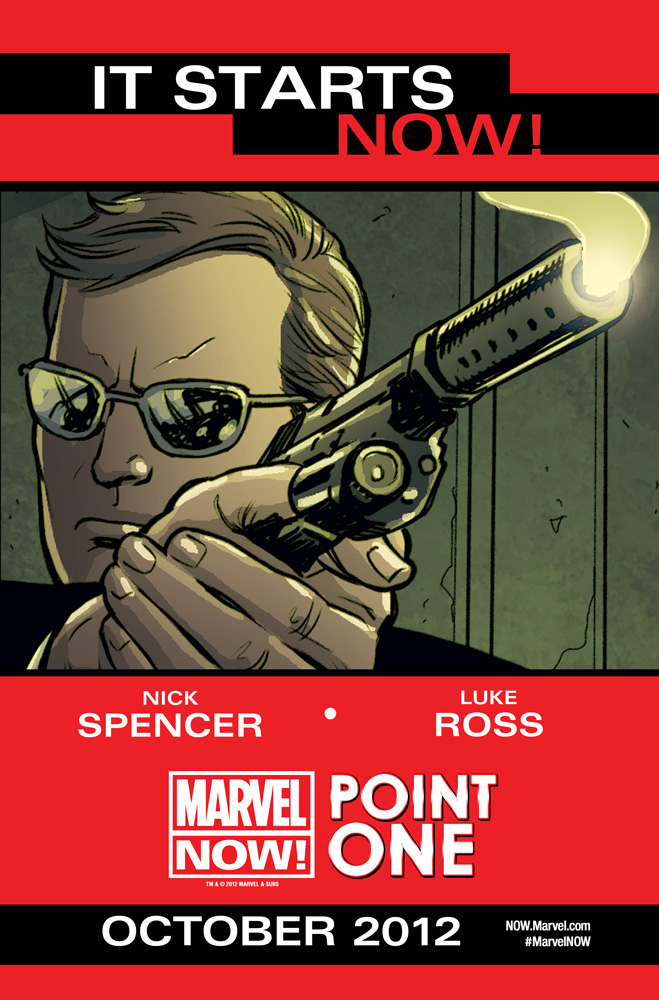
FEATURED REVIEW: MARVEL NOW! POINT ONE

(w) Nick Spencer, Brian Bendis, Jeph Loeb, Kieron Gillen, Matt Fraction, and Dennis Hopeless
(p) Luke Ross, Steve McNiven, Ed McGuinness, Jamie McElvie with Mike Norton, Mike Allred, Gabriel Hernandez Walta

Last year's Marvel Point One was a fun introduction to coming year's storylines, though it retroactively suffered from unfulfilled promises. Why did Scarlet Spider get a solo series but not Nova? Where is the X-Terminated team? Of course, that was the first issue in a series, it seems, so it makes sense that MPO was more of a work in progress than anything else. And at the end of the day, it's still a really fun one shot full of interesting stories. Marve NOW! Point One is the more polished version of the concept - each story included in this issue is evolving into an ongoing series. This anthology format is fun because it's not necessary to know decades of continuity to still enjoy what's going on. In fact, that's the whole idea behind 'Marvel NOW!'

Marvel NOW! Point One is framed by the story following S.H.I.E.L.D. Agents Nick Fury, Phil Coulson, and Director Maria Hill. They've come across a gentleman who monetarily wiped out the New York Stock Exchange within a matter of hours and claims to be from the future. Being from the future obviously has it's advantages when cavorting in the past, and the man basically just wants to give S.H.I.E.L.D. a heads-up about what's coming. It's a strained plot, one that feels forced and underdeveloped. Nick Spencer is obviously trying for some mystery in the man's identity, but it just comes across as unfinished or poorly edited. It made sense for the Watcher in Marvel Point One to have visions of the future surrounding it's supernatural existence, so this scenario feels a bit silly. Then again, these are the kind of things Fury and Coulson will be dealing with in the pages of Secret Avengers, set to debut in February.

Brian (Michael) Bendis and Steve McNiven kick things off with the origin of Star-Lord, leader of the Guardians of the Galaxy. Marvel is making a big push for their cosmic characters, and putting Bendis front and center for a team getting a cinematic movie next year is a stellar choice. And while Bendis' long-form writing style means "Guardians of the Galaxy" feels incomplete, Steve McNiven's amazing artwork pretty much makes up for it.

Next up is Jeph Loeb and Ed McGuinness bringing us "Diamondhead" featuring the new Nova - Sam Alexander - the team introduced in Marvel Point One. While Sam's last adventure was all about the return of the Phoenix, this tale gives readers a bit more insight as to Sam's situation without giving much away in terms of concrete details. The eponymous villain is one of Richard Rider Nova's old enemies, so he confronts the new Nova. A few choice sentences of dialogue reveal that the Nova Corps is gone, and that Sam is apparently the last one...maybe. Dropping hints that answer questions by bringing up more questions is one of Jeph Loeb's strong suits, so it works well here. Ed McGuinness is one of those artists who draws comics like they're perceived by the non-comic book reading population - big, expressive, and colorful. I'm already a fan of Sam Alexander - especially his re-designed Nova uniform - so Nova is one of the series I'm most excited about.

Oh, Young Avengers. If you read this blog on any sort of regular basis, you're probably aware that I absolutely LOVE the Young Avengers. I collected the entire 12-issue original run (dubbed "Season One" in recent years), I've read every YA tie-in issue for Marvel's major events, and I even stuck it out and bought every issue of Avengers: The Children's Crusade. So when Marvel announced they were bringing back the Young Avengers under the watch of Kieron Gillen and Jamie McElvie, I was ecstatic. "The New World" features "Miss" America Chavez, first introduced in 2011's Vengeance mini-series as part of the new Teen Brigade. Kid Loki has decided to put a new Young Avengers team together, and first goes after America (that's her real name, hence the pun) who's taking refuge on Earth-212. Because this is a comic book and heroes tend to fight each other before getting along, a brawl ensues. Even though Miss America basically just beats Loki down then flies away, the whole sequence is meant to develop America and give readers a preview of her social skills, something that will obviously come into play once she joins the team. Breaking the fourth wall is always fun in my book, so Loki's 'wanted' ad was a pleasant surprise and an awesome way to close this chapter.

Matt Fraction and Mike Allred's "It's Art!" is next, featuring Scott Lang as Ant-Man in a prologue to the creative team's upcoming FF. Mike Allred is such a fantastic and wonky artist that it fits Matt Fraction's whimsically poignant writing almost perfectly. Scott Lang is also a great character for Fraction, who specializes in taking somewhat formless characters and giving them direction and focus (Clint Barton, anyone?). "It's Art!" features what I hope will be the norm for FF, which is a stylized narrative structure, consisting of a fantastic balance of inner monologue and dialogue, as well as inventive and innovative panel flow. Seeing Scott's whereabouts through special enlarged panels with arrows is genius, and Fraction's breaking of the fourth wall is so subtle, it smacks you in the face before you even realize.

The final story - before the conclusion of Spencer's S.H.I.E.L.D. bookend - is about Forge. Specifically, a mentally disturbed, manic Forge who stumbles upon a lab he built with a huge machine he didn't build. For a mutant whose ability consists of creating and fixing nearly any machine he can work on, it's a perfect set up. Unlike his counterparts who might give too little, Dennis Hopeless tries for a bit too much with "Crazy Enough". The psychological implications surrounding a techno-manipulator are many, apparently, and Hopeless just digs the hole a bit too big, then doesn't have time to have anything make sense before it ends with a cameo from Cable, foreshadowing Cable and X-Force coming in December.

It's difficult to review a prologue anthology simply by it's definition. These stories and their format are unique. Unlike back-up stories of similar length, these aren't multi-part or even one-shot tales. Each of these small stories is like a "Zero Issue" of sorts. While DC made a whole month of it in September, Marvel NOW! Point One could be considered 'ground zero' for all six featured series. It's a fun issue - simple as that. Knowing that all six series are starting soon gives more weight to these six prologues, and that's part of the charm. If this were just another short story anthology, it would be a bit lacking. But it's not. And we know it. Get ready, because if the level of quality seen in NOW! Point One continues through the next five months of new launches and into the future, Marvel might just have the upper hand on DC.

GRADE
8.5/10