Showing posts with label John Cassaday. Show all posts

Saturday, January 26, 2013

REVIEW: UNCANNY AVENGERS #3

(w) Rick Remender
(a) John Cassaday

Reading Uncanny Avengers is experiencing a modern classic unfold. Much in the same fashion he rendered Uncanny X-Force one of the best comic book series in modern history, Rick Remender is making sure this new series lives up to it's top shelf name. Uncanny Avengers sits comfortably and impeccably between the Avengers and X-Men franchises, in terms of team makeup as well as narrative breadth. Jonathan Hickman is going universal in the pages of Avengers and New Avengers, ratcheting up the scope of the threats facing each team, threats that have universe-sized ramifications. Brian Michael Bendis is bringing his unique brand of interpersonal relationship drama to the X-Men by penning decompressed, character-driven stories. Remender's book and team fall right in the middle, which is kind of the point.

Uncanny Avengers #3 continues "The Red Shadow", an opening salvo that very much reflects Remender's attempt to balance the sheer size of the Avengers with the intimacy of the X-Men. There are a number of different elements that showcase the melding of franchises. Like Red Skull, who is traditionally an Avengers villain, focusing his evil intentions upon the biggest perceived genetic monstrosity of all: the mutant gene. Taking the Nazi ideology to it's extreme conclusion makes Red Skull one of the more foreboding villains in recent history. Or Red's S-Men, a ramshackle team super humans made special externally, through science, magic, or anything other than being a mutant, really. These S-Men (short for Special Men, one would assume) have undergone alterations to become a facsimile of the very perceived threat they stand against. For them, the ends justify the means when the end is the extinction of all mutants. And their backstories reveal the hatred that fuels their endeavors.

It's not often that reading a comic book feels like reading a novel. Remender's narration throughout Uncanny Avengers #3 transforms "The Red Shadow" from a well-written Avengers story into a broad, expansive narrative that's a fantastic allegory for World War II. While Red Skull's general ideology remains the same -- thus does his position in the symbology -- his hatred has shifted from merely one ethnicity to an entire species of mutated humans. Against Red Skull's metaphorical Axis stand the Allied Forces in the Uncanny Avengers, who seek to throttle Red's hypnotic amplification of people's base fears about mutantkind, pushing them to murder those who are different. Captain America vs. Red Skull: sound familiar?

Keeping the gratuitous violence off-panel was a wise choice, artistically, because it gives John Cassaday room to show more with less and to incorporated Remender's narration to give these sequences the cold, bitter tone the story requires. Cassaday's artwork for the entire issue is fantastic, especially his Red Skull, who looks verily insane from beginning to end.

Rick Remender and John Cassaday are creating something truly inspired with Uncanny Avengers. The narrative's underlying symbolism and lasting consequences give it the demeanor of Marvel's flagship 'Marvel NOW!' title. In many ways, Remender has taken the best parts of the Avengers and X-Men franchises and melded them together for stunning results. Uncanny Avengers #3 is the third chapter of "The Red Shadow", but unlike many middle issues, this one doesn't lull or rest on exposition to carry the story into a big conclusion.

GRADE
9/10

Thursday, November 29, 2012

REVIEW: UNCANNY AVENGERS #2

(w) Rick Remender
(p) John Cassaday

Well it's been long enough! Eight weeks after it's debut, Uncanny Avengers is back with it's second issue, and this one's a doozie. Rick Remender and John Cassaday aren't making any compromises with this series, as evidenced by the repeated delays for this issue so Cassaday could make sure the art was up to his high standards. Uncanny Avengers #2 is split into three 'acts' to better convey the large amount of new information being presented. And while this format can feel a tad disjointed from time to time, it all goes toward Remender's bigger picture.

First up are Captain America, Wolverine, and Thor helping with the relief effort in Manhattan after the devastating attack by Avalanche in the first issue. While Avalanche's attack wasn't even close to being the real focal point of UA #1, the ramifications of a mutant attack resulting in hundreds of dead humans are terrifying. Basically, 'Act I' sets the stage for why Uncanny Avengers have come together -- now that Charles Xavier is dead, it seems that his dream of peaceful co-habitation between humans and mutants is slowly dying as well. It's a poignant scene that shows two sides of a desperate situation. Captain America sees this as crucial time frame for the human race to establish a better relationship with the mutant community. For Wolverine, Steve Rogers' "mutant community" doesn't exist and having Havok -- a mutant and brother to international criminal Cyclops -- lead an Avengers response to mutant attacks is a terrible idea. Both perspectives have their merits, but a small, two-panel sequence between a thankful man and Havok himself is enough to prove the Uncanny Avengers are needed now more than ever.

The second part of the issue focuses on Rogue and the Scarlet Witch being held prisoner by the maniacal Red Skull, while 'Act III' brings these two ladies together to close out the issue. While Red Skull did appear at the very end of Uncanny Avengers #1, there wasn't much information regarding his motives or master plan. Here, we get a much more fleshed out Red Skull who explains himself without sounding like he's lecturing 150 bored college freshmen in a beginner's biology class. It's simple, really. Red Skull had his consciousness preserved and downloaded into a cloned body -- circa 1942 -- so he could reawaken 70 years later when "the world had forgotten me and my perceived atrocities." Now, seeing the state of the world with mutants running around, Red Skull has taken the Nazi idealism of purity and strength and applied it to humanity at large which means "mutants are the ultimate invading foreigners." I'm actually surprised no one has ever taken this direction with the Red Skull, but that's kind of what 'Marvel NOW!' is all about, right? Before, most of the dealings of the Avengers stayed relatively separate from the world of the X-Men. But now, classic Avengers villains are getting in on X-Men territory, and the results are bone-chillingly awesome.

In the end, Uncanny Avengers #2 is a more compelling issue than the first, and that's extremely hard to do in the modern comic landscape. Red Skull has always been a rather menacing character, but it's usually at arms length -- he's generally reserved for flashback issues or as a totem for other villains. Fortunately, Rick Remender takes Red Skull to frightening new heights, making him not only one of the most formidable villains in years, but also one of the most powerful in the Marvel Universe. The team itself is slow to actually getting together, but that's what an opening arc is all about, right?

GRADE
9/10

Wednesday, October 10, 2012

UNCANNY AVENGERS #1

(W) Rick Remender
(P/I) John Cassaday

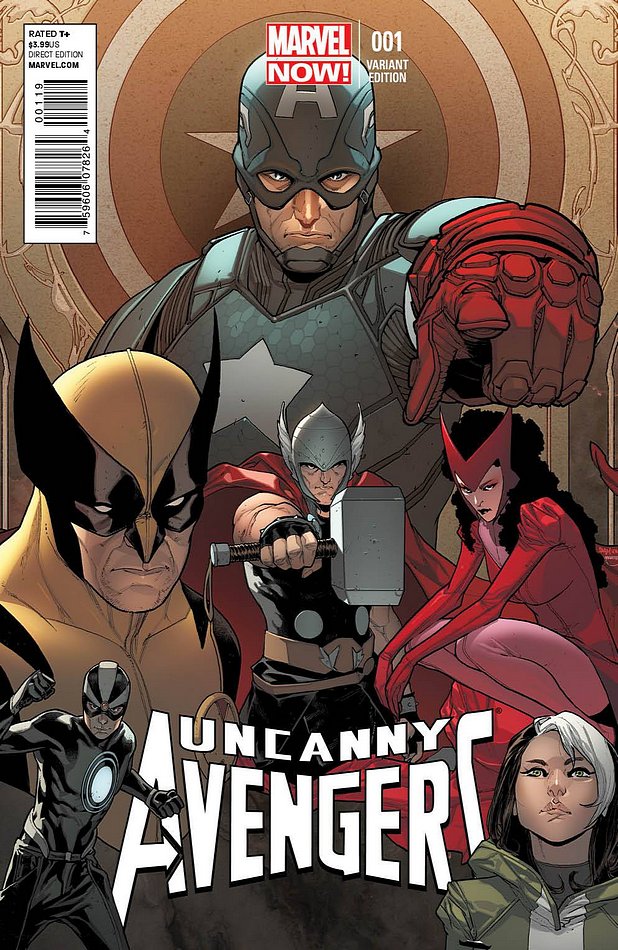
Thought I'd throw up one of the 20 variants for this issue.
If beauty is in the eye of the beholder, than we're all currently holding. Uncanny Avengers #1 is, simply put, an achievement. Rick Remender has taken all the convoluted tension between the Avengers and X-Men and brought it to the surface, making these characters actually talk about it instead of beating the crap out of each other on a whim. That might sound less-than-interesting, but it's actually the one type of confrontation that hasn't been done to death in comic books, and it's absolutely refreshing.

Fittingly, the funeral for Professor Charles Xavier begins the tale of these Uncanny Avengers, with a speech by Wolverine that has enough gruff to make it seem believable, but still conveys the fact that Logan is an intelligent person. This segues into Captain America's meeting with Alex Summers (a.k.a. Havok), the brother of Scott Summers. While not the biggest name in the X-Men roster, Havok has put in his time and paid his dues. Steve Rogers sees that and wants to make Alex the leader of a new Avengers/X-Men hybrid team. In years passed, this book would have been made to take a more natural-sounding path to it's inception. Remember the first arc of The New Avengers, when Brian Michael Bendis wanted so much for the team to feel natural that he set up a massive prison break out that was supposed to be the basis of the series, but was quickly forgotten. Rick Remender isn't beating around the bush, not with his writing style or with these characters' motivations. Steve Rogers comes out and explains his intentions to Alex Summers, explaining that there needs to be something more inclusive.

It may come as a surprise, but many writers like to dumb down their characters and turn them into simple action-and-fight props used to propagate ridiculously complicated plots. It is actually very rare to get a writer who understands that these characters are just like real people when they aren't fighting crime, which means they think like real people and have real people solutions to problems. Instead of using adamantium claws or vibranium shields to solve their problems, these heroes are talking, explaining their feelings to one another and hoping they can work together to make the world a better place. Remender's dialogue comes from a place of unfettered sincerity, and it's what's going to make this series a delight to read.

I can't say enough good things about Uncanny Avengers #1. Rick Remender's plot and scripts are just magnificent - there's no deep connections to continuity, there's no huge revelations about characters we didn't already know (how many issues can depict Cyclops be transported to his cell?) and the characters used are either largely identifiable, or get amazingly organic profiling through character dialogue. All of these elements make Uncanny Avengers one hell of a read. Marvel is really striving to bring in new readers with 'Marvel NOW!', and if this first issue of concept is an example of the quality we'll be getting going forward, then it will be tremendously successful.

GRADE
9/10