Showing posts with label Rick Remender. Show all posts

Thursday, June 20, 2013

Uncanny Avengers #9 Review

(w) Rick Remender
(a) Daniel Acuna

It's quite obvious to me that Rogue and Scarlet Witch's argument represented the real-life arguments online after the release of Uncanny Avengers #5. In that issue, Remender intended to convey the idea that people shouldn't be judged by their race, gender, sexual orientation, or mutation. This was misinterpreted by many as advocating for assimilation instead of diversity. Remender's meltdown on Twitter was widely circulated, and he apologized shortly after, but Uncanny Avengers #9 is where he really gets to let it all out.


** SPOILERS AHEAD! **


At the beginning of the sequence, I assumed Scarlet Witch's argument defending Havok would come out on top. Fortunately, Remender keeps things balanced and allows Rogue to have her own opinion without it sounding condescending. Both women make valid points about what was said by Alex at the press conference, and neither budges from their point of view. If this sounds familiar, it's because this is how most people are, in general. Debate is all well and good, but not often are individuals swayed from their established notions.

As far as the story itself is concerned, Uncanny Avengers #9 advances the narrative for the Apocalypse Twins by setting in motion their plan to annihilate all human life on the planet and start fresh on a new mutant world. Remender is doing an excellent job weaving is grand narrative about Apocalypse -- which began with Uncanny X-Force -- into the world of the Avengers. Wolverine's hard choices have come back to haunt him and now threaten to divide the team when they need to be united the most. Insecurities bubble up, bitter truths are spoken, and everything the team stands for begins to break down.

Uncanny Avengers #9 is an excellent issue. From a long-form perspective, Remender's casting choices have been truly excellent in bringing diversity and balance to the title's tone. It feels like human-mutant relations in the Marvel universe may never be completely peaceful, and the Avengers Unity Team is beginning to internalize this feeling more and more.

GRADE
8/10

Friday, March 29, 2013

Uncanny Avengers #5

(w) Rick Remender     (a) Olivier Coipel

**SPOILERS AHEAD**

On the spectrum on comic book art, it goes from being extremely cartoony/exaggerated on one end, to vividly realistic/lifelike on the other. Rob Liefeld and Humberto Ramos are the first two names that popped into my head when thinking of examples for the former, while David Finch and Ethan Van Sciver represent the latter. While most artists exist somewhere along the spectrum, there are few that find a phenomenal middle ground that represents the comic book format, yet manages to capture dynamic realism. Some of these names include Jim Lee, Jim Cheung, Greg Capullo, John Cassaday, Phil Noto, and Olivier Coipel.

Coipel has been a favorite artist of mine since I read House of M, so when I heard he was doing an issue of Uncanny Avengers with Rick Remender -- a more recent addition to my list of favorite writers -- I was immediately sold. Though, it's not like I wasn't already going to read the issue. Coipel's artwork is an absolute treat for an transition issue that begins to incorporate Remender's storylines from Uncanny X-Force he promised would resurface in this series.

There is a sequence in Uncanny Avengers #5, wherein Alex Summers begins a national dialogue about the use of the word "mutant" as a descriptor of individuals with activated x-genes. For some ridiculous reason, select critics and journalists have chosen to become incensed by the ideas put forth by Havok in his speech. These ideas deal with the perception of mutants as inherently different from humans, which Alex attempts to explain simply isn't true. The controversy surrounds Alex's insistence that the word "mutant" now carries a negative connotation, and that maybe, just maybe, the intelligent peoples of Earth might just possibly be able to think of a better way to interact with those who are different. The point of the speech was that Alex didn't want to be defined by his mutation; a noble belief that ultra-sensitives on the internet have turned into an ugly attempt at casting Rick Remender and his narrative decisions in a bigoted light. It's ridiculous and frankly appalling that a story conveying a hopeful idea for the future of an oppressed people is so viciously attacked because of the wording.


And the funny thing is, Havok's speech is only a small part of the issue. Probably the least technically interesting part about the issue is Alex's speech. It's a sentiment that's been a part of mutant life in the Marvel universe for decades. Remender conveyed that sentiment very well, but it's been done. The speech is important, but in true Remender fashion, the entire issue sets up future stories, not just the big finale at the end. There's the addition of Wonder Man, Wasp, and Sunfire to the team, the romantic tension between Captain America and Scarlet Witch, the attack on the press conference by Grim Reaper, or even the ongoing look at Captain America and Havok's struggle to keep rank.

Uncanny Avengers #5 is a fantastic issue of a fantastic series. Rick Remender knows how to write great comic books and now that we're getting to the point where his storylines from UXF are starting to connect, it's just going to get better and better.

GRADE
8/10

Thursday, February 21, 2013

Captain America #4

(w) Rick Remender     (a) John Romita Jr.

**MILD SPOILERS THROUGHOUT**

It boggles my mind when people tell me they don't like Rick Remender's Captain America. I get that many Cap fans these days are so because of Ed Brubaker's phenomenal run, and I understand the reluctance to get behind a new volume of Captain America that takes the character in the complete opposite direction. What I can't understand is the complete dismissal of the title simply because it doesn't follow the spy thriller format Brubaker made so popular. For the first time in a long time, Captain America is confronting problems he doesn't know how to solve. Even when things looked hopeless, Steve Rogers could always count on his training, his tactical genius, and his overall sense of justice to see him to victory. In Dimension Z, none of these things matter.

Much like how the previous issue leapt a year into the future, Captain America #4 throws readers for a loop by leaping another 11. That full black page with the stark, white "Eleven Years Later" really packs a punch as an issue opener. I let out a rather fawning "Whoa!" to the surprise of my wife sitting beside me. She commented about how rare it was for me to get so into a comic book like that, to exclaim out of sheer excitement.


The revelation at the end of issue three saw Steve Rogers infected by some sort of techno-biological virus that produced Arnim Zola's visage on Steve's stomach, similar to Zola's real face on his own body. So not only has Cap been stuck in a dimension where none of his previous experience helps him in any way, but he's also had a evil consciousness of Arnim Zola chipping away at his soul for over ten years While it's a bit weird that Steve is able to hide a glowing blue face on his torso from his adopted son, Ian, for over a decade, it's more about the idea that hiding this horrible truth represents: Steve is dedicated to protecting Ian from his horrible past.

Remender fleshes out Steve and Ian's relationship this issue, mostly because Ian is finally old enough to have a personality of his own instead of being a precious weight for the Captain as he navigated Zolandia. Now, Cap is training Ian to use the shield, trying to instill good values in the boy, and always looking for a way back to Earth. An in-tact map of the land gives the boys some home in returning home, but that hope raises the bigger issue for Ian: what is home? Now firmly in his early teens, Ian wants to know more than Cap is telling him, and the idea of returning to Earth isn't as desirable to him as it is to Steve, who's actually been there.

Captain America #4 isn't what I expected, but it's everything I wanted. Rick Remender's trademark long-form approach to storytelling means Steve Roger's sojourn to Zolandia isn't going to end any time soon. The first four issues of this series have been a marathon of steadily building up the emotional investment, creating a psycho-weird (a term I just created because no other seemed to describe Dimension Z well enough) reality that tests Cap at every turn, and raises the stakes for Steve and Ian in terms of their relationship and their mission to escape the influence of Zola. Yes, this Captain America is completely different than anything Ed Brubaker wrote in his seminal run. But if you step away from the continuity and just read Remender's Cap as-is, it's one of the most exhilarating, powerful titles to come out of the 'Marvel NOW!' initiative.

GRADE
9/10

Saturday, January 26, 2013

REVIEW: UNCANNY AVENGERS #3

(w) Rick Remender
(a) John Cassaday

Reading Uncanny Avengers is experiencing a modern classic unfold. Much in the same fashion he rendered Uncanny X-Force one of the best comic book series in modern history, Rick Remender is making sure this new series lives up to it's top shelf name. Uncanny Avengers sits comfortably and impeccably between the Avengers and X-Men franchises, in terms of team makeup as well as narrative breadth. Jonathan Hickman is going universal in the pages of Avengers and New Avengers, ratcheting up the scope of the threats facing each team, threats that have universe-sized ramifications. Brian Michael Bendis is bringing his unique brand of interpersonal relationship drama to the X-Men by penning decompressed, character-driven stories. Remender's book and team fall right in the middle, which is kind of the point.

Uncanny Avengers #3 continues "The Red Shadow", an opening salvo that very much reflects Remender's attempt to balance the sheer size of the Avengers with the intimacy of the X-Men. There are a number of different elements that showcase the melding of franchises. Like Red Skull, who is traditionally an Avengers villain, focusing his evil intentions upon the biggest perceived genetic monstrosity of all: the mutant gene. Taking the Nazi ideology to it's extreme conclusion makes Red Skull one of the more foreboding villains in recent history. Or Red's S-Men, a ramshackle team super humans made special externally, through science, magic, or anything other than being a mutant, really. These S-Men (short for Special Men, one would assume) have undergone alterations to become a facsimile of the very perceived threat they stand against. For them, the ends justify the means when the end is the extinction of all mutants. And their backstories reveal the hatred that fuels their endeavors.

It's not often that reading a comic book feels like reading a novel. Remender's narration throughout Uncanny Avengers #3 transforms "The Red Shadow" from a well-written Avengers story into a broad, expansive narrative that's a fantastic allegory for World War II. While Red Skull's general ideology remains the same -- thus does his position in the symbology -- his hatred has shifted from merely one ethnicity to an entire species of mutated humans. Against Red Skull's metaphorical Axis stand the Allied Forces in the Uncanny Avengers, who seek to throttle Red's hypnotic amplification of people's base fears about mutantkind, pushing them to murder those who are different. Captain America vs. Red Skull: sound familiar?

Keeping the gratuitous violence off-panel was a wise choice, artistically, because it gives John Cassaday room to show more with less and to incorporated Remender's narration to give these sequences the cold, bitter tone the story requires. Cassaday's artwork for the entire issue is fantastic, especially his Red Skull, who looks verily insane from beginning to end.

Rick Remender and John Cassaday are creating something truly inspired with Uncanny Avengers. The narrative's underlying symbolism and lasting consequences give it the demeanor of Marvel's flagship 'Marvel NOW!' title. In many ways, Remender has taken the best parts of the Avengers and X-Men franchises and melded them together for stunning results. Uncanny Avengers #3 is the third chapter of "The Red Shadow", but unlike many middle issues, this one doesn't lull or rest on exposition to carry the story into a big conclusion.

GRADE
9/10

Saturday, January 19, 2013

REVIEW: CAPTAIN AMERICA #3

(w) Rick Remender
(a) John Romita Jr.

Alright.


I'm just going to say it.

I love Rick Remender and John Romita Jr's Captain America.

For the better part of the last decade, Ed Brubaker's stoic, dark, spy-y stories about the Sentinel of Liberty have kept me at arms-length from one of Marvel's top characters. Brubaker steeped his Cap stories in the world of espionage, and while that's awesome and cool, I always felt a disconnect between Rogers' personal ethics and his actions as an undercover spy working in the shadows. 

With the 'Marvel NOW!' imperative, Rick Remender has been given the reigns of Captain America, and he's decided to take Steve Rogers in the complete opposite direction that Brubaker had been going. Dimension Z is more than just a weird new setting; it's a metaphor for Cap's life, et al. On Earth, Captain America is arguably the best superhero there is because he's got this amazing combination of tactical genius, physical superiority, genuine faith in his beliefs, and a determination that never quits. After last month's look into a year in the life of being stranded in Dimension Z, Captain America #3 thrusts Steve and his travelling companion Ian (Arnim Zola's son under Cap's protection) into more familiar territory.

This familiarity comes with Steve and Ian being attacked by the Phrox, a species native to Dimension Z who retreated to subterranean caves when Zola invaded and took control of their home. Cap gets to utilize some of his combat skills that have proved useless otherwise thus far, and it goes a long way in making this volume of Captain America feel more organic and natural. The Phrox are wary of Steve and Ian, as their land has been overrun by Zola's mutated experiments, so it makes sense that their first instinct is to kill the invaders. Fortunately, Steve and Ian gain an unlikely ally from a friendly Phrox who saw that Steve, too, was at odds with Zola. Remender also continues his look back at the life of young Steve Rogers in depression-era Manhattan, a story that relates to Cap's current feelings of overwhelming helplessness. As a weak child, Steve was at the mercy of the neighborhood bullies, and in Dimension Z, his skills are rendered all but useless in a place where the landscape shifts and mutant freaks roam the countryside.

John Romita Jr's art is an acquired taste. I've heard that you "either love it or hate it", but I'm more inclined to see it as a learning curve. Much like how it can take time to get used to different writing styles depending on what writer you're reading, the same can be said for artists and their various techniques. Romita has a very stylized look about his work that immerses you without distracting from the story (unlike, say, David Finch's art, which constantly forces me to decipher who's punching what on splash pages and/or fight scenes.)

It makes sense that many people are finding Remender and Romita's vision for Captain America a little off-putting. The most common complaint I've found has been the arguably unnecessary inclusion of the flashbacks to Steve's childhood. As I mentioned earlier, these flashbacks serve not only to shed some light onto a part of Steve Rogers' life that hasn't ever been delved into much, but also to show that even though the world and the circumstances may change, the pain and the struggle remains the same. Captain America #3 comes to an end with a pretty big shocker that's going to have lasting consequences (at least as far as Marvel's solicitations are concerned) that will affect not only the rest of Steve's time in Dimension Z, but also quite possibly for the rest of his life!

GRADE
8/10

Wednesday, December 19, 2012

REVIEW: CAPTAIN AMERICA #2

(w) Rick Remender
(p) John Romita Jr.
(i) Klaus Janson

After the first issue received mixed reviews from critics, Rick Remender's Captain America #2 comes in to cement the series as a sci-fi epic to rival the adventures of the Fantastic Four. The difference is, Captain America isn't prepared for an alternate dimension where physics are suggestions more than rules and Arnim Zola has unleashed a legion of mutated experiments. Remender shines brightest when writing a team--he excels at playing various personalities against each other. Captain America sees Remender having to bounce Steve Rogers against himself.

Regular readers of "The Endless Reel" know that I don't much care for inner monologue. I'm putting that out there because I have a predisposed bias against that particular form of narrative, as more often than not, it doesn't effectively convey the ideas/emotions the writer is aiming to show. And while the inner monologue used throughout Captain America #2 isn't awful, it definitely isn't Remender's strongest work. As evidenced by his phenomenal run with Uncanny X-Force, Rick Remender has a knack for ornate diction. It works for Fantomex, Betsy Braddock, and Warren Worthington III, but not so much for Steve Rogers. And really, the monologue is quite toned down from Remender's normal style, yet still it's overly thought out at times. Captain America is utilitarian, and that's not a bad thing--it's a big part of what makes him who he is. Steve Rogers has a very logical, reason-based approach to life and his own behavior, which suggests his thought process is more streamlined, less superfluous. Remender does well to eliminate filler words, but overall, we still get an intimate glimpse at Steve Rogers' thoughts, and it's uncomfortable. But then again, maybe that's exactly what we need from a Captain America comic book--something that puts us out of our comfort zone.

It's difficult to say how Rick Remender's run with Captain America will pan out. With most other 'Marvel NOW!' titles, I've found myself either raucously sold or defiantly opposed. Remender's Captain America is different from most other titles Marvel is currently offering: it sits outside the general Marvel turn of events due to it's setting in Dimension Z, Captain America is completely out of his element (something we haven't seen in ages), yet the fate of a whole universe hangs in the balance.

GRADE
7/10

Thursday, November 29, 2012

REVIEW: UNCANNY AVENGERS #2

(w) Rick Remender
(p) John Cassaday

Well it's been long enough! Eight weeks after it's debut, Uncanny Avengers is back with it's second issue, and this one's a doozie. Rick Remender and John Cassaday aren't making any compromises with this series, as evidenced by the repeated delays for this issue so Cassaday could make sure the art was up to his high standards. Uncanny Avengers #2 is split into three 'acts' to better convey the large amount of new information being presented. And while this format can feel a tad disjointed from time to time, it all goes toward Remender's bigger picture.

First up are Captain America, Wolverine, and Thor helping with the relief effort in Manhattan after the devastating attack by Avalanche in the first issue. While Avalanche's attack wasn't even close to being the real focal point of UA #1, the ramifications of a mutant attack resulting in hundreds of dead humans are terrifying. Basically, 'Act I' sets the stage for why Uncanny Avengers have come together -- now that Charles Xavier is dead, it seems that his dream of peaceful co-habitation between humans and mutants is slowly dying as well. It's a poignant scene that shows two sides of a desperate situation. Captain America sees this as crucial time frame for the human race to establish a better relationship with the mutant community. For Wolverine, Steve Rogers' "mutant community" doesn't exist and having Havok -- a mutant and brother to international criminal Cyclops -- lead an Avengers response to mutant attacks is a terrible idea. Both perspectives have their merits, but a small, two-panel sequence between a thankful man and Havok himself is enough to prove the Uncanny Avengers are needed now more than ever.

The second part of the issue focuses on Rogue and the Scarlet Witch being held prisoner by the maniacal Red Skull, while 'Act III' brings these two ladies together to close out the issue. While Red Skull did appear at the very end of Uncanny Avengers #1, there wasn't much information regarding his motives or master plan. Here, we get a much more fleshed out Red Skull who explains himself without sounding like he's lecturing 150 bored college freshmen in a beginner's biology class. It's simple, really. Red Skull had his consciousness preserved and downloaded into a cloned body -- circa 1942 -- so he could reawaken 70 years later when "the world had forgotten me and my perceived atrocities." Now, seeing the state of the world with mutants running around, Red Skull has taken the Nazi idealism of purity and strength and applied it to humanity at large which means "mutants are the ultimate invading foreigners." I'm actually surprised no one has ever taken this direction with the Red Skull, but that's kind of what 'Marvel NOW!' is all about, right? Before, most of the dealings of the Avengers stayed relatively separate from the world of the X-Men. But now, classic Avengers villains are getting in on X-Men territory, and the results are bone-chillingly awesome.

In the end, Uncanny Avengers #2 is a more compelling issue than the first, and that's extremely hard to do in the modern comic landscape. Red Skull has always been a rather menacing character, but it's usually at arms length -- he's generally reserved for flashback issues or as a totem for other villains. Fortunately, Rick Remender takes Red Skull to frightening new heights, making him not only one of the most formidable villains in years, but also one of the most powerful in the Marvel Universe. The team itself is slow to actually getting together, but that's what an opening arc is all about, right?

GRADE
9/10

Wednesday, November 21, 2012

FEATURED REVIEW: CAPTAIN AMERICA #1

(w) Rick Remender
(p) John Romita Jr.

Over the last eight years, Ed Brubaker's phenomenal take on the Sentinel of Liberty has been a golden standard for how to interpret a character that had become somewhat superfluous in the modern era of comic books (think Superman circa 1980). Steve Rogers' alter-ego stood for ideals and beliefs that were in short supply in the early 21st century, yet Brubaker managed to find a place for the spiritual successor of the American Spirit amidst growing dissonance the world over.

Now, Rick Remender is at the helm, and he's bringing a whole new Cap' to 'Marvel NOW!'

Remender's been focusing a lot of his efforts recently on team-based titles such as Uncanny X-Force, Secret Avengers, and the new Uncanny Avengers. It wouldn't be out of the ordinary he had a little trouble tackling a solo series. Fortunately, Remender is not one to rest on his laurels, and Captain America #1 is some of the most fun I've had with the Captain in quite some time. Not to downplay Brubaker's talent, but the 'secret agent' direction of his run was less 'fun' than it was captivating and intriguing. Remender, however, is reminding readers that Steve Rogers is a person, not just a symbol or an idea.

Personifying Captain America wasn't high on Brubaker's priority list during his tenure with Steve Rogers -- the Captain's uniform and mindset rarely went missing over the past eight years (not counting when Steve wasn't Captain America anymore), which made it difficult to consider Rogers as a normal person instead of an Energizer Superhero who never stops. Here in Captain America #1, Remender starts things off with a look at Steve Rogers' childhood in a scene that could be called 'ground zero' for Rogers' general attitude of perseverance and dedication. It's a sequence that makes you cringe and feel confidence at the same time...it's something I've never seen done before.

Next, after a quick bout with C-list villain Green Skull (an eco-terrorist bent on over-vegetating the Earth and kill all humans), Rogers meets up with his girlfriend, S.H.I.E.L.D. liaison Sharon Carter. Remender deftly handles the transition from battlefield solider to romantic knucklehead by making the sequence as unsubtle as possible. In Captain America's world, he can parachute into the middle of Manhattan and hand of an international terrorist over to the NYPD, he can just show up in his spectacle of a uniform to meet his love interest, and he can become Steve Rogers at the drop of a hat.

Of course, the main promotional pull for Captain America has been the shift in narrative tone from 'super spy' to 'sci-fi adventure', and it's not quite as big of a jump as most would expect. Before Brubaker made Rogers the character he is today, Captain America used to fight aliens and invaders from parallel dimensions and the such. Remender is bringing the Captain back to this paradigm. Arnim Zola has also been heavily promoted as integral to the first arc of Remender's Captain America. What hasn't been touted as much, is the connection between Zola and Dimension Z, the parallel world that Rogers gets sucked into while on a routine fact-gathering mission. Near the end of Captain America #1, Zola reveals that it's HIS dimension called Zolandia. At least, that's what I took away from the scene. How or why this dimension is called Zolandia is still anyone's guess, but at this point, it doesn't matter. Many writers have difficulty introducing new plot elements without it seeming unfinished or broken (see Green Arrow #14 out a few weeks ago), but Remender manages to pull it off with style.

Rick Remender has a lot of ideas for Captain America. In one issue, he's taken Steve Rogers out of the gritty darkness of the spy game, thrown readers some integral and telling character history, and introduced a whole new chapter in the Captain's life. He's stuck in an alternate dimension that's populated by Arnim Zola's mutated creatures and he's got no way to get back home. John Romita Jr's pencilling gets mixed reviews, usually, but here, it's spot on and works perfectly with Remender's more cheeky style. I've never read Captain America on a regular basis. Captain America #1 by Rick Remender is going to change that.

GRADE
9.5/10

Wednesday, October 10, 2012

UNCANNY AVENGERS #1

(W) Rick Remender
(P/I) John Cassaday

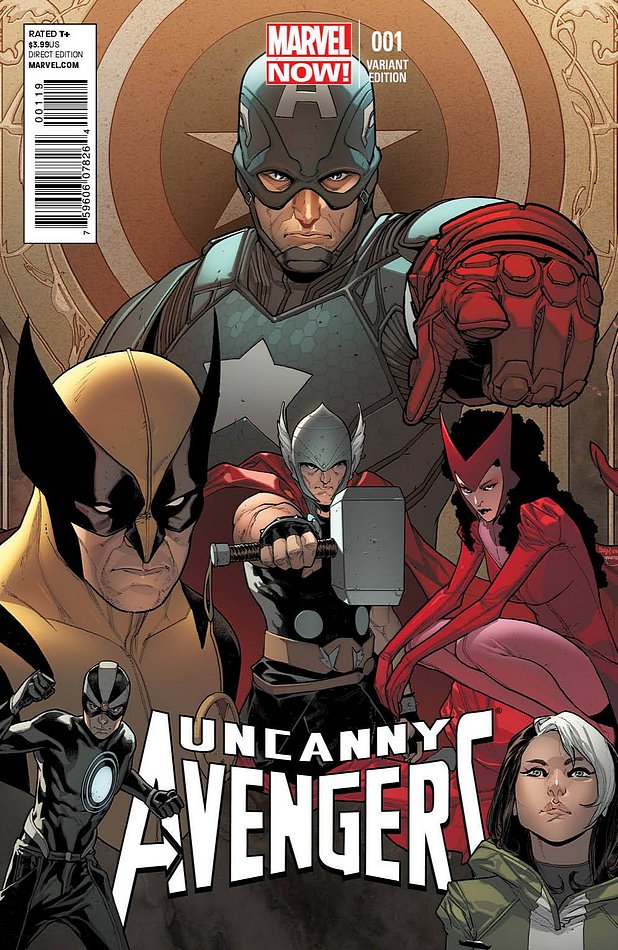
Thought I'd throw up one of the 20 variants for this issue.
If beauty is in the eye of the beholder, than we're all currently holding. Uncanny Avengers #1 is, simply put, an achievement. Rick Remender has taken all the convoluted tension between the Avengers and X-Men and brought it to the surface, making these characters actually talk about it instead of beating the crap out of each other on a whim. That might sound less-than-interesting, but it's actually the one type of confrontation that hasn't been done to death in comic books, and it's absolutely refreshing.

Fittingly, the funeral for Professor Charles Xavier begins the tale of these Uncanny Avengers, with a speech by Wolverine that has enough gruff to make it seem believable, but still conveys the fact that Logan is an intelligent person. This segues into Captain America's meeting with Alex Summers (a.k.a. Havok), the brother of Scott Summers. While not the biggest name in the X-Men roster, Havok has put in his time and paid his dues. Steve Rogers sees that and wants to make Alex the leader of a new Avengers/X-Men hybrid team. In years passed, this book would have been made to take a more natural-sounding path to it's inception. Remember the first arc of The New Avengers, when Brian Michael Bendis wanted so much for the team to feel natural that he set up a massive prison break out that was supposed to be the basis of the series, but was quickly forgotten. Rick Remender isn't beating around the bush, not with his writing style or with these characters' motivations. Steve Rogers comes out and explains his intentions to Alex Summers, explaining that there needs to be something more inclusive.

It may come as a surprise, but many writers like to dumb down their characters and turn them into simple action-and-fight props used to propagate ridiculously complicated plots. It is actually very rare to get a writer who understands that these characters are just like real people when they aren't fighting crime, which means they think like real people and have real people solutions to problems. Instead of using adamantium claws or vibranium shields to solve their problems, these heroes are talking, explaining their feelings to one another and hoping they can work together to make the world a better place. Remender's dialogue comes from a place of unfettered sincerity, and it's what's going to make this series a delight to read.

I can't say enough good things about Uncanny Avengers #1. Rick Remender's plot and scripts are just magnificent - there's no deep connections to continuity, there's no huge revelations about characters we didn't already know (how many issues can depict Cyclops be transported to his cell?) and the characters used are either largely identifiable, or get amazingly organic profiling through character dialogue. All of these elements make Uncanny Avengers one hell of a read. Marvel is really striving to bring in new readers with 'Marvel NOW!', and if this first issue of concept is an example of the quality we'll be getting going forward, then it will be tremendously successful.

GRADE
9/10

Friday, July 6, 2012

NEWS: MARVEL NOW!

On Wednesday, Marvel announced it's plans to 'revamp' it's current line of titles starting in October under the banner 'Marvel NOW!' While stressing this is not a reboot, 'Marvel NOW!' will bring about new series and revamp current series that will reflect the major changes to the Marvel universe as a result of the events of Avengers vs. X-Men. In the few short days since it's announcement, 'Marvel NOW!' has been given a bit more substance through a number of interviews with high-ranking executives at Marvel. 


Instead of mirroring DC and simply launching all it's 'NOW!' titles in the same month, Marvel has opted to launch new or relaunched titles from October through February 2013. An odd move for sure, simply due to the fickle nature of comic book fans who can make a decision on the entirety on 'Marvel NOW!' based on impressions of the first month's worth of content. It seems as though Marvel is taking the safe road, not only in their insistence that 'NOW!' is not reboot, but also in the extended release schedule. DC took a gambit and though it hasn't proved to be the breakout success everyone was hoping for, longtime fans have praised the company for changing damn near everything for the sake of creative freedom and more mass appeal.

New series already announced include Uncanny Avengers, All-New X-Men, and a relaunched Avengers. Confirming what months of rumors have speculated, Marvel is switching up it's creative teams with 'NOW!', giving seasoned writers a chance to explore new franchises. Brian Michael Bendis is leaving his Avengers post that he's held for nearly nine years to pen All-New X-Men, Jonathan Hickman will end his stellar runs on both Fantastic Four and FF to focus on the relaunched, bi-weekly Avengers, and Rick Remender pens the new crossover title, Uncanny Avengers. Of course, these three titles and creative switches are just the tip of the iceberg. Already, it's been leaked that New Avengers will be a part of the 'NOW!' initiative, possibly getting a relaunch and team roster.

Uncanny Avengers features a team of Avengers and X-Men after the fallout of Avengers vs. X-Men as they attempt to operate effectively while learning to get along. So far, the roster includes team leader Havok, Captain America, Wolverine, Thor, Scarlett Witch, and Rogue. Marvel hasn't given any reason behind the choice of characters, and making Havok team leader is a bit of a curveball, but it looks interesting nonetheless, and with art by John Cassaday of Astonishing X-Men fame, you really can't go wrong.

Brian Michael Bendis and Mark Bagley's All-New X-Men is really the most odd of the newly announced series. Featuring the original five X-Men time travelling to the present, Bendis seeks to reintroduce the real, authentic Jean Grey back into the Marvel universe. When announced, the fan feedback focused on a single concern: is this a mini-series or ongoing? With such a specific and fragile set-up, many believed the premise couldn't be sustained for more than, say, six issues or so. Bendis has already come forth to explain that All-New X-Men is indeed an ongoing series and that the time-displaced X-Men are here to stay. Of course, this revelation has sparked the debate over Bendis' 'devil may care' attitude toward continuity and the generally agreed-upon rules of time travel. Then again, he thew Wanda Maximoff's powers to the wind for Avengers: Disassembled, so he may have some trick up his sleeve we don't know about yet.

Finally, the Jonathan Hickman-helmed Avengers will sport a cast of over 18 members and will be released bi-weekly as opposed to the normal monthly schedule. It's a move that I like, if only because a flagship title like Avengers should be more heavily focused on. Without a solid cast of characters yet, it remains to be seen Jonathan Hickman is up to the task of working in Bendis' large shadow. Though, Hickman's Avengers vs. X-Men #6 is the best issue of the series so far, so I'm not too worried.

Starting in October, "The Endless Reel" will be taking a look at each of Marvel's new series associated with it's 'Marvel NOW!' initiative. Only Uncanny Avengers is currently slated for an October launch, but more information will be surfacing in the coming months, so stay tuned to "The Endless Reel" for more information regarding 'Marvel NOW!' and it's coverage on the site. As more info is released, the more I'll endeavor to keep the Monthly Schedule up to date.