(w) Kieron Gillen
 (p) Jamie McKelvie
(i) Mike Norton
(p) Jamie McKelvie
(i) Mike Norton
What do you call it when the stars align, when everything goes exactly as planned, when all the pieces effortlessly fall into place? Usually, it's called perfection. Now, we can add Young Avengers...again.
Alan Heinberg and Jim Cheung's seminal 2005 Young Avengers was one of the most fascinating instances in modern comics history. Mercilessly pigeonholed before it even debuted, Young Avengers #1 was all it took to sway a vast majority of the skeptics. I say this because, logically, there is bound to be a small subset of readers who won't like something for one reason or another, but to be honest, I've never met a single Marvel comics fan (in person or on the internetz) who didn't not only like, but love the original run. Heinberg and Cheung bottled lightning with those original 12 issues. It's testament is the rabid anticipation that's been brewing for a new ongoing Young Avengers ever since the original ended. Sure, we got The Children's Crusade, but that was Heinberg and Cheung's swan song -- an ending with the potential for new beginnings.
Enter Kieron Gillen and Jamie McKelvie, a writer and artist respectively who have worked together numerous times in the past, most notably on their Image series, Phonogram. Gillen and McKelvie's subtle world of music as magic conveyed an idea of youth and popularity as a tiresome barometer of desire, along with the emotional resonance of music through the lens of supernatural pastiche. There's a lot of layers to Phonogram. So what do you get when you put a wildly successful youth-oriented superhero squad with a creative team that somehow perfectly captures the idea of being young? You get Young Avengers by Kieron Gillen and Jamie McKelvie. And now I've used the same literary device twice in the same review.
That's how good Young Avengers #1 is.
'Marvel NOW!' has been a mostly successful venture with a few outlying exceptions. Titles like Avengers, All-New X-Men, and Captain America are good because they commit to they commit to a clear narrative direction. Jonathan Hickman makes the Avengers feel bigger that ever before, Brian Michael Bendis has shifted the entire landscape of the X-Men corner of the Marvel universe, and Rick Remender took the Sentinel of Liberty out of our universe in order to find a bold new frontier for Steve Rogers. Young Avengers #1 does magnificently what so many books fail at doing on a monthly basis, and that is tell a compelling story about young heroes that actually feels like it's about young people. The opening pages featuring Kate Bishop and Noh-Varr (formerly known as both Marvel Boy and Protector) are pristine for Gillen's presentation of the awkward morning after a weird night our parents always warned us about while McKelvie draws these characters to look like actual adolescents, which is, again, something that is frustratingly uncommon in today's comic book landscape.
While Miss America Chavez and Kid Loki were featured exclusively in Marvel NOW! Point One's prologue tale, their time in Young Avengers #1 is limited to a small exchange over Loki's apparent plan to inflict harm of some sort, and America's natural reaction to floor the annoying Asgardian imp. Being such a short sequence, the amount of character development is betrayed by the number of panels. America wouldn't even listen to what Loki had to say in Point One, and now she's at the same location, like she's following him. Then we've got Loki, who tries to dine and dash before being spooked by a corporeal voice. Why is Loki so cheap? Is it because he's the god of mischief or is it because he's young and the money he has is that much more precious to him?
The most emotional storyline comes with the established relationship between Billy and Teddy, a.k.a. Wiccan and Hulkling, the latter of whom still goes out and puts on his proverbial mask to fight crime. Billy doesn't approve of the superhero game after the events of The Children's Crusade, and for good reason. "How many friends have we buried?" he posits his boyfriend as the two attempt to understand the needs and desires of the other. Teddy's surprise confession to privately dealing with the crumbling of his entire life after his mother's murder is surprisingly moving. It's what jumpstarts Gillen's plot, "big bad"-wise, going forward as Billy decides to use his powers again, but just for good. Again, McKelvie's artwork plays a pivotal role in the storytelling as his facial expressions contain depth and a dimension of reality without betraying the core of it being comic book art. Much like Mike Allred, McKelvie focuses on the face as a whole to convey different emotional responses instead of relying on body language or over-expressive features.
Young Avengers #1 was somewhat of a homecoming for this comic book fan. Since I got myself back into reading comics on a regular basis almost two years ago, my collecting has been done exclusively digitally, mostly out of convenience. It wasn't until Marvel announced the relaunch of Young Avengers with Gillen and McKelvie (something I actually hoped for after reading Phonogram and first learning about 'Marel NOW!') that I decided I would start buying in print again. I own all 12 issues of the original Young Avengers, and I didn't want to have a gap in my collection. As they've stated in many an interview, Kieron Gillen and Jamie McKelvie have not recreated the magic that made Alan Heinberg and Jim Cheung's Young Avengers so amazing. Instead, they've evolved the idea (in Gillen's own words) from "being sixteen to being eighteen." While that's only a two year difference, in the life of a person that age, that's all the difference in the world, and Young Avengers #1 captures this sentiment perfectly.
GRADE
10/10
(w) Matt Fraction
(a) David Aja
"You don't gotta pretend you ain't Hawkguy 'round us, Hawkguy."
Clint Barton was already the most atypical member of the Avengers before Matt Fraction got ahold of him--he was a circus performer turned thief when he met the Black Widow, then he joined the Avengers to redeem himself. Clint's never really been the center of attention (at least, not until he was featured in Joss Whedon's The Avengers last summer), and his brash attitude and style got him into trouble more often than not in the past.
Then he was murdered. By the Scarlet Witch.
Avengers: Disassembled brought about a lot of deaths to convey the end of an era--Vision, Jack of Hearts, Thor--but Clint Barton's was the most emotional and the most poignant because he died saving his fellow Avengers from a Kree warship. In the end, the whole Kree "invasion" turned out to be a cruel trick of Wanda Maximoff's dementia, making Clint's death all the more painful.
Eventually, Clint made his way back into the land of the living (go figure) as Ronin, so as to keep secret his newfound resurrection-ness (obviously, he takes the name Hawkeye again after some time). One would think that killing off a character and bringing him back would make him more meaningful as a result. Unfortunately, this was not the case and once again, Clint was mostly pushed to the side, made to be a tertiary character once again. Now, Matt Fraction didn't necessarily bring Hawkeye to the forefront in recent years, but he is writing one of the best--if not the best--interpretations of the character ever. Partnering Fraction's impecable writing with David Aja's artwork has simply been a joy to read over the past five months.
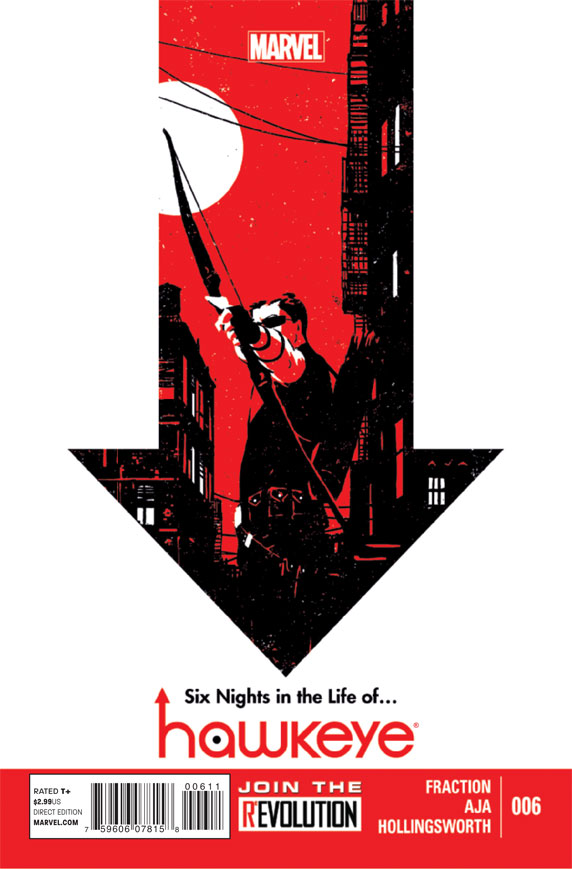
Hawkeye #6 is a stand-alone story about "Six Days in the Life of Hawkeye", a holiday tale that brings back the Eastern European "bros" from the first three issues. In a very much appreciated nod to multiculturalism, Fraction shies away from favoring any religious traditions or otherwise. Spider-Man wishes Clint a "Happy Hanukkah!", Clint's tenants celebrate a "Joyous Kwanzaa", while Clint himself greets some TV-less neighbors with a "Merry Christmas! If, uh. If that's your thing." To many, diversity is a no-brainer, but it's often difficult to pull off without sounding preachy and/or needlessly politically correct. Here, Fraction makes this feel like a holiday story, not a Christmas story, not a Hanukkah story, not a Kwanzaa story, and not even an atheist story. It's simply a fun tale about a guy under pressure during a time of year for reasons much different than the pressures you or I face every December. And while there's not a whole lot of action in this issue, Aja's stylized fight scenes balance the plethora of dialogue nicely.
Various Marvel heroes make cameos this issue, like the aforementioned Spider-Man, and Wolverine helping to foil a plan by A.I.M. Tony Stark shows up to tell Clint to give it a rest with the tangled electronics cords and just buy some new home theater equipment, and Kate Bishop drops by, naturally, to lay some reality on Clint before he makes a very big mistake. A big part of the holiday season is togetherness, and Fraction does an excellent job making it feel like Clint has real relationships with his teammates and friends, not just professional courtesy.
Some people have favorite holiday moveis they watch every year. I feel like this will be an issue I read each and every December. Hawkeye #6 is how a holiday-themed comic should be--inclusive, fun, relatable, grounded, visually appealing, and thematic to the season. Throughout the issue, Clint is pushed to be something he's not. In the end, he comes to terms with being himself and liking that person. It's a feeling most of us go through at one point or another, and the backdrop of snowy New York City nights is just so awesome. Fraction and Aja deliver with Hawkeye #6.
GRADE
9.5/10
(w) Matt Fraction
(p) Javier Pulido
Matt Fraction continues to astound this week with Hawkeye #5, the conclusion to "The Tape" which has seen Clint Barton tracking down a VHS cassette that contains extremely sensitive and classified information regarding the assassination of a political enemy of the United States government. Last issue, Clint made his way to the island of Madripoor in hopes of outbidding a cadre of super villains intent on getting their hands on something that could destroy the reputations of the US government, S.H.I.E.L.D., and the Avengers at large. For a series that has thus far been more about the fun and goofiness of comic books, "The Tape" has been surprisingly dark. There's no old school Hawkeye profile used as a censor bar, there's no pizza dog, and there's nobody overusing "bro". No, this story is about actual high stakes, and that's why it's so good.
Hawkeye #5's metafictional drama gives it a much more intentional punch than most superhero comics because the story hinges on a relatable and realistic narrative. Obviously, Fraction is likening Du Ke Feng to Osama Bin Laden in terms of what the public knows about the terrorist's death. It's the reason this story is so heavy. Fans can argue that the status quo is different after crossover events like Civil War or Siege, but if you really look at the trend, Captain America is still the leader of the Avengers, the X-Men still exist (albeit in a less organized fashion), and Thor is perennially dead/alive. There are minor changes, but not ones that would be perceptible to a casual reader or non-fan. Unlike the various fallouts from various crossover events over the years, the ramifications of this tape going public would actually change how things work in the Marvel universe -- S.H.I.E.L.D. would lose all credit as an 'international' peace-keeping entity (as well as it's funding and acknowledgements, I assume), the Avengers would be shamed and tried as political revolutionaries, and the US government would fall from grace on the global scene. This tape is extremely important.
But in true Matt Fraction fashion, things aren't always what the seem and the final few pages of Hawkeye #5 will remind you how good Fraction is at writing street-level heroes. Clint and Kate Bishop have been in a few pickles before "The Tape", but this is really the first time we get to see the two Hawkeyes in their natural state together, kicking ass and taking names. Hawkeye is one of the best comic book series currently being published and you're doing a diservice to yourself if you read comics and aren't keeping up with this book. As evidenced by most everything he's writing at the moment, Fraction is incredibly gifted at making comics easy and fun to read instead of a chore in backstory and line-wide events. This is the series to read.
GRADE
9/10
(w) Matt Fraction
(p) Javier Pulido
After three extraordinary issues, Matt Fraction missteps a bit with Hawkeye #4. The purposeful flow and nuanced dialogue that's defined the series thus far is sadly in short supply, instead replaced with a lot of internal monologue from Clint Barton. This perspective is hard to pull off in general, but Fraction manages to temper Clint's thoughts with deliberate and fast-paced storytelling that gets our cast of characters into quite a predicament.
The eponymous item from "The Tape" has gone missing from S.H.I.E.L.D. custody, and it's contents will spell disaster for Hawkeye, S.H.I.E.L.D. and by proxy the U.S. government, as well as the President. It's an amazing set-up that sees Clint tasked to the island of Madripoor to bid for the tape in an auction against a slew of villains intent on procuring and exploiting it for their own gains. Unfortunately, most of Clint's journey to a proverbial Babel proves interesting only from arms-length. Internal monologue is supposed to make readers feel more connected to the character thinking, but in this issue, it almost has the opposite effect -- it removes the reader from what's going on. Mostly, it's due to Fraction's narrative flow that takes Clint from one place to another in the span of a panel or two, so his thoughts feel disjointed and lacking in purpose. Like I mentioned earlier, I enjoyed the overall plot and structural elements of the issue, but Clint's thoughts sometimes overshadowed the narrative, and that's when this issue was at it's weakest.
The final pages of Hawkeye #4 include some epic foreshadowing to next month's conclusion of "The Tape", including the contents of the tape, those bidding for it in Madripoor, and a scheme to secure the information no matter what. It's thrilling. It's action-packed. It's Matt Fraction's Hawkeye, and you should be reading it. Even if this issue was a bit weaker than the others.
GRADE
7.5/10
(w) Matt Fraction
(p) David Aja
Matt Fraction might be at a career high point right now. He's finishing up his amazing run on Invincible Iron Man, he's taking over Fantastic Four and FF starting in November, and he's still got time to craft one of the best comic stories I've ever read. Hawkeye isn't about being Hawkeye at all. It's meant to be an homage to everything Clint Barton is or can be when he doesn't wear the proverbial mask. And it's not restricted to Clint Barton, as Young Avengers Kate Bishop (a.k.a. Hawkeye II) has appeared in two of the three current issues, making her a main character more or less. Superheroes are just people with powers and masks - Matt Fraction takes this credo to heart in his writing and it shows through his manipulation of everyday human behavior to better convey his stories.
Hawkeye #3 is not about the Vagabond code, as Marvel so ceremoniously trumpeted for weeks leading up to it's release. Just like most ridiculous events or situations that happen in our everyday lives, the Hawkeyes' life gets turned upside down when a simple trip to the store for tape turns into a high-speed car chase between a 1970 Charger and a phalanx of Mini Coopers. Somehow, Fraction and David Aja are able to convey the pacing and context of an movie-style chase, retaining all the elements that make them exciting while eliminating the huge explosions and impossible stunts.
Fraction's take on Clint and Kate put them in a more casual role. Maybe when one's in the presence of Captain America, Thor, and the like, it's harder to be loose and natural. Maybe that's why the Avengers tend to sound like they're always getting ready for a funeral or talking about expired 401-K plans. Not in Hawkeye, where Clint often screws up and Kate is there to clean it up. Of course, the relationship isn't always one-sided, but Kate definitely has herself together a lot more than Clint, even though he's far older than Kate.
This is a comic book. This is one of the more polished, meaningful examples of good comics I've read in a while. Matt Fraction has a complete understanding of his intentions and how he wants to write Hawkeye. This is a Marvel ongoing series that doesn't feature alien invasions, mutant menaces, evil masterminds, or brainwashed superheroes - this is a series about life's real problems being dealt with in way less based in reality. Acid-tipped arrows? We're not supposed to believe it's real, just that it could be, and that's awesome.
GRADE
9.7/10
 (p) Jamie McKelvie