Showing posts with label Issue Zero. Show all posts

Sunday, September 30, 2012

BATMAN INCORPORATED #0

STORY: Grant Morrison and Chris Burnham
ART: Frazer Irving

I've been pretty on-the-fence with Batman Incorporated since it started back in May. Before the 'New 52', the idea of soliciting out the Batman name seemed absolutely ridiculous - even Grant Morrison's name attached to it couldn't persuade me to believe that a character as dark, brooding, and shadowy as Batman would ever think about turning himself into a brand. The concept, to me, seemed like an idea that came from a lack of ideas. What else is there to do with Batman now except make him go global? I felt like it conveyed a lack of creativity and inability to make new stories for a character that literally died and came back to life just a year or two prior. Batman Incorporated - as I mentioned earlier, to me - represents the epitome of what DC was trying to change with the 'New 52' - overly complex stories, convoluted continuity, and a lack of direction. Sure, Grant Morrison is one of the industry's biggest and best writers, but even he is prone to slipping up every once in a while.

The clear exception to this trend is Batman Incorporated #0, an issue that lightly and interestingly gives readers the early days of Batman's quest to expand his brand across the entire planet. With the threat of the vague and seemingly omni-evil Leviathan  constantly looming, Batman is actually getting paranoid. In true Morrison style, the narrative flow for this issue is pretty frantic, jumping back and forth between locales, setting up multiple characters while giving more insight to Bruce Wayne's thought processes. We get to follow Squire and Knight, El Gaucho, Nightrunner, and others as they all vie for a spot on the most exclusive and prestigious club on the planet. And while I recognize how fun of an issue Morrison has crafted, Batman Incorporated #0 still feels a bit empty.

Morrison's grand plan for Batman has been nearly six years in the making. Starting with "Batman & Son", which introduced Damian Wayne into the fold, Morrison then moved on to launching Batman and Robin, which explored the father/son relationship between Batman and his new Robin. Eventually, Morrison moved on to the first (pre-'New 52') volume of Batman Incorporated, the third act whose name had a double meaning: 'Incorporated' because of the literal business venture's namesake, and also because the series begins to incorporate all the previous elements of story Morrison had spent years laying out. That's why the premise of BI is a bit flimsy, and that's why crafting an effective "Issue Zero" would have been damn near impossible. Had Morrison given up any more information than he did this month, major events would have been spoiled. Obviously, the threat of Leviathan is going to come directly to Batman, and maybe not so much to the Batman Inc members. If you need proof, Morrison is stepping off Batman Incorporated after issue 12, which means he'll have to wrap up the current arc with Leviathan, or DC will just cancel the title altogether.

It's becoming more and more clear that Batman's international army may not be essential to the story, acting more as lieutenants in this 'behind the scenes' war against the very essence of evil. In this sense, Batman Incorporated #0 is a letdown and a success. It let me down by offering very little in the way of story advancement - or even really any information about it at all - and with the staccato nature of the narrative. It was a success because Morrison does an amazing job focusing on the characters he's presenting, giving them developed, clear-cut personalities even if they only get a few panels of page time. So even though they probably aren't all that important in the grand scheme of Morrison's plans, the origins of Batman's soliders around the world is captivating, nuanced, and drawn incredibly well.

GRADE
B-

Thursday, September 27, 2012

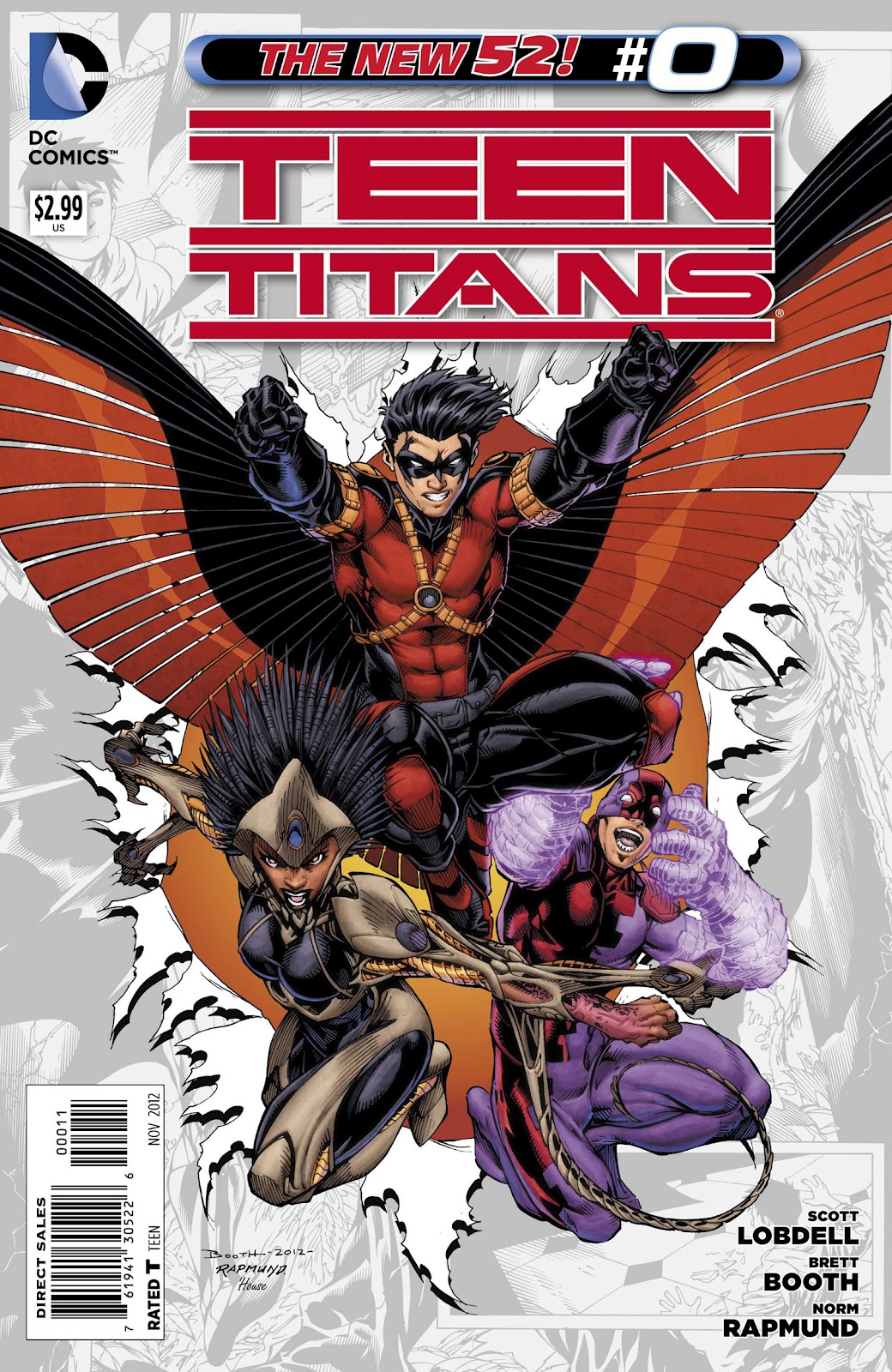
TEEN TITANS #0

STORY: Scott Lobdell
ART: Tyler Kirkham and Batt

Just like with Superboy #10, Scott Lobdell proves with Teen Titans #0 that he's not completely inept at writing the characters he's been given. For this "Zero Month" issue, Lobdell gives us the origin of Tim Drake, better known as Red Robin: former protege of Batman. A few months ago, Lobdell shocked the fan base at San Diego ComicCon by announcing that Tim Drake was never an official 'Robin' of Batman's. Instead, Tim's been Red Robin since he became a caped crusader. In essence, Lobdell majorly altered the character history of arguably the most iconic Robin of them all (at least, on par with Dick Grayson) - this was a big pill for fans of the third Robin to swallow. But putting aside comic book fanaticism, it really doesn't make that much of a difference - Tim still fills the 'Robin' roll at Batman's side, his costume is basically an all-red Robin get-up, and he eventually moves on to let another youngster take the sidekick roll. The truly interesting thing about Teen Titans #0 is how well Lobdell reinvigorates a character who was more or less a carbon copy of Bruce and Dick when he was originally introduced.

Tim Drake is now a prodigy in both the physical and mental arenas. He excels at all intellectual projects, has the potential to be on the US Olympic gymnastics team, enjoys a completely happy home life, and impresses everyone he meets...and that's the problem. After observing Tim in person, Bruce rightfully decides that Tim doesn't shouldn't be Robin. Dick Grayson and Jason Todd came into the roll of Batman's sidekick because their lives had been shattered and broken, same as Bruce years and years ago at the hands of Joe Chill. Tim Drake's life couldn't be better - he's got a bright future and his parents love him. There's literally no reason for him to be Robin. But of course, Tim has a secret obsession with Batman's secret identity.

This is where Tim goes from being a Golden Child to being a multi-faceted character who has a huge flaw: pride. After falling into Bruce's trap by following set-up clues, Tim gets scolded by the Batman who tells him to lay off and just enjoy his life. Unsatisfied with that response, Tim uses his exceptional hacking skills to steal the Penguin's fortune. If this behavior seems alarming and odd, well, it is. Tim's meeting with the Bat didn't discourage him so much as it validated his actions - Tim took the next step in his fight against crime without Batman's consent because Batman even bothered to meet him at all. Lobdell has done good work in making Tim fundamentally different from Dick and Jason before him. His pride in himself becomes his weakness. Now, this wouldn't be a Batman-related story without at least some tragedy. The hacking stunt causes the Penguin to put out a hit on Tim and his parents.

Tim's parents don't die. Lobdell avoids his pitfall and instead puts the Drakes into the witness protection program. The twist comes when Tim is left behind in Gotham - as a perceived orphan at this point - to have the chance at good and successful life he wouldn't get being forced to hide who he is in witness protection. The end result is that even though he's seen and treated as Bruce Wayne's orphaned son, Tim's parents are still alive. Somehow, this is going to tie into future stories, whether it be the upcoming "Death of the Family" crossover (which would make a lot of sense, considering the familial elements at play in this issue), or future arcs.

All in all, Teen Titans #0 is fantastic. Scott Lobdell's writing usually leaves a lot to be desired for me, as a reader and a critic. This month, though, he really stepped up his game and gave a solid origin story for Tim Drake that may not be what hardcore fans wanted, but manages to change the character enough to make him interesting again.

GRADE
B+

Friday, September 21, 2012

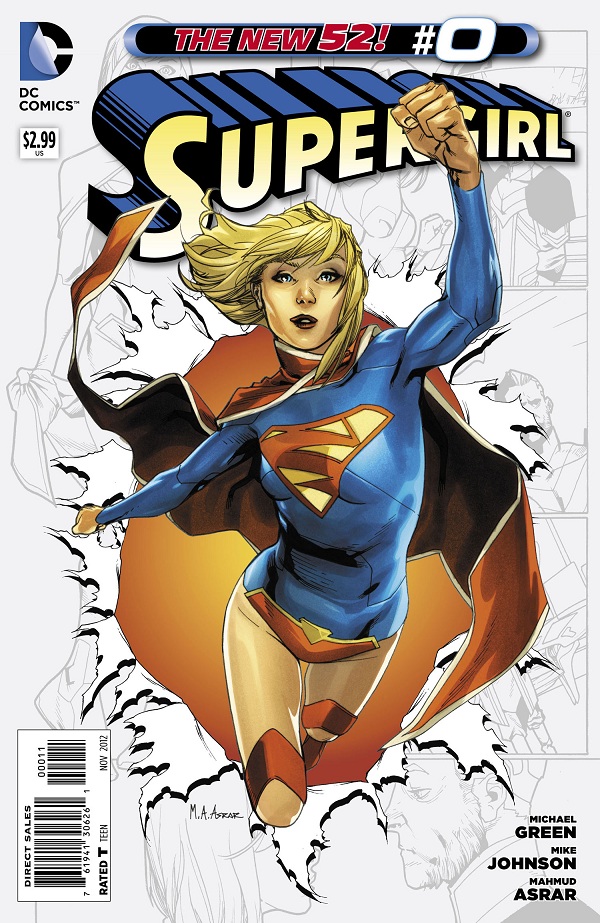
SUPERGIRL #0

STORY: Michael Green and Mike Johnson
ART: Mahmud Asrar

For as good as Supergirl has been, it's starting to become a bit long in the tooth. I know that's a heavy accusation to make, but it comes after a few months of so-so issues, this entertaining yet oddly unsatisfying "Issue Zero", and the anticipation of the upcoming "H'el on Earth" crossover between Superman, Superboy, and Supergirl. It's an odd time for this series, and it shows. Last week's Superboy #0 was a steaming pile of crap that really wasn't worth the read. Supergirl #0 manages to one-up it's male equivalent in every possible aspect, even if it wasn't hard to accomplish in the first place. "The End of the Beginning" is a misnomer, somewhat, as it's a story about the 'end' of Krypton, as well as the 'beginning' of Kara's decades-long journey to become Supergirl of Earth. In reality, it's the 'beginning of the beginning' of Kara's new life, and (arguably) the 'beginning of the end' of Krypton. Oh, diction and syntax - you've reared your fascinating little heads yet again. But enough about the grammatical technicalities of the English language.

Supergirl #0 takes readers back to Argo City on Krypton - the most advanced and prosperous city on the planet, envied by all others. Part of the city's success is attributed to Zor-El's genius power generators that provide limitless energy to all peoples of the city. Though Michael Green and Mike Johnson don't just make him come out and say it, there are heavy implications that Zor-El's generators are responsible for causing the damage to the interior of the planet, resulting in a global increase of earthquake activity. As we all know, Superman's dad - Jor-El - was the one who discovered that Krypton was dying. At first, it seems like Zor-El is just clued-in, and simply wants to save his family. After a few pages and some shifty behavior, it becomes evident that Zor is to blame for the destruction of Krypton, hoping that the force field he built for Argo City would hold against the eruption of an entire planet and earn the errant scientist his presumed redemption. Of course, part of his delusional self-fulfilling prophecy concerns making sure his daughter gets out alive.

Similar to Jor-El's ship for his son, but a lot more eggy, Zor-El places his sleeping daughter into the pod in preparation to send her off-world to orbit a yellow sun until she could be retrieved. The situation becomes a questionable again when Zor is forced to drug his own daughter to see through his plan. Green and Johnson do an excellent job portraying the slowly unhinging Zor-El as he gets closer to his endgame and loses more of his grip on reality.

In a rather surprising twist, Kara's mother - Alura - is visited by none other than...Superboy? With no explanation whatsoever (not even an Editor's Note telling me to wait until next week or anything!), the person who looks exactly like Superboy warns Alura to seek out her daughter and say goodbye. Alura arrives at her husband's lab right as he's about to close the pod and launch Kara into space. Alura shoots Zor-El and attempts to retrieve her daughter before a dying Zor launched the pod. Honestly, this was the biggest letdown of the issue, and it's a big letdown because it's the climax of the entire issue. For the past twelve months, Green and Johnson have done a great job with emotional nuance. The entire scene between Zor-El and Alura is an emotional bombshell that acts as a catalyst for the entire Supergirl series. At least, it's supposed to be.

Green and Johnson drop the ball here, and the entire sequence comes across and hollow and meaningless, mostly because we only know Zor-El as a nutjob now, and we don't know Alura at all. Sure, there are universal human stories at play here, and sometimes that's enough. Unfortunately, Supergirl #0 needed a bit more detail and characterization for a scene like this to work, and it just didn't. It's a painful end to an otherwise solid issue. I'm still looking forward to Supergirl in the future because we'll likely never have to deal with either Zor-El or Alura directly ever again, so it's of no consequence, HAHA!

GRADE:
C+


Thursday, September 20, 2012

DC UNIVERSE PRESENTS #0

STORY: Keith Giffen, Dan Didio, James Robinson, Rob Liefeld, and Tony Bedard
ART: Keith Giffen, Dan Didio, Scott Koblish, Tom Derenick, Marat Mychaels,

In true form, DC Universe Presents #0 offers an anthology of stories within an issue of an anthology series. Last May, DC cancelled six series to make way for the "Second Wave" of 'New 52' titles that included Earth 2, Dial H, World's Finest, Batman Incorporated, G.I. Combat, and The Ravagers. Some of these cancellations actually made sense - when a series didn't look to be going in any concrete direction - but some were canned purely for fiscal reasons. Either way, many of these titles gained a fan base, and DC wanted to do the cool thing and feature these characters left in the proverbial rearview mirror. With December solicitations out, the recently cancelled Captain Atom is featured in The Fury of Firestorm: The Nuclear Men, meaning DC seems intent on keeping these characters around, even if they don't have their own solo ongoing.

The first story is O.M.A.C., written and illustrated by former series regulars Keith Giffen and Dan Didio. I absolutely loved the adventures of Kevin Kho and Brother Eye - each issue was an homage to quirky, sci-fi books from the 60s and 70s that were about action and supernatural boogeymen. While this prequel story - "Origins Matter After Cancelation" - doesn't feature Kevin or his O.M.A.C. persona, Giffen and Didio take us back to when Brother Eye worked for Maxwell Lord and Checkmate. Mostly, Brother Eye gives Max an expository dump about how the satellite came to be and why. Of course, Max knows all of this, and info overloads normally make me cringe, this is Giffen and Didio's style for O.M.A.C., especially since this is only a short story intended to give more backstory that offers foreshadowing to future events. In that regard, it succeeds in spades.

Second at bat is James Robinson and Tom Derenick's Mister Terrific prequel. In essence, this short story reads just like the MT series - full of scientific jargon, quantum mechanics, and a willingness to let those two amazing elements do the heavy lifting. Especially in this story, wherein Michael Holt basically learns everything about his life by jumping through an uncalibrated portal technically linked to the Ninth Dimension. Robinson is careful to remind readers that this is one of many possible outcomes, leaving the door open for Michael's future to deviate from the visions of latter days. Of course, Mister Terrific can't be running around knowing his entire life's path, and Michael's memory is purged once he steps out of the malfunctioning portal door. I wish there was more about Michael Holt as a person and less foreshadowing for the future that only really served to clue in us readers. But for what it is, this tale does the trick.

I've never liked Rob Liefeld. Even in the 90s, I couldn't stand his artwork or his writing. It's one of the reasons I stuck to DC mostly during that era, and it's the reason I never got beyond the first issue of Hawk and Dove last September. Hawk and Dove is an example of a series cancelled because it was bad, plain and simple. The characters weren't engaging, the stories weren't interesting, and the artwork was classic Liefeld, which meant over-exaggerated everything. Liefeld smartly abjures the pencilling duties for this origins story, but it just makes his uninspired narrative all the more obvious. "Balance of Power" focuses on an argument between the celestial gods of Peace and War (how DC justifies their existence against the Greek gods in Wonder Woman is anyones guess) over the newest avatar of Peace, Dawn Granger. Similar to how Scott Lobdell info dumps on a regular basis in the pages of Teen Titans, Liefeld uses this debate between the gods as a means to give a character history. It's so damn boring! And it really doesn't even matter because I can't imagine DC is planning on reintroducing Hawk and Dove to any other book any time soon.

Next up is "Mother Machine", the origins story of the title's namesake, and prequel tale to Blackhawks, a series that could have been DC's equivalent of S.H.I.E.L.D. if they had handled it better. Unfortunately, there's not much to talk about concerning this story - beyond revealing that the Blackhawks participated in the battle against Apokolips' armies, this is all about Mother Machine coming to be. Everything makes a bit more sense now, as it's obvious Mother Machine came from an Apokoliptan Mother Box. The ending tagline says we'll see more of Mother Machine in the future, which could spell the return of Darkseid.

The final story about Deadman comes from Tony Bedard and Scott McDaniel, both of whom do a fantastic job telling the tale of Boston Brand's first mission of possession. In a cruel twist of fate, the goddess Rama sends Boston to save the soul of the man who murdered him. Of course, Boston rejects his task until he's forced back into the situation and winds up saving the day anyway. It's a telling moment for Brand, the moment he recognizes that his actions have consequences, not only for his own well-being, but also for those he's charged with helping. Deadman doesn't get enough page time in Justice League Dark, though I supposed I should be thankful he's a recurring character at all. Bedard's "Instant Karma" reminds one of why the first five issues of DC Universe Presents are still the best.

As a whole, DC Universe Presents #0 is a good read. As individual stories, the tales about O.M.A.C., Mister Terrific, and Deadman are considerably better than those about the Blackhawks and Hawk and Dove. Read them all, or just read the ones you want. It's kind of up to you when it comes to an anthology format such as this. I only read one issue of the "Challengers of the Unknown" arc because it just wasn't my cup of tea. But I jumped right back in with "Savage", then regrettably "Kid Flash". DC Universe Presents #0 is definitely worth the buy, if only for the fact that you get five stories from five different creative teams at a whopping 48 pages.

GRADE
B-

Wednesday, September 19, 2012

JUSTICE LEAGUE #0

STORY: Geoff Johns
ART: Gary Frank

Before the reboot, Billy Batson was the world's most perfect kid - he listened to his parents, did his homework, was kind to everyone he met, and generally didn't have a bad thought in his head. It was for this sterling character that Billy was chosen to be Captain Marvel, the scion of the wizard Shazam. And even though the Captain saw his fair share of evil throughout his adventures, Billy never stopped being that perfect little boy. Now, in the 'New 52, he's a brat and a jerk - he can't seem to get along with anyone, and he actively works against others whenever he can. A lot (and I mean a lot) of comic book news outlets have painted the recent Shazam back-up stories in Justice League as a terrible reintroduction to one of DC's most iconic and long-lasting characters. On the contrary, I think it's one of the wisest and most interesting changes made yet.

The 'New 52' is supposed to be about making things new, and what better way than to make the most unrelatable character in the DC universe just a bit more realistic? While many long-time comic book fans want to hold their beloved characters in a time-lock - never allowing for them to grow or change - it's a pipe dream, and one that the hardcore crowd is going to have to get over as comic books continue to move into newer, bolder territories. Similarly, some Marvel fans are up in arms about a book with the title Uncanny Avengers that features Rogue and Thor on the same team. So what?

As you guessed, Justice League #0 focuses on Billy and his transformation into Captain Marvel Shazam. Yes, this is the second big change to the character: Captain Marvel is now called Shazam, and the wizard once called Shazam is now simply "The Wizard", as there don't seem to be too many of them running around. I guess DC just got tired of lording the trademark over Marvel's head. Either way, it makes a lot more sense to call the superhero Shazam - there wasn't any real reason for the name 'Captain Marvel' in the first place.

I really do love Billy's new personality. He's an orphan whose been forced to grow up much faster than he should have. It's a sad but real problem in the world, today, that more and more children are made to raise themselves. The silver lining, of course, is that Billy understands the world much more than most other 15 year olds, and he proves it. The Wizard has been searching for centuries to find a "purely good" person on which to bestow his powers, only to come up empty-handed. "No one is pure good," explains Billy to a baffled, millennia-old wizard. Billy sees the situation for what it is: an over-romanticism of a certain, unattainable goal that would solve every problem ever and bring peace to mankind. The Wizard wants so much to believe that there must be a person who is pure good, that he's wasted eons searching for it, even though it doesn't exist. Quite eloquently, Billy goes on about bad encompassing the good in the world, no matter what. And while it seems that young Batson might be without hope, the Wizard looks into his soul a second time and finds the good buried beneath layers and layers of bad. In the end, it is the potential for good that will defeat the evil.

Gary Frank's art is fantastic. His work in the "Shazam" back-ups was good, but it feels like he put extra time and effort into these pages, as they feel more emotional, more vibrant, and more expressive than ever. His facial expressions are pure genius - Billy's being the obvious best - but he also knows how to draw bodies to convey an idea. The Wizard's slouch gives you the feeling he has been burdened by so much for so long that his guilt is literally crushing him.

Justice League #0 was a gamble. For a general public that doesn't read a lot of comic books, making this "Issue Zero" a Shazam-only story could be bad for the bottom line. Literally nowhere in theses pages are the actual Leaguers featured. Johns and Frank dedicate this issue to Shazam, giving him a damn fine introduction as he gets ready to join the League proper starting in 2013. Before the reboot last year, Captain Marvel was always the boy scout, more so even than Superman. He never erred, rarely faltered, and was liked by all. He was a bit more sickeningly perfect than Superman, which was hard to do. Now, we have a dynamic character who actually has depth, who really does have a reason for acting beyond a surface-level desire to uphold truth, justice, and the American way. Now, we have a real Shazam.

GRADE
A

Friday, September 14, 2012

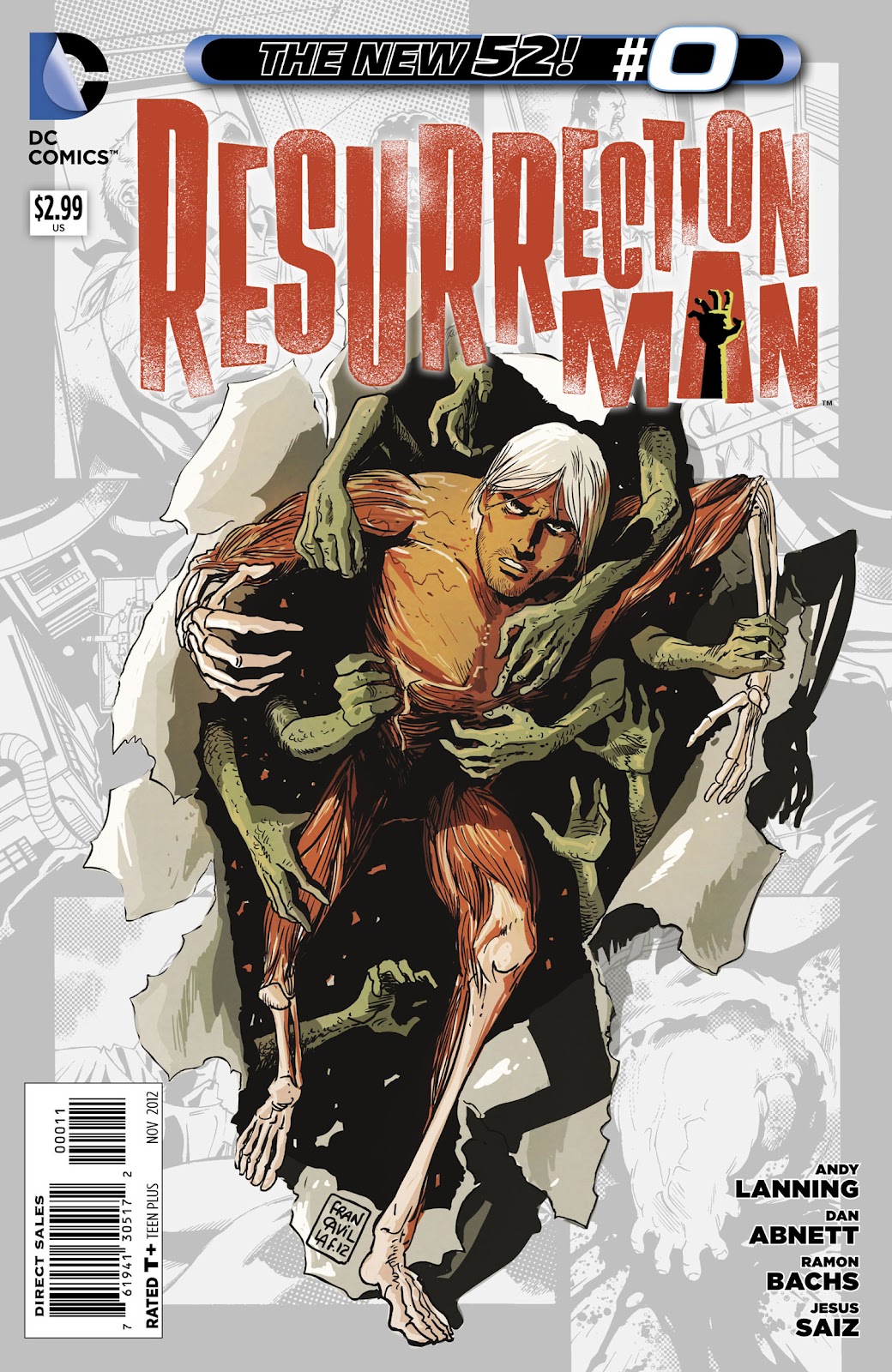
RESURRECTION MAN #0

STORY: Dan Abnett and Andy Lanning
ART: Ramon Bachs and Jesus Saiz

Mitch Shelley is a huge ass. At least, the real Mitch Shelley. Not the Mitch Shelley we've been following over the past 13 months. Last month, it was revealed that the main character of Resurrection Man was actually a clone of the true Mitch Shelley, who it turns out is the evil mastermind behind the entire series' worth of criminal activities. It was an eloquent - if not slightly sadistic - way to technically end the series. Dan Abnett and Andy Lanning were given this chance to explain things a bit more with Resurrection Man #0, and thus the issue gives readers a more comprehensive historical account of the real Mitch Shelley, as well as the events that led to the creation of "Resurrection Man" Mitch Shelley. The biggest shortcoming of this "Zero Issue" is that Abnett and Lanning seemed to have planned for Resurrection Man to continue, as foreshadowing and set-ups for future plot lines are littered throughout these pages.

For the same reason I've had a love/hate relationship with this series for the past few months, Resurrection Man #0 ups the ante by continuing to be one of the best titles from DC's 'New 52' even though this is the very seriously final issue. I tried to not get too attached to this series, as I knew the adventures of Mitch Shelley would soon be coming to an end. It didn't work, and just like the frustration of watching Firefly after it had been cancelled, I found myself upset that a series this good was so underrated. Honestly, I was holding out for a last-minute renewal, similar to Community's miraculous fourth season (SIX SEASONS AND A MOVIE!).

The plot of Resurrection Man #0 would seem straightforward enough. Fortunately, Abnett and Lanning don't take the easy way out, instead opting to make this origin story as wacky and sci-fi as possible. The first thing we're made to understand is that Resurrecting Mitch's memories were actually Proto-Mitch's memories. This means that it was the jerk-wad Mitch who was in the Middle East with Deathstroke and Hooker five years prior. This also accounts for all the other horrible flashbacks Living-and-Dying Mitch would have about his "past". At some point in Iraq, O.G. Mitch is badly wounded then attacked by some fish monster thing and injected with the tektite solution - a self-healing agent -  which becomes the catalyst that starts the proverbial ball rolling. To save the rest of his horribly wounded team, Mitch Sr. orders the tektite solution used to treat all of them. This is how Director Hooker receives his powers, as well as the Body Doubles.

In the hoopla of the explosions that cause all the harm, the Original Mitch Shelley loses his arm. Even with the tektites flowing through him, the reattachment is unsuccessful. Shelley orders his dead arm incinerated to keep the tektite solution out of enemy hands. But as Jeff Goldblum said in Jurassic Park, "Life finds a way." The tektites survive the incineration and escape through the smoke into nature where they instinctually sap all surrounding matter to 'resurrect' Mitch Shelley from the blueprint of his DNA grafted onto them. It's a bit complex, a bit high-concept, and is just plain cool. The tektites simply reconstitute Neu-Mitch whenever he dies in the same fashion, giving him a new power each time in the process.

Resurrection Man #0 also looks toward the (now nonexistent) future of the series. Who is the fishy-man who injects the first Mitch with tektites originally? How does Deathstroke's involvement with Mitch Shelley connect with his time with Team 7? How will Mitch make amends for the terrible crimes of his source material? Where does Kim Rebecki fit into all of this? And why is the Devil being set up to become a major character? Alas, it's highly unlikely any of these questions will ever be answered, unless Mitch joins the Justice League Dark or something. (Hint, hint, DC.)

GRADE
A

SERIES GRADE:
A+

Thursday, September 13, 2012

BATMAN #0

STORY: Scott Snyder
ART: Greg Capullo

It truly is astonishing how good Scott Snyder is on Batman. He has such an fantastic hold on the character - as both Batman and Bruce Wayne - that anything he writes seems so natural, so organic in it's flow and content. This is the 'New 52', and as such, it's not uncommon for things to feel awkward and out of place. Not Batman, though. While Snyder's epic "City of Owls" mega-arc spanned the first year of the title (not to mention most of the other Bat-books for a month in May), it was hard to gauge how this title could read on a less cerebral level. That is, could this Batman be personal, or would it continue to be Snyder's outlet for the more sensational Batman stories? While last month's "Bat Box" issue was incredibly satisfying, I truly missed Greg Capullo's artwork, which comes back this month, making Batman #0 the best of the two non-Owl themed issues yet.

I'd like to reiterate how great Scott Snyder is at writing this title because last week, I wrote in my review for Action Comics that there seems to be a few distinct types of "Zero Month" issues: the ones that gave a semi-comprehensive origin story (i.e. - Stormwatch, Animal Man, The Phantom Stranger, etc.), the ones that only focus on a particular episode from the past (i.e. - World's Finest, Earth 2, Action Comics), and the increasingly rare ones that find a way to balance both sides into a solid issue that offers some revelations into how things began, but don't resort to grand history lessons each page.

Batman #0 falls into this third category. Without an actual new origin, the writers of Batman books had to find new ways to exploit "Zero Month" - they don't get the luxury of rewriting history. In Detective Comics, we met Bruce's final teacher before he returned to Gotham. In Batman and Robin, we get a history of Damian's upbringing in the League of Assassins, and in Batman, we get Snyder's take on Bruce's earliest days fighting crime in his home city. He isn't Batman yet, and in fact, Bruce has moved him and Alfred from the mansion into Crime Alley because, "this is where I have to be, Alfred. This is where my war begins." It's a technically appropriate sentiment, but one that seems childish, even to Alfred at that moment. "And how is that war going so far, sir?"

In a surprising bit of fan service, Snyder has resurrected the original Red Hood! Yep, before Jason Todd took that moniker and built himself a cool looking red helmet, another villain had that name, albeit with a lot less swagger and talent. In Batman #0, the original Red Hood shows up with his gang to rob a bank and soon enough, he realizes that Red Hood Five is an impostor. In fact, it's Bruce Wayne trying to put a stop to criminal activity before taking on the cowl. Again, it seems childish and less thought out than we're used to from Bruce Wayne. But that's kind of the point of this issue, isn't it? Readers get a glimpse into how Bruce stumbled around before truly understanding who he was and how to fight the darkness spread throughout Gotham. This is an issue about uncertainties and how that leads to failure.

The only part of this issue that felt forced was the conversation between Bruce and Jim Gordon. After being back for three months, Bruce has moved himself into the most dangerous part of Gotham and hasn't been seen living the high life like all the other billionaires. Add to that sightings of a vigilante attempting to take the law into his own hands and Gordon begins to have a pretty good circumstantial case against the current Mr. Wayne. Of course, it's just that - circumstantial. In the end, Bruce denies everything and Gordon seemingly believes him without much of a huff. It feels like this is supposed to be Gordon eliminating Bruce Wayne as s suspect of being the vigilante (and eventually, Batman), but it feels cheap. If all these elements were adding up and equaling Bruce Wayne, what was stopping Gordon from looking into it further? The word of an insanely rich trust fund baby who just went missing for six years and now lives in Crime Alley? It all just seems a bit too much to suspend disbelief.  I understand that often, a comic book world is simply more fantastical than ours, but simple human deduction would have eventually led Gordon back to Bruce. Of course, there's always the possibility that Gordon just assumes Bruce is Batman without ever actually revealing his true thoughts.

Batman #0 does a fantastic job giving readers a history without being boring or unimportant. Batman-related books could have suffered terrible setbacks with these "Zero Month" issues. Instead, Snyder is leading the pack in terms of quality and type of story that should be told. Us readers already know how Bruce's parents died and how he becomes Batman, so these issues should be more about building up a world that leads into the present day, and Scott Snyder has done this in spades.

GRADE
A-

Wednesday, September 12, 2012

SUPERBOY #0

STORY: Tom DeFalco
ART: R.B. Silva and Rob Lean

I don't know what to think anymore. I know that's a pretty bold statement to make, but seriously, I'm all but out of reasons to continue reading Superboy. Since the beginning, the Boy of Steel's story has been one muddled, under-developed narrative after another with no discernable connecting factors. Superboy himself is a two-dimensional character whose only character development has come from sloppy inner monologue penned by a writer who doesn't know how to write as a teenager. Add to that plot lines riddled with obtuse, vague advancement, and a reliance on shock value to sell a complex story. Of course, there's always an exception to the rule, and Superboy #10, back in June, was a refreshing change of pace from the constant threat of N.O.W.H.E.R.E., the secretive criminal organization who manufactured Superboy, and acted as the 'big bad' for the first nine months of the title. Unfortunately, after that one month, Superboy descended back into mediocrity.

In Superboy #0, writer Tom DeFalco brings back N.O.W.H.E.R.E., for reasons that seem obvious at first, but slowly become incessantly annoying and unimportant. Harvest makes his unwanted return to the 'New 52' as he tells a story about the clone uprising on Krypton eons ago. Yes you read that right: this issue prominently features a villain telling a story.

It. is. so. boring.

Without any sort of backstory or identity, Harvest is already a boring villain because his motivations don't have meaning. Readers don't know why he's doing any of this, so it's not interesting. It's the same reason children's cartoons often feature mad villains who simply want to "take over the world." - they tend to not have a concrete reason for their actions, allowing for a range of stories. But they're intended for children. I expect a bit more from DeFalco and DC in general when it comes to one of their semi-flagship characters.

Harvest's tale is about Kon, the first clone on Krypton to rise up against his creators. Eventually, he starts a violent revolution against the Kryptonians, resulting in a defeat and the extermination of all clones planet-wide. It's an interesting enough story, but it's presentation is just so lazy it's hard to get past the fact that we're literally being read an alien fable. I can think of at least five different ways issue could have gone that would have effectively conveyed the ideas without stooping to the most basic and frustrating of storytelling styles.

In the end, not much is revealed in the way the origins of Superboy. Sure, the tale of Kon and his bloody rampage against his makers could foreshadow future events, but as a stand-alone issue, this one falls so short of good it's hard to put into words. As I flipped through the issue upon initial purchase, I pondered for a moment if perhaps Harvest was a Kryptonian clone looking to restart his revolution. It got me excited to read the issue, thinking DeFalco would actually make some connections and give me something to hold onto going forward. The opposite happened: I was so let down by this issue that I don't even know if I want to continue reading Superboy.

Good luck going forward, DeFalco.

GRADE
F

Thursday, September 6, 2012

THE PHANTOM STRANGER #0

STORY: Dan Didio
ART: Brent Anderson and Scott Hanna

And just like that, The Phantom Stranger became one of my favorite series. While DC (I still say unjustly) cancelled the phenomenal Resurrection Man - a series rooted in classic, episodic storytelling that slowly built up a genuinely interesting character - it has replaced that series with tales of the Phantom Stranger in the able hands of Dan Didio, a man who wrote O.M.A.C. so well it was literally too good for most readers. Out of the pages of The New 52 #1, Didio brings us the exploits of the most enigmatic member of the "Trinity of Sin", and it is so, so, so good.

The Phantom Stranger was always a mystery. But unlike so many other characters shrouded in misdirection and facades, Phantom Stranger existed on his own level - his actions, his reasons, and his meaning were all unknown. He would appear seemingly out of nowhere, and act upon his own, unexplained predilections without notice. Truly, he was a stranger in a comic book universe where (almost) every character eventually gets a backstory, whether it's necessary or not. The Phantom Stranger fully takes advantage of the 'new' part of the 'New 52', offering a definitive origin, more fleshed-out character development, and an all-around kick-ass time.

Religious symbolism is an ample well for storytelling, and in the opening pages of The Phantom Stranger #0, it becomes pretty obvious that the Stranger was once Judas Iscariot, the man who betrayed Jesus Christ of Nazareth. Dan Didio deftly handles this symbolism, taking care to never mention either the Stranger or Jesus by name, but instead through Judas' suicide attempt and looming fate. "You are beyond forgiveness," a council of wizards explains to poor Judas (yes, a council of wizards. Though they all happen to resemble Shazam, suggesting a connection in future issues.) "Your greed has forever darkened the world." - it's enough to get the point across without sounding preachy. Didio understands that symbolism is just that: symbolic.

Judas is then cursed by the Band o' Wizards to wear a necklace made of coins, wear Jesus' robe, and walk the Earth for eternity until he's called upon again. While it seems like there's a lot to take in all at once, this is 'Issue Zero'. The whole point of the prequel issue idea is to offer a more comprehensive explanation of a certain character, in most cases through a look into the events that take place before the first issue. With The Phantom Stranger, we're literally given the entire origin of the character to the extent that we need it. Obviously, we don't need to know Judas' pre-judgement history because another book already took care of that. Didio tells us everything we need to know: who the Stranger is, how he came to be, why he does whatever he does, and where this series is going as it moves forward.

I was honestly quite skeptical of DC's "Third Wave", as two of my favorite series (Justice League International and Resurrection Man) were cancelled to make room for new titles. But after reading The Phantom Stranger, I feel better about the other three upcoming series. Dan Didio knows what kind of writer he is, and he recognized that his full-blown style (as presented throughout O.M.A.C.) was too much. For The Phantom Stranger, Didio reels in his bombastic style just enough to make the series more accesible to a larger audience without sacrificing the pulp and charm that make his writing so good.

GRADE
B

Wednesday, September 5, 2012

EARTH 2 #0

STORY: James Robinson
ART: Tomas Giorello

"Zero Month" is the DC's design to give readers a bit more history to the characters this company revamped just one year ago. The idea is to bring us stories from before issue number one; a simple premise that already doesn't hold true to some titles (like Green Lantern, Green Lantern: New Guardians, etc.) Of course, there are titles that are taking full advantage of this chance and going all-out origin (like The Phantom Stranger and Stormwatch). Then there are titles like Earth 2, which are simply telling select tales - not really making (apparent) connections to the present day, but also not giving a full history lesson.

In James Robinson's Earth 2 #0, we're introduced to Terry Sloan, a.k.a. "Mr. 8", the eighth 'wonder' who protects Earth after Superman, Batman, Wonder Woman, Supergirl, Robin, Catwoman, and an unnamed seventh (who actually becomes my most persistent question throughout the new mysteries this issue brings up). It's not exactly clear what Sloan's abilities are, exactly. Does he have powers, or is he just a high-tech badass? I read the issue as the latter, assuming he was just a government-sanctioned ally of the 'Trinity'.

I was a bit disappointed with Earth 2 #0. I was expecting a bit more insight into Superman, Batman, and Wonder Woman, while instead I got a mission that doesn't really give any insight into any of them except that there are multiple ways Kryptonite can be manipulated to have varied effects on Superman. Other than that, this issue is solely about Sloan's still-shrouded-in-mystery endgame.

Of course, that process starts in E2 #0 - set six years in the past - as the Trinity and Sloan infiltrate an Apokoliptan mind-control broadcasting machine. In a nod to Darkseid's pre-'New 52' inclinations, the mind-control is based on a psychological implosion achieved through the ant-life equation. After arriving at the core of the machine, Sloan deceives the Trinity, uses synthesized opal Kryptonite to drive Superman insane, and starts rambling about those under the anti-life equation's control are "...beyond salvation. So I will destroy them." Even after a bomb blast care of Batman, Sloan gets up - albeit with hundreds of shards of glass sticking out of him - and activates a chain reaction that detonates the four anti-life machines around the globe. In a stunning panel by Tomas Giorello, the massive explosions shoot out from the Earth's surface as our planet begins to resemble Apokolips - a chilling notion if there ever was one.

A few more tidbits are revealed about Earth 2 in general, as well this issue. As I mentioned earlier, Kryptonite is much more maleable in this dimension, perhaps due to Robinson's claim that Earth 2 is rooted more in the mystical and supernatural than it's New Earth counterpart. We also learn that the war with Apokolips has been raging for a long, long time, and that the 'wonders' of Earth 2 are more like a task force than a god-like collective entity. Granted, they're up against an army that would put the range of heroes in the main DC continuity to shame, as well.

A big revelation in Earth 2 #0 is the existence of an extensive multiverse! It's interesting that DC would green light this idea, as the pre-'New 52' continuity was marred by decades of multi-dimensional history and crossover, and one of the major points of the relaunch was to consolidate these infinite universes. It's hard to get excited for a multiverse again. Really, it is. Introducing Earth 2 was a fantastic idea because it would not only bring back the Justice Society, but also provide an easy and straightforward approach to multiple dimensions, while mirroring ideas pioneered in the 1960s and 70s that culminated in Crisis on Infinite Earths in the mid-80s. While it was implied that the former level of chaotic transdimensional shuffling wouldn't be a problem this time around, Terry Sloan escapes to the "Ninth Dimension", meaning that there are a possible nine different universes now open to writers, technically. It's frustrating and unnecessary.

The 'New 52' is still young, and this new continuity needs time to come into it's own as an established universe with diverse, interesting, developed characters in a rich, vibrant world. Robinson's venture in Earth 2 is fantastic, but the introduction of a new multiverse is really, really annoying.

GRADE
C+

Tuesday, June 12, 2012

(FEATURE) NEWS, NEWS, & MORE NEWS!

It figures that the weekend I'm out of communication with the civilized world - sleeping in the fields of Manchester, Tennessee and attending four straight days of nigh-constant music - the comic book world gets bombarded with news concerning cancellations, new titles, and anniversary events! Well, here's a little rundown of DC's weekend activities and how they will affect "The Endless Reel"


'NEW 52' THIRD WAVE & ZERO ISSUES ANNOUNCED

Announced this weekend, September will be see every title under the 'New 52' banner receive their very own "Issue Zero" to commemorate the anniversary of DC's imprint relaunch. Every issue will get a 'Zero' issue in September, continuing with their 13th (or 5th, in the case of 'Second Wave' titles) issue in October. DC has also announced FOUR new series being added to the 'New 52' lineup, bringing the total number of titles to a whopping 55, seeing as Justice League International will be ending in August, with an Annual issue in September.

The first new title is Talon, a spin-off from Scott Snyder's Batman that will feature Calvin Rose, the only assassin to ever escape the Court of Owls. Snyder's work on Batman over the past year has been phenomenal and the Court's influence over Gotham is a vast entity that's only been scratched at the surface. Hopefully, Talon will be as good as Snyder's current work, though it will be written by co-plotter James Tynion IV. Second is the Dan DiDio-helmed Phantom Stranger, a character we were only offered a glimpse of in this year's Free Comic Book Day issue, The New 52 #1. The Stranger's connection to magic seems more overt in the 'New 52' universe, but his mystery will most likely be just as enigmatic and tight-lipped as before. Sword of Sorcery will be DC's newest mystical jaunt with a fan-demanded "Amethyst: Princess of Gemworld" tale coupled with a "Beowulf" back-up story by Tony Bedard with art by Jesus Saiz. "Amethyst" will be written by Christy Marx and pencilled by Aaron Lopresti, whose work on Justice League International has be great for it's entire run. Finally, Team Seven will merge the DC and Wildstorm universes even further with an - obviously - team-based series set in this universe's pre-superhero days with characters like a young Steve Trevor, Dinah Lance (Black Canary), Amanda Waller, a pre-Grifter Cole Cash, Alex Fairchild, John Lynch, and the Deathstroke: Slade Wilson. T7 will be written by Justin Jordan with art by Jesus Marino.

Come September, I'll be covering all "Issue Zero"s for Talon, Sword of Sorcery, Phatom Stranger, and Team Seven to determine which series (or two) I'll add to the list of regularly scheduled coverage in October. Based on page hits and '+1's, I'll make a decision.


GREEN LANTERN #0 TO POSSIBLY INTRODUCE ARAB GL

In DC's Free Comic Book Day offering this year, The New 52 #1, the final pages of the issue revealed a massive fight between some of the most iconic characters from the 'New 52' so far, along with an array of reintroduced characters like Elemental Woman (from Flashpoint), Black Adam (supposedly), the Atom, Vibe, as well as a mysterious new Green Lantern that seemed to have darker skin.

Now, with promotional art from Green Lantern #0 coming this September, we can see this new Green Lantern busting through the cover with an Arabic phrase tattooed on his right arm. Roughly translated to courage, bravery, or fearless - appropriately - the tattoo marks a second drive toward diversity for the Green Lantern brand in less than a month, considering Green Lantern Alan Scott's announced sexual orientation. While this new GL's first image also has him brandishing a handgun for some reason, it's safe to say DC isn't looking to make one of it's most iconic and famous characters a 'bad' person in any way. But everything is relative, and next year's promised "Trinity War" event seems to be part of this new GL's story.


DC CANCELS THREE MORE 'NEW 52' TITLES

After announcing four new titles being added to the 'New 52' lineup, bringing the total to 55 starting in September, DC quickly announced, just today and only one two days after it's initial announcement, the cancellation of three more titles on the heels of Justice League International in August. While they will still receive their "Issue Zero"s, Captain Atom, Resurrection Man, and Voodoo will all end in September, making way for the 'Third Wave' titles. While all three titles were performing poorly, Resurrection Man is a featured title here at "The Endless Reel" and will be missed, along withe Justice League International. Both JLI's Annual issue and Resurrection Man's "Issue Zero" will be covered here in September to give them proper send-offs.

In cancellation-related news, Dan DiDio did also announce that DC Universe Presents #0 will feature the Blackhawks, Hawk and Dove, O.M.A.C., and Mister Terrific, all characters whose series were cancelled during the 'Second Wave' back in May. This shows that DC is committed to it's characters, even if their series don't work out. This means that, hopefully, we'll see more of Mitch Shelley and the JLI in the future, somewhere in the pages of the 'New 52'.