Showing posts with label Red Robin. Show all posts

Sunday, May 26, 2013

Teen Titans #20

Where does one find such a stylish bucket to wear?
(w) Scott Lobdell     (a) Eddy Barrows and Patrick Zircher

Scott Lobdell never ceases to confound me.

Why is Red Robin on the cover wearing a weird bucket helmet and acting like a super villain? Maybe it would make sense if RR was acting out of character for more than a single panel per issue. I think Lobdell truly believes that the readers of Teen Titans understand what's going on from issue to issue, so he doesn't feel the need to actually explain things like Red Robin being an enemy on the cover. Or why Psimon is around at all

Now, the cover being a total misdirect is somewhat forgivable because that's simply an industry-wide problem, not specifically a Lobdell one. But the cover conveys the idea that Red Robin is not himself, that there's someone or something pulling the strings of his mind and, thus, manipulating the Titans in some way. As I mentioned earlier, prior issues have reduced this confusing (yet seemingly important) plot string to a single panel, hoping readers wont forget very forgettable events. Teen Titans #20, however, features Red Robin on the cover, standing over a defeated team of Titans, and sporting some retro-looking, glowing red eyes.


Is there any insight to this change in RR? At all?

No.

None.

About one third of the way in, Lobdell decides it's time we all learned about Trigon and his family of demons by way of a shoehorned history lesson from Trigon himself...talking to his sons. Doesn't sound too odd, does it? Except that why would Trigon be explaining his life and intentions to his OWN CHILDREN!?!?!?!?! There's no reason for ol' six-eyes to wax poetic to his own kin because they already know who he is. I feel like I shouldn't even need to say these things, like Lobdell is purposely going out of his way to make this comic book series nigh unreadable.

Teen Titans #20 is a joke. It's just another issue in this series that depresses me. I think back to the days when Geoff Johns wrote Teen Titans, and I wonder what that Superboy and Wonder Girl would think of their aimless 'New 52' counterparts. Lobdell has eroded almost anything that made these characters likable, sacrificing any modicum of relatability in the name of ridiculous plot advancement.

GRADE
3/10

Monday, April 29, 2013

Teen Titans #19

(w) Scott Lobdell and Tony Bedard     (a) Eddy Barrows

I don't even know where to start.


** SPOILERS AHEAD **


What a mess of an issue. Seriously. Was Scott Lobdell just trying to throw everything that came into his head directly into Teen Titans #19? It's got the full team (minus Skitter, whom I'll remember but Lobdell certainly wont), plus appearances by Psimon, Raven, Beast Boy, and the evil demon, Trigon. Yes, it makes sense for Raven to be floating around seeing as she's Trigon's daughter, but beyond that, nothing in Teen Titans #19 has any semblance of cohesion.

Let me back up.


The ONLY good part about this issue is the revelation that Wonder Girl's father is none other than Lennox from the pages of Wonder Woman. It makes sense, and it finally makes a decent connection between Cassie Sandsmark and the Olympians. But it's only one panel, and it's not really a revelation because Cassie can't see Trigon's imagination. So basically, the audience now knows who Cassie's father is (if you've been reading Wonder Woman and shame on you if not), thereby achieving some fairly freshman-grade dramatic irony.Oh-la-la. Also, Scott Lobdell's inexplicable obsession with inner monologue is tempered quite a bit by Tony Bedard's co-scripting. Thank you, Tony.

Now let's talk about the bad.

First, we get a guest appearance from Beast Boy after the events of The Ravagers #12. For those of you who haven't read that particular issue, don't worry; it hasn't been released yet. So basically, disregard Beast Boy because his inclusion is based on events that haven't technically taken place yet, and he's not all that important to the story anyway.

Next, let's talk about Psimon. He's was a B-list villain (at best) before the 'New 52', but now, he's more like a flunky because Scott Lobdell has turned him into a sniveling, angst-ridden teenager who gets pouty when everything doesn't go his way. I suppose in an unintentionally metafictional sense, Psimon is a great interpretation of a teenage super villain, but that doesn't change the fact that he's just an asshole and all I wanted to do was get past any time he was in-panel. Oh, and there's a part where Beast Boy and Psimon battle until their powers "cancelled each other out" which makes no sense because one has mental psychic abilities while the other has physical shapeshifting. In what world do those two things coincide? My brain hurts.

None of this is to mention Scott Lobdell's dialogue, which I (think I) know is his because it's so much more awkward sounding than the stuff Bedard wrote. Like when Kid Flash is a huge prick after saving Superboy and says, "The words you're looking for are 'thank' and 'you'!" It's a minor complaint, but when has Kid Flash ever used more words than necessary? He's a speedster that gets things done quickly. Or the gem from Raven; "Why do humans visit such harm upon their children?" Well, first off, that's terrible diction. Visit? Sure it works, but it just sounds really dumb. And that's not even taking into account that fact that humans, technically, really didn't do any of this to these kids. It was Harvest, REMEMBER?!?!?! So why is the human race being judged?

Teen Titans #19 is another issue of terribleness from Scott Lobdell. Tony Bedard's co-scripting helped out, but there's little to be achieved by putting duct tape on a giant engine made of random parts that barely works and is constantly on the brink of completely falling apart.

Oh, and Red Robin is still being a huge dick for no reason whatsoever.

GRADE
3/10

Thursday, March 28, 2013

Teen Titans #18 (mini review)

(w) Scott Lobdell     (a) Eddy Barrows

Holy God. 

Seriously. 

Words might not be enough to describe just how much I loathe Scott Lobdell's Teen Titans. The man has single-handedly decimated years of amazing character development from Geoff Johns and others that made the Teen Titans one of DC's best books. 

Teen Titans #18 is so full of terrible, I basically stopped reading after the first half. It took everything in me to continue reading, and I was upset the entire time. Nothing about this issue is good. Tim's super awkward semi-psychotic breakdown over Damian Wayne's death is just god-awful. He just yells at a nonexistent Damian before Alfred finds him hugging nothing. If I were Alfie, I'd be calling Arkham.

Then we get the weird reuniting of the Teen Titans wherein Superboy continues to act like a complete dick to the surprise of no one. What did surprise me was that Scott Lobdell, once again, felt it necessary to reference N.O.W.H.E.R.E. It's infuriating to see that terrible acronym pop up yet again for no reason whatsoever. Get over it, Lobdell.

None of this is to mention the inclusion of the Suicide Squad. Why? Just because. Deal with it, apparently.

And isn't Red Robin supposed to be possessed by the Joker or something? I don't know. I'm so far beyond hoping or believing that Scott Lobdell can write a coherent story I just don't know what to do.

I am counting the days until Justin Jordan's debut issue on the series because it seriously could not be any worse than this steaming pile Scott Lobdell calls his work.

GRADE: 0/10

Thursday, January 31, 2013

REVIEW: TEEN TITANS #16


(w) Scott Lobdell and Fabian Nicieza
(a) Brett Booth

I usually take the time to express my opinions on a given comic book issue as best I can. I put effort into what I write because the people writing and illustrating the comics I read put effort into the work they produce. Unfortunately, Scott Lobdell and Fabian Nicieza seemingly do not respect their readers enough to not treat them like dimwitted know-nothings, so I'm not going to give the same effort I usually give for this review of Teen Titans #16.

First off, Red Robin's internal monologue at the beginning of the issue is as ridiculous and asinine as ever, but the real kicker is that Lobdell tries to convince us readers that Tim Drake and Jason Todd are so close, they're like brothers. Any fan of DC knows that this is a BIG FAT LIE. In what world are Tim and Jason close? The one where Jason died before Tim was even introduced into the Batman mythos? Or the one where Jason came back from the dead and tried to kill Tim, who was Batman's sidekick at the time? I would say he was Batman's Robin at the time, but we all know how Lobdell dropped the ball on that one. 

Also, Tim says there's no one he'd rather have by his side than Red Hood when facing the Joker. Really? Not Batman? Or Batgirl? Or Nightwing? Or any of the other people in the DC universe that are more trustworthy than Red Hood? What an absolutely stupid idea. Seriously, Scott Lobdell, stop insulting my intelligence.

Oh, and the big thing.

WHY DOESN'T RED HOOD SHOOT JOKER? Jason has his gun the entire time he's conscious. If 17 issues of Red Hood and The Outlaws, not to mention years of pre-'New 52' character development that stayed in-continuity, have shown that Jason has no problem using a gun to kill people, why doesn't he lift his arm up and unload into the Joker? Because Scott Lobdell can't write. It's such an obvious plot hole that can't be ignored.

Almost forgot about the gas bomb dummy Jason shoots up instead of the Joker because Joker apparently had all the time in the world to keep talking to Red Robin and Red Hood while also escaping without them noticing him replacing his body no more than ten feet away. WHAT? I nearly closed the book at this point because there's no way this could have happened in a way that would make sense.

There's a lot of dialogue to hate in Teen Titans #16, but my favorite bit of awfulness comes from Wonder Girl speaking to Arsenal who is right next to her: "So, Arsenal isn't the moron he made you out to be." Like nails on a chalkboard, this sentence sounds. She refers to Arsenal in the third person then references some unnamed person who described Arsenal with no further information. So frustrating.

And Raven pops up for no reason other than to awkwardly set up the next arc. And Lance from Team 7 is around for some unexplained reason. God, I just wanted it all to end and it just kept going.

In conclusion, this issue was awful. Just awful.


GRADE
.5/10

And the '.5' is only because the stupid fight between Red Hood and Red Robin was kind of cool looking. Kind of.

Thursday, January 3, 2013

REVIEW: TEEN TITANS #15

(w) Scott Lobdell and Fabian Nicieza
(p) Brett Booth
(i) Norm Rapmund

In the new year, I've resolved to moderate myself a bit more when it comes to my dislike of certain comic books and/or their creative teams. In that spirit, I'll give it up to Scott Lobdell and Fabian Nicieza for staying consistent in their use of overbearing inner monologue. In issues past, the've confined this technique to the character on-panel, but in the case of Teen Titans #15, Lobdell and Nicieza go the extra mile by injecting Red Robin's awkward and creepily accurate inner monologue into the sequences featuring the rest of the Teen Titans, thereby making Tim Drake an omniscient narrator in the story he's in...and...wait...

Red Robin's personal thoughts seem to predict his teammates exact sequence of actions, and after reading the part of this issue featuring Tim and the Joker, it makes a bit more sense -- Tim's thoughts are being broadcast to the world. There's no other way to explain how Joker knows exactly what Tim is thinking. How Tim doesn't know his mind has been hijacked on that scale is anyones guess. Well, except for Lobdell and Nicieza.

Besides the inner monologue, the rest of Teen Titans #15 is enjoyable. The guest appearance from Batgirl is a welcome addition to a team that doesn't have a lot of direction without a shadowy leader. Wonder Girl stays in character with her needless opposition to Batgirl's driven style. Kid Flash also gets the spotlight, but in a horrific way as his actions lead to a city-wide Joker serum epidemic. While the connection between the Red Robin/Joker confrontation and the terrors befalling the Teen Titans is a rather thin one, it's still fun to see just how broken and twisted the Joker has become. In a way, it shows not only the Joker's madness, but also how predictable adolescents can be, to the point that Joker was able to assume their every move and stay one step ahead the entire time.

Teen Titans #15 is a fun read, if not a strong tie-in to "Death of the Family". Yes, the Joker does indeed psychologically torture Red Robin, but he's been doing that to all the Bat-allies, and this meeting didn't seem to have much meaning to it besides informing Tim that his teammates would be responsible for genocide. Why is Joker going after Tim's teammates? Isn't the whole point of his rampage to get at Batman, not Red Robin? It seems like Lobdell and Nicieza are using the transitive property to justify an attack on the Teen Titans. Hopefully, Tim will get that pesky thought-projecting bug taken care of by next issue so Joker doesn't have as much to work with.

GRADE
6.8/10

Wednesday, December 12, 2012

REVIEW: BATMAN #15

(w) Scott Snyder
(a) Greg Capullo
(i) Jonathan Glapion

"Death of the Family" marches along this week in Batman #15 with a sort-of interlude issue for the whole event. This month, nearly all the Bat-books have a connection to "DotF", meaning there's a whole lot more narrative going on all around Scott Snyder's central plot. Of course, this isn't to say that this issue is boring, or any lesser quality than any other issue, it's just not as action-packed and/or thrilling as last issue's edge-of-the-seat chapter. Snyder knows how this story has to play out and what that means for Batman and his extended crime-fighting family. Batman #15 is really what this Joker-centric story is all about: the disintegration of Batman's support system. 

We know the Joker sees Batman as a king of Gotham who can't be his best because he has weights tying him down in the form of his allies. Each new Bat-hero that emerges becomes one more person Bruce has to worry about, just one more body to inevitably find, according to the Joker. He's not wrong. The best part of "Death of the Family" is that the Joker is absolutely right--while Batman might consider himself a loner (along with DC's editorial staff), the evidence of decades of sidekicks, allies, and frenemies says differently. Bruce's penchant for taking in outcasts and turning them into shadowy vigilantes points more to his obsessive need for family rather than his isolationism. Sure, every time a new Robin pops up, Bats gets pretty defensive about taking on a new partner, and he never really approved of Barbara becoming Batgirl, but the end result says that Batman needs a strong, extensive support system to maintain his desired crime-fighting lifestyle. Heck, he created Batman, Inc. just to have more allies/soldiers around the world. Bruce needs his family, and Joker knows it.

This month, Bruce reveals a shocking secret about his history with the Joker than sends Nightwing, Red Robin, Batgirl, Red Hood, and Robin into a hissy fit. The actual information isn't so important as the fact that Bruce kept a major secret from his allies. Bruce attempts to convince the others that Joker doesn't actually know anyone's identity and that it's all just a twisted mind game. The revelations from the past make Bruce's words somewhat hollow in the eyes of the others, and they start to question Bruce's ability to keep a clear head in the midst of this chaos. It very much feels like a turning point for Batman and his allies, that they might never fully trust each other ever again, that this is how the family falls apart.

GRADE
9/10

Friday, November 30, 2012

REVIEW: TEEN TITANS #14

(w) Scott Lobdell and Fabian Nicieza
(p) Ale Garza

"The Origin of Wonder Girl" has been my favorite arc of Teen Titans so far, mostly because it's the first story to actually resemble a 'putting the team together' aesthetic. While this should have happened in the first...you know...arc...it didn't because it was constantly being overshadowed by N.O.W.H.E.R.E. and the perceived deep integration with Superboy. Now, readers are finally getting some back story on the members of the Teen Titans, starting with Wonder Girl and the Silent Armor.

Last month, I explained how much I enjoyed Fabian Nicieza's writing for Teen Titans #13 and that if things kept going the way they were, TT could really grow into one of DC's best series. And while last issue took two steps forward, TT#14 takes one step back by moving Nicieza from sole scripting duties to being a co-writer with Scott Lobdell. It's a little frustrating to see Lobdell's spin on an arc that I've loved up to this point. Thankfully, it seems Nicieza put the nix on frequent thought balloons and stiff inner dialogue, though, so it's not nearly as painful to read as some of Lobdell's earlier issues.

A large chunk of Teen Titans #14 is focused on the team members themselves, which is a far cry from Lobdell's plot-only writing style. Solstice gets a visit from a mysterious phantom-esque character named Lance who claims to be able to alter metagenes and help Kiran regain her human appearance. I found myself wondering if this was Kurt Lance from Team 7, then a small editors note mentioned I should check out Birds of Prey for some insight into Lance's identity. Meanwhile, Red Robin and Superboy have to accept that Wonder Girl is going to live with the Silent Armor, something that casts a pall across the three of them, while the rest of the team jokes about their sour attitudes.

The final pages of the issue lead directly into next month's "Death of the Family" tie-in issue. Teen Titans is slowly, but surely, getting better. N.O.W.H.E.R.E., Harvest, and "The Culling" were all meant to be factors that would add to the Teen Titans mythology and lend meaning to the creation of the team. Instead, Lobdell botched the entire storyline early on, never fixed it, and now has to dig his way up toward a better book. It's working, but each month I find myself worrying that the title will dip back to it's former platitudes.

GRADE
7.5/10

Thursday, October 25, 2012

FEATURED REVIEW: TEEN TITANS #13


(w) Scott Lobdell with Fabian Nicieza
(p) Ale Garza

Now that Scott Lobdell has duties elsewhere (come back soon for my Superman #13 review), he's leaving Teen Titans in the hands of Fabian Nicieza, whose most recent work with Kid Flash in DC Universe Presents #12 was completely sub-par. Now, I assumed, going into this issue, that I would not be impressed. I figured that Lobdell's plot coupled with Nicieza's scripts would just be too much for my brain to handle, causing me to shut down mid-issue. To my surprise, Teen Titans #13 surpassed all my low expectations and made the title viable as a 'top tier' book once again. Nicieza brings a sensibility to the general plotting that makes it far less campy and stylized that most of what Lobdell writes directly.

"The Origin of Wonder Girl" continues this month and still stands as my favorite Teen Titans arc thus far. Not only do we get the more comprehensive story behind Cassie and Diesel's relationship, but we get more development from Superboy and Red Robin, though more indirectly by their responses. Before this arc, Cassie Sandsmark was little more than a girl with mystical armor - no real personality or depth beyond her fierce and aggressive attitude. Last month's Teen Titans #0 was great for fleshing out Tim Drake as Red Robin, but Drake's a character who generally wasn't altered much beyond some minute details. Cassie, on the other hand, seems to have no connection to Wonder Woman or the Greek gods at all.

Previous issues of Teen Titans have brought information dumps, but never have they been enjoyable or subtle in their context. For some reason, Lobdell always figured it would be best to just give readers all the information at once, leaving reactions and discussion until the end when we (and the characters in the book) could take a moment to reflect on what was revealed and/or explained. This was a big mistake because this isn't how people operate! We interact with each other while storytelling, especially when the story is interesting and the listener wants to know more. It might seem like a small bit of technique, but the fact that Nicieza has Superboy and Red Robin interjecting from time to time with offhanded comments and observations makes a world of difference when it comes to making a story more believable. Add to that a reduced use of the inner monologue Lobdell is so fond of, and Teen Titans #13 might just take the cake for my favorite single issue of the series so far.

It's unfortunate, but a lot of Scott Lobdell's missteps are not a result of the title he's working on, but rather a fundamental misunderstanding of how people read comics and how they stay interested and compelled in the contemporary marketplace. For Lobdell - a writer who came to prominence in the adjective-soaked weirdness of the 1990s - trying to write the Teen Titans effectively was not working. His tailored style didn't fit with today's teenagers, and it was systematically pulling the series into the dirt. I'm glad Fabian Nicieza is getting a chance to make the series good. Hopefully, he can keep this trend going and make Teen Titans one of the 'must have' titles of the 'New 52'.

GRADE
8/10

Thursday, September 27, 2012

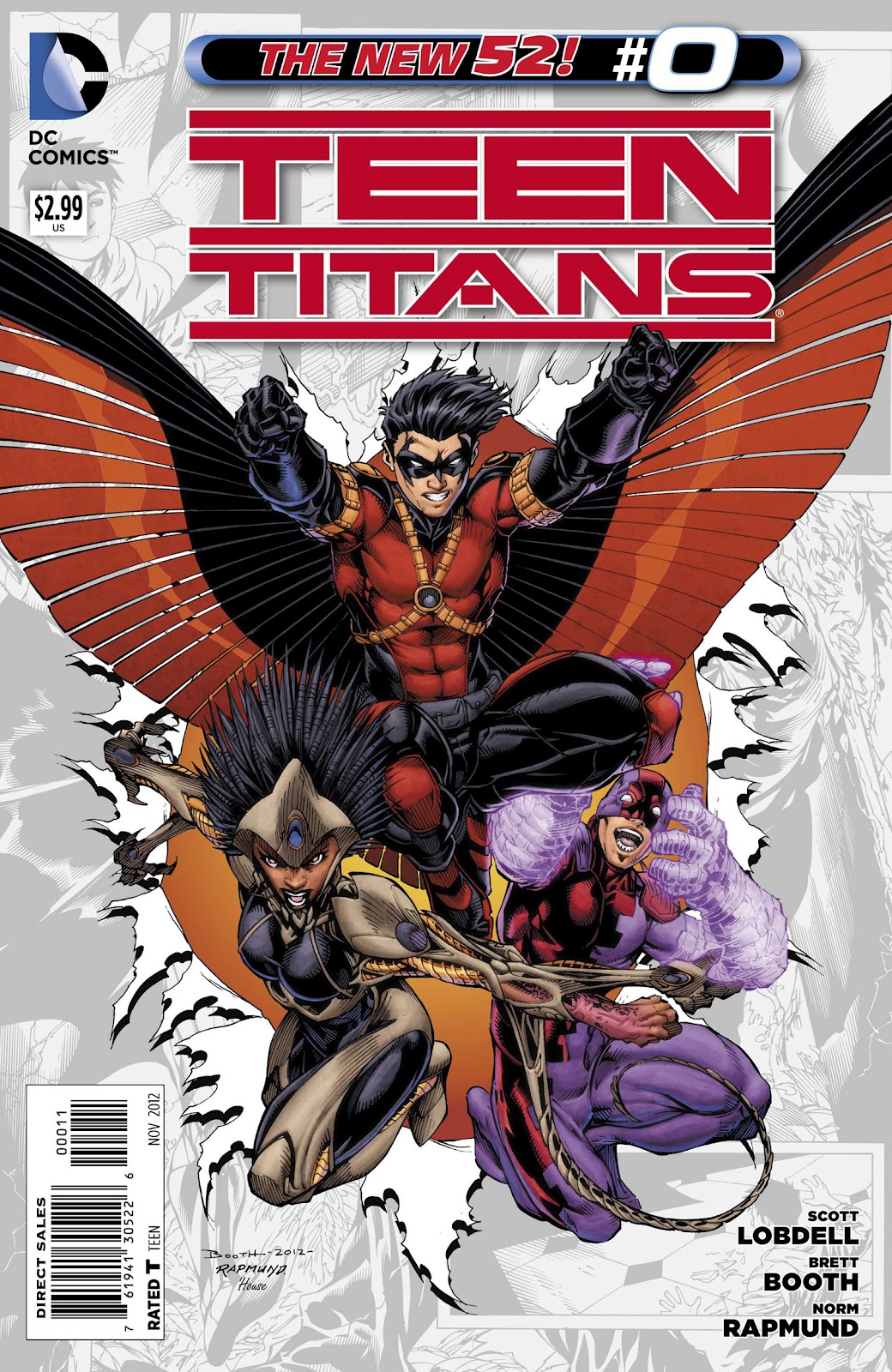
TEEN TITANS #0

STORY: Scott Lobdell
ART: Tyler Kirkham and Batt

Just like with Superboy #10, Scott Lobdell proves with Teen Titans #0 that he's not completely inept at writing the characters he's been given. For this "Zero Month" issue, Lobdell gives us the origin of Tim Drake, better known as Red Robin: former protege of Batman. A few months ago, Lobdell shocked the fan base at San Diego ComicCon by announcing that Tim Drake was never an official 'Robin' of Batman's. Instead, Tim's been Red Robin since he became a caped crusader. In essence, Lobdell majorly altered the character history of arguably the most iconic Robin of them all (at least, on par with Dick Grayson) - this was a big pill for fans of the third Robin to swallow. But putting aside comic book fanaticism, it really doesn't make that much of a difference - Tim still fills the 'Robin' roll at Batman's side, his costume is basically an all-red Robin get-up, and he eventually moves on to let another youngster take the sidekick roll. The truly interesting thing about Teen Titans #0 is how well Lobdell reinvigorates a character who was more or less a carbon copy of Bruce and Dick when he was originally introduced.

Tim Drake is now a prodigy in both the physical and mental arenas. He excels at all intellectual projects, has the potential to be on the US Olympic gymnastics team, enjoys a completely happy home life, and impresses everyone he meets...and that's the problem. After observing Tim in person, Bruce rightfully decides that Tim doesn't shouldn't be Robin. Dick Grayson and Jason Todd came into the roll of Batman's sidekick because their lives had been shattered and broken, same as Bruce years and years ago at the hands of Joe Chill. Tim Drake's life couldn't be better - he's got a bright future and his parents love him. There's literally no reason for him to be Robin. But of course, Tim has a secret obsession with Batman's secret identity.

This is where Tim goes from being a Golden Child to being a multi-faceted character who has a huge flaw: pride. After falling into Bruce's trap by following set-up clues, Tim gets scolded by the Batman who tells him to lay off and just enjoy his life. Unsatisfied with that response, Tim uses his exceptional hacking skills to steal the Penguin's fortune. If this behavior seems alarming and odd, well, it is. Tim's meeting with the Bat didn't discourage him so much as it validated his actions - Tim took the next step in his fight against crime without Batman's consent because Batman even bothered to meet him at all. Lobdell has done good work in making Tim fundamentally different from Dick and Jason before him. His pride in himself becomes his weakness. Now, this wouldn't be a Batman-related story without at least some tragedy. The hacking stunt causes the Penguin to put out a hit on Tim and his parents.

Tim's parents don't die. Lobdell avoids his pitfall and instead puts the Drakes into the witness protection program. The twist comes when Tim is left behind in Gotham - as a perceived orphan at this point - to have the chance at good and successful life he wouldn't get being forced to hide who he is in witness protection. The end result is that even though he's seen and treated as Bruce Wayne's orphaned son, Tim's parents are still alive. Somehow, this is going to tie into future stories, whether it be the upcoming "Death of the Family" crossover (which would make a lot of sense, considering the familial elements at play in this issue), or future arcs.

All in all, Teen Titans #0 is fantastic. Scott Lobdell's writing usually leaves a lot to be desired for me, as a reader and a critic. This month, though, he really stepped up his game and gave a solid origin story for Tim Drake that may not be what hardcore fans wanted, but manages to change the character enough to make him interesting again.

GRADE
B+

Thursday, August 23, 2012

TEEN TITANS #12

STORY: Scott Lobdell
ART: Brett Booth and Norm Rapmund

Whenever I review Teen Titans, I find my thoughts tend to devolve into "Scott Lobdell can't write." That's a harsh accusation and one that's barely accurate. Scott Lobdell does indeed have a lot of good ideas - he thinks big and writes even bigger. Too often, unfortunately, those thoughts are simply too big, causing Lobdell's entire structure to fall apart. This was the case for "The Culling", which was rooted in interesting causes, but was conveyed in such disarray, that it ended up being one of the weakest story arcs of 2012. On the flip side, Teen Titans #12 points out another monthly problem with Lobdell's writing: the inability to accurately express teenage dialogue.

Just like in the real world, each character in DC's universe has their own voice. One of the chief goals of a comic book writer is to convey said voice effectively while simultaneously injecting their own narrative flair. Writers like Geoff Johns and Scott Snyder understand this concept - one doesn't change so much as bend a character in an effort to develop something new. Pushing these heroes to their limits is acceptable, but Bruce Wayne's favorite band or hairstyle doesn't change from creative team to creative team.

One of the reasons Teen Titans feels so half-baked is because there hasn't been any effective character development. Basically, he's so wrapped up in his plot to pay any close attention to smaller details that build a character from the ground up. I've spent paragraphs outlining Lobdell's missteps, so I'll spare those of you who follow my coverage of TT. But this lack of development is really only the beginning of the problem.

Having cardboard cutouts as your main characters in issue 12 is a huge fault with Teen Titans #12. Without more concrete personalities, each member of the Titans ends up sounding like an uptight, 30-something rather than adventurous teenagers who have already seen more horrible things than most of us will ever see in our entire lives. "I'm sorry...but the longer I am fully covered in the Silent Armor, the less control I have over my actions," is about the blandest way this concept can be conveyed. Seriously, what kid talks like that? A much more believable sentence might read, "This armor...the more I wear it, the more I lose control" - it get's the same point across without sounding cold and clinical, like reading from a script or cue cards. Later, Red Robin chimes in with this gem, in reference to Cassie's soul becoming engulfed by the mystic armor: "I know that is you inside that armor!" A sentence so awkwardly structured that I had to read it again just to make sense of it in my head.

This strained, clumsy working of the English language isn't even normal for refined adults, let alone superpowered teenagers. In a motel off the Jersey Turnpike, Bunker, Kid Flash, and Solstice are holed up while Miguel recovers. As the ever-tenacious Bunker attempts to go help Superboy and Red Robin, only to fall to the floor in pain, Solstice analyze's the team's situation in yet another terribly awkward sentence: "Miguel, if we're going to be a team, which you have been such a strident proponent of, then we have to take our leader's orders seriously." (Aside from the atrocious substitution of commas in place of hyphens) When writing, it's a general rule of thumb to use the least amount of words possible while still effectively conveying your idea. The revised version of the above sentence could easily read, "If you want this team to work - something you've been fighting for quite adamantly - then you've got to follow Red Robin's orders." While not wildly different, the latter sentence flows so much more easily and naturally.

But enough of Jay's English Class.

Teen Titans #12 continues to look at the origin of Wonder Girl. And honestly, this arc has been far more interesting than anything so far - I really enjoyed the mythology and mystery surrounding the Silen Armor. Last month, we found out the Silent Armor was forged in the center of the sun and somehow causes Cassie pain and cuts years off her life. Now, things are getting harry as Cassie loses control to the armor more and more, harming her teammates in the process. Red Robin and Superboy hatch a plan to give Kon-El a sliver of separation between Cassie and the armor so he can use his telekinesis to separate them, thereby destroying the armor.

That's when homeboy Diesel shows up. Honestly, he's not that important yet. After taking the essence of the armor from Cassie while ripping her a new one for leaving him for dead, Diesel doesn't even try and fight Cassie - he just flies away. Cassie's remarks about the situation on the last page help make things interesting as far as cliffhangers go, but nonetheless, Diesel is still a pretty big enigma.

I spent a lot of time on this post, mostly because I feel that in the past, I may have lambasted Scott Lobdell without anything to back it up. Sure, I explained my general misgivings with his style, but I really wanted to find examples, evidence to my claims that the man just keeps tripping over one of the easiest character archetypes in the literary world: the awkward teenager. So while I'm admittedly impressed with this arc's mythological aspects, the Teen Titans themselves are still about as interesting as a plank of wood.

Also, where's Skitter?

GRADE
C+

Friday, August 10, 2012

BATMAN AND ROBIN #12

STORY: Peter J. Tomasi
ART: Patrick Gleason and Mick Gray

After a pretty awesome first arc and a better-than-average contribution to "Night of the Owls", Batman and Robin has really found a place as a title focused on the relationship between these two characters and how it differs from former Robins because Damian is Bruce's son. Damian is a very complex character that Grant Morrison created (kind of), built up quite a bit, then just left for everyone else to clean up. In many ways, it would be like having divorced parents with passionate political beliefs that were polar opposite from one another. Damian was raised a loyal Libertarian, and has been thrust into the world of Democrats that he's only now beginning to understand, though he still feels inclined to prove his self worth by any means necessary. Unfortunately, all of these excellent elements surrounding Damian's characterization only show up sparingly throughout this current arc, and not at all in this issue.

"Terminus Maximus" has been billed as the 'main arc' of the past three issues, yet until Batman and Robin #12, you could have fooled me and said the big story was "War of the Robins", a side story concerning Damian's desire to defeat each of the former Robins in an effort to prove himself the best of Batman's sidekicks. Indeed, the "Robins" arc is far more insightful and interesting, as it has to do with emotional ramifications instead of blind villainy. Damian is a 10 year old assassin child challenging much older, stronger men to bouts of strength and wits - tell me that's not more awesome than a plot about yet another psychotic villain who wants to kill Batman and give Gotham the "truth". However I feel about the quality of each story, "Terminus" takes the spotlight this issue, as DC billed the issue as "The Final fight with Terminus!" Though, this is the one and only meeting, let alone fight, that Batman and Terminus have had. I don't know why Peter J. Tomasi wanted to crush a six-issue story into three, but he does so here with as much grace as a Juggernaut in a china shop.

Terminus himself is a pretty by-the-books villain, one who believes that Batman has made the city worse through his actions. Now, Termy wants to make the city fear Batman by sending out an army of lunatics to brand civilians with a bat symbol. While that particular part of the arc is cool, the entirety of the attack on Gotham lasted less than one issue. This month, it's all about Batman vs. Terminus, though there's really not a lot of logic to it. Terminus takes his name because he's terminal, and also because he wants to terminate Batman, I'm going to assume. Beyond that, we don't know anything about this guy. He doesn't have a proper name, his sickness is never given adequate explanation, and his hatred for Batman never evolves past vague "your actions affected me negatively" emotions that aren't based in anything real.

It's a real shame that "War of the Robins" not only ends this issue, but also gets pushed to the severe edges of the narrative. As Bats and Robin take on Terminus and this thugs, Nightwing, Red Robin, and Red Hood show up to lend a hand to save their city from this villain-of-the-week. The panels featuring all the former (and current) Robins together are filled with witty banter and snaps at each other much like brothers in the backyard. It's really at this point, nearly 2/3 of the way through the issue, that things start getting interesting, and it's because Tomasi finally starts focusing on relationships for a moment.

Now that "Terminus" is in the past, we have Batman and Robin #0 to look forward to next month, hopefully shedding some light onto the formative years of Damian's life in the League of Assassins. Because really, I just want to forget Terminus was even a villain. Tomasi even had to throw in a biochemical warhead for Batman to stop to make Termy more that just another faceless threat. But even that didn't work.

GRADE
B

Thursday, July 26, 2012

TEEN TITANS #11

STORY: Scott Lobdell
ART: Brett Booth and Norm Rapmund

It seems that my issues with Teen Titans and Superboy in the first nine months of DC's 'New 52' had a lot more to do with the N.O.W.H.E.R.E. arc than I realized. While I still feel that Scott Lobdell's scripts are a bit long in the tooth for a pair of series about teenagers, I've been enjoying both titles loads more since the end of "The Culling". A big part of this change of heart comes from more character development, something Lobdell neglected in favor of a convoluted, painfully intertwined plot.

Teen Titans #11 kicks off with a bang, as Kid Flash, Bunker, and Solstice come under attack by Loose Canon, a surly blue fellow who can feed on energy then weaponize it (similar to, say, Cable or Ms. Captain Marvel). It's actually a fun little fight scene that ends when Cassie stops moping in her room and over-charges Canon, causing him to burn out. The actual fight really isn't all that important, while the reason for the fight boils down to Bunker's mistake. After hearing of Red Robin's intention to disband the Titans - in last month's issue - most of the team disagreed with Tim's course of action. Bunker takes things into his own hands and puts out an ad on Craigslist to recruit new members. Obviously, things don't turn out well, but the entire episode does a great deal to bolster Bunker's personality. Unlike Red Robin, Superboy, and Wonder Girl - who have all been revamped - Bunker is a brand new character, a fact Lobdell has been taking advantage of in Teen Titans, as well as in Superboy, where the gay Mexican guest-starred earlier this month (what a weird sentence to type).

Lobdell has been deftly building up Miguel Jose Barragan as the team's heart and soul. Red Robin is too buys brooding, Kid Flash never takes things seriously, Superboy isn't an actual member of the team yet, Cassie is a total basket case, Solstice is still trying to figure out how to lead a normal life, and Skitter is barely even seen these days. Bunker gets to be the straight man - the most normal character of the bunch - who has to deal with his teammates craziness. And to be honest, the whole Craigslist idea isn't that bad in today's modern age of technological communication.

Side note that really has nothing to do with the rest of the issue/this review: Superboy looks like he flew out of 1994. It's 2012, Scott - wearing shades at night, black tank tops, and motorcycle gloves went out of style with Culture Club and Clear Pepsi.

The main focus of Teen Titans this month comes down to Wonder Girl and the mysterious Silent Armor she wears. After quickly defeating Loose Canon, Cassie seems to lose all control over the ancient armor "forged in the heart of the Sun..." Without much wanring, Wonder Girl attacks and defeats Solstice, Kid Flash, and Bunker before Red Robin and Superboy show up to find Cassie begging for death before she takes another life. Brett Booth makes the right decision to withhold showing the readers the full power of the Silent Armor until the final panel. Instead of revealing the blood-thirsty version of Wonder Girl mid-issue, Booth keeps her off-panel while using the Titans' reactions to convey the horror of their friend taken by a godly power.

GRADE
B

Monday, July 16, 2012

BATMAN AND ROBIN #11

STORY: Peter J. Tomasi
ART: Patrick Gleason, Mick Gray, Keith Champagne, and Dustin Nguyen

This week at Comic-Con International in San Diego, Scott Lobdell revealed that Tim Drake went straight from a regular kid - with a knack for detective work - to Red Robin, without actually spending any time as Batman's official sidekick. This change sent waves through the comic book community, most of them negative. Tim Drake is definitely as popular - if not more so - as Dick Grayson, so it's odd that DC would so easily let Lobdell change continuity all willy-nilly. The reason I bring up this revamp is that Tim is still included in Peter J. Tomasi's "War of the Robins" story that's been the best part of Batman and Robin the past two months, even though he (now!) was never technically a Robin.

Damian takes his fight to Red Hood this issue, and DC has labeled it in promotional materials as the beginning of the newest Robin's quest to defeat all the former ones, even though he technically did beat Tim Drake last month in a battle of morality and ethical dilemmas. Perhaps this is DC's attempt to clean up the Robin retcon by saying Tim's encounter with Damian wasn't an actual fight that falls under the classification of "War of the Robins". But that seems a bit silly.

Nonetheless, Red Hood's turn is here. Jason Todd returns to his Gotham apartment, exhausted, only to find himself ambushed by Damian. Batman's son truly is a great character. What could have simply been a new Robin content to live a life of servitude under his father's wing has become a complex ten-year-old child leading a life of someone thrice his age. This facet of Damian was explored throughout the first eight issues of Batman and Robin, as Tomasi looked to show that Robin has problems and issues more akin to weathered assassins than his peers playing in schoolyards. Of course, Damin is 10 years old, so he's still got some insecurities that come with that age. One of which happens to be an inferiority complex when it comes to his mantle as Robin.


Damian Wayne is Bruce's only biological son, but the man has two other sons who he feels more connected with. Damian's dilemma isn't an uncommon one for children raised by a single parent - he's figuring out how to manage a relationship with the absent parent. And in this case, Damian feels that in order to prove himself to his father, he must defeat Bruce's former surrogate children.


Unlike last month, Tomasi spends a majority of this issue focused on Terminus. This slowly decaying villain has sent out a cadre of super-powered thugs to brand as many Gotham citizens as possible with Batman's symbol. Terminus has managed to turn the city's symbol of hope (no matter how dark and twisted that hope may be) into one of fear...again. At one point, Batman's just standing in a plaza, surrounded by buildings all triggered to explode at the same time. "Leave my city ALONE!" screams Batman as he has a hundred million times before. Tomasi is taking the easy way out, making Gotham the scapegoat in this pissing match riled up by Terminus for reasons unapparent so far. Sure, Tomasi threw us a bone last month with some cryptic flashbacks into Terminus' life, but they did little to give meaning to this villain's actions. All we know is that Termy sees himself as Gotham's true son and seeks to knock Batman off his high-and-mighty pedestal.


With two plot lines running simultaneously, Tomasi should be focusing on "War of the Robins", a narrative that actually has a purpose and can give real insight to Batman's various sidekicks throughout the years - it's a character-driven plot that has a lot more potential. Terminus' plot to make the city his own is one that has been done to death for the last sixty years of Batman's history, and it feels like more of a support story that's getting too much limelight.


GRADE
C+

Thursday, June 28, 2012

(COMIC) TEEN TITANS #10

STORY: Scott Lobdell
ART: Brett Booth and Norm Rapmund

And just like that, Scott Lobdell is getting it right! This month's Superboy acted as part one of "The Mysterious Mystery of Mystery Island", and Teen Titans #10 brings us the other half of the post-"Culling" aftermath with Red Robin, Kid Flash, Solstice, and Bunker.

Since Lobdell used the first nine months of the 'New 52' to tell his sprawling, epically nonsensical arc about N.O.W.H.E.R.E., it makes sense to break this "cool down" into two parts, allowing for each character to get a bit more panel time as a result. While the writing isn't as personal as the scenes between Superboy and Wonder Girl, Lobdell still manages to give each character a lot more depth. For one, Kid Flash and Solstice have a thing. I'm sure Lobdell would argue that he planted the seeds for this relationship throughout the N.O.W.H.E.R.E. N.O.N.S.E.N.S.E., but he really didn't. Either way, the scene doesn't come off as forced or pandering - these kids actually seem like they enjoy each other's company.


About seven pages in, we meet up with Superboy and Wonder Girl at the point where Superboy #10 ended, bringing them to the 'other side' of the island, which meant it literally flipped over. With the team reassembled, Kon-El and Cassie discuss telling the others about the crazy flipped island thingy they discovered, but ultimately decide to not say anything based on the fact that no one knows what it means, so why cause more anxiety. After that, the island's nature isn't touched on again. This would be one of my only criticisms of this issue - Lobdell totally drops the island story in favor of one-on-one character dialogues. Honestly, the character development is much better anyway (and very much needed), so it's not even that big of a deal. It's mostly annoying on principle.


Tim Drake has a major crisis of conscience this month as he fails to see his succes beyond the failures that that came with it. Artemis was murdered (still confused as to why such a minor character made such a big impact), Danny the Street was destroyed, and Skitter is still missing. Tim feels like he didn't do enough, and decides to disband the Titans while chatting with Bunker. It's a childish decision - one based on fear - and Bunker stops Tim to knock some sense into him. Like many other heroes before him, Tim gets the 'responsibility' from Bunker about being a leader, taking initiative, making the tough decisions, and pressing on even when the going gets tough.


This, of course, leads us into the most awkward one-on-one of the issue between Superboy and Red Robin where Kon-El asks Tim exactly why he came to rescue him in the first place. Like a pretentious middle-aged accountant talking to a child, Tim tells Superboy to wait six months and learn before asking that question again. I'm sure Lobdell didn't intend for Tim to come worse than Bono, but it feels that way. Poor Kon-El - clones are sooooooo dumb, right?


I began reading this issue groaning each time N.O.W.H.E.R.E. or the Culling was mentioned. I wasn't a fan of that storyline, and at first, it felt like Lobdell basically doesn't have any other ideas, so he's forced to keep reminding us about this big thing that happened in order to fill speech bubble space. After a while, though, I realized that this is Lobdell's transition period - soon, new enemies will show up (like Amanda Waller - all around bad-ass) and the convoluted tale of N.O.W.H.E.R.E. can be relegated to the "early mistakes" pile.


GRADE
B

Saturday, June 16, 2012

(COMIC) BATMAN AND ROBIN #10

STORY: Peter J. Tomasi
ART: Patrick Gleason and Mick Gray

In the month after "Night of the Owls", all the Batman-related books are starting new story arcs. Peter J. Tomasi and Patrick Gleason's Batman and Robin #10 might be simultaneously the most interesting and the most boring new story of the bunch. Since Big Ol' Bats already has three series dedicated to his solo outings, Tomasi has been focusing on Damian Wayne quite a bit, not only dealing with his daddy issues throughout the first arc, but also with Damian's talent for strategic battle during last month's Talon incursion. This has been a consistently smart move on Tomasi's part.

Batman and Robin #10 kicks off "Terminus", but you'd barely know it if you didn't want to. The so-called Terminus takes a far, far back seat to the issue's main events. All the same, this guy obviously has criminal intentions, and his body seems to be falling apart. Terminus spends the issue regenrating in some crazy regeneration machine. That's it. I'm sure there will be more to this, but it also doesn't seem very interesting. At this point, Terminus is just some dude who wants to kill Batman - hold the phone! No, the real meat in this issue comes from the 'War of the Robins' storyline.

Bruce has called all the Robins, former and current (except for Jason Todd, for obvious reasons), together for a family portrait at Wayne Manor. One of the best things about the Robin mantle is that there isn't one type of person who becomes Robin - they come in all shapes and sizes and personalities. Within minutes, Tim Drake and Damian are at each other's throat. Dick Grayson loftily sits above their squabble, as his position as Robin can never be questioned (he's the O.G., baby!)

The feud between Tim and Damian is interesting, mostly because it stems from simple disrespect. Whenever Batman and Superman had disagreements, they never lost respect for one another, but neither boy here regards the other in any good light. For Damian, Tim is stuck-up and looks down on Damian, while Tim feels that Damian is a psychopath and unworthy of a title he and Dick worked hard to maintain. That's pretty much the description you're going to get anywhere else. The truth of the matter is much deeper, even if Tomasi doesn't know it.

Tim Drake was the son Bruce never had. Sure, Dick was the first Robin and literally had no parents and was adopted by Bruce, but they've always had a stronger working relationship (at least in my memory. Maybe I need to go back and reread old Silver Age issues). Tim, on the other hand, was the one who figured out who Batman was, the one with the detective skills to rival Bruce's own, and the Robin that took the name from respectable to iconic. Like I said, Tim was the son Bruce never had. Until Damian. Tim's real beef is that Damian is a real Wayne and Bruce's actual son. Obviously, it's painful to see your mentor and father-figure move on to a new apprentice, a new disciple. And sure Tim left of his own accord, but he keeps the mantle Red Robin, an obvious homage to his former title which means he still has deep emotional ties to the name and the job. Dick, conversely, left and took the name Nightwing, moved to a new city and generally tried to distance himself from Batman for quite some time.

Damian, of course, lives in Tim's all-encompassing shadow. Tim held the mantle for so long and did so well, it's obvious to Damian that Bruce is looking to make Damian more like Tim. The entire first arc of Batman and Robin was about Damian's issues with his upbringing as a killer, and in a sense, he was able to make a good step forward in dealing with those issues. But Tim is always there - a constant reminder of how good a Robin can be and how lacking Damian is compared to Tim.

The night after their blow-up at Wayne Manor, Damian calls all the former Robins together, even extending an invitation to Jason Todd, the Red Hood! When they all show, Damian declares "war" on them. Damian explains that at some point, he will confront each of them and defeat them at something they consider themselves the best. Of course, they all immediately assume Damian means a fight, but the little Robin's much smarter than that! His only goal with Tim is to get Red Robin to admit he'd had homicidal thoughts. Tim rebuffs this by saying he's never acted on those thoughts, which is what separates them.

I really do tend to enjoy superhero stories where the heroes are in-fighting, and the "War of the Robins" portion of Batman and Robin #10 is totally awesome. My psychoanalytical critique aside, these characters are all awesome and now, they've got an arc slowly building that will pit them all against one another in a variety of circumstances. FANTASTIC. Terminus will probably continue to be a boring sub-plot that will eventually slip it's way into the main story, pulling the entire arc down as a result, but we'll cross that bridge when we get to it. For now, awesomeness.

GRADE
A

Friday, April 27, 2012

(COMIC) TEEN TITANS #8

STORY: Scott Lobdell
ART: Ig Guara and JP Mayer

As the creative force behind Teen Titans, Superboy, and Red Hood and The Outlaws, Scott Lobdell has a lot of room to create fantastic stories that involve a great lineup of characters that could possibly evolve into a sort-of mini-universe within DC's larger mainframe. Unfortunately, Lobdell has completely squandered both Teen Titans and Superboy with trite dialogue, a ridiculously convoluted tale about the organization called N.O.W.H.E.R.E. (a pet peeve of mine is unexplained acronyms) that captures/recruits teenaged metahumans for some mysterious use. Also, some weirdo mutant thing called Harvest is the ringleader of the whole thing.

Apparently, Lobdell is building toward some 'official' crossover between Teen Titans and Superboy called "The Culling". By dictionary definition, a culling means a trimming down, a reduction. I can only assume this is the central idea behind Lobdell's crossover because there's been absolutely no indication of what this culling actually is. This month's Superboy carried the same "The Culling: Prelude" tag as this issue of Teen Titans, yet there's nothing to in either issue that points to this event - the exception being the cameos of Beast Boy and Terra at the end of Superboy #8.

This month in Teen Titans, the team is somehow already balls-deep in a fight with Omen, a metahuman teenager who can manipulate reality and...minds? Maybe? It's not really explained, like most things in Teen Titans, so I suppose I should stop complaining, huh? Mostly, Omen brings out the insecurities and fears of each team member, using these feelings to pit them against each other. But at the end, it turns out that the entire issue was a dream being collectively shared by the team. They've been strapped to steel lab beds the entire time, all of their struggles simply a made-up reality courtesy of Omen.

Honestly, it feels like a lot of wasted time. If all of it was a just a hallucination of-sorts, what was the point? What purpose did this entire issue serve? And with painful dialogue like, "Wha--? Last thing I remember was writhing in Omens grip...and now I'm dressed like Superboy's prom date. And bound to this table, to boot. Super strength would normally be enough to break free but..." This monologue by Wonder Girl made me literally cringe while reading it. Nobody talks like that ever. It's an affront to basic intelligence to make a character literally say what they are thinking. It's abhorrent and Lobdell better start taking a look at how he treats this title or he will lose all of his readers.

Also, Superboy is on the cover, yet not in the issue. This is sooooooo aggravating I cannot tell you.

GRADE:
D

Wednesday, March 28, 2012

(COMIC) TEEN TITANS #7

Written by Scott Lobdell
Artwork by Brett Booth and Norm Rapmund

I don't know what's going on with Scott Lobdell. With Teen Titans and Superboy both currently his responsibility, Lobdell has managed to totally undo twelve of decent storytelling in a single month. In my review of this month's Superboy, I waxed poetic about how Lobdell was telling us his story instead of showing us, which is a cardinal sin when dealing in graphic arts. This month unfortunately shows that Lobdell is migrating his Superboy style over to Teen Titans, with horribly long info dumps to prove it. Along with an extremely chopped up narrative, Teen Titans #7 might be the worst of the series so far.

The issue starts with a jump into the near future. Superboy is once again being held against his will by N.O.W.H.E.R.E., and Director Centerhall decides to bore everyone to death with a five-bubble monologue that takes up the ENTIRE FIRST PAGE. That's right, the first page of the entire issue is dedicated to a lengthy diatribe from a villain in a situation that hasn't been explained yet. It's maddening. After Kid Flash pops up for a second, Lobdell immediately throws the reader back in time.

Then we meet Danny the Street. In Scott Lobdell's new Teen Titan universe, there is a metahuman teenager who is an actual street and has the ability to create doors that lead to random destinations. What. A. Joke. Backed into a narrative corner, Lobdell pens a character, with literally no personality, whose only exists to serve a trite narrative function - get the kids out of a jam. It's such a stupid concept that I kept getting distracted and trying to think of an explanation for why Lobdell would think such a convoluted idea was a good one.

The rest of the issue fairs no better. At one point, the narrative shifts to Wonder Girl as she stands over a defeated Ravager with an editor's note explaining that the fight can be seen in Superboy #8. WHAT A CROCK OF SHIT! This issue is all about Superboy's rescue operation and Lobdell conveniently decides to leave out an arguably vital part of the story (considering the upcoming The Ravagers series) with no obvious reason other than to sell more issues of Superboy.

It's unfortunate that a team as great as the Teen Titans is being dragged through this narrative mud. When a writer treats his audience with little regard to their intelligence, it's apparent and it's insulting. Scott Lobdell has managed to make me seriously rethink Teen Titans and Superboy as A-list titles from the 'New 52.'

GRADE:
C-

Sunday, February 26, 2012

(REVIEW) Teen Titans #6

Written by Scott Lobdell
Artwork by Brett Booth and Norm Rapmund

After five issues of their new origin story, the Teen Titans still aren't a coherent team and it's becoming a bit frustrating. Why did the first issue feature Superboy - front and center - when he isn't a part of the team and doesn't it look like he will be in the near future? And while Teen Titans may have coasted along on momentum for the first few months, the past few issues have been disappointing.

This trend continues with issue six. Now that Superboy has beat all of them down without breaking a sweat, it's time to move on to some awesome new storyline, right? No. Instead, we get more of a one-shot story about how Kid Flash was sped up too much by Superboy's telekinetic powers, so he's in danger of going so fast that he literally phases out of existence. SNORE! This exact story has been used in speedster stories more times than DC is willing to admit. It's a staple of speed-having superheroes, but in 2012, it's a total and unwarranted cliche that should have been avoided. Since they're not important enough for the Justice League to answer their call, the Titans call Virgil Hawkins, a.k.a. Static, though no one seems to know he's a superhero. After some scientific mumbo-jumbo, Virgil and Red Robin go to work trying to fix Bart Allen. And the payoff isn't even great! In the end, Virgil develops a suit to keep Bart's erratic speed in check. That's right comic fans: Kid Flash must wear his suit or he will die! It's such an annoying plot twist that I almost rather Lobdell had simply left Bart alone and let him keep wearing Red Robin's old costume.

Elsewhere in Titan world, we get some seriously awful dialogue between Wonder Girl and Brick Boy (alright fine, Bunker) wherein Miguel reveals that he is gay in the most blunt and unnatural way possible. It's honestly hard to read - like those moments in TV shows that are just simply too embarassing and you can't help but cover your eyes. Also, the villain for the issue was terribly unoriginal. I mean, Grymm? Seriously, it's not that hard to think up names.

So, in conclusion, we get an issue that basically revolves around getting Kid Flash a new costume and putting the kids up against a foe that isn't Superboy. Unfortunately, the issues persistent over the past few months have stuck with Teen Titans, making it more of a chore to read than fun.

GRADE:
C-

Monday, January 30, 2012

Review: Teen Titans #5

Review


Teen Titans #5
Written by Scott Lobdell
Artwork by Brett Booth and Norm Rapmund

Teen Titans has been pretty good since the 'New 52' relaunch. While some of the member choices are a bit questionable (I mean, Skitter instead of Beast Boy? C'mon...), Scott Lobdell has done a great job weaving the stories of each of these characters into a larger mythology within the new DC universe. Lobdell also pens Superboy, giving him ample page space to make connections, create an intricate backstory and give the DC universe a rather formidable enemy.

Issue five claims to present all the members of the Teen Titans together for the first time. Unfortunately, this is a lie, as Skitter is absent from the brawl and Superboy is their enemy. So...they're kind of all there? Whatever. The issue still stands on it's feet as a great book. I was skeptical, from the beginning, of Bunker, a new teen hero who's Hispanic, homosexual and who's power consists of creating purple psionic bricks. It's a pretty weak description for a character that has actually been written well and without a whole lot of sappiness, which is difficult for comic book writers to avoid when writing multi-ethnic or homosexual characters. In this battle, Bunker is the only one - at least for a moment - who can stand up to Superboy's own psionic powers, slowing him down enough for Red Robin to swoop in and give ol' Kon-El the psychological beatdown he needed all along.

We're still in a transitional place for the Titans. Superboy is their enemy. Kid Flash doesn't have a proper costume yet, Skitter doesn't understand her powers, Wonder Girl is anything but 'wonderful', and Solstice has yet to be developed beyond the 'information dump' girl. But this is the fifth issue, and we're starting to see the seeds of the full team take root. Superboy starts questioning his beliefs, all the rest of them get a dose of humble pie as they're beat to the ground one by one, and N.O.W.H.E.R.E. begins to panic as they realize that Superboy may no longer see them as allies (and still no acronym clarification). Soon, we'll get to see the road Superboy takes to joining the Teen Titans.

While not the finest issue of the title thus far, it's definitely one of the better ones. While both Teen Titans and Superboy have taken the scenic route in their storytelling, those scenes are starting to make more sense and things are being brought together more and more. Lobdell has the chance to build an inter-title mythology and so far, he's succeeding.

Grade: B-