Showing posts with label Andy Lanning. Show all posts

Friday, September 14, 2012

RESURRECTION MAN #0

STORY: Dan Abnett and Andy Lanning
ART: Ramon Bachs and Jesus Saiz
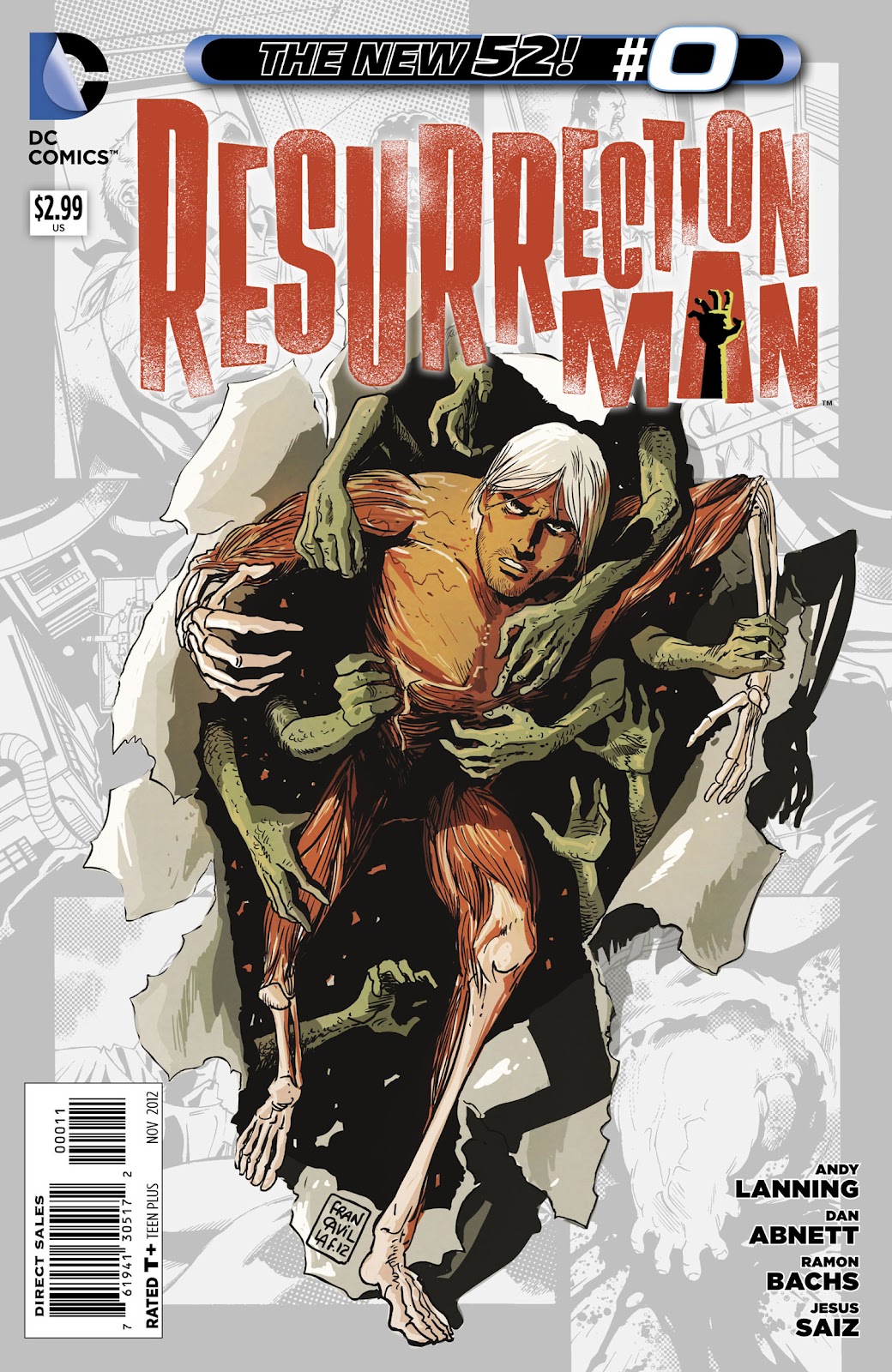
Mitch Shelley is a huge ass. At least, the real Mitch Shelley. Not the Mitch Shelley we've been following over the past 13 months. Last month, it was revealed that the main character of Resurrection Man was actually a clone of the true Mitch Shelley, who it turns out is the evil mastermind behind the entire series' worth of criminal activities. It was an eloquent - if not slightly sadistic - way to technically end the series. Dan Abnett and Andy Lanning were given this chance to explain things a bit more with Resurrection Man #0, and thus the issue gives readers a more comprehensive historical account of the real Mitch Shelley, as well as the events that led to the creation of "Resurrection Man" Mitch Shelley. The biggest shortcoming of this "Zero Issue" is that Abnett and Lanning seemed to have planned for Resurrection Man to continue, as foreshadowing and set-ups for future plot lines are littered throughout these pages.

For the same reason I've had a love/hate relationship with this series for the past few months, Resurrection Man #0 ups the ante by continuing to be one of the best titles from DC's 'New 52' even though this is the very seriously final issue. I tried to not get too attached to this series, as I knew the adventures of Mitch Shelley would soon be coming to an end. It didn't work, and just like the frustration of watching Firefly after it had been cancelled, I found myself upset that a series this good was so underrated. Honestly, I was holding out for a last-minute renewal, similar to Community's miraculous fourth season (SIX SEASONS AND A MOVIE!).

The plot of Resurrection Man #0 would seem straightforward enough. Fortunately, Abnett and Lanning don't take the easy way out, instead opting to make this origin story as wacky and sci-fi as possible. The first thing we're made to understand is that Resurrecting Mitch's memories were actually Proto-Mitch's memories. This means that it was the jerk-wad Mitch who was in the Middle East with Deathstroke and Hooker five years prior. This also accounts for all the other horrible flashbacks Living-and-Dying Mitch would have about his "past". At some point in Iraq, O.G. Mitch is badly wounded then attacked by some fish monster thing and injected with the tektite solution - a self-healing agent -  which becomes the catalyst that starts the proverbial ball rolling. To save the rest of his horribly wounded team, Mitch Sr. orders the tektite solution used to treat all of them. This is how Director Hooker receives his powers, as well as the Body Doubles.

In the hoopla of the explosions that cause all the harm, the Original Mitch Shelley loses his arm. Even with the tektites flowing through him, the reattachment is unsuccessful. Shelley orders his dead arm incinerated to keep the tektite solution out of enemy hands. But as Jeff Goldblum said in Jurassic Park, "Life finds a way." The tektites survive the incineration and escape through the smoke into nature where they instinctually sap all surrounding matter to 'resurrect' Mitch Shelley from the blueprint of his DNA grafted onto them. It's a bit complex, a bit high-concept, and is just plain cool. The tektites simply reconstitute Neu-Mitch whenever he dies in the same fashion, giving him a new power each time in the process.

Resurrection Man #0 also looks toward the (now nonexistent) future of the series. Who is the fishy-man who injects the first Mitch with tektites originally? How does Deathstroke's involvement with Mitch Shelley connect with his time with Team 7? How will Mitch make amends for the terrible crimes of his source material? Where does Kim Rebecki fit into all of this? And why is the Devil being set up to become a major character? Alas, it's highly unlikely any of these questions will ever be answered, unless Mitch joins the Justice League Dark or something. (Hint, hint, DC.)

GRADE
A

SERIES GRADE:
A+

Thursday, August 9, 2012

RESURRECTION MAN #12

STORY: Dan Abnett and Andy Lanning
ART: Javier Pina

The entirety of Resurrection Man has been a mystery. From the beginning, Mitch Shelley has struggled to figure out who he is and how he came to have the incredible powers he possesses. In it's 12 issues, this series has taken us all over the United States, introduced an exceptional supporting cast, and showcased a host of awesome powers at Shelley's disposal after his disposals. Dan Abnett and Andy Lanning created this character 15 years ago, and Shelley's 'New 52' reboot put him into a world that isn't ready for superheroes, turning him into more of an outcast than his previous incarnation. Unfortunately, sales numbers didn't lean in it's favor, and Resurrection Man #12 stands as the final (chronological) issue of the series. It's also the best one yet.

In many ways, Resurrection Man is a type of narrative that actually can end after a relatively small number of issues. Even though,the premise of Shelley's situation is one that could be mined for years if done effectively (looking at you, Wolverine), should it? After a while, the series would be in danger of falling into a simple and uninteresting 'power of the week' format that focused on what cool new moved Shelley had instead of quality storytelling. Just look at NBC's Heroes, a show that started off so strong, so promising, only to end up wallowing in a convoluted train wreck involving a superpower-centric carnival. I'd hate to see Mitch Shelley teaming up with Flash or Green Lantern, to be honest. I'd like to quickly clarify that I'd read any and all issues of this series if it had been allowed to continue. I love the character, the premise, and the cast. In Abnett and Lanning's hands, Mitch Shelley's adventures would have been awesome going forward. But that's not the case, and the Shelley's creators send him out with a bang and a big cliffhanger that we'll get the inside scoop on in Resurrection Man #0.

At the mercy of Director Hooker, Shelley is sent through stress tests with virtual reality simulations so Hooker's scientists can research the deaths and resurrections to find a way to replicate the ability in others. While this may seem cliched, it's actually quite graceful in it's execution. Hooker takes a moment to give readers an abridged explanation of tektites, a form of nanotechnology that unlocks different abilities in different people. For Hooker, it's immortality; for the Body Doubles, it's strength and regeneration. And for Mitch Shelley, it's coming back to life with a new superpower each time he dies. From Hooker's own mouth, "Mitch Shelley is the Holy Grail."

I'm not going to give a lot away about the plot of this issue, as it's the last and the surprises throughout the issue are awesome enough that they warrant secrecy. Suffice it to say, a lot of bombs are dropped. As I suspected, Abnett and Lanning really do pull out all the stops for this issue, bringing resolutions to a lot of loose ends while simultaneously raising a whole bunch of new questions that will hopefully be adressed in Issue Zero. A lot of what felt like filler throughout Resurrection Man's run now seems a bit more important now that we've reached an end. And really, the last page cliffhanger makes the entire issue and series worth the read.

GRADE
A

Wednesday, July 25, 2012

AQUAMAN #11

STORY: Geoff Johns
ART: Ivan Reis, Joe Prado, Jonathan Glapion, and Andy Lanning

While he gets out all of the cosmic-level threats and crossover bonanzas with Green Lantern, Geoff Johns saves the scandal and intrigue for Aquaman, a series that has been one of the 'New 52's best titles, not only for it's fantastic arcs and high-caliber artwork, but also because this is a character who has never really been treated right, so Johns is doing everything he can to right that wrong. "The Others" started off rather vague, only sparingly giving readers small amounts of information regarding the team Arthur was on before the Justice League. Most of this arc has been about Aquaman's relationship with his arch-nemesis Black Manta and how it differentiates from old DCU canon, even on a metafictional level. So it's nice that in Aquaman #11, Johns gives us a little more character development for some of the...well...other members of the Others.

"The Others" is starting to feel like 'Arthur Curry's Asshole Hour' because he just can't seem to be nice to any of his former teammates. While the King of Atlantis may have shown some compassion to some persons during the run of "The Trench", all of that seems to have been washed away in favor of a far more pig-headed version of Arthur that wont listen to anyone else and makes rash, impulsive decisions that hurt him and those around him. And while I'm confident this is all part of Johns' plan for Aquaman, it's a bit disconcerting to see the character so violently shaken from his generally stoic presence. Then again, having to deal with a vengeful criminal who happens to be a genius super villain can push a man.

If the Justice League is supposed to be the cool kids club, then the Others is definitely the nerd table. Aquaman himself straddles the line between mainstream and alternative, while the four other remaining members all have some quirk that keeps them from enjoying an actual life outside their powers. Prisoner is haunted by the memories of his military squad and their families - he constantly feels the pain of having lost his surrogate brothers, while simultaneously feeling empty because he had no real family of his own. The Operative - whom we discovered is an elderly gentleman last issue - assumes the thankless mantle of the "nameless agent working for every side..." then using those relationships to garner support when need be. As evidenced by his age, the Operative seems to believe his actions are necessary to keep the world spinning, so to speak.

Vostok quickly becomes the most interesting of the team after his quick tale of growing up in a Russian isolation chamber (with literally no human contact at all) in preparation to be the nation's greatest Cosmonaut, a dream that faded when the program was cancelled and Vostok was released, left to wander a world full of creatures and things he have never seen. Vostok admits to the team that he's been on the moon for two years, "waiting for you to contact me." Even on a team of misfits, Vostok is 'out there'. All of the Others are outsiders who don't fit into normal society, and they came together because of this fact.


"The Others" continues to be dynamite. Johns is weaving an intricate melodrama that's less about the sinking of Atlantis and more about Arthur Curry's relationship with his past. While Black Manta represents the worst of Aquaman's history, the Others represent the best of his younger days. Unfortunately, Arthur is only focused on defeating Black Manta, forsaking the help of his allies and opting to rush in by himself. Black Manta's big find at issue's end also promises big things for the next issue.


GRADE:
A

Monday, July 16, 2012

RESURRECTION MAN #11

STORY: Dan Abnett and Andy Lanning
ART: Jesus Saiz and Javier Pina

If you keep up with "The Endless Reel", you know how much I adore Resurrection Man. In a universe full of interconnecting narratives and convoluted history, Mitch Shelley's adventures represent what comics used to be - a rip-roaring good time full of superpowers, good vs. evil, and a damn fine mystery to solve. That being said, the past couple of issues have floundered somewhat, unable to make any significant progress in uncovering Shelley's mysterious past at all. Of course, Shelley's rotating power set is also a draw to the book, but he's had the same shadow powers for those same few issues, so it's starting to get a bit stale. Resurrection Man #11 comes back around and brings some resolution to at least a one ongoing plotline dealing with the Transhuman, an old villain looking to help Shelley figure out his past.


It's nice to see a character experiencing a relatable form of amnesia; it seems Mitch's memory loss came from more normal circumstances. He begins to remember more about his former life the more he experiences in familiar territory. Too often, amnesia in comic books is caused by magic or super powers, meaning the solution to reversing the memory loss comes from said magic or super powers. In Shelley's case, it may have just been a bump on the head.


Kim Rebecki has been an ally to Shelley for some time, using her empathic powers to understand how things and people work simply through touch. This month, her power reveals a giant skyscraper hidden in plain sight at the Soder Cola factory in Viceroy, South Carolina - Mitch's hometown. With cloaking technology in place, the skyscraper appears invisible to the citizens of Viceroy, allowing the organization that turned Mitch into the Resurrection Man to operate in secret while using the Soder factory as a cover.


A large portion of the issue is devoted to Mitch and Kim fending off an attack by Director Hooker, the man responsible for Mitch's arrest warrant. After locating the Transhuman, Mitch and Kim attempt to free the old man before he reveals his betrayal - his is a super villain, after all. Honestly, it's a bit of a let down, as much of Resurrection Man's run has been dedicated to Mitch and Kim tracking down the Transhuman, someone they believed to be a friend. Of course, it's not out of the ordinary for Mitch to have such bad luck. Mitch is killed this issue, bringing an end to the 'shadow master' powers and introducing his 'eye laser' ability - similar to that of Cyclops' optic blasts, but more lightning-esque and less controlled.


What started out as one of my favorite series in DC's 'New 52' has quickly become stale, possibly a reason for it's cancellation. Dan Abnett and Andy Lanning have fantastic storytelling ability, but it feels like they don't know what to do with Mitch Shelley. There seemed to be a focus for the first six issues, but recent months have yielded a lot of fighting without much substance. And while nothing's wrong with a fight sequences every once in a while to break up the narrative, using confrontations as a means of plot advancement doesn't work if they don't advance anything!


GRADE
C

Friday, June 29, 2012

(COMIC) AQUAMAN #10

STORY: Geoff Johns
ART: Ivan Reis, Joe Prado, and Andy Lanning

Last month, the big reveal was that Aquaman killed Black Manta's father when Arthur's father had a heart attack shortly after Manta attacked them. It was a major twist in the Aquaman/Black Manta history, and one that changes their core relationship. Pride is something neither man is in short supply of, which means their feud is everlasting and intensely personal.

Aquaman #10 begins with The Operative trying to figure out how Black Manta knew where to find the other members of The Others. After infiltrating Manta's headquarters, the Operative is revealed to be a fairly old man who works out of a giant military plane with his son who thinks his father needs to get out of the game before he gets himself killed. Geoff Johns has included a lot of diversity in Aquaman thus far (Shin, Manta, Ya'wara, etc.) and takes it one step further by including an old person. I hesitate to say 'elderly' because that sounds a bit more fraile, which the Operative definitely is not.

The rest of the issue features Shin's recounting of the events surrounding Arthur and Manta's feud to Mera, which also acts as the narration to the confrontation between the Others and Black Manta. Johns expertly weaves Shin's tale into the scenes of Aquaman against Black Manta, moving between flashbacks and the present with a flow not unlike that seen in Green Lantern: Rebirth. Arthur's rage is real, yet Ivan Reis' artwork vividly conveys the obvious doubt Arthur has about the situation, however minute that feeling may be. When Aquaman rages out at Ya'wara about killing Black Manta, you can see the anger in Arthur's eyes. The thing is, Arthur didn't even mean to kill Manta's father. Arthur goes after Black Manta, whom he believes to be alone on a fishing boat, and accidentally kills Manta's father while Manta is diving.


Instead of a conflict of pure vengeance and rage, the relationship between Aquaman and Black Manta in the 'New 52' is based on deep-seeded emotional issues and the transfer of blame tied to the death of their respective fathers. Family stands as a core element of Aquaman, and Johns' reimagining of the Aquaman/Black Manta feud is astonishingly good, especially when coupled with Arthur's past secrets being unearthed one person at a time.


GRADE
A

Monday, June 18, 2012

(COMIC) 4-SENTENCE REVIEWS #4!

Resurrection Man #10
(Abnett, Lanning, Saiz)

I've been a extremely avid fan of Resurrection Man since last September, mostly based on the fact that Dan Abnett and Andy Lanning were less concerned with creating some amazingly big story arc and more focused on just writing interesting stories. I was pretty upset when DC announced that the series would end after it's 'Issue Zero' this coming September, but after reading Resurrection Man #10, I'm wondering if maybe it wasn't all that bad of a call. This month, Mitch Shelley and Kim Rebecki are still on the hunt to uncover Mitch's mysterious past, but instead of advancing the story at all, Abnett and Lanning bring back the 'avenging angels' that came after Mitch way back in issue four or five, a move that shows that maybe these writers really don't have a solid future in plan for the man who can't die. It's far more likely that Mitch Shelley's story will have a super-satisfying conclusion come next month, but we'll just have to wait and see.

GRADE: B


Before Watchmen: Minutemen #1 of 6
(Darwyn Cooke)

Minutemen is supposed to be a look back at the original superhero team that set the (arguably) 'golden standard' for what the Watchmen eventually aspire to attain: the original idea of truth, justice, and the American way. And while we know the Minutemen had their own set of problems, they also operated in a simpler time when origin stories didn't involve intergalactic sentries or mystical interventions, but instead came from ordinary people looking to make their world a little bit better. In this first of six issues, Darwyn Cooke spends a lot of time going over the origins of each member of the Minutemen, and while this could come off as cheesy and overbearing, Cooke masterfully makes each introduction feel like you're meeting these characters for the first time. It's a phenomenal first issue and even better beginning to the Before Watchmen event.

GRADE: A


Before Watchmen: Silk Spectre #1 of 4
(Cooke, Conner)


In the first title dedicated to a member of the Watchmen (the first in the Before Watchmen series focused on the Minutemen, which features the Comedian, but none of the other Watchmen proper), and it's pretty damn good. Laurie Juspeczyk has grown up in the shadow of her mother, both in terms of training and studying to carry on the Silk Spectre name, as well as her infamous streak of compromising work after her days as a superhero ended. Laurie's tale starts as a romantic story with chisel-jawed Greg, a boy who knows about her mother's racy past and doesn't care - all he wants is to be with Laurie, and the two of them decide to run away from home and hitchhike to wherever. Darwyn Cooke has set up a very mid-60s story, complete with adolescent angst, social hierarchy, and a pinch of hippies to keep us interested for the next issue.

GRADE: B

Friday, June 1, 2012

(COMIC) AQUAMAN #9

STORY: Geoff Johns
ART: Ivan Reis, Joe Prado, Oclair Albert, and Andy Lanning

"The Others" has been a fantastic narrative, thus far, that has opened up a whole new chapter in Arthur Curry's life that readers have never seen before. Of course, Geoff Johns is making Aquaman's team before the Justice League a new incarnation, but that's just the funniest thing; the 'Others' seem so familiar and normal that it feels like they've been around for years and we're just now getting to know them. I'm sure that's the sentiment Johns was going for, but he pulls it off spectacularly well. Paying a writer to pen an origin story?: $2,000 (I'm thinking, I don't know). Feeling close to characters you just met?: Priceless.

In Aquaman #9, the search for the rest of the Others continues with the Prisoner, a man who can construct things out of water? It's not entirely clear at this point what the Prisoner's powers are as opposed to what power he gains from the golden gauntlets when Black Manta attacks him in his hospital bed. Ya'wara and Arthur discuss the rest of the gang: Vostok is coming to meet them from his self-imposed isolation on the Moon, the 'Operative' "will find us. He always does," explains Arthur, with only the Prisoner's fate left up to chance. Aquaman is so good because it builds and shows rather than tells readers what is happening. Basically, Aquaman is the exact opposite of Scott Lobdell's Superboy.

The latter six or seven pages are dedicated to Dr. Shin's recount of Arthur's history with Black Manta. An understandably impatient Mera demands the tale out of the cowardly doctor who reveals that, indirectly, it was Shin himself who was responsible for most of Arthur's misfortune. After studying and helping Arthur for years during his childhood, Shin expressed interest in taking Arthur's abilities public. Arrhur's father, Thomas, hated the idea and immediately took Arthur and cut off all ties and communication with Shin. Shin went on to publish his findings, but without proof, he became a laughing stock in the scientific community. Desperate to reclaim his reputation, Shin hired Black Manta to retrieve a sample of Arthur's DNA. Manta and Thomas Curry fight and Manta manages to escape, albeit without the DNA. See, this was the point in the old Aquaman story where Manta killed Thomas Curry and sent Arthur on his path toward righteous redemption. This time around, Thomas lives. Unfortunately, he dies of a heart attack a week later and - in a fit of rage - Arthur murders Black Manta's father.

...

See what they did there? THEY JUST BLEW OUR MINDS! It's interesting and awesome how writers are using the 'New 52' relaunch to make DC's heroes more human. No one is perfect, and the original origin stories that have followed my favorite characters around for decades made them all look like saints and martyrs in every way. Reality is less polished and writers like Geoff Johns and Scott Snyder know this, which is why their books are consistently the best ones.

Johns has fundamentally changed the game between Aquaman and Black Manta. While their histories still intertwine significantly, Arthur's former golden-boy status is gone and Manta's evil ways are no longer as arbitrary. Everything is better than the pre-'New 52' Aquaman and it shows no signs of slowing down soon.

GRADE:
A+

Saturday, April 14, 2012

(COMIC) RESURRECTION MAN #8

STORY: Dan Abnett and Andy Lanning
ART:

Last month, I wrote about how Resurrection Man continued to be one of my favorite offerings from DC's 'New 52' because it wasn't yet focused on a grander story or epic to move it's events forward; Mitch Shelley's abilities alone are enough to keep the story moving. Of course, pieces of the greater plot concerning Shelley's have been slowly coming together throughout the first seven issues of the series - he had a dream about working as a weapons engineer in Iraq and he keeps running into other people who seem to know the history of Mitch Shelley.

Resurrection Man #8 begins the process of tying together some of the loose ends in Shelley's life with Dan Abnett and Andy Lanning introduces two new characters. The first is Kim Rebecki, a private eye from South Carolina with the power of psychometry (psychic response through touch); and the second is a batshit crazy necromancer called The Butcher. And that, dear readers, is what comic books are about! By thrusting the real with the surreal, Abnett and Lanning have created a fantastic narrative without really even telling us what's going on! Both have been hired by the same client to hunt down and bring in Mitch Shelley.

By the end of the issue, more questions have been raised than answered, but the road toward enlightenment also becomes a little clearer. Since taking lives powers his magic, the Butcher seems to implode after Shelley "takes back" his own life, leaving the necromancer only his own life force with which to cast a spell. Rebecki, on the other hand, stands down after she touches our anti-hero and sees that he's not the monster her client made him out to be. With his life's history rushing through her head, Shelley gains a partner. Before they even begin their journey, however, the Suicide Squad shows up and Deadshot puts a bullet in Shelley's temple.

Next month, I'll be covering Suicide Squad #9 to see what happens between the team and the Resurrection Man.

GRADE:
A

Tuesday, February 21, 2012

(REVIEW) DC Universe Presents #6 "Challengers of the Unknown"

"Challengers of the Unknown" - Part 1

Written by Dan Didio and Jerry Ordway
Artwork by Dan Didio, Jerry Ordway, Ray McCarthy, Andy Lanning and Marlo Alquiza

Last month, DC Universe Presents finished up with Deadman's story, which was quite a satisfying one. This month, the book's second arc begins, highlighting the Challengers of the Unknown, a rather old DC trademark that has made a few appearances through the decades, but hasn't made much of a dent. Dan Didio - who's been working on O.M.A.C. up until now - does a great job reintroducing the mythology behind the Challengers and reinterpreting it for the modern age and the 'New 52'.

With it's new origins as a reality show gone wrong, Challengers of the Unknown (the show in the book) sends six celebrities and an archaeologist out with the show's host to brave the wilderness while simultaneously attempting to outwit the other players and 'win' the competition. Even from this first issue featuring the revamped Challs (as they're nicknamed throughout DC history), there's an obvious sense that the reality show premise is simply there to get these characters out into the unknown.

The story features Nanda Parbat - the mystical place where the revamped Jason Todd trained - as well as a giant ice monster that attacks the team as they attempt to escape the icy mountains via helicopter. It's action-packed and fun to read, both qualities of which have been exemplified by Didio over on O.M.A.C. The only problem with this introduction to the Challs is that we get very little actual background information of any character. Of course, Didio and Jerry Ordway have months ahead of them to establish this team as a part of the new DC universe.

GRADE:
B-

Saturday, February 11, 2012

(REVIEW) Resurrection Man #6

Written by Dan Abnett and Andy Lanning
Artwork by Fernando Dagnino

Resurrection Man #6 opens with notes from Arkham Asylum. The notes just so happen to be describing one of the two things I truly fear in life; being locked away in a mental institution with no chance of being let out. I'm not saying I'm crazy, and I know it's an irrational fear, but it's an intense phobia nonetheless. Mitch Shelley has been admitted to Arkham and has been deemed 'insane' because he tells the doctors he can't die and that he has super powers. In this rebooted DC world, the idea of individuals possessing 'powers' is a relatively new one. Thus, Shelley is kept against his will.

Featuring yet another prison break from Arkham (seriously, that place has the worst track record), Shelley becomes savvy to a prison guard taking payouts to cause riots so various criminals can escape in the chaos. It's a simple, yet extremely effective, narrative trope that writer Dan Abnett has made fresh by making his main character unable to do anything about it until he dies. Of course, most of this title's "ah-hah!" moments come from Shelley's resurrections and powers, but it's great seeing it from the perspective of a group of characters whose job it is to gauge sanity.

Fletcher, the aforementioned corrupt guard, incites a cell-break for Sumo, one of Batman's rogues, as a diversion to allow Sumo escape through the service tunnels. Before Fletcher or Sumo can escape, Shelley attacks and brings down the obese super villain. Seeing the man he's tortured for days finally displaying a semblance of power, Fletcher shoots Shelley through the temple even after Commissioner Gordon's expressed cease fire order. Deemed a hero, Fletcher takes medical leave. The final pages show Shelley going to take his revenge against the 'hero' who gambled Gotham's safety against a few bucks. It's a great, single-issue arc that really captures what the 'New 52' wanted to do; present easier-to-digest stories that could be accessible to new readers. Resurrection Man tends to hit this mark more times that not, and each month, Mitch Shelley's journey becomes more and more enigmatic.

GRADE:
A

Sunday, January 15, 2012

Review: Resurrection Man #5

Review


Resurrection Man #5
Dan Abnett - Writer
Andy Lanning - Pencils

Much like Action Comics #5 this month, I felt this episode of Mitch Shelley's saga left a lot to be desired. I don't know if DC coordinated this or not, but it seems like multiple issues are delving into origin stories this month.

***SPOILERS***
Last we left Shelley, he was dead...again. But this time, it took a bit more to send him back. While being treated by a beautiful redhead physician, we get a flashback to three years prior. Deathstroke makes a guest appearance as a contracted mercenary with some possibly hypocritical tendencies, but mostly we see Shelley going about his job, which seems to be covert in some sense. The situation is left vague to let the reader come to their own conclusions before an eventual reveal. However it's meant to be read, it feels like Shelley isn't in the most ethical lines of work. Unfortunately, the issue only spirals into more confusion until the flashback ends and Shelley awakens on a hospital bed.

Dan Abnett throws a lot of plot into this issue and doesn't give many answers to raised questions. I'm sure there's an eventual conclusion that everything will lead to, but introducing some cybernetic-suited warrior in the last pages without so much as a name is kind of frustrating. It makes for a good cliffhanger, but not a solid single issue of work.

Grade: C-