Showing posts with label Jesus Saiz. Show all posts

Wednesday, March 20, 2013

Justice League #18

(w) Geoff Johns     (a) Jesus Saiz

Geoff Johns is taking the same route Cartoon Network's Justice League did in 2004 by expanding the roster of the League in anticipation of bigger, more ferocious enemies in the future. Honestly, it would have been nice to see more of the core team's adventures and interpersonal relationships before diving into team expansion. Sure, this is Justice League #18 and the 'New 52' has been around for close to two years, but in the modern age of decompressed storytelling, 18 issues has only produced a handful of conflicts that the League has faced. 

Back in the day, 18 issues could have been 18 different stories, a different approach to team building, but one that offered a more robust look at how said team works as a unit. Today, it's still somewhat unclear how the core League members truly work together, how their personalities play off each other, and how that affects their behavior. Johns has done an excellent job delivering character development where possible, but it's still frustrating to see new members coming in at this point. And that's not even mentioning Justice League of America, which also sees Johns bringing lesser known characters into the spotlight. It's just a geyser of new characters, it seems.


** SPOILERS AHEAD! **


Justice League #18 is an exciting issue because we get to see so many faces in one issue. With Hal Jordan out of the picture for the time being, and the near-destruction of Boston in "Throne of Atlantis", Batman and Cyborg decide it's time to reveal the Grid, a circumstantial database of all the world's superheroes. I say circumstantial because the entire Grid was a side-effect of the persistent flow of information into Cyborg's always-connected mainframe. Since he's basically a living supercomputer, Cyborg shares the curse of overabundance with Superman -- they're both continuously aware of almost everything around them. The difference is that Clark hears everyone while Victor processes digital information terabytes at a time. Thus, over the five years of the League's existence, Cyborg inadvertently collected all the known information on every superhero on Earth.

But it's just that: only the known information. Justice League #18 not only showcases established heroes like Black Canary, Zatanna, Firestorm, and Nightwing in a new light, but also gives minor and new characters a chance to shine with a chance at membership in the planet's most exclusive hero club. While the current members of the League all understand the where they are and what the stakes are going forward, most of the invited candidates have no idea what they're in for. It's this juxtaposition that provides a nervous tension that simmers throughout the issue. Even Nightwing and Batman's short interaction reflects their relationship post-"Death of the Family". And how could it not be awkward? Six of the most powerful beings on the planet are judging and choosing new colleagues to patrol everything, not just a city or neighborhood beat.

There's no escaping the fact that Justice League #18 is a good old-fashioned prelude issue. There's so much being set up from beginning to end that it's hard to squeeze a story-proper out of an issue like this. Fortunately, Geoff Johns stands up to the task and makes the entire affair feel completely fluid and natural. My bias for the structure of character development aside, JL #18 hits all the right marks. At the end of the day, it's really hard not to like seeing so many familiar (and some unfamiliar) faces in one issue.

GRADE
7.5/10

Friday, September 14, 2012

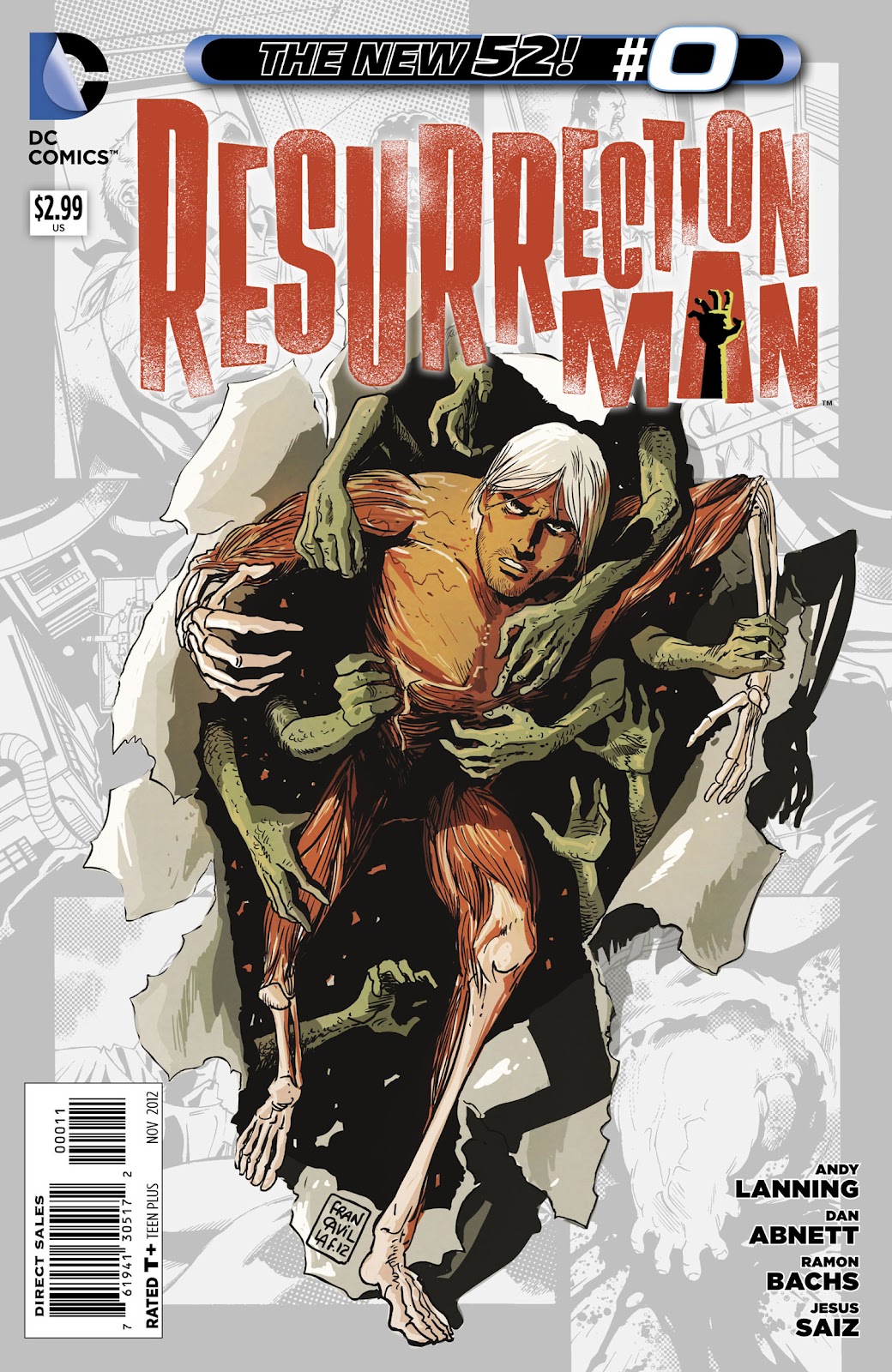
RESURRECTION MAN #0

STORY: Dan Abnett and Andy Lanning
ART: Ramon Bachs and Jesus Saiz

Mitch Shelley is a huge ass. At least, the real Mitch Shelley. Not the Mitch Shelley we've been following over the past 13 months. Last month, it was revealed that the main character of Resurrection Man was actually a clone of the true Mitch Shelley, who it turns out is the evil mastermind behind the entire series' worth of criminal activities. It was an eloquent - if not slightly sadistic - way to technically end the series. Dan Abnett and Andy Lanning were given this chance to explain things a bit more with Resurrection Man #0, and thus the issue gives readers a more comprehensive historical account of the real Mitch Shelley, as well as the events that led to the creation of "Resurrection Man" Mitch Shelley. The biggest shortcoming of this "Zero Issue" is that Abnett and Lanning seemed to have planned for Resurrection Man to continue, as foreshadowing and set-ups for future plot lines are littered throughout these pages.

For the same reason I've had a love/hate relationship with this series for the past few months, Resurrection Man #0 ups the ante by continuing to be one of the best titles from DC's 'New 52' even though this is the very seriously final issue. I tried to not get too attached to this series, as I knew the adventures of Mitch Shelley would soon be coming to an end. It didn't work, and just like the frustration of watching Firefly after it had been cancelled, I found myself upset that a series this good was so underrated. Honestly, I was holding out for a last-minute renewal, similar to Community's miraculous fourth season (SIX SEASONS AND A MOVIE!).

The plot of Resurrection Man #0 would seem straightforward enough. Fortunately, Abnett and Lanning don't take the easy way out, instead opting to make this origin story as wacky and sci-fi as possible. The first thing we're made to understand is that Resurrecting Mitch's memories were actually Proto-Mitch's memories. This means that it was the jerk-wad Mitch who was in the Middle East with Deathstroke and Hooker five years prior. This also accounts for all the other horrible flashbacks Living-and-Dying Mitch would have about his "past". At some point in Iraq, O.G. Mitch is badly wounded then attacked by some fish monster thing and injected with the tektite solution - a self-healing agent -  which becomes the catalyst that starts the proverbial ball rolling. To save the rest of his horribly wounded team, Mitch Sr. orders the tektite solution used to treat all of them. This is how Director Hooker receives his powers, as well as the Body Doubles.

In the hoopla of the explosions that cause all the harm, the Original Mitch Shelley loses his arm. Even with the tektites flowing through him, the reattachment is unsuccessful. Shelley orders his dead arm incinerated to keep the tektite solution out of enemy hands. But as Jeff Goldblum said in Jurassic Park, "Life finds a way." The tektites survive the incineration and escape through the smoke into nature where they instinctually sap all surrounding matter to 'resurrect' Mitch Shelley from the blueprint of his DNA grafted onto them. It's a bit complex, a bit high-concept, and is just plain cool. The tektites simply reconstitute Neu-Mitch whenever he dies in the same fashion, giving him a new power each time in the process.

Resurrection Man #0 also looks toward the (now nonexistent) future of the series. Who is the fishy-man who injects the first Mitch with tektites originally? How does Deathstroke's involvement with Mitch Shelley connect with his time with Team 7? How will Mitch make amends for the terrible crimes of his source material? Where does Kim Rebecki fit into all of this? And why is the Devil being set up to become a major character? Alas, it's highly unlikely any of these questions will ever be answered, unless Mitch joins the Justice League Dark or something. (Hint, hint, DC.)

GRADE
A

SERIES GRADE:
A+

Monday, July 16, 2012

RESURRECTION MAN #11

STORY: Dan Abnett and Andy Lanning
ART: Jesus Saiz and Javier Pina

If you keep up with "The Endless Reel", you know how much I adore Resurrection Man. In a universe full of interconnecting narratives and convoluted history, Mitch Shelley's adventures represent what comics used to be - a rip-roaring good time full of superpowers, good vs. evil, and a damn fine mystery to solve. That being said, the past couple of issues have floundered somewhat, unable to make any significant progress in uncovering Shelley's mysterious past at all. Of course, Shelley's rotating power set is also a draw to the book, but he's had the same shadow powers for those same few issues, so it's starting to get a bit stale. Resurrection Man #11 comes back around and brings some resolution to at least a one ongoing plotline dealing with the Transhuman, an old villain looking to help Shelley figure out his past.


It's nice to see a character experiencing a relatable form of amnesia; it seems Mitch's memory loss came from more normal circumstances. He begins to remember more about his former life the more he experiences in familiar territory. Too often, amnesia in comic books is caused by magic or super powers, meaning the solution to reversing the memory loss comes from said magic or super powers. In Shelley's case, it may have just been a bump on the head.


Kim Rebecki has been an ally to Shelley for some time, using her empathic powers to understand how things and people work simply through touch. This month, her power reveals a giant skyscraper hidden in plain sight at the Soder Cola factory in Viceroy, South Carolina - Mitch's hometown. With cloaking technology in place, the skyscraper appears invisible to the citizens of Viceroy, allowing the organization that turned Mitch into the Resurrection Man to operate in secret while using the Soder factory as a cover.


A large portion of the issue is devoted to Mitch and Kim fending off an attack by Director Hooker, the man responsible for Mitch's arrest warrant. After locating the Transhuman, Mitch and Kim attempt to free the old man before he reveals his betrayal - his is a super villain, after all. Honestly, it's a bit of a let down, as much of Resurrection Man's run has been dedicated to Mitch and Kim tracking down the Transhuman, someone they believed to be a friend. Of course, it's not out of the ordinary for Mitch to have such bad luck. Mitch is killed this issue, bringing an end to the 'shadow master' powers and introducing his 'eye laser' ability - similar to that of Cyclops' optic blasts, but more lightning-esque and less controlled.


What started out as one of my favorite series in DC's 'New 52' has quickly become stale, possibly a reason for it's cancellation. Dan Abnett and Andy Lanning have fantastic storytelling ability, but it feels like they don't know what to do with Mitch Shelley. There seemed to be a focus for the first six issues, but recent months have yielded a lot of fighting without much substance. And while nothing's wrong with a fight sequences every once in a while to break up the narrative, using confrontations as a means of plot advancement doesn't work if they don't advance anything!


GRADE
C

Monday, June 18, 2012

(COMIC) 4-SENTENCE REVIEWS #4!

Resurrection Man #10
(Abnett, Lanning, Saiz)

I've been a extremely avid fan of Resurrection Man since last September, mostly based on the fact that Dan Abnett and Andy Lanning were less concerned with creating some amazingly big story arc and more focused on just writing interesting stories. I was pretty upset when DC announced that the series would end after it's 'Issue Zero' this coming September, but after reading Resurrection Man #10, I'm wondering if maybe it wasn't all that bad of a call. This month, Mitch Shelley and Kim Rebecki are still on the hunt to uncover Mitch's mysterious past, but instead of advancing the story at all, Abnett and Lanning bring back the 'avenging angels' that came after Mitch way back in issue four or five, a move that shows that maybe these writers really don't have a solid future in plan for the man who can't die. It's far more likely that Mitch Shelley's story will have a super-satisfying conclusion come next month, but we'll just have to wait and see.

GRADE: B


Before Watchmen: Minutemen #1 of 6
(Darwyn Cooke)

Minutemen is supposed to be a look back at the original superhero team that set the (arguably) 'golden standard' for what the Watchmen eventually aspire to attain: the original idea of truth, justice, and the American way. And while we know the Minutemen had their own set of problems, they also operated in a simpler time when origin stories didn't involve intergalactic sentries or mystical interventions, but instead came from ordinary people looking to make their world a little bit better. In this first of six issues, Darwyn Cooke spends a lot of time going over the origins of each member of the Minutemen, and while this could come off as cheesy and overbearing, Cooke masterfully makes each introduction feel like you're meeting these characters for the first time. It's a phenomenal first issue and even better beginning to the Before Watchmen event.

GRADE: A


Before Watchmen: Silk Spectre #1 of 4
(Cooke, Conner)


In the first title dedicated to a member of the Watchmen (the first in the Before Watchmen series focused on the Minutemen, which features the Comedian, but none of the other Watchmen proper), and it's pretty damn good. Laurie Juspeczyk has grown up in the shadow of her mother, both in terms of training and studying to carry on the Silk Spectre name, as well as her infamous streak of compromising work after her days as a superhero ended. Laurie's tale starts as a romantic story with chisel-jawed Greg, a boy who knows about her mother's racy past and doesn't care - all he wants is to be with Laurie, and the two of them decide to run away from home and hitchhike to wherever. Darwyn Cooke has set up a very mid-60s story, complete with adolescent angst, social hierarchy, and a pinch of hippies to keep us interested for the next issue.

GRADE: B

Monday, January 9, 2012

Crisis Update: The O.M.A.C. Project

Crisis Update
Volume 1, Entry 2


The O.M.A.C. Project
Greg Rucka - Writer
Jesus Saiz - Pencils


After Countdown to Infinite Crisis, DC launched the four mini-series that would lead us dear readers into the comic event nearly 20 years in the making. A cynic would say that DC decided to release four consecutive six-issue mini-series before the main event merely to sell more books and tie-ins. And those cynics would be right. When I first read The O.M.A.C. Project nearly seven years ago, it was a lot more impressive. Perhaps it was the anticipation of greater things to come.

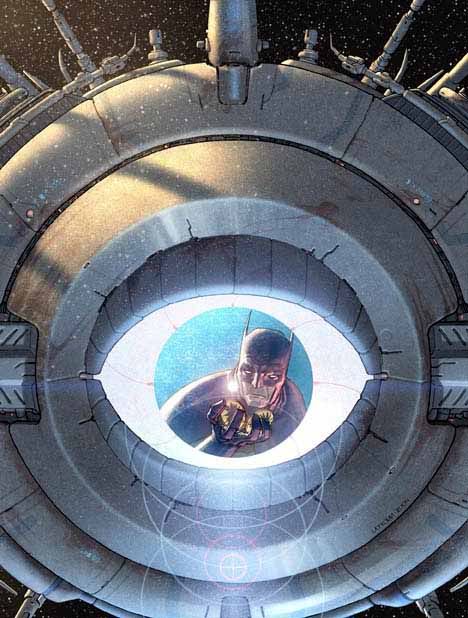
Greg Rucka pens a story better suited for an oversized one-shot (or at most, a three-issue series) more than an extended six-issue saga. Much of the page space is taken up with needless exposition and somewhat pointless espionage panels. And even with all the talking and cold stares, Maxwell Lord - the title's titular villain - is barely fleshed out as a character. The O.M.A.C. Project tells the tale of how Max Lord hijacked Batman's paranoia-inspired Brother Eye - a satellite equipped with any and all information pertaining to all meta-humans across the planet. Lord's motive is solid - he's frightened of the sheer power heroes like Superman wield - Lord has a history in the DC universe, yet Rucka takes little time to give the reader context as to why Checkmate's Black King is so damn mad at superheroes.

Sasha Bordeaux is also a pretty lame character. Of course she's a Rucka-created character because she has barely any development or personality. In O.M.A.C., she is simply the cardboard cutout that acts as the 'main character', the one us readers are forced to follow around despite her inane dialogue. And Jesus Saiz's 'same face' syndrome is quite problematic in these pages, as Bordeaux looks nearly the same as her sort-of-rival Jessica Midnight, another Checkmate agent, one who opposes Lord's total control of the organization.

***SPOILERS***
And then there's "Sacrifice", an arc within an arc leading up to the beginning of O.M.A.C. #4. What's unfortunate is that in an obvious ploy to sell more books, DC made reading "Sacrifice" a necessity to understand anything in O.M.A.C.'s plot going forward. In September of 2005, readers had to pick up Superman #219, Action Comics #829, Adventures of Superman #642, and Wonder Woman #219 to get the whole story of how Max Lord uses his mind control abilities to make Superman his own meta-human weapon. At the end of Wonder Woman #219, Diana snaps Max's neck while Brother Eye records everything. And that is exactly where O.M.A.C. #4 picks up! Even when it was current, I remember feeling taken advantage of by DC; why shouldn't all the major plot points of a mini-series exist within said series? It's such a point of frustration that really had no purpose. Later on (around issue 5) the Brother Eye gains sentience, which is pretty cool, but even that juicy plot development gets sidetracked so we can get back to Sasha's personal drama. Bleh.

So, the basic problem with O.M.A.C. is a lack of depth. The idea for the story is a solid one rooted in DC's tumultuous past, but the concept and plot are given very little room to grow and are thus bogged down by their own weight. Definitely read The O.M.A.C. Project, if only for the basic necessary facts needed going forward into Infinite Crisis. Beyond basic exposition, there is little else to love about this title.

Grade: C-