Showing posts with label Geoff Johns. Show all posts

Thursday, February 23, 2017

Who is the New Geoff Johns?

With DC Comics Chief Creative Officer Geoff Johns stepping away from comics to fulfill a more comprehensive role for DC Entertainment’s film and television franchises, the role of ‘World Builder’ for the Rebirth universe – DC’s soft-relaunched ‘classic’ universe that kicked off last June – has gone largely unfilled. While it’s true that Johns himself designed Rebirth and the mysteries surrounding the multiversal crisis, he’s yet to write a book since it began. Even the first major crossover event, Justice League vs. Suicide Squad, was handled by The Flash writer Joshua Williamson.

Generally speaking, things have been going well – many titles are enjoying an uptick in sales, some due to a twice-monthly publishing schedule, and the DC Universe feels like it once did as creators bring more and more elements from the past to the present. There’s incredible talent at DC, and it’s to the publisher’s credit that there are so many different voices contributing to Rebirth’s impressive output thus far. That said, this initiative has felt like a ship without a captain onboard, a huge new sandbox filled with awesome toys and no adult supervision.

Rebirth is great in no small part to the engenderment of nostalgia; familiar names that seemed alien or mischaracterized during the ‘New 52’ suddenly felt right again, like DC finally grasped what made these characters work and just let it happen instead of trying to control every single detail. Unfortunately, the high quality of individual Rebirth series belies the absent cohesion, mainly the aforementioned playground metaphor concerning the lack of a ‘brand leader’ to direct the general flow of DC shared universe narrative.

I’m not advocating for a World Builder in the way Johns was or Grant Morrison before him – mainly, there needs to be at least one or two creators whose titles affect other titles outside crossover issues or events, a writer helming a book that speaks to the wider DC shared superhero universe while also telling a cogent story. Marvel’s toyed around the concept over the decades, most recently with Brian Michael Bendis then Jonathan Hickman before the directionless-ness the House of Ideas is currently experiencing (although an argument could also be made for Al Ewing or Nick Spencer at the time of this writing.)

There are a few good options for ‘universal affecter’. Joshua Williamson is killing it on Flash and wrote an exciting, interesting crossover event that didn’t get too big or cave in on its own conceit. Scott Snyder is arguably DC’s most well-known creator, but he’s almost too comfortable in the Batman corner to effectively impact much outside Gotham’s shadow. Dan Abnett writes Aquaman and Titans, Peter J. Tomasi has Superman and Super Sons, Ben Percy is on Teen Titans and Green Arrow – any of these three would be a good choice. But honestly, it comes down to the Justice League, and I don’t say that lightly.

In the 1990s, Grant Morrison wrote JLA and directed the course of DC Comics for years. He followed that up with a giant multiversal saga that spanned three events and a new Superman origin story over a decade (Seven Soldiers of Victory, Final Crisis, Action Comics: Superman at the End of Days, The Multiversity). Similarly, Johns held the reins at DC with Justice League throughout the five years of the ‘New 52’, even going so far as to blatantly ignore the status quo to finish “The Darkseid War”. For the DCYou initiative (the death throes of the ‘New 52’ that started in Spring 2015), Bryan Hitch was also given the freedom to ignore continuity for Justice League of America (an expressed ‘side story’) before he scored the Rebirth volume of the Justice League eponymous title to all-around negative reception because it’s terrible.

A certain level of authority comes with writing the Justice League, the power to change the direction of any one of these incredibly important characters. Whether it’s the effects of a battle or the development of interpersonal relationships, what happens in the League is significant across DC titles and always has been.

With all this said, the clear decision for the ‘New Geoff Johns’ is Steve Orlando.

Orlando began his career at DC Comics with Midnighter during the DCYou initiative, celebrated for its engaging and well-characterized take on StormWatch’s resident badass as well as his tactful representation of Midnighter’s sexuality. He then scripted issues of Batman and Robin Eternal and wrote the Justice League – The Darkseid War: Shazam! one-shot. For Rebirth, Orlando hit the ground running with Midnighter and Apollo (the sequel series to Midnighter) and Supergirl, then co-wrote “Night of the Monster Men” with Tom King through Batman, Nightwing, and Detective Comics in October 2016. What seals the deal for Orlando as ‘DC Showrunner’ is his most recent project: Justice League of America.

** SPOILERS FOR JUSTICE LEAGUE vs. SUICIDE SQUAD AHEAD! **

Justice League vs. Suicide Squad changed how ordinary citizens see superheroes after Maxwell Lord uses his Eclipso powers to possess the League (except Batman) and turns them into soldiers to take control of the entire planet in less than fifteen minutes. More often than not the ends don’t justify the means, and no manner of excuse can shake the distrust and fear ordinary civilians begin to feel in the wake of their protectors turning on them. With Hitch’s Justice League floundering out of the gate, Orlando’s quirky JLA roster is the superhero team we need, and also the one we totally deserve after having to read “The Extinction Machine” (Justice League #1-5.) Batman understands that powerless need to feel empowered, that living in a world with gods watching over them doesn’t mean they can’t themselves be heroes. This is the reason for Bruce’s Justice League of America, a purposely named team with purposely chosen individuals to carry out a purposely designed mission statement.


Mari McCabe (Vixen) brings a level of celebrity to the team, a model and animal activist turned heroine whose take-no-crap attitude is necessary to keep conflicting personalities in line and ready to act. Ryan Choi takes up the mantle of the Atom when Ray Palmer goes missing in the Microverse and Batman comes knocking with an offer to be in the…a Justice League. After she saves the world in JL vs. SS, all Caitlin Snow (Killer Frost) wants is a chance for redemption, so that’s what Batman offers; he secures her release from the Suicide Squad and vouches for her membership. Ray Terrill (The Ray) thought he was allergic to light and lived inside until he couldn’t take it anymore and discovered he was living light – after four years of learning how to become and manipulate light, Ray’s first instinct is to help those in need with his abilities. Dinah Drake (Black Canary) is there to keep the team in check and be the moral center that stays their hand when it harms instead of helps, a role Batman insists any team needs. And then there’s Lobo, a galactic bounty hunter who would probably love Donald Trump, can’t die, and happens to owe Batman a debt.

Each of these individuals brings something different to the table in terms of power sets, personalities, and culture. Orlando recognizes the necessity for relatable characters with diverse backgrounds working together for the greater good, less manifest destiny like the world’s most powerful heroes banding together as planetary defense force and more a collective of people with powers trying to be better. And this is exactly why Orlando’s writing is engaging – he tells stories about heroes striving to improve themselves and find closure in a world where the impossible happens every day. All of Orlando’s work exhibits this theme on some level, and it’s the tone DC needs right now even as it enjoys the financial success of Rebirth, et al.

Allowing Orlando to bring his cunning, organic, character-driven style to Justice League of America shows DC has faith in the man’s ability. The astonishing lead-up to the series included four character-specific one-shot Rebirth issues – Vixen, The Ray, Killer Frost, The Atom – and a collective Justice League of America: Rebirth one-shot all before the first proper #1 issue; this points to DC’s investment in Orlando and this series in general.

With DC Entertainment’s film universe in flux and Bryan Hitch’s Justice League in the toilet, Justice League of America is poised as the publisher’s new flagship title that reflects a more comprehensive theme for Rebirth moving forward, one that focuses on characters and finds common ground through relatable situations.

Geoff Johns did an admirable job directing the ‘New 52’ despite its many and varied flaws. His parting gift to DC Comics was the Rebirth initiative that fused the old with the new by bringing elements from the classic DC universe into the standardized ‘New 52’ timeline, a move that could have been disastrous but as proven to be exactly what the company needed. This healthy balance of new ideas and tradition is a perfect landscape for Steve Orlando to helm a new era of DC Comics that values diversity and inclusion and honors the past while working for a better future.

Wednesday, May 8, 2013

Justice League of America #3

(w) Geoff Johns     (a) David Finch

I want to like Justice League of America more than I do. The first issue was fun in as much as a set-up issue can be, and the second issue was build-up for the teams first mission. There hasn't been a lot of time to develop the team dynamic, and it's starting to hurt the series as a whole. It's surprising because Geoff Johns is usually spot-on when it comes to character development and team books.

Before I get into the issue proper, I want to address something that's been bothering me since the first issue. WHERE IS SIMON BAZ? He was completely absent from the first two issues -- his dossier introduction aside -- and in Justice League of America #3, he appears in all of two panels, and they're both panorama shots so he's barely visible. Simon's inclusion on the team is a big reason why I was interested in the title in the first place, and he's still nowhere to be seen three issues in. A lot of people had the same issue with Justice League when it first began, but those first six issues were a complete origin story where all the Leaguers meet for the first time. The JLA is established and has yet to have a full-team mission.

Alright. Moving on.


** SPOILERS AHEAD **


Justice League of America #3 opens with a scene between Stargirl and Amanda Waller. While their conversation starts off innocently enough, it quickly takes a sharp left turn when Waller takes a hard stance against Stargirl's wish to be a more active member of the team. The comic book trope of the youngest superhero of the bunch feeling left out drives the sequence, but Waller's ugly attitude shows just how sketchy this team is at it's most basic level. Courtney Whitmore -- as Waller reveals her name to be -- joined the team as a bright-eyed, optimistic do-gooder who is now being blackmailed into running PR for this government-sanctioned superhero team. It's all very intriguing. And David Finch's facial work really characterizes Waller's ugly nature.

Vibe feels like a 'deus ex machina' to get the team and himself out of almost any technological quandary. Oh, there's a security camera? Vibe can't be photographed and neither can those around him...as of this issue. Not in his own series; only in this issue of Justice League of America. Also, I really don't like Katana. I've never read any of her pre-New 52 material, and the first issue of Katana was so hideous I just put it down and screamed into a pillow for a few minutes. She just seems like such a ridiculous Japanese stereotype that I just can't understand why people stomach her.

Green Arrow's faux pas during an orchestrated arrest of Catwoman fantastically well done, and Ollie's subsequent use of the privileged information about Catwoman's true allegiances to garner a place on the team is eloquent and hilarious.

Speaking of Catwoman, I read Catwoman #19 after Justice League of America #3 because it's supposed to be a look at Selina's 48 hours inside Arkham Asylum before she escapes at the end of JLA #3. I wouldn't recommend doing the same unless you're interested in reading a story that has nothing to do with anything at all. The whole plan was for Catwoman to get info about the Secret Society whilst inside Arkham. Instead, she antagonizes everyone and really doesn't get much in the process. 


GRADE
7/10

Total Side Note:
Within the pages of Catwoman #19, Ann Nocenti took it upon herself to explain that Arkham Asylum isn't actually a historic mansion turned into a hospital, but rather a fully modern facility employing holographic technology to make it look like a historic mansion. 

Two reasons why I hate this so much.

1.) It totally and completely destroys the idea that Arkham is a genuinely frightening place. The facility's presence is juxtaposed to it's primary function which is what made it such a compelling part of the Batman mythos. If this holds across other titles, it will mean that Arkham is just another loony bin, no different than your average high-tech insane asylum.

2.) If Dr. Arkham has the money to spend on holographic infrastructure for an entire facility, why can't he spend more on security, overall structural integrity, and pooling of resources to achieve real results? It makes absolutely no sense. If Dr. Arkham is some weirdo who only runs the asylum to play around with the criminally insane, why does Batman trust him? And if he truly does think he's doing the best he can, why does Batman suffer such a fool?

Thursday, March 21, 2013

Justice League of America #2

(w) Geoff Johns     (a) David Finch

After a brisk yet satisfying first issue, Justice League of America #2 stumbles a bit as Geoff Johns attempts to get the action rolling as quickly as possible. Honestly, it's kind of annoying that the "Secret Society" is already known to so many people. I know Martian Manhunter says that all the villains he's interrogated have no idea what the Society is, but the fact remains that A.R.G.U.S. knows about it so how secret can it truly be? Johns spent six issues building up to Darkseid's arrival in Justice League. Here, the team is already assembled and out on their first mission. I'm all for getting to the point, but this seems needlessly fast paced.

The most unfortunate part is that this entire issue feels very much like it could have been the first, with the first issue as a #0. I know DC already did "Zero Month", but if Johns wants things to move at this kind of speed, he's already misstepped because the first issue was so slow. Both issues have been good, but neither fit together particularly well, and that's not a good relationship between the first and second issues of a new flagship series. 

Surprisingly, Green Arrow turns out to be the surprise star of JLA #2, and he's only conscious for the latter half of the issue. I still don't know why, but Johns insists on writing Steve Trevor as a massive ass, and his conversation with a newly awake Ollie Queen reasserts this bewildering fact all over again. Back in Justice League #8, Arrow attempted to join the League proper with less than desirable results. Trevor approached Arrow and it was established that Green Arrow would be an agent of A.R.G.U.S. It seems that now, after Ollie's been through the gauntlet to uncover the Society, Trevor has no problem throwing him to the curb without a satisfying explanation. The emotional tension between Ollie and Steve is great, and Ollie's insistance that Steve "sold out" is a fantastic throwback to Green Arrow's classic counterculture characterization.

Even though JLA #2 doesn't have the same feel as the first issue, Geoff Johns is still stetting up something big. Perhaps the series is supposed to feel like it's not completely sure of itself, much like Steve Trevor and his grasp on the JLA situation in general. Last year's The New 52 #1, which came out on Free Comic Book Day, portended the coming of a Trinity War that pitted hero against hero. That reality is coming closer and closer to fruition with more characters and plot lines being introduced.


GRADE
7.5/10

Wednesday, March 20, 2013

Justice League #18

(w) Geoff Johns     (a) Jesus Saiz

Geoff Johns is taking the same route Cartoon Network's Justice League did in 2004 by expanding the roster of the League in anticipation of bigger, more ferocious enemies in the future. Honestly, it would have been nice to see more of the core team's adventures and interpersonal relationships before diving into team expansion. Sure, this is Justice League #18 and the 'New 52' has been around for close to two years, but in the modern age of decompressed storytelling, 18 issues has only produced a handful of conflicts that the League has faced. 

Back in the day, 18 issues could have been 18 different stories, a different approach to team building, but one that offered a more robust look at how said team works as a unit. Today, it's still somewhat unclear how the core League members truly work together, how their personalities play off each other, and how that affects their behavior. Johns has done an excellent job delivering character development where possible, but it's still frustrating to see new members coming in at this point. And that's not even mentioning Justice League of America, which also sees Johns bringing lesser known characters into the spotlight. It's just a geyser of new characters, it seems.


** SPOILERS AHEAD! **


Justice League #18 is an exciting issue because we get to see so many faces in one issue. With Hal Jordan out of the picture for the time being, and the near-destruction of Boston in "Throne of Atlantis", Batman and Cyborg decide it's time to reveal the Grid, a circumstantial database of all the world's superheroes. I say circumstantial because the entire Grid was a side-effect of the persistent flow of information into Cyborg's always-connected mainframe. Since he's basically a living supercomputer, Cyborg shares the curse of overabundance with Superman -- they're both continuously aware of almost everything around them. The difference is that Clark hears everyone while Victor processes digital information terabytes at a time. Thus, over the five years of the League's existence, Cyborg inadvertently collected all the known information on every superhero on Earth.

But it's just that: only the known information. Justice League #18 not only showcases established heroes like Black Canary, Zatanna, Firestorm, and Nightwing in a new light, but also gives minor and new characters a chance to shine with a chance at membership in the planet's most exclusive hero club. While the current members of the League all understand the where they are and what the stakes are going forward, most of the invited candidates have no idea what they're in for. It's this juxtaposition that provides a nervous tension that simmers throughout the issue. Even Nightwing and Batman's short interaction reflects their relationship post-"Death of the Family". And how could it not be awkward? Six of the most powerful beings on the planet are judging and choosing new colleagues to patrol everything, not just a city or neighborhood beat.

There's no escaping the fact that Justice League #18 is a good old-fashioned prelude issue. There's so much being set up from beginning to end that it's hard to squeeze a story-proper out of an issue like this. Fortunately, Geoff Johns stands up to the task and makes the entire affair feel completely fluid and natural. My bias for the structure of character development aside, JL #18 hits all the right marks. At the end of the day, it's really hard not to like seeing so many familiar (and some unfamiliar) faces in one issue.

GRADE
7.5/10

Sunday, March 10, 2013

Green Lantern #18

(w) Geoff Johns     (a) Szymon Kudranski

It's the proverbial beginning of the end as Geoff Johns marches toward his final issue of writing Green Lantern. There are nine years and a whole lot of amazing stories that have come before this, and judging by Green Lantern #18, Johns is looking to change the franchise in big ways right here at his finale. "Wrath of the First Lantern" graces the issues' cover even though Volthoom never even shows up, and the sour relationship between Hal Jordan and Sinestro rears it's head, once again putting the two egomaniacs at odds.

Hal and Sinestro aren't all that different -- they both have elephant-sized egos, it's just that more often than not, Hal has luck on his side while Sinestro has had to overcome extreme adversity to legitimize his overconfidence. Where these two Lanterns diverge is in their charm because Hal can talk to and persuade almost anyone to see things his way, while Sinestro likes to yell and curse to flaunt his mental psychological superiority. Johns encourages this poisonous relationship by throwing Simon Baz into the Dead Zone along with his two predecessors to see what the ring's presence will do to them.

The biggest letdown on Green Lantern #18 is the detailed explanation of Volthoom by Tomar Re. First off, it's too long; an entire two-page spread is dedicated to the story of the First Lantern and how he came to be, which is nice. But the entire tale feels shoehorned into an issue that should have focused solely on Hal and Sinestro finding a way back to the land of the living. Instead, Tomar Re's exposition dump hits the brakes on any momentum Johns was building and leaves the rest of the issue feeling sluggish. Sure, we get a fight between Hal and Sinestro for possession of the atomically-split second GL ring, but after a long lecture from a dead guy about someone else who isn't even in this issue, the brawl felt too short and overlooked.

Green Lantern #18 is a great issue when it's focused on Hal, Sinestro, and Simon. While Johns does take some minor detours that feel underwhelming, the overall experience is pleasant. Szymon Kudranski's art is spectacular and fits with the Dead Zone backdrop perfectly. Is it a coincidence that Hal seems to look a lot like Geoff Johns himself? "Wrath of the First Lantern" is a mixed bag when it comes to quality. I wasn't impressed with the first four issues of the crossover and GL #18 doesn't even feature the eponymous Lantern. As an actual story, it's nothing to shake a stick at, but the effects of the First Lantern's existence are causing all sorts of indirect results that are far more interesting than yet another emotional spectrum conflict.

GRADE
7.5/10

Thursday, January 31, 2013

REVIEW: AQUAMAN #16

(w) Geoff Johns (a) Paul Pelletier

**WARNING: SPOILERS AHEAD**

Hot off last week's big reveal at the end Justice League #16, Geoff Johns throws "Throne of Atlantis" into fifth gear in Aquaman #16 with some fights, some twists, and a whole lot of new questions that need answering before the end of the crossover. Orm the Ocean Master -- aka the current King of Atlantis -- sentenced the Superman, Batman, and Wonder Woman to death by expulsion to the "dark waters". While Aquaman searches for his beleaguered friends who are sinking to the bottom of the Mid-Atlantic Trench in weird pods, the reserve members of the Justice League bring the fight to the invading Atlantean army on the surface. 

The most exciting part of Aquaman #16 is seeing the extended League roster show up to lend a hand in this time of crisis, and how that affects the League proper. Some choice dialogue reveals that Batman and Cyborg had been developing the idea of having a sort-of emergency call list of Leaguers on stand-by, but Batman's frustration at Cyborg's call to arms shows Vic acted of his own accord. Cyborg's decision to circumvent Batman's input is an important step for Victor, a relatively popular hero who isn't featured in any other series of the 'New 52', and who desperately needed some character development beyond his father issues. Now, we have some friction between Cyborg and Batman, something that will surely come up in future issues. And seeing more heroes being added into the mix is just plain exciting.

While the extended League takes on the Atlantean forces, Aquaman and Cyborg manage to free Superman, Batman, and Wonder Woman while also learning that the monsters Aquaman believed he had sealed away at the end of "The Trench" have mysteriously returned. Up to now, educated assumptions pointed to Orm's hand moving the chess pieces around the board to force an war that would prove Atlantis' superiority.   The dramatic irony of the Trench monsters' freedom finally comes to light for the characters, but their arrival raises even more questions because Orm is as confused about their sudden and seemingly indiscriminate strike as the League. 

Even though everything is coming together, Johns keeps us guessing to the end with the big twist at the end of Aquaman #16. The reveal makes a lot of sense and it points to how and why the events of "Throne of Atlantis" have taken place, but it also leaves things open for a solid resolution in Justice League #17.

GRADE
8/10

Friday, January 25, 2013

REVIEW: JUSTICE LEAGUE #16

(w) Geoff Johns
(p) Ivan Reis
(i) Joe Prado

Last fall, a number of DC creators, editors, and executives started talking about how 2013 was going to be a year full of changes for the 'New 52'. Geoff Johns' epic "Throne of Atlantis" could have been a simple crossover between Justice League and Aquaman -- a natural move since Johns writes both series -- but it's slowly transforming into a turning point for the entire DCnU.

Justice League #16 sets up the final pieces for the inevitable war between Atlantis and the surface world. The issue is thick with anticipation -- the difference between war and peace lies with Aquaman's ability to temper the Justice League's justifiable anger over the tidal wave that decimated the eastern seaboard against his brother Orm's anger over the perceived attack on Atlantis. At some points, Aquaman is literally standing between the League and Orm, stopping all hell from breaking loose. Aquaman's ethical quandary over how to proceed -- standing with the League and demanding justice from Orm, or adhering to Atlantean tradition by forsaking the entire surface world -- is a central theme for the entire sequence. The one unfortunate element of this situation is that all the character behave in cliche superhero fashion of punching first and asking questions later. Batman, in particular, acts particularly out of character for a hero who understands the intricacies of how fear compels people to do unspeakable things. But traditional superhero tropes aren't enough to detract too much from this stellar issue. 

But there's a lot more to Justice League #16 than just the beachhead confrontation between the League and Ocean Master. For one, Dr. Shin has been an important and central character in Aquaman since the first issue, so it comes as no surprise that he's a target of a team of Atlantean assassins who believe Shin is a key figure in turning the tide of the coming war. Being the foremost human expert on Atlantean physiology puts the Doctor in the unique position of finding a weakness to exploit. Johns also properly introduces Dr. T.O. Morrow into the 'New 52' with his suggestion that S.T.A.R. Labs employ his nameless "android" to take control of the weather from Orm, who has used his mystical staff to conjure up a series of deadly storms. It's just a passing remark, and the idea gets shot down by Cyborg's dad pretty quickly, but not before a certain Dr. Magnus and his Metal Men are also mentioned. Being the Chief Creative Officer for DC, Johns has a lot of freedom to include little nuggets of foreshadowing. Of course, the biggest "holy sh*t" moment comes with the final splash page that points to a bold new direction not only for Justice League, but also the DCnU at-large.

Justice League #16 is a fun issue full of intense action, plot-advancing story, and an ending that will get most any DC fan excited for the future of the series and the 'New 52'. Already, a tidal wave has destroyed the east coast of the United States. That's going to last for a while, and a war with Atlantis is going to change the landscape even more. Since last Free Comic Book Day, we've known that 2013 would bring "Trinity War", the first major 'New 52' crossover that would effect the entire line. "Throne of Atlantis" may or may not be a prelude to this massive event, but it's setting the standard for 2013 being about big ideas and big changes.

GRADE
9/10

REVIEW: GREEN LANTERN #16

(w) Geoff Johns
(a) Doug Mahnke
(i) Christian Alamy, Keith Champagne, Tom Nguyen, and Mark Irwin

Since his first appearance in last September's Green Lantern #0, Simon Baz has polarized internet discussion boards for a variety of reasons. From readers who felt Baz was an unnecessary attempt at diversity, to those who felt his 'mistaken terrorist' storyline was too politically motivated, to others who simply disliked the fact that a Green Lantern was carrying a gun. Of course, for all the detractors, there were just as many fans who were vocal in their excitement for a superhero more representative of modern American culture. Green Lantern #16 offers a good helping of plot advancement thanks to the arrival of B'dg, a squirrel-like Green Lantern most recently featured in Robot Chicken's "DC Comics Special" in a segment highlighting some of the more ridiculous characters in DC's pantheon. 
It seems as though Geoff Johns took this slight to the might B'dg to heart. The adorably bad-ass B'dg becomes Baz's teacher/coach by default once he learns Hal Jordan is technically dead.

One of the best things about Simon Baz has been the way Johns has characterized him beyond the ring. Too many times in comic books, characters are introduced and made to accept their fate with little to no question for the sake of moving the story along quickly enough to keep readers interested. Johns, instead, has taken the time to flesh out Simon as a person. Simon's journey has two parallel narratives that play off one another and pay off in big ways throughout this issue. Simon's primary goal is clearing his name of terrorist actions. By focusing on a more human task, Johns is able to incorporate the Green Lantern element as the secondary narrative that's just now coming to a head. B'dg's arrival signals a turning point for Simon's career as a Green Lantern, from amateur with a ring to a member of the most powerful and revered peacekeeping force in the universe.

The final pages of Green Lantern #16 prove that Simon Baz is no temporary replacement; for a while, I was worried that Baz was more of an experiment that could be ended as quickly as it was started. Of course, that could still be the case, but Simon's inclusion in the upcoming Justice League of America coupled with the fact that the Green Lantern Corps really hasn't ever had a problem with there being an inordinate number of Lanterns from Earth points to his being around for a while. With "Rise of the Third Army" coming to a close next week, and "Wrath of the First Lantern" coming next month, I'm sure the Corps will be needing all the firepower it can get.

GRADE
8.5/10

Friday, December 28, 2012

REVIEW: JUSTICE LEAGUE #15

(w) Geoff Johns
(p) Ivan Reis
(i) Joe Prado

I'm torn in my feelings about "Throne of Atlantis".

I really want to like the story, and I very much want to understand how this is a bold, new direction for both Aquaman and Justice League. This week saw the release of the first two parts of "Throne of Atlantis" within Aquaman #15 and Justice League #15 respectively. Since Geoff Johns is writing both titles, he's not limited to cooperating with other writers to convey a singular tale. Instead, this is more like Johns featuring Johns--the characters feel fluid throughout the narrative because they're being written the same way each time, and the story itself is strong because the whole thing is Johns' brainchild. While this situation should have birthed some amazingly epic crossover, the whole idea kind of falls flat. We've seen Atlantis rise up before, and it's kind of starting to get old. I know this is the first time it's happened in the 'New 52', and for that reason, I'm willing to give Johns the benefit of the doubt when it comes to world-building (seeing as he's DC's Chief Creative Officer). And that's why I'm torn over this crossover as a whole: Johns is doing the best he can to make a rather dated idea more appropriate for the modern age, and while it's there are some general missteps made, there's also a lot to like in these pages.

Let's look at the missteps first. I'm worried "Throne of Atlantis" is getting dangerously close to Ultimatum territory in terms of needless death and unapologetic detriment to that universe at-large. In fact, the splash page of the tidal wave looming over Metropolis is eerily similar in look, tone, and feel to the wave Magneto sent to destroy New York City. Upon closer analysis, the similarities become even more apparent. Both Magneto and Ocean Master unleash a massive force of nature upon an unsuspecting human population in an effort to drastically alter the status quo. Both villains are purposefully left out of the issue wherein they cause the destruction, mostly as a means of making them more sinister and foreboding. Lastly, both Magneto and Orm lash out because someone or something is manipulating their emotions through death or destruction.

Now for the good. The fact that Geoff Johns has developed this entire crossover means he's got a lot up his sleeve. There are bound to be plot twists, double-crossings, hidden agendas, and shocking fallouts. Even though the events depicted in Justice League #15 mirror other comic book stories, Johns writers some of the best interpersonal relationships around. For "Throne of Atlantis", he's included a number of plot elements that have been building in both Justice League and Aquaman since their respective beginnings. We see Batman and Aquaman putting aside their personal issues with each other and working together to stop some of Scarecrow's henchmen. The normal, civilan dinner shared by Superman and Wonder Woman gives Diana perspective as to how Clark manages his life outside the League. And Cyborg's slow-burning narrative with his father continues to spotlight Victor's isolation and need to feel human.

The good outweighs the bad, in the end. Justice League #15 has some glaring weaknesses in terms of basic premise, but Geoff Johns' solid character work makes up for it. Additionally, bringing on the stellar Aquaman artistic team of Ivan Reis and Joe Prado was a dynamite choice on DC's part. While Jim Lee's pencils are good, I've always liked Ivan Reis' facial expressions and Joe Prado's depth in shading. I'm excited for "Throne of Atlantis" because I really like stories like this, and I'm confident Johns will do it justice.

GRADE
8/10

Friday, December 21, 2012

REVIEW: GREEN LANTERN #15

(w) Geoff Johns
(a) Doug Mahnke
(i) Keith Champagne, Christian Alamy, Mark Irwin, Tom Nguyen

For the first time in three months and eleven issues (including this week's Green Lantern: New Guardians #15), "Rise of the Third Army" feels really grave. So far, the new army created by the Guardians of the Universe has been more theoretical in it's horror and scope, mostly growing in the background and scattered panels throughout Green Lantern Family titles. In Green Lantern #15, Geoff Johns brings the Third Army to a horrifying forefront, as well as continuing Simon Baz's journey as the most grounded and believable superhero in a long time.

Even before this issue, Simon Baz rebuffed most superhero cliches. Sure, he's a nobody from some city in Michigan, but Kyle Rayner was also a nobody in an alley. No, Baz stands apart because his journey didn't start with a power ring. Most any other hero you can think of (besides characters like Wonder Woman) begins their story with a mask, with the desire to do good in a world gone bad. Baz is simply trying to clear his name of terrorism charges for something he didn't do. Geoff Johns recognized how normalized the process of character introduction had become in the mainstream superhero world, and how the community at-large had just come to accept it. Sure, there's a whole world of independent comics that explore alternative origin concepts, but applying less conventional character development to a hero as popular as Green Lantern is admirable. (For the record, I love independent comics and the previous statement is in no way meant to undermine the quality or caliber of independent comics or publishers.)

The Third Army is so f*cking scary. I couldn't say that before reading Green Lantern #15. Geoff Johns managed, in two sequences, to achieve what Green Lantern Corps, Green Lantern: New Guardians, and Red Lanterns have failed to convey, and that's the pure breadth of this parasitic legion spreading across the universe. Maybe it was an editorial decision, but it seems like Johns simply had to punch things up a bit in order to get a little momentum with "Rise of the Third Army" going. And while the 'crossover' event has been enjoyable, it mirrors Scott Snyder and Jeff Lemire's "Rotworld" crossover in that they both seem to be floundering a bit, offering stories with little advancement or affect on the greater tale. Either way, seeing a planet-sized swarm of grey monsters made my stomach drop.

Green Lantern #15 is simply exceptional. Geoff Johns is literally building Simon Baz's character--his moral, his ethics, his personality--from the ground up as he deals with his personal issues while simultaneously trying to learn why he's received a Green Lantern ring and is being approached by a talking squirrel (for those who watched Robot Chicken: DC Comics Special, B'dg's inclusion in this storyline is just awesome.) "Rise of the Third Army" finally feels real, like something ominous and terrible is getting ready to devastate the entire universe.

GRADE
9/10

Friday, November 23, 2012

REVIEW: JUSTICE LEAGUE #14

(w) Geoff Johns
(p) Tony S. Daniel

Justice League #14 brings the conclusion to "The Secret of the Cheetah", last month wherein Wonder Woman's best friend, Barbara Minerva, was possessed by the Amazonian goddess of the hunt and driven crazy by the power. I'd never read too much that included Cheetah in the pre-'New 52' days (probably saw her in crossovers, etc.), but I can't imagine she was anywhere near as cool as Geoff Johns' reinterpretation -- it's like going from tofurkey to a honest-to-goodness Thanksgiving bird! This month, we discover how Barbara Minerva's actions are more nefarious than we previously believed.

At the end of JL#13, Cheetah sank her teeth into Superman and turned him into a rabid man-cheetah bent on taking down his comrades. This is a cool plot development -- the Cheetah is either as strong or stronger than the Man of Steel -- but it's not given the opportunity to go anywhere before the League discovers the Cheetah's weakness and uses it on Clark. The appearance of the ancient tribe who worships the Cheetah as the goddess of the hunt isn't interesting enough. Sure, they've got a lot of insight on the Cheetah as a deity, Barbara Minerva's intentions, and how to save Superman's life, but it all comes at the cost of too much expository monologue. 

Instead of making this story arc a bit more fluid and organic -- perhaps with a full issue of cheetah-controlled Superman hunting the League members -- "The Secret of the Cheetah" feels rushed and compressed. Promotional material form DC states that the "road to 'Trinity War' is paved through Justice League #14'. With nothing else to go on, I can't really say what that connection might be. Then again, Johns is a master as subtle build-up to explosive results, so there's a big possibility I'll be reading "Trinity War" next year, and I'll come back to JL#14 only to see something I'll tell myself should have been obvious.

GRADE
7.8/10

Monday, November 12, 2012

REVIEW: GREEN LANTERN #14


(w) Geoff Johns
(p) Doug Mahnke

This week, "Rise of the Third Army" continues in Green Lantern #14 as Simon Baz comes face to face with the Justice League. He's been deemed a suspected terrorist already, and now that he's got a Green Lantern ring on his finger, he's just a super-powered suspected terrorist. The first thing you're thinking is, "They get into a fight, right? Superman or Batman misinterprets something, and a construct gets thrown out, then it's just a big brawl, right?" Wrong. Simon knows he can't take on the entirety of the Justice League, and he doesn't plan to. Simon's self-awareness points to Geoff Johns' increasing efforts to make the newest Green Lantern a bit more relatable and realistic. Johns understands how cliched superhero meetings have become in recent years, so this first confrontation between Simon and JL is less about a show of force and more about a show of wits.

Simon attempts to remove his ring and give it to the Justice League when the spectral energies of Sinestro and Hal Jordan burst forth in an explosion of green energy to protest. This is where Johns could have gone the easy route and made all these heroes gang up on Simon Baz. Instead, Simon subconsciously uses the ring to build himself a getaway car, then twenty getaway cars to throw the League off his trail. Sure, the Flash and Superman are probably fast enough to have found Baz in the chaos of everything, but that's not what this story is about -- it's about Simon thinking outside the box and how that type of thinking has been absent from mainstream superhero comics for quite some time.

Johns also takes some time to build mythology through sequences featuring the Guardians conversing with the still-mysterious First Lantern, Black Hand's imprisonment in the Chamber of Shadows, and the Third Army ravaging the universe in the name of peace and order. I'm enjoying Simon Baz's personal voyage as he comes to terms with being a Green Lantern and what that means in the greater scheme of his life. And while there hasn't been a lot of crossover with the Third Army proper, Johns is obviously building to something that will test Simon as a GL and as a person.

GRADE
8.5/10

Wednesday, October 31, 2012

FEATURED REVIEW: AQUAMAN #13


(w) Geoff Johns
(p) Ivan Reis and Joe Prado

"The Others" concludes this issue after a six-month adventure featuring the rag-tag team of misfits that Arthur Curry once allied. Geoff Johns has done a stellar job going beyond a simple character reboot, and has made Aquaman one of the preeminent characters in the 'New 52'. While the first arc, "The Trench", did well to give readers a general structure for Arthur and the series in general, "The Others" has been all about character development and growth - Arthur's history with Black Manta isn't as black and white (eh? eh? Get it??) as it was pre-'New 52', and that's led Johns to make both characters more interesting and fun to read than they have in years. 

Don't get me wrong, "The Others" has it's fair share of faults -- Aquaman's constant violent bitterness, Mera's ineptitude when it comes to Arthur's feelings, a whole new cast of characters that only somewhat make an impression -- but these nitpick-y criticisms are part of a larger picture that Johns is drawing concerning the King of Atlantis. Obviously, this isn't the last time we'll be hearing from Arthur's old teammates, so it makes sense that Johns didn't want to reveal everything about these characters in their introductory arc. After learning that Arthur had a whole life before meeting her, Mera doesn't really know how to approach her husband, and that's exactly what the character needs at this point in her narrative.

The biggest problem I had with "The Others" was Arthur's irrational anger and 'Lone Ranger' attitude that continued to get him into trouble. It's becoming more and more clear that Johns is using 'mystery' as a story element that applies to Arthur on a variety of different levels -- his ancestry, this friends, his motivations, etc. Arthur is an introvert, and one that seemingly gets explosively angry when others impede on his isolation. I understand wanting to make Aquaman a little rougher around the edges, but making him a huge jerk to his longtime friends is not the way to do it, per se.

That being said, Aquaman #13 turns the entire story around for me in a positive light. Arthur is finally starting to understand that by pushing away those who love him the most, he was putting them in more danger than if he had just accepted their help. At the end of Aquaman #12, Others member Vostok was murdered by Black Manta. Vostok was the most secluded of the group, spending decades waiting for the team to come back together so he could have a purpose once more. Arthur doesn't handle Vostok's death well, but in a good way. Obviously, Arthur is heartbroken that one of his oldest allies is dead, but the half-Atlantean hero uses this horrific event to motivate himself to be better than he's been.

The message Johns tries to convey with Aquaman #13 and "The Others" as a complete arc, is that Arthur Curry used to be a different man, one that used violence and anger to solve all his problems until those same qualities became the source of all his problems. Black Manta's presence was the trigger that brought the old Arthur bubbling to the surface. It's a truly genius way to write a story, letting the tale almost tell itself as Arthur's past starts to make more and more sense in context with the rest of his team. Arthur even admits, "I didn't tell you...because I'm ashamed, Mera." Arthur understands that his past is just that -- the past. He wants to separate himself from the chaotic man he used to be, but the ghosts of former mistakes keep rearing their heads.

In the end, Johns reveals that Black Manta's entire mission was simply building up to the upcoming "Throne of Atlantis" crossover with Justice League. Manta answers to someone, but we don't yet know who. It's most likely Arthur's half-brother, Orm (more popularly known as Ocean Master), but knowing Geoff Johns and his penchant for throwing curve balls, it may be someone even more sinister. Aquaman #13 is as perfect a conclusion issue as one can get. It neatly (but not too easily) wraps up "The Others", shows how the protagonist has learned and grown because of the events that transpired, and it deftly makes readers excited for the next story.

GRADE
9.5/10

Wednesday, October 17, 2012

JUSTICE LEAGUE #13


(w) Geoff Johns
(p) Tony S. Daniel
(i) Richard Friend and Batt

It's not often that Geoff Johns takes a breather. Usually, the man is constructing some massive arc that has major ramifications for the entire DCnU, and then some. It's not a bad quality at all. In fact, Johns' ability to make nearly anything he writes feel epic is what makes him such an amazing storyteller. For the past 13 months, Johns has worked magic with Justice League, a series that many journalists have criticized for having a lackluster opening arc and a mediocre second. Here's the thing - nothing is perfect, not even the Justice League. Fanboys - and increasingly, journalists - are becoming hardened against different interpretations of established continuity, no matter the situation. Why does it matter that Hal Jordan is a huge jerk? Why can't that be part of the variety of personalities on the team? Is it really a huge deal that only three members of the League appear in the first issue, even though it's the beginning of an origin story that spans six issues? Are we that jaded against change? Sure, Hal says annoying things from time to time, but I'd rather have him cracking bad jokes every once in a while than a set of seven perfect examples of human ingenuity and dedication who say the right thing every time.

Justice League #13 starts a three-issue arc focusing on the Cheetah, a classic Wonder Woman villain reimagined with a much better backstory. I mentioned Johns' penchant for the grandiose earlier because this issue proves how well he can write a smaller-scale narrative, as well. This isn't a planet-wide threat, or even a nation-wide one - "The Secret of the Cheetah" is a personal tale about Wonder Woman and Cheetah's past. It's also about a team willing and ready to help their fellow teammate without a moment's hesitation. Cheetah is largely considered to have been Wonder Woman's arch-enemy in the pre-'New 52' universe, so it makes sense that Diana's relationship with Cheetah cuts deeper than the team could know. Johns is applying his multi-layered narrative style to a more minimal stage, resulting in heavy interpersonal relationships and emotionally-driven plot advancement.

Tony S. Daniel is stepping in for a few issues before Ivan Reis and Joe Prado take over in a few months, and his style is a breath of fresh air. Jim Lee was doing some great issues for the first few months of the 'New 52', but the quality steadily feel through the summer and into the fall. It's nice to see more crisp detail and solid inking, and honestly, the artwork goes a long way in making Justice League #13 such a good issue. 

And while DC's website claimed that Johns' "Shazam" back up was still happening, in actuality, it's a story penned by Geoff Johns and Jeff Lemire about Steve Trevor and Oliver Queen. Trevor is done working for A.R.G.U.S., and decides to drink himself into a stupor when Ollie Queen shows up to deliver some bad news that looks to be of some importance in the upcoming Justice League of America starting next year.


GRADE
8/10

Wednesday, September 19, 2012

JUSTICE LEAGUE #0

STORY: Geoff Johns
ART: Gary Frank

Before the reboot, Billy Batson was the world's most perfect kid - he listened to his parents, did his homework, was kind to everyone he met, and generally didn't have a bad thought in his head. It was for this sterling character that Billy was chosen to be Captain Marvel, the scion of the wizard Shazam. And even though the Captain saw his fair share of evil throughout his adventures, Billy never stopped being that perfect little boy. Now, in the 'New 52, he's a brat and a jerk - he can't seem to get along with anyone, and he actively works against others whenever he can. A lot (and I mean a lot) of comic book news outlets have painted the recent Shazam back-up stories in Justice League as a terrible reintroduction to one of DC's most iconic and long-lasting characters. On the contrary, I think it's one of the wisest and most interesting changes made yet.

The 'New 52' is supposed to be about making things new, and what better way than to make the most unrelatable character in the DC universe just a bit more realistic? While many long-time comic book fans want to hold their beloved characters in a time-lock - never allowing for them to grow or change - it's a pipe dream, and one that the hardcore crowd is going to have to get over as comic books continue to move into newer, bolder territories. Similarly, some Marvel fans are up in arms about a book with the title Uncanny Avengers that features Rogue and Thor on the same team. So what?

As you guessed, Justice League #0 focuses on Billy and his transformation into Captain Marvel Shazam. Yes, this is the second big change to the character: Captain Marvel is now called Shazam, and the wizard once called Shazam is now simply "The Wizard", as there don't seem to be too many of them running around. I guess DC just got tired of lording the trademark over Marvel's head. Either way, it makes a lot more sense to call the superhero Shazam - there wasn't any real reason for the name 'Captain Marvel' in the first place.

I really do love Billy's new personality. He's an orphan whose been forced to grow up much faster than he should have. It's a sad but real problem in the world, today, that more and more children are made to raise themselves. The silver lining, of course, is that Billy understands the world much more than most other 15 year olds, and he proves it. The Wizard has been searching for centuries to find a "purely good" person on which to bestow his powers, only to come up empty-handed. "No one is pure good," explains Billy to a baffled, millennia-old wizard. Billy sees the situation for what it is: an over-romanticism of a certain, unattainable goal that would solve every problem ever and bring peace to mankind. The Wizard wants so much to believe that there must be a person who is pure good, that he's wasted eons searching for it, even though it doesn't exist. Quite eloquently, Billy goes on about bad encompassing the good in the world, no matter what. And while it seems that young Batson might be without hope, the Wizard looks into his soul a second time and finds the good buried beneath layers and layers of bad. In the end, it is the potential for good that will defeat the evil.

Gary Frank's art is fantastic. His work in the "Shazam" back-ups was good, but it feels like he put extra time and effort into these pages, as they feel more emotional, more vibrant, and more expressive than ever. His facial expressions are pure genius - Billy's being the obvious best - but he also knows how to draw bodies to convey an idea. The Wizard's slouch gives you the feeling he has been burdened by so much for so long that his guilt is literally crushing him.

Justice League #0 was a gamble. For a general public that doesn't read a lot of comic books, making this "Issue Zero" a Shazam-only story could be bad for the bottom line. Literally nowhere in theses pages are the actual Leaguers featured. Johns and Frank dedicate this issue to Shazam, giving him a damn fine introduction as he gets ready to join the League proper starting in 2013. Before the reboot last year, Captain Marvel was always the boy scout, more so even than Superman. He never erred, rarely faltered, and was liked by all. He was a bit more sickeningly perfect than Superman, which was hard to do. Now, we have a dynamic character who actually has depth, who really does have a reason for acting beyond a surface-level desire to uphold truth, justice, and the American way. Now, we have a real Shazam.

GRADE
A

Wednesday, September 5, 2012

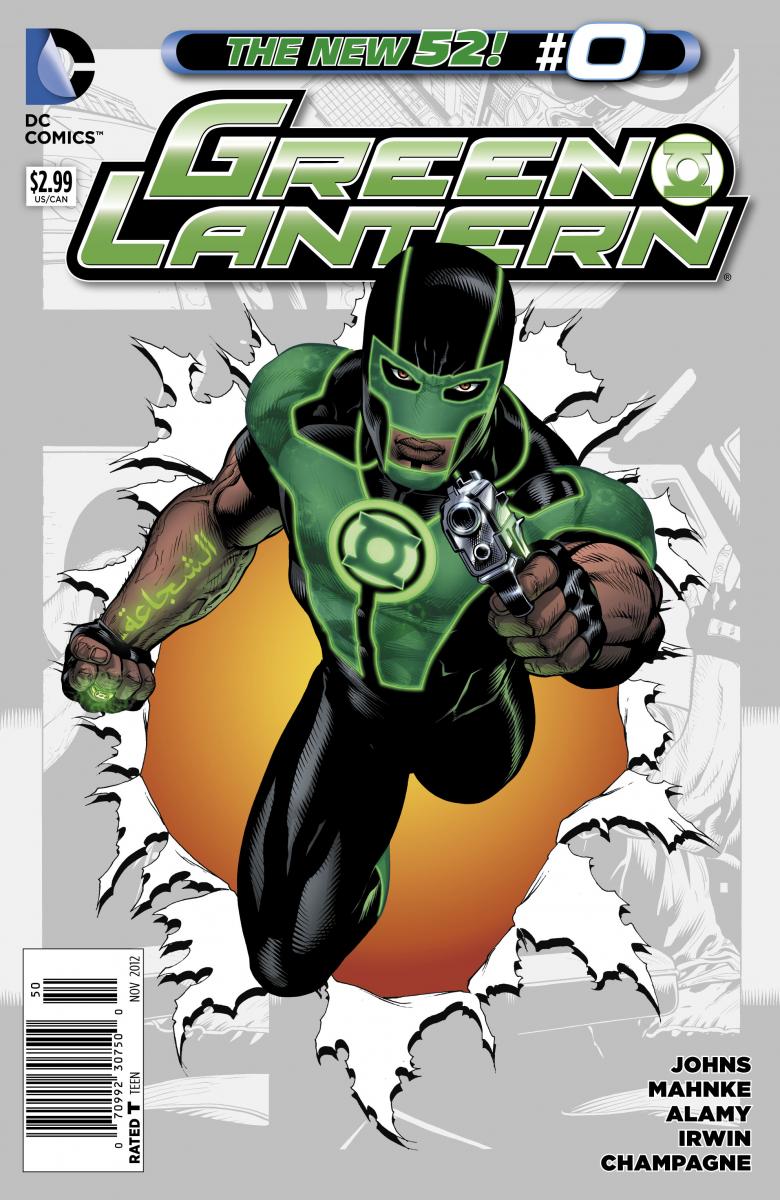
GREEN LANTERN #0

STORY: Geoff Johns
ART: Doug Mahnke and Christian Alamy

I've been critical of Green Lantern as of late. Since DC's relaunch, my favorite franchise has been swimming around, unable to focus on a path for Hal Jordan or Sinestro, the two main characters who should have a clear-cut direction more than any of the other Lanterns out there. And I still stand by my convictions; Geoff Johns has obviously been building toward "Rise of the Third Army" for a while, and in that set-up, he focused so much on the forest that he forgot to take care of the individual trees. Last week's Green Lantern Annual #1 and this week's Green Lantern #0 are a return to form for Johns on this series, as he employs the invigorating, character-driven storytelling that's so ample over in Aquaman month after month. Green Lantern #0 focuses entirely on Simon Baz, the newest member of the Green Lantern Corps - or is he? In truth, the exact basis of his enlistment isn't exactly clear, but that's not really what this issue is about. Indeed, Johns takes his time this 'Issue Zero' to flesh out his newest Emerald Warrior before he ever receives the ring.

Baz is an Arab-American who grew up in Dearborn, Michigan, has two siblings, and whose life was turned upside down after the events of September 11, 2001. Fast-forward to the present, and we jump in with Baz in hot pursuit by the police after stealing a van, which he realizes has a massive bomb set to go off in less than a minute. He survives the bomb, but gets detained by the Department of Homeland Security. It's a lengthy process - the suspected terrorist situation - that Johns mirrors by the amount of time he spends with Baz's interrogation. Johns obviously has some opinions about the federal government's treatment of only suspected terrorists, and it's refreshing to see this expressed in a way that doesn't necessarily demonize the government as much as it questions the way our Defense Department operates. During his questioning, it's revealed that Baz worked at the decommissioned car factory that blew up when he drove the stolen van into the loading dock. At first, the significance of the location isn't even hinted at. Baz is asked why he decided to blow up his old place of work. He's asked if he has a vendetta against the United States. He's asked who instructed him to blow up a car factory. The entire scene is poignant and cuts deep to the heart of the discrimination and fear that overwhelms out country and by proxy, our government.

It's only when he's about to be literally tortured that the ring finds it's newest keeper. Baz breaks free of his captors grip and nearly escapes before having a gun pointed at his face. "Simon Baz of Earth," the ring explains, "You have the -- ERROR -- ability to overcome great fear." One simple word changes the nature of Baz and his identity as a Green Lantern forever. The ring's simple error - that originated when Hal and Sinestro were literally murdered in Annual #1, and Hal's construct ring remerged with Sinestro's ring - could have one of a hundred meanings. It could be that Baz isn't connected to the Green Lantern Central battery; it could mean the Guardian's don't know he exists; Baz could be the most powerful Green Lantern there is. It's been quite a long time since Green Lantern was this engaging and visceral.

Already, Johns has established Simon Baz as one of the coolest new characters to hit DC's 'New 52' since it began. Some might say that the newest Green Lantern hasn't had enough page time to warrant a decision on his fate. But seriously, he's freaking awesome.

GRADE
A

Thursday, August 30, 2012

JUSTICE LEAGUE INTERNATIONAL ANNUAL #1

STORY: Geoff Johns and Dan Didio
ART: Jason Fabok

It really is the end for the Justice League International. After a year of amazing stories, a slowly-expanding roster, and a death in the family, the JLI all but disintegrates before our eyes as Geoff Johns and Dan Didio bid farewell to one of DC's quirkiest titles. It came as a bit of a surprise when DC announced it would cancel Justice League International after it's Annual issue, especially since it wasn't a low performer like other cancelled series such as Mister Fantastic, Men of War, or Resurrection Man. For months, fans and critics have been speculating as to reasons why; was it to set-up a bigger event? Was JLI going to be relaunched under a different name? Was DC planning on revising it's number of monthly titles? We didn't have a lot to go on, and the editorial executives were staying tight-lipped. And this week, DC announced that Geoff Johns and David Finch would be starting a new series, Justice League of America. After I read the initial press release concerning JLA, I immediately knew why JLI was cancelled. It makes sense, on a certain level, to want to expand the 'Justice League' franchise without diluting the name itself. Justice League and Justice League Dark both have clear-cut plot-centric premises, while JLI told more character-driven stories. It really is a shame to see the series go, but Justice League International Annual #1 goes the book justice and sends the team off in an appropriately dour - yet potentially promising - way.

Annual #1 picks up a few weeks after the events of JLI #12, wherein Batwing resigned, the team fought the late Lightweaver's delusional brother, and the future of these characters rested in Batman's capable hands. Bringing the series full-circle, Booster's primary concern is now increasing the team's visibility and public image by way of impressing the United Nations by taking on dangerous missions around the globe. We drop in with our lovable band of misfits in Central Africa, where Guy Gardner is leading a squad against a vicious warlord named Aki Mukassa. As Batwing flies the violent revolutionary away from the riot below, the warlord activates a bomb and kills himself mid-air. The entire situation is symbolic of the JLI's status quo as the team that gets it done, but not very well. While the rest of the team is satisfied with saving numerous innocent lives, Booster is upset that the JLI couldn't hand Mukassa over to the UN.

The breaking point comes later, when Booster informs the team that he's expanded the roster by recruiting Olympian and Blue Beetle. "Where are Superman and Wonder Woman?" asks Beetle, which sends Guy Gardner into a rage that results in his resignation from the JLI. With Rocket Red already dead, as well as Vixen, Fire, and Ice in the hospital, it's as though Booster takes one step forward for every two steps back. He sees that their numbers are dwindling, and he does whatever it takes (a la lying to Beetle about the JLI's roster) to make his team better.

And while the first half of the book is really all about Booster and his insecurities, the latter half focuses on O.M.A.C., who becomes possessed by Brother Eye, the sentient satellite and computer program designed and built by Batman to observe and analyze every metahuman on Earth in order to develop defenses against them if necessary. Since the 'New 52' relaunch, it's been interesting to see what has survived the editorial culling and now exists in the ner universe - the events of Infinite Crisis aren't mentioned anywhere else in the 'New 52' (that I know of), so it could stand to reason the whole thing never happened, but that Brother Eye was still created. And just like in Infinite Crisis, Brother Eye's been hijacked! With a new 'programmer' calling the shots, Brother Eye takes complete control of Kevin Kho's body and mind as it attempts to destroy the JLI and re-upload himself to the satellite orbiting Earth. During the confrontation, O.M.A.C. (apparently) kills Olympian, then uses his overwhelming technology to send Blue Beetle back to the Reach, the alien society where Jaime's scarab originated.

There's a lot of action going on during the finale, but in the end, Booster Gold is the only one who's able to stand up to the brutish, unstoppable O.M.A.C. Using 25th century anti-virus protection, (easter-eggedly called the 'Skeets Protocols') Booster is able to stop Brother Eye's uplink to the satellite and separate Kevin from the O.M.A.C. programming that was making his life a living hell. Of course, this victory is short-lived as Booster Gold from the future-future comes back to warn our Booster of horrible things to come before he simply disappears, as if he never existed. Then suddenly, the same thing happens to our Booster Gold!

By the time we reach the final pages, the team is technically down to just Godiva and a heavily-injured August General in Iron. Rocket Red and Olympian are dead, Batwing and Guy Gardner have resigned Blue Beetle is on the other side of the galaxy, and Booster is deleted from time and space. Justice League International Annual #1 is not only the JLI's most exciting issue, but it sets up the next chapter of the collective 'Justice League' story very well. At the very end, Batman has a chilling conversation with his creation, Brother Eye: "Eye am home and eye will be waiting for my new programmer's signal. He is coming, Batman. And you will join him or die." recites Brother Eye as if from a script. The emotionless, yet highly sophisticated, Brother Eye looks to be the focal point of things to come. Perhaps in the same vein as Infinite Crisis, Batman's presumptuousness concerning other heroes became paranoia, resulting in some of the darkest days in DCU history.

GRADE
A+

GREEN LANTERN ANNUAL #1

STORY: Geoff Johns
ART: Ethan Van Sciver

There's a lot going on in Green Lantern Annual #1. There's so much happening, in fact, that the amount of information is almost too much. This over-sized issue has two goals: to finish up "The Revenge of Black Hand" as well as preluding "Rise of the Third Army", the Green Lantern Family-wide crossover starting in October that will see the Guardians of the Universe's new legion of soldiers attempt to eradicate the Green Lantern Corps as well as the rest of the multicolored Corps littered throughout the universe. While Geoff Johns has been slowly dragging the Guardians into madness over the past few years, this singular issue really drives the point home, showing just how ruthless these little blue guys can be.

Johns does an apt job flowing from one focus to the next. The beginning of the issue is all about Hal Jordan, Sinestro, and Black Hand. Slowly, scenes of the Guardians start to trickle in before their crazy crusade against emotion takes center stage. It's an interesting way to segue from one plot point to the next, and Johns knows these characters so well, he can interweave the stories without actually having them connect. Amid major revelations every few pages, Johns manages to keep things light and well-paced throughout the issue, taking time to make emotional jabs when can, and relying on readers' visceral connection to the story to keep the momentum going.

As a whole, Green Lantern Annual #1 is really all about the Guardians and their descent into madness. After millennia of attempting and failing to squelch chaos across the universe, the Guardians have obviously started to show the cracks in their armor. Starting back in Green Lantern: Rebirth when it was revealed that the Blue Ones had imprisoned a 'fear entity' within the Green Lantern Central Battery, causing the yellow impurity that had plagued the rings for eons. The list of their grievances goes on and on, but now, with a universe more chaotic than ever, the Guardians have reached the end of their rope. Plagued by insubordination within their ranks and throughout the cosmos, the Guardians turn to their last hope (if you can call it 'hope'), the First Lantern. While there is virtually still nothing known about the individual encased within a shimmering crystal lantern, it stands to reason that he/she is the origin of the emotional entities that power the seven differently colored lanterns (not counting the Black Lanterns because death isn't an emotion).

One of the best parts of the issue is the meeting between the Guardians and the Hidden Guardians. Billions of years prior, the Guardians decided to leave half of their people behind in the Chamber of Shadows to guard the First Lantern from any who would attempt to steal his power, while the other half would venture out into the universe to create peace in place of the chaos. The Hidden Ones immediately question the Guardians' motives when they demand the First Lantern and his awesome power. The fight that ensues is not only cool for the simple comic-bookiness of it (little blue aliens fighting each other with sci-fi energy ball beams!), but also because it really gives a visual interpretation of the Guardian's insanity as Ganthet kills the Hidden Ones' leader with a knife to the throat. It's chilling, watching a Guardians murder in cold blood. It's the kind of thing Geoff Johns is known for: emotional backhanding that takes you by surprise through shock and awe.

After the Guardians defeat the Hidden Ones and take the First Lantern, the crap really hits the fan. Ganthet uses the First Lantern's power to step through time and space into the cemetery where Hal and Sinestro are facing Black Hand. With his fellow brain-addled Guardians, Ganthet soaks Black Hand in energy, charging up the lone Black Lantern to become their tool against Hal, Sinestro, and the rest of the Green Lantern Corps. After the dust settles, the Guardians throw Hand into the Chamber of Shadows with the surviving Hidden Ones before locking them all up for future use. It's small, but sick detail that reinforces the Guardians' cruelty.

And then there's the Third Army. The Guardians - in their infinite madness - use their own genetic material to create a new creature. I hesitate to call it a 'life'-form because the Guardians make sure it doesn't have a heart or soul, just a direct connection to the Guardians' hive mind. Basically, the little blue guys are waging a war on free will, a frightening endgame if there ever was one.

Next month's Green Lantern #0 focuses on new GL, Baz. Up until now, I'd been confused as to how DC was going to shoehorn a new Green Lantern into the mythos, but after reader Green Lantern Annual #1, things are starting to make a lot more sense. Already, some have criticized this issue - and Johns' direction with the GLU in general - for being a rehash of previously tread ground. To that, I say what isn't? This year's amazing "Court of Owls" is based on any secret society trope, but that doesn't mean it can't be interesting and fresh. "Rise of the Third Army" promises to be a huge (if not long) event that will change the landscape of the Green Lantern books and the DCU at-large for a long time to come.

GRADE
A