And with a single issue, Powergoat is my favorite new character of 2016.
I don't suspect this weed-eating goat with an aggression complex will appear again anytime soon, but this fun little nugget of humor acts as a stylized metaphor for Mark Russell's observations on American culture. Much like with Prez, Russell digs deep into the socio-economic framework of colonial capitalism and finds the inherent comedy within: it's funny because it's true.
Powergoat is an allegory for aggressive sales tactics and the supposed strength they are trying to sell; it's literally just a goat (albeit, with a hyper-masculine attitude) tied to a stick and Fred has no idea what "weeds" are, but the perception of wealth through material possessions becomes too much, and poor Fred caves in and buys one anyway.
Russell doesn't sugar-coat his intentions in The Flintstones #2. "In other news, people are buying stuff they don't need. It's called 'crap', and it's taking Bedrock by storm!" I cannot think of a more perfect or eloquent way to explain the root of American capitalism.
The First Church of Animism reveres their savior, Morp, until the bird plays a record and everyone is a bit disappointed, at which point their faith wains. The following mass, the clergy introduce Peaches, a pink elephant who's to be the new god that just wants everyone to have a good time, a pretty solid gospel.
When Wilma discovers Peaches is just a vacuum cleaner the clergy have masqueraded as a deity, the whole charade begins to crumble. In a poignant call to reason by the presiding pastor, he asks "...isn't the important thing that the god makes you feel like your life has meaning? Does it really matter what form a god takes?"
Fred's immediate skepticism is a mirror to Evangelical religious dogma: adherence to an idea instead of the ideals religion is intended to teach. "C'mon, we've done good work in this church. Just because some god didn't pan out, you're not going to go back to smashing people with clubs are you?" At least one gentleman disagrees. Everyone walks out.
So, are these the seeds of atheism in The Flintstones, or the earliest days of the religiously devout, the ones who need a more concrete concept of god to feel fulfilled? Either way, Russell plays with the ideas of spirituality and commercialism throughout The Flintstones #2, reaching a fever pitch when Fred feels the familiar sense of failure -- after only selling one bottle of vitamins in a pyramid scheme -- many Americans suffer through every day, the feeling that he's doesn't deserve the good things in his life. As Wilma is apt to do, she helps Fred see reason and gives him perspective on the difference between real and borrowed happiness. She posits that connections with other humans is what matters, and that all this crap around them doesn't bring anything but regret.
I don't believe Wilma simply meant the material "crap" infesting Bedrock, but also the vitamin-selling scam and the Church of Animism shenanigans -- as long as Fred loves Wilma and Wilma loves Fred, they're going to be okay. Everything else is just crap. So long, Powergoat: Lucky the Dog of 2016.
Showing posts with label Comic Book Review. Show all posts
Friday, August 12, 2016
Tuesday, October 30, 2012
REVIEW: SUPERMAN #13
This review was originally published on PopMatters.com.
(w) Scott Lobdell
(p) Kenneth Rocafort
There’s something different about Superman in the
‘New 52’. I’m not just talking about the new costume or back-story, or the fact
that Grant Morrison is handling his early days in Action Comics – DC has fundamentally shifted the Man of Steel’s
position in their mindset, and it basically amounts to a downgrade for the Last
Son of Krypton.
Hear me out.
In recent years, Batman has become not only DC’s
most popular character, but also arguably the most popular comic book character, in general. Christopher Nolan’s “Dark Knight” trilogy framed Batman for a
modern generation and it became a huge success. Hence, DC has focused a lot
more of its comic book efforts on Batman. The ‘New 52’ features 13 different
Batman-related titles each month – five of which focus on Bats exclusively or
with a partner – while there are only four dedicated to the Superman Family.
For as long as Superman has been around, he’s been DC’s poster boy and,
frankly, the most iconic superhero in the world – until now.
Of the Superman-related titles, two of them focus on
Clark Kent’s alter-ego. Grant Morrison has been guiding Superman through his
early years in Action Comics to
varying degrees of success, while the character’s eponymous book has been
caught in a flurry of creative switch-ups, editorial tightening, and overall
dissonance concerning the direction the title should be moving. George Perez
publically left the title after revealing a number of woes concerning
management at DC dictating creative choices, leaving Superman to flounder for a bit. With no solid course or focus, the
title has been lacking. Last month, Scott Lobdell was brought on board for Superman #0 to lead the series into the
upcoming “H’el on Earth” crossover between Superman,
Superboy, and Supergirl.
I have a rather tumultuous personal opinion
concerning Scott Lobdell. While I absolutely hated his runs on both Superboy and Teen Titans, I find Red Hood
and The Outlaws to be one of my favorite titles month to month. I can’t
really explain it, and at this point, I don’t know that it much matters. Superman #13 affirms that Lobdell is
bringing the best of what he brings to Red
Hood and The Outlaws – including series artist Kenneth Rocafort – to his
interpretation of the Man of Steel. All the stiff dialogue, convoluted plot,
and unrealistic emotional drama that littered the pages of TT and Superboy are
absent here, replaced by a surprisingly solid handle on Superman as a character
with a clearly defined and structured narrative path.
Superman
#13 almost acts as a reset button
for the series. While events in previous issues are mentioned, it’s mostly to
set the scene. The only real thing any new reader would need to know going into
this issue is that Clark Kent has been frustrated working for the Daily Planet
for some time. Clark’s grand Network-style
exit from the hallowed halls of journalism are quickly (and humorously) tamped
when “fashion-obsessed, self-absorbed bobblehead” Cat – a fellow journalist –
walks out after Clark and explains how she was inspired by his speech. While
Cat wants Clark to feel better about what he’s done, the fact that she came and
no one else did points to Clark’s all-around attitude concerning the
money-grubbing entertainment conglomerate. It’s a sly move on Lobdell’s part,
giving both Clark and Cat more depth as characters with little more than a
tactical conversation.
The beginning of the issue heralds a new character,
Dr. Veritas. She’s a rather utilitarian-looking figure with a lab coat draped
over what looks like body armor. Of course, the more obvious explanation is
that Kenneth Rocafort’s penciling style just makes everyone look badass like
they’re wearing battle armor. If that’s the case, awesome, if not, then there’s
got to be a reason for her unexplained militaristic get-up. Either way, Veritas
is already an interesting character because Superman knows who she is and we
don’t. Oh, and she has a lab with a machine that can exert the weight of the
planet for Superman to bench-press. The machine’s amazing capabilities aside,
the fact that it exists and that this woman owns it is incredibly fascinating.
I found myself wanting to know more and more about Dr. Veritas and her
relationship with Superman the entire time I was reading.
Scott Lobdell is a curious writer, for sure. Some of
his work falls so terribly flat I want to go back and save the paper and ink
used to make the issues he’s written, and some of goes on my “Must Buy” list
for the month. Superman #13 reads
fantastic and looks fantastic thanks to Kenneth Rocafort and his
chiseled feature-heavy style that compliments Superman so well. I was starting
to get annoyed by how frumpy Supes was looking as drawn by Jesus Merino and
later Dan Jurgens. Not only does Lobdell start an excellent new chapter in
Clark Kent’s life, but he also builds directly up to next month’s start of
“H’el on Earth”, featuring the other
last survivor of Krypton’s death. Basically, if you were reading Superman and got disappointed each
month, stick with it. If you haven’t read this series up until now, start here.
GRADE
8/10
Monday, October 29, 2012
EXTRA! EXTRA! (OCT 24-30, 2012)
Batman: The Dark Knight #13
(w) Gregg Hurwitz
(p) David Finch
Batman: The Dark Knight #13 continues Gregg Hurwitz's phenomenal Scarecrow arc that reintroduces Doctor Jonathan Crane to the 'New 52' in a much more frightening scope than he's ever been before. Hurwitz has been parsing out Scarecrow's horrid past over each issue instead of dumping it on readers all at once, a decision that's been paying off in spades as Crane becomes more and more terrifying with each subsequent issue. On top of that, Scarecrow's new super toxin is forcing Bruce to face his actual fear - that of actually ascending into the light and being able to live a normal life. It's a poignant perspective to take on Batman, that he indeed had a choice about how to live his life and deliberately chose to chase after the darkness and envelop himself in shadows.
GRADE: 8.5/10
I, Vampire #13
(w) Joshua Hale Fialkov
(p) Andrea Sorrentino
I, Vampire sits rather comfortably outside the main DC universe - though there are crossovers from time to time, a majority of what happens doesn't directly affect much of the other characters DC has at it's disposal. That being said, Joshua Hal Fialkov succeeds every month in bringing a new chapter to his fascinating story of Andrew Bennett, his rise into glory and his current fall into darkness. I, Vampire #13 sees Mary Seward - formerly 'Queen of Blood' - teaming up with Bennett's professor friend to find Andrew's maker, while Andrew and his new prodigy, Tig, track down Deborah Dancer - a woman from Andrew's past who is only half-vampire. Fialkov is taking big risks in sending his main character down such a twisted and violent path, but such risks can lead to daring results and amazing narratives - I, Vampire easily falls into that category month after month.
GRADE: 8/10
X-Treme X-Men #5
(w) Greg Pak
(p) Paco Diaz
X-Treme X-Men is the weird step-sibling of the X-Men canon of series Marvel produces - it's events are spun out of an arc from Uncanny X-Men by Kieron Gillen, only one character from Earth-616 is present, and the team travels across various dimensions hunting down evil versions of Charles Xavier. On one hand, it's a rather limiting premise - one that doesn't allow for much diversion - while on the other hand, it has the potential for a literal infinite amount of stories due to the nature of the multiverse. So far, Greg Pak has done a great job bringing short, action-packed arcs that take advantage of a infinite multiverse with cool, alternate versions of the X-Men hanging around. X-Treme X-Men #5 finishes up a two-part tale of evil Xavier in the wild west.
GRADE: 8.3/10
(w) Gregg Hurwitz
(p) David FinchBatman: The Dark Knight #13 continues Gregg Hurwitz's phenomenal Scarecrow arc that reintroduces Doctor Jonathan Crane to the 'New 52' in a much more frightening scope than he's ever been before. Hurwitz has been parsing out Scarecrow's horrid past over each issue instead of dumping it on readers all at once, a decision that's been paying off in spades as Crane becomes more and more terrifying with each subsequent issue. On top of that, Scarecrow's new super toxin is forcing Bruce to face his actual fear - that of actually ascending into the light and being able to live a normal life. It's a poignant perspective to take on Batman, that he indeed had a choice about how to live his life and deliberately chose to chase after the darkness and envelop himself in shadows.
GRADE: 8.5/10
I, Vampire #13
(w) Joshua Hale Fialkov(p) Andrea Sorrentino
I, Vampire sits rather comfortably outside the main DC universe - though there are crossovers from time to time, a majority of what happens doesn't directly affect much of the other characters DC has at it's disposal. That being said, Joshua Hal Fialkov succeeds every month in bringing a new chapter to his fascinating story of Andrew Bennett, his rise into glory and his current fall into darkness. I, Vampire #13 sees Mary Seward - formerly 'Queen of Blood' - teaming up with Bennett's professor friend to find Andrew's maker, while Andrew and his new prodigy, Tig, track down Deborah Dancer - a woman from Andrew's past who is only half-vampire. Fialkov is taking big risks in sending his main character down such a twisted and violent path, but such risks can lead to daring results and amazing narratives - I, Vampire easily falls into that category month after month.
GRADE: 8/10
X-Treme X-Men #5
(w) Greg Pak
(p) Paco DiazX-Treme X-Men is the weird step-sibling of the X-Men canon of series Marvel produces - it's events are spun out of an arc from Uncanny X-Men by Kieron Gillen, only one character from Earth-616 is present, and the team travels across various dimensions hunting down evil versions of Charles Xavier. On one hand, it's a rather limiting premise - one that doesn't allow for much diversion - while on the other hand, it has the potential for a literal infinite amount of stories due to the nature of the multiverse. So far, Greg Pak has done a great job bringing short, action-packed arcs that take advantage of a infinite multiverse with cool, alternate versions of the X-Men hanging around. X-Treme X-Men #5 finishes up a two-part tale of evil Xavier in the wild west.
GRADE: 8.3/10
Sunday, October 28, 2012
REVIEW: BATMAN, INCORPORATED #4
(w) Grant Morrison
(p) Chris Burnham
FINALLY -- an issue of Batman Incorporated that's not layered in 50,000 levels of misdirection, metaphorical symbolism, intricate backstory, or mind-bending espionage. And it's the best issue yet. Seriously. Grant Morrison and Chris Burnham's road has been a bit bumpy so far, with the third issue of Batman Incorporated being the first 'New 52' title delayed more than a few weeks, then an "Issue Zero" that took us out of the main story for another month. Batman Incorporated #4 feels like the series is gaining momentum for the first time, and it's incredible reading. Not to mention that most of Batman, Inc. shows up (including Nightwing and Red Robin) for a massive raid on the League of Assassins.
Grant Morrison announced a while back that he'll be leaving Batman Inc. after issue 12; an fact that doesn't bode well for the title, which has been Morrison's vehicle to bring a conclusion to his years-long, multi-title arc concerning Batman, Talia al Ghul, and Damian Wayne. I honestly thought we'd have to wait until at least issue seven or eight to get deep into plot advancement, but Morrison brings the thunder early this month. Chris Burnham beautifully illustrates Morrison's epic battle between Batman and his army and the waves upon waves of the deadliest killers in the entire world.
Batman Incorporated has been a victim of circumstance since it began, and though that was partly Morrison's own fault, it's now growing into it's own as a solid title in the 'New 52' lineup. I'm skeptical it'll continue after Morrison steps down, as that would open up a spot for a new title in the roster while also trimming down the already massive number of Batman-related titles. That being said, if DC were to get someone like China Mieville to take over, the series might just stand a chance of continuing.
(p) Chris BurnhamFINALLY -- an issue of Batman Incorporated that's not layered in 50,000 levels of misdirection, metaphorical symbolism, intricate backstory, or mind-bending espionage. And it's the best issue yet. Seriously. Grant Morrison and Chris Burnham's road has been a bit bumpy so far, with the third issue of Batman Incorporated being the first 'New 52' title delayed more than a few weeks, then an "Issue Zero" that took us out of the main story for another month. Batman Incorporated #4 feels like the series is gaining momentum for the first time, and it's incredible reading. Not to mention that most of Batman, Inc. shows up (including Nightwing and Red Robin) for a massive raid on the League of Assassins.
Grant Morrison announced a while back that he'll be leaving Batman Inc. after issue 12; an fact that doesn't bode well for the title, which has been Morrison's vehicle to bring a conclusion to his years-long, multi-title arc concerning Batman, Talia al Ghul, and Damian Wayne. I honestly thought we'd have to wait until at least issue seven or eight to get deep into plot advancement, but Morrison brings the thunder early this month. Chris Burnham beautifully illustrates Morrison's epic battle between Batman and his army and the waves upon waves of the deadliest killers in the entire world.
Batman Incorporated has been a victim of circumstance since it began, and though that was partly Morrison's own fault, it's now growing into it's own as a solid title in the 'New 52' lineup. I'm skeptical it'll continue after Morrison steps down, as that would open up a spot for a new title in the roster while also trimming down the already massive number of Batman-related titles. That being said, if DC were to get someone like China Mieville to take over, the series might just stand a chance of continuing.
GRADE
9/10
9/10
Friday, October 26, 2012
REVIEW: RED LANTERNS #13
(w) Peter Milligan
(p) Gabriel Sepulveda
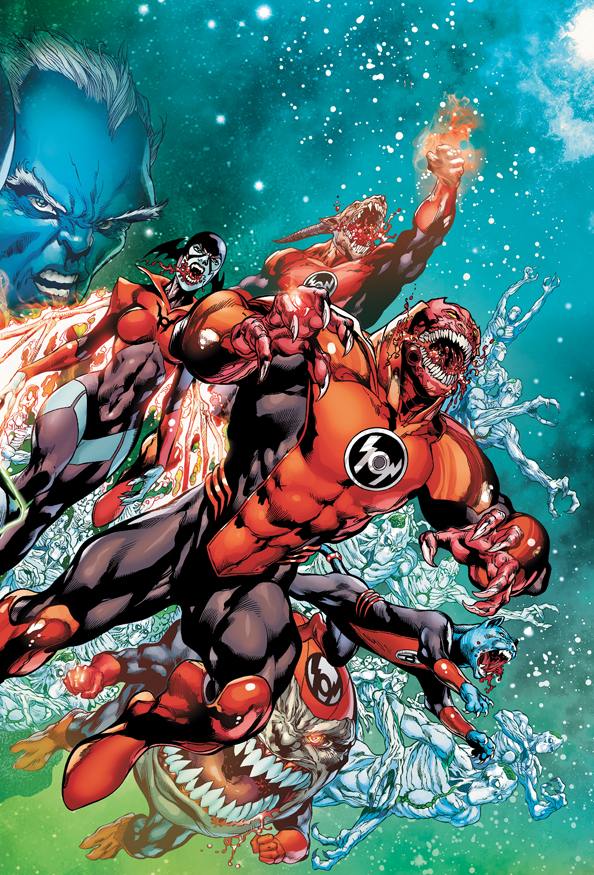
Red Lanterns hasn't been the best book of the 'New 52', but neither is it the worst, or even close really. Giving Atrocitus and the Red Lantern Corps their own series was a risky move, but one that has paid off in terms of the world-building - the greater good, if you will. While they are indeed fueled by pure rage, and their methods absolutely include torture and murder, the Red Lanterns are still good guys, technically, out to right the wrongs in the universe. Actually, Atrocitus has been one of the more multi-faceted characters throughout the entire 'New 52'. Without any sort of focused mission or crisis to follow, the Red Lantern leader has had to deal with his personal demons throughout the series, and that's not something a lot of comic book writers get to try. Even though the results have been mixed, the fact that Peter Milligan is ready and willing to delve into the psyche of the universe's angriest living thing is impressive in it's own right.
Red Lanterns #13 brings Atrocitus and his crimson cronies into "Rise of the Third Army" in style with the best tie-in this month. It's crazy that of all the Green Lantern Family titles, it's Red Lanterns that gives readers the most information and the best story leading into the event. The issue focuses on a young inhabitant of planet Arhtky named Taya. Taya's parents are murdered by a vicious warlord named Cord who has apparently been laying waste to the planet town by town. Taya and her sister are taken prisoner, and Taya is forced to be a dancer for Cord and his men. Milligan does a fantastic job conveying Taya's growing rage through these pages, and he hits an issue high when Taya's sister is murdered simply for offering herself in exchange for Taya's innocence. These pages are simply brutal, and honestly hard to read at some points. This is all to Milligan's credit, who's been struggling to find the right niche when it comes to the essence of rage.
Soon, the story integrates Atrocitus, Bleez, Rankorr, and new Red Lantern Skorch as they descend upon Arhtky to lay judgement upon Cord and his men. Taya is mortally wounded in the chaos, and Atrocitus explains that the Red Lantern central battery isn't yet at full enough capacity to create new rings. When the Red Lanterns 'feel' Taya's rage half a universe away, they understand that since she won't receive a ring, it's up to them to seek vengeance on her behalf. Up until this issue, Milligan was again having difficulty justifying the Red Lanterns' actions against their supposed morality. The fact that Atrocitus comes to Taya's aid is a solid example of how the Red Lanterns act as a force of justice, however ruthless it may be.
The Guardian Soldiers also happen to be on Arhtky, and Atrocitus soon learns that the eyes are the weakness. I won't go into this part of the issue any more because it's the first real introduction to the Third Army, and it's worth reading.
If you can't tell, I was seriously and pleasantly surprised by Red Lanterns #13. The main reason I've kept up with the series is because Green Lantern is my favorite character franchise, and I just wanted to collect all the GL Family titles. Simple as that. Now, I'm truly invested in Red Lanterns.
GRADE
9/10
REVIEW: THE FLASH #13
(w) Francis Manapul and Buccellato
(a) Francis Manapul

I never thought I could be so terrified of Gorilla Grodd.
That sentence pretty much sums up my experience reading The Flash #13, the issue that begins "Gorilla Warfare" which pits Flash and the Central City's Rogues against Grodd and his invasion force of super-intelligent apes. Grodd, as a character, is an instance where non-comic book fans would have a difficult time understanding how a smart gorilla is in any way a dangerous threat to Flash. Of course, those who read know that Grodd is one of Barry Allen's most deadly enemies. In recent years (and before the 'New 52' relaunch) Grodd had become increasingly less viable as a villain, trading in his viciousness for higher intelligence and more scheme-centric plans. His animated self as seen in Justice League and Justice League Unlimited was also tempered for younger audiences as well as for the general feel of the shows. Fortunately, Francis Manapul and Brian Buccellato do Grodd a service in The Flash #13 by revitalizing the character and making his an ominous presence once again.
Grodd himself doesn't say a lot this month, but he doesn't have to - the slew of soliders rocketing to Earth in capsules says enough for him. The Rogues are still on-scene, trying to make their getaway to no avail because the apes attack. One of the best parts of The Flash thus far is how he villains of the story are written just as well as Barry. These aren't just enemies that show up for a few issues then disappear - these are Flash's Rogues! Each Rogue answers to his or her own moral code, and it starts showing once Flash becomes overwhelmed by the gorillas.
But how is Flash having difficulty fighting giant, slow gorillas, you ask? Well, Grodd truly believes it was he who was destined to be the scion of the Speed Force, not Barry. Based on this notion, Grodd is constantly attempting to access the Speed Force, and it seems as though he was able to use it as part of the invasion of Central City. Thus, Grodd's gorilla soliders have been affected by the Speed Force, allowing them to more easily combat Flash's supersonic speed. It's a bit flimsy, but I'm willing to let this pass because of how well Manapul and Buccellato frame the main story.
Grodd is insane, through and through. Trickster approaches the looming ape king and offers his services as a credible citizen of Central City, as well as a villain who knows how to find Flash. In the most graphic sequence of the issue, Grodd literally tears the Trickster's arm off before claiming that he needs no man's help in his conquest. It's a powerful scene and one that shows just how much for violent and ruthless Grodd is under Manapul and Buccellato's direction.
GRADE
9/10
Saturday, September 8, 2012
BIG CHANGES COMING
NEW REVIEW FORMAT
Since the beginning of 'The Endless Reel', I've kept a pretty strict review format, which I supplemented a few months ago with 4-Sentence Reviews to give some other titles I read a spotlight on top of the regularly covered titles.
Now, with DC entering Year Two of the 'New 52', and Marvel Comics soft-relaunching a majority of their line under the 'Marvel NOW!' moniker, I want to take 'The Endless Reel' to a new level. I want to branch out of the traditional review format and give readers a more comprehensive and complete comic book experience - at least from the major two companies. I'm only one man.
Starting in October, 'The Endless Reel's review format will change in a rather significant way. While there will still be standards REVIEWs, I've created some 'columns' that will focus on different parts of the DC universe - mostly categorized by title families - as well as a section for 'Marvel NOW!' titles, as well as 4-Sentence Reviews, which will be rebranded as EXTRA! EXTRA! Posts will include "The Dark Write", a Batman Family column covering two or more Batman titles each week. There will also be "Leagues Beyond" - focusing on Justice League books like JL, The Flash, Aquaman, Wonder Woman, and the upcoming JLA - "Marvel NOW!", which is pretty self-explanatory, as well as "Rotworld LIVE!" which will cover every issue of Animal Man, Swamp Thing, and Frankenstein: Agent of S.H.A.D.E. relating to the crossover "Rotworld" event. And "Into the Night" will offer regular coverage of both I, Vampire and Justice League Dark.
One of the trade-offs of offering more title coverage on 'The Endless Reel', is that the amount of actual words dedicated to titles within these columns will be less than a full review. Not four sentences short, but not a full, six paragraph review. That being said, I will continue to bring comprehensive analysis to all the titles I cover, no matter the length of their reviews. Also, from time to time, I'll feature one of the column-related titles as a full-length review.
I'll update the MONTHLY SCHEDULE in the coming days as I get everything fine-tuned, and soon, 'The Endless Reel' will move on to it's next phase!
MARVEL NOW!
Now that Avengers vs. X-Men is winding down, Marvel is close to launching 'Marvel NOW!', their soft-reboot that will affect a great portion of the company's titles. While some new titles are being introduced, a whole slew of books are being relaunched with new #1's and new creative teams.
After eight years of major events that all supposedly led up to this, Marvel is mixing up it's long-established creative teams. These writer and artist changes promise cool new directions for characters that have honestly grown stale in these last few years. With new perspectives and new talent, I'm looking forward to not only the new titles, but also reading relaunched titles that I wouldn't have read before. Much like my rekindled interest in DC's line when the 'New 52' launched, 'Marvel NOW!' is getting me back into Marvel, post-AvX, and I want that experience to be part of 'The Endless Reel'.
Initially, all titles under the 'Marvel NOW!' name will be listed in the MONTHLY SCHEDULE section. I plan on reading all the #1's, then deciding which ones will be covered on a regular basis. Then again, I may just review all of them. We'll see.
Sunday, August 5, 2012
THE FIRST X-MEN #1 of 5
STORY: Christos Gage and Neal Adams
ART: Neal Adams
The First X-Men doesn't need to exist. It's as simple as that. For some reason, Christos Gage thought it would be cool to look at X-Men before there were...X-Men...which doesn't make much sense. The whole idea behind the name was that they were Xavier's Men, hence, X-Men. I understand that Gage and Adams are not calling this group 'X-Men' within the narrative, but the book's title and Neal Adams' obvious opine for the 1980s convey a sloppy and repetitive series that just didn't need to be. The problem stems from ground be retread. A team working for the safety and wellbeing of mutantkind? That's the X-Men! It's somewhat frustrating that Gage and Adams think this is some grand new idea that their pioneering. If they don't think what they're writing is somehow new, why would they write it in the first place? So either way, The First X-Men doesn't make sense.
From the very first page, this narrative feels undeveloped. Wolverine is helping a friend from the army find his son who has run away from home. Who is this mysterious friend? I guess we'll never know. Even with such a shaky beginning, I continued reading in hopes that the story would start making more sense. Instead, I was treated to more nonsense just for the sake of it. Why does The Wolverine want to act as babysitter to a bunch of muntant children? With decades of continuity as evidence, Logan doesn't take to children easily. Sure he was a mainstay at the Xavier School for a long, long time, but he was rarely more than a passing resident, mostly there to make sure the X-Men had the muscle they needed. Who's honestly going to take this seriously? And Sabertooth is helping out? I know there was a time when he and Wolverine worked together, but again, Gage and Adams warp Victor Creed's base personality, simply to tell a story. Not cool.
Then there's Charles Xavier. Dear God in Heaven, Charles Xavier. Why in the world Christos Gage and Neal Adams would feel it was okay to turn the greatest mutant revolutionary in Marvel universe history into a whining, selfish prig who just wants to be normal is beyond me. While he never actually says the word "normal", it's obvious that Xavier wants to live a purposely average life, which is an affront to the character at a very raw level. What's even more frustrating is how Marvel allowed this to happen.
None of this is even to mention Holly Bright, a carbon copy of Mastermind, who manipulates peoples minds into believing the horrific things he makes them see are real. Seriously, she does the exact same thing. Oh, but her name is Holo, which is a total anachronism because holograms or even the idea of them wouldn't have been around in this "years ago" time period. It's just so sloppy.
Perhaps the most frustrating parts of this series - and there are obviously many - is that Erik Lensherr is going to join the team. Magneto. So, Christos Gage and Neal Adams are trying to claim that Wolverine and Magneto were on a Pre-X-Men team that helped mutant kids before Charles Xavier possessed his lifelong ethics (really????) and decided to try and guide the mutant race. The entire idea is just stupid. There is no way this is alright. Not by a long shot. What The First X-Men is comes down to one word: disappointing. Not only is this series totally unnecessary, it slaps comic book fans across the face with a whole new slew of (technically official) canon that's just depressing to think is now part of a comic book universe that still had some semblance of sense to it. I'm not even going to start into Neal Adams' completely dated and awful artwork because it will just depress me. I'll just say, it's mind-numbingly bad (Magneto's hair looks like Nite Owl II's cowl).
ART: Neal Adams
The First X-Men doesn't need to exist. It's as simple as that. For some reason, Christos Gage thought it would be cool to look at X-Men before there were...X-Men...which doesn't make much sense. The whole idea behind the name was that they were Xavier's Men, hence, X-Men. I understand that Gage and Adams are not calling this group 'X-Men' within the narrative, but the book's title and Neal Adams' obvious opine for the 1980s convey a sloppy and repetitive series that just didn't need to be. The problem stems from ground be retread. A team working for the safety and wellbeing of mutantkind? That's the X-Men! It's somewhat frustrating that Gage and Adams think this is some grand new idea that their pioneering. If they don't think what they're writing is somehow new, why would they write it in the first place? So either way, The First X-Men doesn't make sense.From the very first page, this narrative feels undeveloped. Wolverine is helping a friend from the army find his son who has run away from home. Who is this mysterious friend? I guess we'll never know. Even with such a shaky beginning, I continued reading in hopes that the story would start making more sense. Instead, I was treated to more nonsense just for the sake of it. Why does The Wolverine want to act as babysitter to a bunch of muntant children? With decades of continuity as evidence, Logan doesn't take to children easily. Sure he was a mainstay at the Xavier School for a long, long time, but he was rarely more than a passing resident, mostly there to make sure the X-Men had the muscle they needed. Who's honestly going to take this seriously? And Sabertooth is helping out? I know there was a time when he and Wolverine worked together, but again, Gage and Adams warp Victor Creed's base personality, simply to tell a story. Not cool.
Then there's Charles Xavier. Dear God in Heaven, Charles Xavier. Why in the world Christos Gage and Neal Adams would feel it was okay to turn the greatest mutant revolutionary in Marvel universe history into a whining, selfish prig who just wants to be normal is beyond me. While he never actually says the word "normal", it's obvious that Xavier wants to live a purposely average life, which is an affront to the character at a very raw level. What's even more frustrating is how Marvel allowed this to happen.
None of this is even to mention Holly Bright, a carbon copy of Mastermind, who manipulates peoples minds into believing the horrific things he makes them see are real. Seriously, she does the exact same thing. Oh, but her name is Holo, which is a total anachronism because holograms or even the idea of them wouldn't have been around in this "years ago" time period. It's just so sloppy.
Perhaps the most frustrating parts of this series - and there are obviously many - is that Erik Lensherr is going to join the team. Magneto. So, Christos Gage and Neal Adams are trying to claim that Wolverine and Magneto were on a Pre-X-Men team that helped mutant kids before Charles Xavier possessed his lifelong ethics (really????) and decided to try and guide the mutant race. The entire idea is just stupid. There is no way this is alright. Not by a long shot. What The First X-Men is comes down to one word: disappointing. Not only is this series totally unnecessary, it slaps comic book fans across the face with a whole new slew of (technically official) canon that's just depressing to think is now part of a comic book universe that still had some semblance of sense to it. I'm not even going to start into Neal Adams' completely dated and awful artwork because it will just depress me. I'll just say, it's mind-numbingly bad (Magneto's hair looks like Nite Owl II's cowl).
GRADE
D-
Friday, August 3, 2012
EARTH 2 #4
STORY: James Robinson
ART: Nicola and Trevor Scott
Months before it's debut, James Robinson explained how Earth 2 wasn't just going to be a Justice Society book, how it's title was deliberate in how he wanted to create a whole new world, not just another team series. With fans bursting at the seams for 'New 52' versions of their favorite JSA team members, Robinson could have simply taken the easy route and put the Justice Society together in a similar fashion to how Geoff Johns did so over on Justice League. In that case, Johns needed to quickly establish the team in order to keep up with this new universe's continuity. Luckily, Robinson has a bit more breathing room which allows him to move Earth 2 at a more deliberate pace.
Earth 2 #4 is the first major 'wonders' encounter since Superman, Batman, and Wonder Woman sacrificed themselves to defeat an Apokolyptan invasion five years prior (see Earth 2 #1). Solomon Grundy - Earth 2's avatar of the Grey, a facsimile of the Rot over in Animal Man and Swamp Thing - is rampaging through Washington D.C. and killing everything in his path while demanding to face the Jade Knight. As this Earth's avatar of the Green, Alan Scott feels Grundy's power, knowing it's something he must face. Similarly, Hawkgirl's heightened senses show her that the decay suddenly upon her and Jay Garrick at the end of last issue is coming from America (they're in Poland, remember?) By issue's middle, Hawkgirl and Flash are facing off against Grundy, who seems none too pleased that Green Lantern hasn't shown up.
Many, many critics feel that Green Lantern and Solomon Grundy's connections to the Green and theRot Grey are too similar to the Jeff Lemire and Scott Snyder's work with these concepts over in the regular old DCU. In their perspective, Robinson is retreading ground and Lemire and Snyder are covering amply. What these journalists fail to see is how important the Red/Green/Rot connections are to each world. As it stands, DC is looking to make this 'New 52' universe inarguably cohesive, a task it stands to accomplish if it can keep writers reigned in when it comes to rewriting history or resurrecting characters, as well as making sure that the events in one book can affect those in another. So while Earth 2 is technically set in another universe, it's the closest parallel dimension to 'New Earth', which allows for the high possibility that they share common elements. The best part is that Robinson is taking already amazing story elements and twisting them just enough to make Earth 2 unique.
Also, AL PRATT!
Yes, the Atom (Smasher) makes his hardened military 'New 52' debut. While little is actually revealed in the way of expository explanation, a glimpse into the recent past shows a young Pratt unable to control his powers being taken in by the government. Flash back to Al Pratt the human weapon. After the Apokolyps invasion and the end of the Age of Wonders, the world's governments created an international army to make sure Earth would be ready if any alien threat were to come after the planet again. One of these countermeasures apparently includes recruiting Wonders. By the time Pratt is air-dropped into the hot zone, Green Lantern is putting the smack down on the regenerative Grundy who is more amused by Scott's actions than threatened.
While I'm a fan of James Robinson's Earth 2 thus far, it was definitely time for a flashy battle to showcase the characters he'd been building up for three issues so far. And yes, it's a little far-fetched that two characters simply 'felt' the evil of Grundy and therefore were able to find him, but the means of getting to a massive fight in Washington D.C. between Solomon Grundy and Green Lantern, Flash, Hawkgirl, and the Atom are completely justifiable. Plus, a few panels near the end hint at Hawkgirl's (Kendra's?!?!?) connection to Al Pratt and the agency he works for. Earth 2 just gets better and better each month! Even my complaints about Nicola and Trevor Scott's art last issue have been resolved - the lines are cleaner, the faces are bust better, and the that first panel where Alan uppercuts Grundy is astounding.
Robinson recently promised Wildcat coming soon to the pages of Earth 2, along with Doctor Fate and a slew of others. In such a unique position, Robinson is doing everything he can to make the heroes of Earth 2 just as epic and amazing as their New Earth counterparts. In most ways, he's succeeding (I'm looking at you, Hal Jordan).
ART: Nicola and Trevor Scott
Months before it's debut, James Robinson explained how Earth 2 wasn't just going to be a Justice Society book, how it's title was deliberate in how he wanted to create a whole new world, not just another team series. With fans bursting at the seams for 'New 52' versions of their favorite JSA team members, Robinson could have simply taken the easy route and put the Justice Society together in a similar fashion to how Geoff Johns did so over on Justice League. In that case, Johns needed to quickly establish the team in order to keep up with this new universe's continuity. Luckily, Robinson has a bit more breathing room which allows him to move Earth 2 at a more deliberate pace.
Earth 2 #4 is the first major 'wonders' encounter since Superman, Batman, and Wonder Woman sacrificed themselves to defeat an Apokolyptan invasion five years prior (see Earth 2 #1). Solomon Grundy - Earth 2's avatar of the Grey, a facsimile of the Rot over in Animal Man and Swamp Thing - is rampaging through Washington D.C. and killing everything in his path while demanding to face the Jade Knight. As this Earth's avatar of the Green, Alan Scott feels Grundy's power, knowing it's something he must face. Similarly, Hawkgirl's heightened senses show her that the decay suddenly upon her and Jay Garrick at the end of last issue is coming from America (they're in Poland, remember?) By issue's middle, Hawkgirl and Flash are facing off against Grundy, who seems none too pleased that Green Lantern hasn't shown up.
Many, many critics feel that Green Lantern and Solomon Grundy's connections to the Green and the
Also, AL PRATT!
Yes, the Atom (Smasher) makes his hardened military 'New 52' debut. While little is actually revealed in the way of expository explanation, a glimpse into the recent past shows a young Pratt unable to control his powers being taken in by the government. Flash back to Al Pratt the human weapon. After the Apokolyps invasion and the end of the Age of Wonders, the world's governments created an international army to make sure Earth would be ready if any alien threat were to come after the planet again. One of these countermeasures apparently includes recruiting Wonders. By the time Pratt is air-dropped into the hot zone, Green Lantern is putting the smack down on the regenerative Grundy who is more amused by Scott's actions than threatened.
While I'm a fan of James Robinson's Earth 2 thus far, it was definitely time for a flashy battle to showcase the characters he'd been building up for three issues so far. And yes, it's a little far-fetched that two characters simply 'felt' the evil of Grundy and therefore were able to find him, but the means of getting to a massive fight in Washington D.C. between Solomon Grundy and Green Lantern, Flash, Hawkgirl, and the Atom are completely justifiable. Plus, a few panels near the end hint at Hawkgirl's (Kendra's?!?!?) connection to Al Pratt and the agency he works for. Earth 2 just gets better and better each month! Even my complaints about Nicola and Trevor Scott's art last issue have been resolved - the lines are cleaner, the faces are bust better, and the that first panel where Alan uppercuts Grundy is astounding.
Robinson recently promised Wildcat coming soon to the pages of Earth 2, along with Doctor Fate and a slew of others. In such a unique position, Robinson is doing everything he can to make the heroes of Earth 2 just as epic and amazing as their New Earth counterparts. In most ways, he's succeeding (I'm looking at you, Hal Jordan).
GRADE
A
Wednesday, August 1, 2012
JUSTICE LEAGUE INTERNATIONAL #12
STORY: Dan Jurgens
ART: Aaron Lopresti and Matt Ryan
It's the beginning of the end for the JLI. Save for Justice League International Annual #1 - being released in this month's fifth week, along with a slew of other Annuals - Dan Jurgens' seminal series has come to a close with the "Funeral of Rocket Red". While the story title itself is a bit of a misnomer, this month's issue takes the team to Russia to visit Gavril Ivanovich's grave for a proper send-off by the teammates that stood by him in the end.
As the end of a series, Justice League International #12 has a lot of loose ends to tie up. Fortunately, Jurgens takes the time to bring proper conclusions to the plot points that matter. Last month, the late Lightweaver's twin brother, Malik, vowed to destroy the JLI, whom he believes was the responsible party in Lightweaver's death. If you read JLI #11, you saw that it was actually the government-ordered strike that killed Lightweaver. The fight between Malik and the JLI serves mostly to symbolize the team's position as the most accessible and relatable Justice League team. The League proper deals with situations that are so big, so dire that the end nearly always justifies their means, while the 'Justice League Dark' operates outside the public eye - their methods kept secret due to their controversial nature. The JLI sits in the middle of this spectrum as the Justice League that isn't quite perfect, yet are still accountable for their actions. In this sense, Malik's ambush works on both a technical and narrative level.
The group's trip to Russia to honor their fallen friend also points to their humanity. The death of a teammate is never taken lightly in the pages of DC's comic books, but rarely is it given the respect it deserves. Often, whole slews of characters will be killed off in major events, only to be noted in a mass-funeral or memorial wall in a later issue. Very often, death is taken lightly in comic books. Going against that trend, Dan Jurgens sees the importance of grieving and finding closure after the death of a friend and uses these emotions to weave a tale that brings the JLI full-circle and looks forward to the future and the potential it holds.
While Guy Gardner uses his GL ring to transmit a live feed from the hospital room of Ice and Vixen, Fire is inexplicably left in her induced coma, unable to even remotely attend the funeral. Jurgens doesn't give any reason for this story choice beyond the medical decision, which is a total cop-out. Knowing this would be the last issue, it would have been nice if Jurgens had brought everyone together. Perhaps I'll get my wish in JLI Annual #1 later this month.
Batwing resigns from the team for no other reason than he was barely on it to begin with; he cites "too many duties elsewhere", but he was never really all that interesting anyway. Batman's reasons for leaving are a bit more poignant. Bruce takes the time to explain that he's no longer needed, that Booster Gold is more than qualified to lead the team, and that their old headquarters and bankroll had been reinstated. Much in the vein of the JLI's history within the DCU, Batman sees the potential in this rag-tag group and gives them a chance - the chance no one else was willing to give them after a less-than-perfect inaugural outing.
GRADE
A
Wednesday, July 25, 2012
AQUAMAN #11
STORY: Geoff Johns
ART: Ivan Reis, Joe Prado, Jonathan Glapion, and Andy Lanning
While he gets out all of the cosmic-level threats and crossover bonanzas with Green Lantern, Geoff Johns saves the scandal and intrigue for Aquaman, a series that has been one of the 'New 52's best titles, not only for it's fantastic arcs and high-caliber artwork, but also because this is a character who has never really been treated right, so Johns is doing everything he can to right that wrong. "The Others" started off rather vague, only sparingly giving readers small amounts of information regarding the team Arthur was on before the Justice League. Most of this arc has been about Aquaman's relationship with his arch-nemesis Black Manta and how it differentiates from old DCU canon, even on a metafictional level. So it's nice that in Aquaman #11, Johns gives us a little more character development for some of the...well...other members of the Others.
"The Others" is starting to feel like 'Arthur Curry's Asshole Hour' because he just can't seem to be nice to any of his former teammates. While the King of Atlantis may have shown some compassion to some persons during the run of "The Trench", all of that seems to have been washed away in favor of a far more pig-headed version of Arthur that wont listen to anyone else and makes rash, impulsive decisions that hurt him and those around him. And while I'm confident this is all part of Johns' plan for Aquaman, it's a bit disconcerting to see the character so violently shaken from his generally stoic presence. Then again, having to deal with a vengeful criminal who happens to be a genius super villain can push a man.
If the Justice League is supposed to be the cool kids club, then the Others is definitely the nerd table. Aquaman himself straddles the line between mainstream and alternative, while the four other remaining members all have some quirk that keeps them from enjoying an actual life outside their powers. Prisoner is haunted by the memories of his military squad and their families - he constantly feels the pain of having lost his surrogate brothers, while simultaneously feeling empty because he had no real family of his own. The Operative - whom we discovered is an elderly gentleman last issue - assumes the thankless mantle of the "nameless agent working for every side..." then using those relationships to garner support when need be. As evidenced by his age, the Operative seems to believe his actions are necessary to keep the world spinning, so to speak.
Vostok quickly becomes the most interesting of the team after his quick tale of growing up in a Russian isolation chamber (with literally no human contact at all) in preparation to be the nation's greatest Cosmonaut, a dream that faded when the program was cancelled and Vostok was released, left to wander a world full of creatures and things he have never seen. Vostok admits to the team that he's been on the moon for two years, "waiting for you to contact me." Even on a team of misfits, Vostok is 'out there'. All of the Others are outsiders who don't fit into normal society, and they came together because of this fact.
"The Others" continues to be dynamite. Johns is weaving an intricate melodrama that's less about the sinking of Atlantis and more about Arthur Curry's relationship with his past. While Black Manta represents the worst of Aquaman's history, the Others represent the best of his younger days. Unfortunately, Arthur is only focused on defeating Black Manta, forsaking the help of his allies and opting to rush in by himself. Black Manta's big find at issue's end also promises big things for the next issue.
ART: Ivan Reis, Joe Prado, Jonathan Glapion, and Andy Lanning
While he gets out all of the cosmic-level threats and crossover bonanzas with Green Lantern, Geoff Johns saves the scandal and intrigue for Aquaman, a series that has been one of the 'New 52's best titles, not only for it's fantastic arcs and high-caliber artwork, but also because this is a character who has never really been treated right, so Johns is doing everything he can to right that wrong. "The Others" started off rather vague, only sparingly giving readers small amounts of information regarding the team Arthur was on before the Justice League. Most of this arc has been about Aquaman's relationship with his arch-nemesis Black Manta and how it differentiates from old DCU canon, even on a metafictional level. So it's nice that in Aquaman #11, Johns gives us a little more character development for some of the...well...other members of the Others."The Others" is starting to feel like 'Arthur Curry's Asshole Hour' because he just can't seem to be nice to any of his former teammates. While the King of Atlantis may have shown some compassion to some persons during the run of "The Trench", all of that seems to have been washed away in favor of a far more pig-headed version of Arthur that wont listen to anyone else and makes rash, impulsive decisions that hurt him and those around him. And while I'm confident this is all part of Johns' plan for Aquaman, it's a bit disconcerting to see the character so violently shaken from his generally stoic presence. Then again, having to deal with a vengeful criminal who happens to be a genius super villain can push a man.
If the Justice League is supposed to be the cool kids club, then the Others is definitely the nerd table. Aquaman himself straddles the line between mainstream and alternative, while the four other remaining members all have some quirk that keeps them from enjoying an actual life outside their powers. Prisoner is haunted by the memories of his military squad and their families - he constantly feels the pain of having lost his surrogate brothers, while simultaneously feeling empty because he had no real family of his own. The Operative - whom we discovered is an elderly gentleman last issue - assumes the thankless mantle of the "nameless agent working for every side..." then using those relationships to garner support when need be. As evidenced by his age, the Operative seems to believe his actions are necessary to keep the world spinning, so to speak.
Vostok quickly becomes the most interesting of the team after his quick tale of growing up in a Russian isolation chamber (with literally no human contact at all) in preparation to be the nation's greatest Cosmonaut, a dream that faded when the program was cancelled and Vostok was released, left to wander a world full of creatures and things he have never seen. Vostok admits to the team that he's been on the moon for two years, "waiting for you to contact me." Even on a team of misfits, Vostok is 'out there'. All of the Others are outsiders who don't fit into normal society, and they came together because of this fact.
"The Others" continues to be dynamite. Johns is weaving an intricate melodrama that's less about the sinking of Atlantis and more about Arthur Curry's relationship with his past. While Black Manta represents the worst of Aquaman's history, the Others represent the best of his younger days. Unfortunately, Arthur is only focused on defeating Black Manta, forsaking the help of his allies and opting to rush in by himself. Black Manta's big find at issue's end also promises big things for the next issue.
GRADE:
A
GREEN LANTERN #11
STORY: Geoff Johns
ART: Doug Mahnke, Christian Alamy, Keith Champagne, and Tom Nguyen
With Geoff Johns and Green Lantern, there's never really a down moment. That's not to say 'there's never a dull moment', because frankly, there are from time to time."Secret of the Indigo Tribe" was one such instance where Johns' perspective as GL-series team leader led him to overestimate how interesting the narrative was as it's own arc. Fortunately, this month kicks off "The Revenge of Black Hand" that was teased last month when William Hand committed suicide to escape the imprisoning nature of the Indigo Tribe, only to be resurrected by a brand new Black Lantern ring.
Black Hand gets a good reintroduction in these pages as one of the DC universe's most twisted, sadistic, evil villains. As depicted back at the beginning of the Blackest Night event in 2009, William Hand's family life was less than perfect, leading William to murder his entire family which put him on the path to be the avatar for the Black Lanterns. His power now restored, Hand travels back to Earth and resurrects his entire family as the beginning of his personal army of the dead. Even without the Blackest Night connection, this scene is super, super creepy; Hand has a conversation with the corpses of his family members while they all sit around a dinner table watching William eat. BN was really the last time Johns got to cut loose with the 'misery and death' talk, yet he comes back to it with a passion - Hand pledges, "I'm going to kill as many people as I can in as many ways as I can. And then I'm going to raise them from the ground and they're going to do the same thing." In two speech bubbles, Johns successfully gets the major focal point of the story arc across to readers as well as making any reader squirm in their seat just a little bit. Some villains take an entire six-issue run to get to their point, and more often than not, these characters still feel underwhelming. Black Hand under Johns' guidance has always been frightening, but now he's downright sickening (and not in the drag queen sense).
Hal & Sinestro's side of things is a bit more boring until they get their hands of the Book of Black once again. The duo heads to Korugar to fetch the Book of Black, giving Johns yet another chance to remind readers just how hated Sinestro is on his home planet. Normally, this kind of redundant fact inclusion grates on me, but Johns has used it sparingly since the "Sinestro" arc, and for new readers, it can be helpful to remember that Sinestro was once one of the most hated criminals in the universe. The real meat of their journey to Korugar this issue comes when they open the Book of Black to see what else they can learn about the Guardians' plan to eradicate the Green Lantern Corps, a conspiracy that's been building across the four Green Lantern titles for some time now and will come to a front his October in "Rise of the Third Army".
Here's what Hal and Sinestro's vision tells us:
--> There's a new Green Lantern coming (the Arab GL that's been in teasers and appears on the cover of Green Lantern #0).
--> The Guardians will get their hands on John Stewart to torture and/or kill him.
--> Kyle Rayner is destined to become a Red Lantern (*snore*...DC already did this with Guy Gardner).
--> Guy Gardner is in jail.
--> Atrocitus has command of the Manhunter robots.
Couples with what Sinestro saw in his original vision back in Green Lantern #6:
--> The Guardians will murder the entire Green Lantern Corps (to make way for the Third Army)
-->Sinestro will be taken as a member of the Indigo Tribe (done and done)
--> The Guardians will somehow use the White Lantern rings to execute their plans.
There seems to be a lot (like, a lot) of prophecy and premonitions floating around with not a whole lot of story advancement to back it up. Sure, these revelations are pretty cool (save for Kyle going Red, which is just a silly retread), but one page of awesome images from future events isn't enough to save Hal and Sinestro's lacking narrative. Even their banter feels hollow and flat this issue.
One of Geoff Johns' strongest points as a writer is his ability to create huge, cosmic events that change the landscape of the world he molds. Unfortunately, DC seems to be shying away from imprint-wide events, sticking to family series crossovers (like Batman's "Night of the Owls", or Young Justice's "The Culling") in order to make each part of DC's line stronger on it's own before deconstructing it down the road, which we all know is a question of 'when?' rather than 'if'. The teaser promo for "Rise of the Third Army" doesn't include Hal or Sinestro anywhere in the image, a startling fact seeing as both Hal Jordan and Thaal Sinestro are two of the franchise's most recognizable characters. I'm sure Black Hand will fit into the scheme of things somehow, which will Bring Hal and Sinestro into the fight as well.
ART: Doug Mahnke, Christian Alamy, Keith Champagne, and Tom Nguyen
With Geoff Johns and Green Lantern, there's never really a down moment. That's not to say 'there's never a dull moment', because frankly, there are from time to time."Secret of the Indigo Tribe" was one such instance where Johns' perspective as GL-series team leader led him to overestimate how interesting the narrative was as it's own arc. Fortunately, this month kicks off "The Revenge of Black Hand" that was teased last month when William Hand committed suicide to escape the imprisoning nature of the Indigo Tribe, only to be resurrected by a brand new Black Lantern ring.Black Hand gets a good reintroduction in these pages as one of the DC universe's most twisted, sadistic, evil villains. As depicted back at the beginning of the Blackest Night event in 2009, William Hand's family life was less than perfect, leading William to murder his entire family which put him on the path to be the avatar for the Black Lanterns. His power now restored, Hand travels back to Earth and resurrects his entire family as the beginning of his personal army of the dead. Even without the Blackest Night connection, this scene is super, super creepy; Hand has a conversation with the corpses of his family members while they all sit around a dinner table watching William eat. BN was really the last time Johns got to cut loose with the 'misery and death' talk, yet he comes back to it with a passion - Hand pledges, "I'm going to kill as many people as I can in as many ways as I can. And then I'm going to raise them from the ground and they're going to do the same thing." In two speech bubbles, Johns successfully gets the major focal point of the story arc across to readers as well as making any reader squirm in their seat just a little bit. Some villains take an entire six-issue run to get to their point, and more often than not, these characters still feel underwhelming. Black Hand under Johns' guidance has always been frightening, but now he's downright sickening (and not in the drag queen sense).
Hal & Sinestro's side of things is a bit more boring until they get their hands of the Book of Black once again. The duo heads to Korugar to fetch the Book of Black, giving Johns yet another chance to remind readers just how hated Sinestro is on his home planet. Normally, this kind of redundant fact inclusion grates on me, but Johns has used it sparingly since the "Sinestro" arc, and for new readers, it can be helpful to remember that Sinestro was once one of the most hated criminals in the universe. The real meat of their journey to Korugar this issue comes when they open the Book of Black to see what else they can learn about the Guardians' plan to eradicate the Green Lantern Corps, a conspiracy that's been building across the four Green Lantern titles for some time now and will come to a front his October in "Rise of the Third Army".
Here's what Hal and Sinestro's vision tells us:
--> There's a new Green Lantern coming (the Arab GL that's been in teasers and appears on the cover of Green Lantern #0).
--> The Guardians will get their hands on John Stewart to torture and/or kill him.
--> Kyle Rayner is destined to become a Red Lantern (*snore*...DC already did this with Guy Gardner).
--> Guy Gardner is in jail.
--> Atrocitus has command of the Manhunter robots.
Couples with what Sinestro saw in his original vision back in Green Lantern #6:
--> The Guardians will murder the entire Green Lantern Corps (to make way for the Third Army)
-->
--> The Guardians will somehow use the White Lantern rings to execute their plans.
There seems to be a lot (like, a lot) of prophecy and premonitions floating around with not a whole lot of story advancement to back it up. Sure, these revelations are pretty cool (save for Kyle going Red, which is just a silly retread), but one page of awesome images from future events isn't enough to save Hal and Sinestro's lacking narrative. Even their banter feels hollow and flat this issue.
One of Geoff Johns' strongest points as a writer is his ability to create huge, cosmic events that change the landscape of the world he molds. Unfortunately, DC seems to be shying away from imprint-wide events, sticking to family series crossovers (like Batman's "Night of the Owls", or Young Justice's "The Culling") in order to make each part of DC's line stronger on it's own before deconstructing it down the road, which we all know is a question of 'when?' rather than 'if'. The teaser promo for "Rise of the Third Army" doesn't include Hal or Sinestro anywhere in the image, a startling fact seeing as both Hal Jordan and Thaal Sinestro are two of the franchise's most recognizable characters. I'm sure Black Hand will fit into the scheme of things somehow, which will Bring Hal and Sinestro into the fight as well.
GRADE
B-
Subscribe to:
Posts (Atom)