Showing posts with label Peter J. Tomasi. Show all posts

Wednesday, May 8, 2013

Spotlight: Batman and Red Hood #20

(w) Peter J. Tomasi     (a) Patrick Gleason and Cliff Richards


** SPOILERS AHEAD **


It's becoming more and more apparent that the Batman and Robin title rebranding is the planned fallout of "Death of the Family" and the death of Damian Wayne all along. Scott Snyder did little to close out his Joker-centric story in the pages of Batman, and while there was a slew of "Requiem" issues dedicated to the memory of Damian Wayne, many of them only included a passing mention of that horrific event before focusing on their own respective plots. Thus, Batman and... not only serves as a look at Bruce Wayne's ongoing struggle with the death of his son, but also pairs Batman with his other allies just after he's betrayed all their trust, at a time when he needs them more than ever.

Batman and Red Hood #20 is split into two distinct narratives. The first deals with Carrie Kelley, the redheaded girl who was giving Damian acting lessons unbeknownst to either Bruce or Alfred, while the second pairs Batman with Red Hood to go after the assassins who took the $500,000 bounty placed on Damian by his mother, Talia al Ghul. Each of these segments is designed to convey both Bruce and Batman's processing of Damian's death.

Introducing Carrie Kelley was a bold move by Peter J. Tomasi. She's an iconic figure in one of the most revered Batman stories of all time. A lesser writer would have screwed the pooch and gone more high-concept. Instead, Tomasi gives Carrie the same sense of independence as her Dark Knight Returns source material did and makes the character a believable part of the DC universe backdrop within the span of two issues. Bruce's icy attitude belies his assertions that Damian is fine and his sudden disappearance is of no concern. Having Carrie as a foil to that mood is not only narratively brilliant, but also a breath of fresh air from Bruce's constant melodrama. I call it melodrama because there's only so much one man can brood.

Similarly, Tomasi takes another gambit by turning Batman into a giant, huge, massive asshole. Since the end of "Death of the Family", Batman has been trying to reestablish the relationships he had with his various allies. It hasn't worked out so well. In Batman and Red Hood #20, it seems that Batman has finally accepted that communication is the best route to trust by laying his cards on the table when he asks Jason Todd for help -- he's angry and needs to be violent. 

Things take a turn when Batman's ulterior motives come out; forcing Jason to return to the site of his death to relive that moment in hopes of finding a way to bring back Damian. It's a sick and twisted thing to do, and Red Hood points it out, plainly. The frustrating part of this whole sequence is that Batman's counterargument is weak and plagued by paternal emotion. Batman is grasping at straws in his horrific depression and is now dragging down his allies.

The past two issues of Batman and... have been designed to show how both personas of Bruce Wayne and Batman are coming apart at the seams. His family is crumbling around him into the pit where Damian used to be, and his borderline-psychotic actions are doing nothing to help the situation. I understand why Tomasi is doing this, and he's doing a fantastic job writing it, but he's also slowly turning Batman into an emotionless obsessive whose singular mindset will be his own downfall. Honestly, I don't know how to feel about it and that excites me.

GRADE
8/10

Saturday, April 13, 2013

Green Lantern Corps #19

(w) Peter J. Tomasi     (a) Fernando Pasarin


**SPOILERS BECAUSE IT'S HARD NOT TO WITH THIS ISSUE**


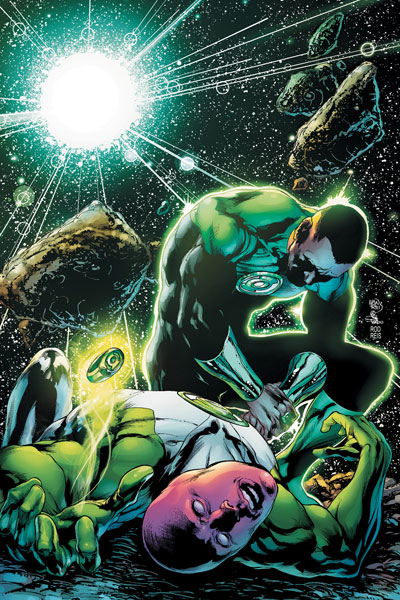
"Wrath of the First Lantern" has gone on too long. And that's after "Rise of the Third Army", the 'crossover' that went nowhere. Since last October, the Green Lantern team has been building toward this epic ending, but it's been diluted by time. There's no getting around that.

Green Lantern Corps #19 -- also known as Part Ten of this everlasting story -- is your standard going-through-the-motions issue that doesn't really know what it's doing while we wait for Green Lantern #20. The First Lantern, Volthoom, isn't around much, and John Stewart's minuscule C-story about reassembling Mogo suddenly becomes priority number one. The storytelling is erratic at best.

Mogo is a character that changes based on what's needed. First, he was simply a Green Lantern who happened to be a planet. Then, he became the place where GL rings are forged. Now, he happens to be able to encase large numbers of Green Lanterns within pieces of his planet crust to protect them from Volthoom's attack. How? Not explained.

Oh, and then there's the big old battle of the Green Lantern's Mogo saved against the Yellow, Black, and Red Lantern avatars of themselves...which turn out not to be Volthoom, but Mogo trying to teach everyone a lesson about being better than "what if?"s.

WHAT?!?

The entire "Wrath of the First Lantern" saga has been about attempting to stop Volthoom before he's able to absorb enough power to rewrite the universe. For some reason, Mogo is able to quarantine his fellow Green Lanterns and involve them in a emotionally charged war against ghosts of themselves without Volthoom noticing. No one seems to be worried that they're taking all this time to go through the motions while the First Lantern is gearing up to wipe existence clean.

Green Lantern Corps #19 is as much a filler issue as you can get. It involves contrived character development based on a continued 'deus ex machina' device. Nothing about the plot is really advanced at all. It's only worth it if you're a completionist.

GRADE
4/10

Wednesday, January 30, 2013

FEATURED REVIEW: GREEN LANTERN CORPS ANNUAL #1

(w) Peter J. Tomasi
(a) ChrisCross

"Rise of the Third Army" concludes this week with Green Lantern Corps Annual #1, a rather fantastic finish to a somewhat lackluster 'crossover' event that spanned all four Green Lantern Family titles from the 'New 52'. Things started out well enough last August with Green Lantern Annual #1, but the actual "Rise" of the Guardians' new army has been slow-burning, to put it lightly. In fact, the Third Army was rarely more than background noise that happened to pop into the main story every so often. Fortunately, Green Lantern Corps Annual #1 offers a bit of redemption for "Rise of the Third Army" with a satisfying conclusion that smoothly leads into the upcoming follow-up crossover, "Wrath of the First Lantern".

The Guardians of the Universe have been losing their marbles for quite a while. Geoff Johns provided the catalyst with the reveal that the Blue Ones had been hiding the fear entity Parallax within the Green Lantern central battery for eons. Besides giving explanation to the ineffectiveness of the Green Lantern rings against the color yellow, Johns' revelations in Green Lantern: Rebirth were the first of many that showed how billions of years of immortality have made the Guardians lose sight of their ethics.

In Green Lantern Corps Annual #1, Peter J. Tomasi picks up all the plot pieces -- from Green Lantern, Green Lantern Corps, Green Lantern: New Guardians, and Red Lanterns -- that have been piling up over the past four months. The Guardians' endgame is near, and part of that includes deceiving all Green Lanterns ignorant to the threat of the Third Army into returning to Oa for a mass genocide. Guy Gardner, new Lantern Simon Baz, and the squirrel-like B'dg concoct a plan to exploit the Guardians and inform the rest of the Corps as to what's happening by manipulating the Guardians' massive egos. John Stewart and Star Sapphire Fatality finally manage to see Mogo's reconstitution through. Kyle Rayner and his Rainbow Brigade show up near the end to add some seriously needed firepower. Finally, Atrocitus' reprogrammed Manhunters join the fray against the most powerful, most insane beings in the known universe.

This is Green Lantern storytelling at it's best: crackling interconnectedness that conveys the larger-than-life essence of science fiction storytelling. And unlike Geoff Johns' previous epic Green Lantern story arcs, the Guardians sit firmly at the center of this conflict, not through past mistakes or misinterpreted intentions, but by the will of their own machinations. Parallax, the Sinestro Corps, the Black Lanterns; all of them pale in comparison to the Guardians of the Universe in terms of raw power. Ganthet and his sorely misled brethren want peace in throughout the universe, no matter what the cost. In one sense, their endeavor is no different than in the past. Just like any other technology, advancements are made as time moves forward. For the Guardians, upgrading their technology means having a singular goal, a shared focus that allows for the best possible results. Under these guidelines, the Green Lantern Corps is like an old PC from the mid-90s: slow, outdated, and not worth the effort it would take to make it better.

Just like any nefarious villain bent on total control, the Guardians bite off more than they can chew, leading to the explosive -- if not foreseeable -- escape of the mysterious First Lantern, now named Volthoom. Without spoiling the circumstances of his escape or his intentions, the First Lantern's plans are a natural step forward from "Rise of the Third Army" that will give all the different Lanterns a lot to deal with in the coming months. Geoff Johns' Green Lantern plans have been coming to fruition for the past eight years, and it will be exciting to see how the Guardians' fall from grace will end. I word it like this because I can't see an outcome to "Wrath of the First Lantern" where the Guardians are still in power. Already in the 'New 52', the rules have changed for the Green Lantern franchise in significant ways, and introducing a First Lantern into the mix makes logical, if not yet evident, sense.

Green Lantern Corps Annual #1 does a great job finishing up one story arc and starting another. While the entire "Rise of the Third Army" event was less fast-paced as I had originally expected it to be, the conclusion makes it worth the build-up because we've been able to slowly integrate the idea of a hive-minded army of locust soldiers assimilating sentience into the basic setting of Green Lantern series. Instead of "Rise" being a one-month blitzkrieg (like, say, "Night of the Owls"), Johns and Company opted for pacing that made the threat of the Third Army all the more real and disturbing.

GRADE
9/10

Friday, December 14, 2012

REVIEW: BATMAN and ROBIN #15

(w) Peter J. Tomasi
(a) Patrick Gleason

After two months of so-so "Death of the Family" tie-in titles, Batman and Robin #15 comes out swinging. Not only does Damian take center stage on his mission to find Alfred while Batman's off tracking down the Joker, but Patrick Gleason's interpretation of the new, faceless Joker might be the scariest and creepiest version of the Clown Prince of Crime yet.

Much of Batman and Robin #15 is a psychological game between Robin and Joker. Damian's only been Batman's partner for a short amount of time, and from what I've read in the 'New 52' so far, it seems like Damian's never encountered the Joker. That's a big deal. Damian already has a penchant for being egotistical and brash when it comes to his ability oppressed by Batman's paternal instincts. Add the Joker's snide attitude and loss of all humanity, and Damian quickly recognizes the Joker is seriously deranged. But when the youngest Wayne sees a video of Joker blinding Alfred by pouring ammonia in his eyes, Damian is all to quick to renounce his oath to not kill anymore by promising to kill the Joker. On the one hand, it shows how determined Damian becomes after he fully understands the terror of Joker's mental instability. On the other, the whole sequence feels rushed and somewhat lacking. If it had only been a page longer, it would have really packed a huge punch. Instead, Damian's promise to kill Joker comes across as childish from a boy readers know doesn't have any philosophical issues with murder outside his father's opinions nagging at the back of his mind.

But really, this issue comes down to one single idea: "Robin's greatest fear is being responsible for Batman's death, and Batman's greatest fear is being responsible for Robin's death." Joker lays it out as simply as he can because that's exactly what needs to be said. Strip away the insanity, the murderous tendencies, and the tricky dialogue, and what you're left with is a character who is actually speaking truths, however twisted they might be--Batman's allies drag him down. They make him weaker because he has to care for them instead of performing at peak efficiency. It might not be what we want to hear, but it's real. This isn't to say that Robin, Nightwing, Batgirl, Red Hood, and Red Robin should be done away with (though, I guess we'll see the status quo at the end of "DotF"), just that we, as fans, need to recognize that one of Batman's weaknesses is his family. Of course, when you add the crazy back into Joker, he wants everyone dead!

Batman and Robin #15 is by and far the best "Death of the Family" tie-in issue yet, and is simply one of the best issues of the series overall. Damian Wayne is brash and confident to a fault, and it comes to a head when he faces the Joker, a villain who feeds on traits like overconfidence and uses it to his advantage. This series went through a bit of a rough patch for a few months in the late summer/early fall, but these past few issues have been fantastic. Peter J. Tomasi comes in at a close second for best interpretation of the Joker. And really, the only reason for that is because Scott Snyder developed the Joker's 'New 52' persona, so he's kind of got the best hold on him. If you're looking for a good "Death of the Family" tie-in, but you don't want to go overboard with issues, stick with Batman and Robin.

GRADE
8.5/10

Thursday, October 11, 2012

DARK WAS THE KNIGHT, VOL. 1 (OCT 10-16, 2012)


Welcome to 'Dark Was The Write', a mostly weekly column highlighting some of the less highlight-y titles connected to Batman and his dark city. Usually, the lead Batman title will get it's own review, and secondary issues get some love here! The Batman family of titles is by far DC's largest, so I won't always be covering everything released each week (like, I really don't like Batwoman), but there will usually be a healthy dose of Gotham City's problems represented.

Batgirl #13
"Death of the Family" Prologue
(W) Gail Simone
(P/I) Ed Benes


Batman and Robin #13
"Eclipsed"
(W) Peter J. Tomasi
(P) Patrick Gleason and Tomas Giorello
(I) Mick Gray


Although each of these issues features the same amount of offhanded remarks about the Joker, Batgirl #13 is labeled as a "Death of the Family" prologue, while Batman and Robin #13 is just beginning a two-part arc before rolling into the "DotF" event in December. The only slight advantage Batgirl has is that clown-masked men ambush Barbara and her mom at issue's end. But I'm getting ahead of myself.

------

I used to read Batgirl regularly, until about issue four. I didn't understand why, and if frustrated me greatly, but Gail Simone was just not delivering the kind of quality work I'd seen in Secret Six. Alas, I cancelled by subscription, and the last time I saw Batgirl, it was for "Night of the Owls", an event that let me read all the tie-in issues without being privy to the ongoing story.

But I have to say I'm pleasantly surprised by Batgirl #13. In what I can only assume is the conclusion of the current arc, Batgirl faces the deadly Knightfall who's out to kill Batgirl and the rest of the Batman family. In some ways, Knightfall has a point when she explains how Batman and his crew have allowed Gotham to rot. It's the crux of writing meaner, grittier stories when Batman's actions should be cleaning up the city. Only in a comic book city do seven superheroes operate and crime never gets any better. In fact, it seems to get worse with the passage of time. Gotham in the 1960s was probably a very nice place to live, albeit a bit seedy. Nowadays, I struggle to understand how anyone living in this fictional universe even gives Gotham the time of day.

Knightfall is revealed to be Cherise Carnes, daughter to one of Gotham's most influential and powerful real estate moguls. It feels like whenever a writer needs an out of some sort, he/she creates a villain with some connection to Gotham that makes them feel superior to Batman and his cronies. It's usually some sewer-dwelling psycho given unwieldy power, but there also seems to be a good number of 'super rich' families inhabiting Gotham that have a surprising amount of vengeful offspring. I've read this archetype before, is what I'm trying to say, but Gail Simone manages to pull it off without sounding redundant and cliched.

The lead-in to "Death of the Family" at the end was sub-par. After reading Scott Snyder's explosive pages in Batman #13, I guess I just expected more. Though, I don't want to get myself into a situation where I'm comparing all the tertiary stories of this event to Snyder's main run because nothing will live up to it. Barbara's mother is attacked by Joker's minions, and three villains (of Batgirl's, I'm assuming) are released from prison by three mysterious strangers (unless they've appeared in the series before, in which case I apologize to regular readers of Batgirl who know these characters' significance) with the death of Batgirl on their minds.

GRADE: 7.5/10

------


I don't have a lot to say about Batman and Robin #13. The story is so cliched zombie infection that I don't even want to discuss it. DC is committed to getting it's books out on time each month, and I commend them for that. The downside of this comes when artists aren't up to the task and single issues have a 10-12 person-strong artistic team. It's not terrible this month, but Patrick Gleason shares penciling duties with Tomas Giorello, and it's really one of the most jarring artistic changes I've seen in an issue in a long time. Gleason's minimalist style has worked well for Batman and Robin, showing a more fluid side of how the Dark Knight can be drawn. Tomas Giorello's style, however, leans toward detail and shadowing at every angle. It wouldn't be so frustrating if the art styles were a bit closer matched, but it feels like DC just picked any random artist and said "Finish up what Gleason left behind, kthanks," then left. This was a disappointing issue of Batman and Robin, for sure. Hopefully the "Death of the Family" tie-in issues will be better than this crapfest.

GRADE: 3/10

Friday, August 10, 2012

BATMAN AND ROBIN #12

STORY: Peter J. Tomasi
ART: Patrick Gleason and Mick Gray

After a pretty awesome first arc and a better-than-average contribution to "Night of the Owls", Batman and Robin has really found a place as a title focused on the relationship between these two characters and how it differs from former Robins because Damian is Bruce's son. Damian is a very complex character that Grant Morrison created (kind of), built up quite a bit, then just left for everyone else to clean up. In many ways, it would be like having divorced parents with passionate political beliefs that were polar opposite from one another. Damian was raised a loyal Libertarian, and has been thrust into the world of Democrats that he's only now beginning to understand, though he still feels inclined to prove his self worth by any means necessary. Unfortunately, all of these excellent elements surrounding Damian's characterization only show up sparingly throughout this current arc, and not at all in this issue.

"Terminus Maximus" has been billed as the 'main arc' of the past three issues, yet until Batman and Robin #12, you could have fooled me and said the big story was "War of the Robins", a side story concerning Damian's desire to defeat each of the former Robins in an effort to prove himself the best of Batman's sidekicks. Indeed, the "Robins" arc is far more insightful and interesting, as it has to do with emotional ramifications instead of blind villainy. Damian is a 10 year old assassin child challenging much older, stronger men to bouts of strength and wits - tell me that's not more awesome than a plot about yet another psychotic villain who wants to kill Batman and give Gotham the "truth". However I feel about the quality of each story, "Terminus" takes the spotlight this issue, as DC billed the issue as "The Final fight with Terminus!" Though, this is the one and only meeting, let alone fight, that Batman and Terminus have had. I don't know why Peter J. Tomasi wanted to crush a six-issue story into three, but he does so here with as much grace as a Juggernaut in a china shop.

Terminus himself is a pretty by-the-books villain, one who believes that Batman has made the city worse through his actions. Now, Termy wants to make the city fear Batman by sending out an army of lunatics to brand civilians with a bat symbol. While that particular part of the arc is cool, the entirety of the attack on Gotham lasted less than one issue. This month, it's all about Batman vs. Terminus, though there's really not a lot of logic to it. Terminus takes his name because he's terminal, and also because he wants to terminate Batman, I'm going to assume. Beyond that, we don't know anything about this guy. He doesn't have a proper name, his sickness is never given adequate explanation, and his hatred for Batman never evolves past vague "your actions affected me negatively" emotions that aren't based in anything real.

It's a real shame that "War of the Robins" not only ends this issue, but also gets pushed to the severe edges of the narrative. As Bats and Robin take on Terminus and this thugs, Nightwing, Red Robin, and Red Hood show up to lend a hand to save their city from this villain-of-the-week. The panels featuring all the former (and current) Robins together are filled with witty banter and snaps at each other much like brothers in the backyard. It's really at this point, nearly 2/3 of the way through the issue, that things start getting interesting, and it's because Tomasi finally starts focusing on relationships for a moment.

Now that "Terminus" is in the past, we have Batman and Robin #0 to look forward to next month, hopefully shedding some light onto the formative years of Damian's life in the League of Assassins. Because really, I just want to forget Terminus was even a villain. Tomasi even had to throw in a biochemical warhead for Batman to stop to make Termy more that just another faceless threat. But even that didn't work.

GRADE
B

Monday, July 16, 2012

BATMAN AND ROBIN #11

STORY: Peter J. Tomasi
ART: Patrick Gleason, Mick Gray, Keith Champagne, and Dustin Nguyen

This week at Comic-Con International in San Diego, Scott Lobdell revealed that Tim Drake went straight from a regular kid - with a knack for detective work - to Red Robin, without actually spending any time as Batman's official sidekick. This change sent waves through the comic book community, most of them negative. Tim Drake is definitely as popular - if not more so - as Dick Grayson, so it's odd that DC would so easily let Lobdell change continuity all willy-nilly. The reason I bring up this revamp is that Tim is still included in Peter J. Tomasi's "War of the Robins" story that's been the best part of Batman and Robin the past two months, even though he (now!) was never technically a Robin.

Damian takes his fight to Red Hood this issue, and DC has labeled it in promotional materials as the beginning of the newest Robin's quest to defeat all the former ones, even though he technically did beat Tim Drake last month in a battle of morality and ethical dilemmas. Perhaps this is DC's attempt to clean up the Robin retcon by saying Tim's encounter with Damian wasn't an actual fight that falls under the classification of "War of the Robins". But that seems a bit silly.

Nonetheless, Red Hood's turn is here. Jason Todd returns to his Gotham apartment, exhausted, only to find himself ambushed by Damian. Batman's son truly is a great character. What could have simply been a new Robin content to live a life of servitude under his father's wing has become a complex ten-year-old child leading a life of someone thrice his age. This facet of Damian was explored throughout the first eight issues of Batman and Robin, as Tomasi looked to show that Robin has problems and issues more akin to weathered assassins than his peers playing in schoolyards. Of course, Damin is 10 years old, so he's still got some insecurities that come with that age. One of which happens to be an inferiority complex when it comes to his mantle as Robin.


Damian Wayne is Bruce's only biological son, but the man has two other sons who he feels more connected with. Damian's dilemma isn't an uncommon one for children raised by a single parent - he's figuring out how to manage a relationship with the absent parent. And in this case, Damian feels that in order to prove himself to his father, he must defeat Bruce's former surrogate children.


Unlike last month, Tomasi spends a majority of this issue focused on Terminus. This slowly decaying villain has sent out a cadre of super-powered thugs to brand as many Gotham citizens as possible with Batman's symbol. Terminus has managed to turn the city's symbol of hope (no matter how dark and twisted that hope may be) into one of fear...again. At one point, Batman's just standing in a plaza, surrounded by buildings all triggered to explode at the same time. "Leave my city ALONE!" screams Batman as he has a hundred million times before. Tomasi is taking the easy way out, making Gotham the scapegoat in this pissing match riled up by Terminus for reasons unapparent so far. Sure, Tomasi threw us a bone last month with some cryptic flashbacks into Terminus' life, but they did little to give meaning to this villain's actions. All we know is that Termy sees himself as Gotham's true son and seeks to knock Batman off his high-and-mighty pedestal.


With two plot lines running simultaneously, Tomasi should be focusing on "War of the Robins", a narrative that actually has a purpose and can give real insight to Batman's various sidekicks throughout the years - it's a character-driven plot that has a lot more potential. Terminus' plot to make the city his own is one that has been done to death for the last sixty years of Batman's history, and it feels like more of a support story that's getting too much limelight.


GRADE
C+

Thursday, June 21, 2012

(COMIC) GREEN LANTERN CORPS #10

STORY: Peter J. Tomasi
ART: Fernando Pasarin and Scott Hanna

I haven't been too impressed with Green Lantern Corps as of late. Peter J. Tomasi seems to be throwing all his energy towards Batman and Robin leaving GLC with a husk of a narrative to drive it forward. Part of this boring streak comes from the use of the Alpha Lanterns, a group of ridiculous Lantern police who have been a constant nuisance since they were first introduced years ago. I'm not a fan of the Alpha Lanterns - not from a story perspective, but from a narrative one. Alpha Lanterns are just buzzkills; they're not really "evil", and their storylines always focus on moral dilemmas. There's only so many times the Alphas can rise up - only to be talked back down using ethical logic - and brought back to the status quo before readers get bored. I'm already there.

Nonetheless, Green Lantern Corps #10 is easily the most enjoyable issue of the "Alpha War" so far. The first two entries into this arc were mired with legal jargon and judiciary proceedings - not things you want (or expect) from an action-based comic book. And while the best part of this month's issue is actually a debate over an issue of hypocrisy, the fights come out in spades.

Now that John Stewart has an expiration date, the Alphas and the Guardians discuss how it should be done. It's very, very interesting to see the direction Tomasi is taking this story now. The Alpha's immediately suggest that the Guardians be the one to execute Stewart; a way to "legitimize" the Alphas' decree. Without hesitation, the Guardians decline. Then the Alpha's suggest a group of Lanterns be chosen at random to do the deed, to which the Guardian's see (rightly so) as totally hypocritical. In a last ditch effort, the Alphas suggest an outside mercenary to act as executioner. Fed up with the Alphas' presumptuous attitudes, the Guardians decree that if the Alpha's want to execute John Stewart, they'll have to do it themselves. It's a harrowing part of the book and one that does not bode well for the future of the Alpha Lanterns. Eventually, Guy springs John from the Sciencells with dozens of Lanterns as backup. 


The worst part of this month's issue comes from John's confrontation with Kirrt's parents. By his own conscience, John asks to meet with them when they arrive to attend Kirrt's official funeral on Oa. It's a really stupid scene because John tries to explain that he's not looking for their forgiveness - he only wants a chance to apologize for his actions.

This isn't true at all!

If John really wanted to apologize with no ulterior motive, he would have written a letter or recorded a video for Kirrt's parents. And maybe they wouldn't read/watch it, but that's their choice. What Tomasi is actually giving John Stewart is one more chance to make things right with Kirrt's family. John wants a few more minutes to explain his side of the story and how it was the right thing to do. This is total bullshit. John's personality goes through such a violent shift in only a matter of pages that it's jut jarring to follow. One minute, he wants to atone for what he's done, the next, he's ready to die. Make up your mind, man! (I am, of course, speaking to Tomasi, who can't seem to decide if John should be a cold-hearted killer or a martyr. Either way, I feel like GL fans will lose. Putting John Stewart in this situation was unnecessary and mean. John's always been the GL that feels guilt more than any of them, and yet Tomasi decides John's the one to have to go through this totally painful and embarrassing trial.

GRADE
B-

Saturday, June 16, 2012

(COMIC) BATMAN AND ROBIN #10

STORY: Peter J. Tomasi
ART: Patrick Gleason and Mick Gray

In the month after "Night of the Owls", all the Batman-related books are starting new story arcs. Peter J. Tomasi and Patrick Gleason's Batman and Robin #10 might be simultaneously the most interesting and the most boring new story of the bunch. Since Big Ol' Bats already has three series dedicated to his solo outings, Tomasi has been focusing on Damian Wayne quite a bit, not only dealing with his daddy issues throughout the first arc, but also with Damian's talent for strategic battle during last month's Talon incursion. This has been a consistently smart move on Tomasi's part.

Batman and Robin #10 kicks off "Terminus", but you'd barely know it if you didn't want to. The so-called Terminus takes a far, far back seat to the issue's main events. All the same, this guy obviously has criminal intentions, and his body seems to be falling apart. Terminus spends the issue regenrating in some crazy regeneration machine. That's it. I'm sure there will be more to this, but it also doesn't seem very interesting. At this point, Terminus is just some dude who wants to kill Batman - hold the phone! No, the real meat in this issue comes from the 'War of the Robins' storyline.

Bruce has called all the Robins, former and current (except for Jason Todd, for obvious reasons), together for a family portrait at Wayne Manor. One of the best things about the Robin mantle is that there isn't one type of person who becomes Robin - they come in all shapes and sizes and personalities. Within minutes, Tim Drake and Damian are at each other's throat. Dick Grayson loftily sits above their squabble, as his position as Robin can never be questioned (he's the O.G., baby!)

The feud between Tim and Damian is interesting, mostly because it stems from simple disrespect. Whenever Batman and Superman had disagreements, they never lost respect for one another, but neither boy here regards the other in any good light. For Damian, Tim is stuck-up and looks down on Damian, while Tim feels that Damian is a psychopath and unworthy of a title he and Dick worked hard to maintain. That's pretty much the description you're going to get anywhere else. The truth of the matter is much deeper, even if Tomasi doesn't know it.

Tim Drake was the son Bruce never had. Sure, Dick was the first Robin and literally had no parents and was adopted by Bruce, but they've always had a stronger working relationship (at least in my memory. Maybe I need to go back and reread old Silver Age issues). Tim, on the other hand, was the one who figured out who Batman was, the one with the detective skills to rival Bruce's own, and the Robin that took the name from respectable to iconic. Like I said, Tim was the son Bruce never had. Until Damian. Tim's real beef is that Damian is a real Wayne and Bruce's actual son. Obviously, it's painful to see your mentor and father-figure move on to a new apprentice, a new disciple. And sure Tim left of his own accord, but he keeps the mantle Red Robin, an obvious homage to his former title which means he still has deep emotional ties to the name and the job. Dick, conversely, left and took the name Nightwing, moved to a new city and generally tried to distance himself from Batman for quite some time.

Damian, of course, lives in Tim's all-encompassing shadow. Tim held the mantle for so long and did so well, it's obvious to Damian that Bruce is looking to make Damian more like Tim. The entire first arc of Batman and Robin was about Damian's issues with his upbringing as a killer, and in a sense, he was able to make a good step forward in dealing with those issues. But Tim is always there - a constant reminder of how good a Robin can be and how lacking Damian is compared to Tim.

The night after their blow-up at Wayne Manor, Damian calls all the former Robins together, even extending an invitation to Jason Todd, the Red Hood! When they all show, Damian declares "war" on them. Damian explains that at some point, he will confront each of them and defeat them at something they consider themselves the best. Of course, they all immediately assume Damian means a fight, but the little Robin's much smarter than that! His only goal with Tim is to get Red Robin to admit he'd had homicidal thoughts. Tim rebuffs this by saying he's never acted on those thoughts, which is what separates them.

I really do tend to enjoy superhero stories where the heroes are in-fighting, and the "War of the Robins" portion of Batman and Robin #10 is totally awesome. My psychoanalytical critique aside, these characters are all awesome and now, they've got an arc slowly building that will pit them all against one another in a variety of circumstances. FANTASTIC. Terminus will probably continue to be a boring sub-plot that will eventually slip it's way into the main story, pulling the entire arc down as a result, but we'll cross that bridge when we get to it. For now, awesomeness.

GRADE
A

Friday, May 18, 2012

(COMIC) GREEN LANTERN CORPS #9

STORY: Peter J. Tomasi
ART: Fernando Pasarin and Scott Hanna

This cover is a misdirect.
The firs six issues of Green Lantern Corps were action-packed and fun to read. The same cannot be said for "Alpha War", the current arc. Granted, I've said nice things about GLC the past few months mostly because I was hoping things would start moving a little quicker. Unfortunately, Green Lantern Corps #9 suffers from simply not being interesting.

"Alpha War" seems to be a misdirect, as there has been no 'war', so to speak. Yes, the Alpha Lanterns are getting all up in John Stewart's face, and yes, the Guardians are probably using the Alphas to bring about the coming of the mysterious "Third Army". The stakes just don't seem as high as they should be. I read an editorial piece recently that posited that the Guardians of the Universe have become long in the tooth; they've been so dastardly for so long now, it's not as shocking to see them scheming as it was back in, say, 2007. And the fact that - after years of storytelling - there are still deep, dark secrets in the Guardians' closet means that these blue beings have been corrupting the universe since it's inception, and that's a notion that throws the entire DC Universe into question. Apparently, no one at DC thought to look into this further.

Basically, Green Lantern #9 is one long trial. It's suuuuuuper boring. A lot of trial jargon and scenes of the entire Corps in attendance doesn't make up for a filler of an issue. The only good part comes when a few Lanterns raid the crypt and attempt to smash Kirrt's statue after hearing about the cowardice that led to his murder. Guy Gardner stops them and takes a few pages to lecture them about knowing how to use fear. It's a 'lesson' that's been taught every which way for years and it's lazy.

Peter J. Tomasi needs to step up his game. Green Lantern Corps was doing great, but mucking it up with legal drama is murdering it's reputation.

GRADE:
D+

Wednesday, May 9, 2012

(NIGHT OF THE OWLS) BATMAN AND ROBIN #9

STORY: Peter J. Tomasi
ART: Lee Garbett, Andy Clarke, Ray McCarthy, and Keith Champagne

First off, I want to apologize for not writing up reviews for Batwing and Detective Comics last week. I know I said I would be covering all issues of DC's 'New 52' connected to Batman's "Night of the Owls" event, but those two issues were downright boring. I understand the desire to want an Bat Family-wide crossover to it's fullest, but those two titles felt soooo forced, I just couldn't write enough about them - good or bad - to justify a review.

That being said, Batman and Robin #9 is a much better (if not great) chapter in the "Night of the Owls" saga, one that sees Robin on his own in a surprising new light: commanding officer. Damien's role in the counteroffensive against the Talons takes him outside Gotham city limits to find and protect Major General Benjamin Burrows, and it just so happens Burrows is running night drills with his troops.

Damien goes into military mode, barking orders and setting precise formations to best defend against the undead assassin. It's a little confusing, how Batman and his allies so readily put others in the line of fire to protect others. Basically, Robin is forced to outrun the Talon by leaving foot soliders behind to slow it's advance - a decision Damien knows will lead them to their death. I understand that Burrows is a target and that his status makes him a key player in Gotham, but it seems negligent to allow soliders to be slaughtered in a scenario they weren't ready or trained for. Of course, this could be exactly how Peter J. Tomasi wanted to play it.

The story falls apart, somewhat, when General Burrows' family history is injected. During the Revolutionary War, George Washington promised a large sum of land to Edwin Wilkins. When Wilkins was taken by the British, this specific Talon was called upon to murder Wilkins and his family to secure the promised land for the Court of Owls. The Talon was successful with all but the youngest Wilkins son, who somehow survived and was adopted by the Burros family, making General Burrows the last surviving descendent of Edwin Wilkins. Now, this Talon asked to come after Gen. Burrows to finally complete the mission he was given over 200 years ago.

This connection between the Talon and Burrows would make a whole lot more sense if Burrows still owned the land, or anything like that. In the flashback, the Talon even says that the Court eventually took control of the land, so why does he care so much about killing Burrows? It doesn't make much sense and pulls down a book that was pretty damn good up to that point.

GRADE:
B-

Sunday, April 22, 2012

(COMIC) GREEN LANTERN CORPS #8

STORY: Peter J. Tomasi
ART: Fernando Pasarin and Scott Hanna


Things are changing in the Green Lantern Corps. At the end of Peter J. Tomasi's "The Lantern Keepers" arc, John Stewart was forced to murder a fellow Corpsman to avoid releasing the access codes to Oa's security and defense systems. It was a bold move to make John a killer once again. Many writers spent many years leading the stoic Green Lantern through mental anguish and recovery over his inability to save the planet Xanshi from destruction. This time, however, John knows that what he did was for the greater good, no matter now bad it makes him feel.

The beginning of the issue shows a rather large showing of Lanterns moving the Sinestro Corps Central Battery onto Oa for safekeeping. John has dug a hole big enough for the yellow battery, but Guy constructs a giant hammer and knocks it in sideways instead of vertically, as John had planned for. While his actions came in a moment of anger, Guy explains that the symbol of the Sinestro Corps shouldn't be standing upright, especially not on Oa. And the Guardians agree! For the first time in Guy Gardner's career, the Guardians of the Universe agree with his opinion. The Guardians then offer Guy a sort-of 'general' position within the Corps, to stand above the rest and answer only to the Guardians themselves. Totally in character, Guy gleefully accepts, smugly adding, "What the hell took you so long to rub the blue glue outta your eyes and see I'm the one!"

The real point of this issue (outside Guy's promotion) is the final page; the Alpha Lanterns descend to arrest John for the murder of Green Lantern Kirrt, an action that will surely lead to this "Alpha War".

GRADE:
B

Friday, April 13, 2012

(COMIC) BATMAN AND ROBIN #8

STORY: Peter J. Tomasi
ART: Patrick Gleason and Mick Gray

Every bit the epilogue issue, Batman and Robin #8 wraps up the Dark Knight's conflict with Morgan Ducard (a.k.a. Nobody) and starts putting together the pieces of his relationships with Damian. Peter J. Tomasi has done something that even many of today's best writers don't often show: downtime. To keep readers interested, characters are often simply thrust from one enemy/conflict to the next with no respite. And while I'm perfectly content not seeing my favorite superheroes on the toilet, I do enjoy seeing them without the mask on (figuratively), just being themselves.

This month, Damian finally listens to Bruce's recorded words (from previous issues) about their relationship. The fight against Nobody took it's toll on both Bruce and Damian, and Alfred enforces his 24-hour concussion lockdown, giving father and son time together that doesn't involve stopping a weapons deal or taking out the Joker. Damian also finally names his dog, a small nuance that reaches back to issue two when Bruce first buys the dog for Damian, and playing catch in the backyard is kind of like the end result of two issues-worth of growing tension and release.

Of course, Damian is still apprehensive, telling his father "And here I thought we didn't like each other," to which Bruce responds, "We don't understand each other. There's a difference." It's a fitting theme for this first arc of Batman and Robin under the 'New 52' banner. Just because they don't have difficult agreeing on anything, that doesn't mean they don't care for each other.

The issue starts dipping into cheesy territory when Damian explains, "I don't want to end up like Ducard...without a moral compass...I don't want to turn into a nobody. I want to be like you. I've always wanted to be like you." After all this time, Damian sheds his hardened skin after one close call with death. Knowing that Batman and his Robin had a relationship before the relaunch is almost necessary, or this scene loses most of it's meaning.

GRADE:
B

Thursday, March 15, 2012

(COMIC REVIEW) Batman and Robin #7

Written by Peter J. Tomasi
Artwork by Patrick Gleason and Mick Gray

And just like that, Batman and Robin picks up exactly where it left off last month; no flash-forwards, no frills. Even from the first pages, this has been my favorite issue of Batman and Robin thus far. I'm sure this is partly due to the completion of Peter J. Tomasi's first story arc and the satisfaction that comes with following a plot for months toward it's climactic conclusion. It's also because this is such a solid issue.

Morgan Ducard and Bruce go head to head this month, a proper bout that brings out the emotional instability in both men. Morgan still blames Bruce for 'stealing' his father away, and Bruce wants to kill Morgan for hurting Damian, and nearly does before stopping himself to show his son the meaning of restraint. The fight is incredibly fun to read, with expert shading from Mick Gray complimenting Patrick Gleason's subtle, yet descriptive pencilling.

The final pages, in which Damian murders Morgan - even after Bruce stopped himself from doing the same thing - are a terrific build-up for the next arc. My only complaint: Damian getting all religious with the "Forgive me, Father, for I have sinned," shtick. It's annoying and grating. Other than that small snafu, Batman and Robin #7 sits at the top, in terms of quality, for this series thus far.

GRADE:
A

Saturday, February 18, 2012

(REVIEW) Green Lantern Corps #6

Written by Peter J. Tomasi
Artwork by Fernando Pasarin and Scott Hanna

As DC's 'New 52' hits it's sixth month, many plot lines started back in September are coming to a close - or at least getting damn close. With Green Lantern Corps, Peter J. Tomasi has brought us to the end of his first arc. This month's issue was one of the most interesting and fun issues of the series since September. While it's not difficult to 'over-do' a character in a title like Green Lantern Corps, it's surprisingly been done a number of times in the pastThe fight against the Urakians comes to a head this month, showcasing not only Tomasi's strength at writing ensemble work, but also for Fernando Pasarin's beautiful art. Drawing tons of Lanterns fighting together, each projecting a different construct, is a difficult undertaking and one Pasarin steps up to with grace and fluid pencilling. Scott Hanna's inking isn't intrusive or loud, and his shading is exquisite.

With a crap-ton (the scientific measurement) of guns and a 'fear bomb' rigged to go off at the center of the Urakian operations, Guy Gardner's secret team goes in head first, relying on the element of surprise, bullets and a whole lot of willpower. Poignantly, Gardner observes, "...they sure as hell ain't immune to lead!" The fight scenes are exquisite and the Urakian's power-conversion system is a classic - if not cliched - human battery concept; the Urak leaders are keeping their people connected to a stargate so they can transport the Central Battery from Oa to Urak, displacing the Guardians' home as the center of the universe.

The big GASP moment came when John Stewart is forced to murder a fellow Green Lantern - Kirrt - before he gives up the codes for Oa's defense systems. And while it seemed (for a moment) that Kirrt may have been concocting a plan, Stewart realized his brother in arms had fallen. With the fate of the entire Corps in the balance, Stewart does what he believes must be done. Of course, we'll see the fallout of his actions in next month's epilogue issue.

As I mentioned earlier, it's been great learning about Green Lanterns other than Guy Gardner, John Stewart and Kilowog. Bringing in the 'Mean Machine' and including some of the better characters from past series - such as Sheriff Mardin, Hannu, and Brik - has been Green Lantern Corps' saving grace. I'm excited to see where Tomasi takes the series after next month's issue.

GRADE:
A-

Thursday, February 9, 2012

(REVIEW) Batman and Robin #6

Written by Peter J. Tomasi
Artwork by Patrick Gleason

Oh, Damian Wayne. What a weird character. Maybe it's because he debuted as Robin at one of the only times in the last 10 years that I wasn't regularly reading comics, or maybe it's just his attitude, but the kid's an oddball, to say the least. Of course, he's be written as a weirdo. Born and raised by Talia Al'Ghul, trained as an assassin his whole (ten years of) life. That kind of childhood is bound to leave a mark. But the real focus of this first arc of Batman and Robin hasn't been Robin, per se. While Peter J. Tomasi has done a stellar job penning the awkward relationship between Bruce Wayne and his son, this arc's been all about everyones daddy issues. The primary relationship, that of Bruce and Damian, is only a lingering idea behind all of this issue's events, as Batman and his Robin don't get any shared panel space.

Damian has teamed up with Morgan Ducard, forced to kill an ambassador Ducard claims has ties to human trafficking. While the tension surrounding Damian's decision to pull the trigger pretty much fade away when he fires nothing, Ducard makes his deceptive nature truly known (like trolling the planet killin' Batman Inc. members and dressing up as a character from Neon Genesis Evangelion wasn't enough). Normally, I'm not a fan of random historical exposition to back-up a story-in-progress, but Bruce's time with the Ducards father and son works a rich story with minimal detail and drag.

By the end of the issue, Damian reveals that he's been playing both Bruce and Ducard! Using his past to solidify the believability of his leaving Wayne Manor, and using his shaky relationship with Bruce to leverage Ducard's trust. It's a brilliant plot twist, one that could have been written much more lazily. Tomasi has done a great job keeping the story engaging while not burning out readers with constant action or pages of expository dumps.

GRADE:
B+

Friday, January 20, 2012

Review: Green Lantern Corps #5

Review


Green Lantern Corps #5
Peter J. Tomasi - Writer
Fernando Pasarin - Pencils

Back in 2005 - after Hal Jordan's resurrection in Rebirth - DC brought back Green Lantern's sister series from the days before the original Parallax saga starting with a mini-series entitled Green Lantern Corps: Recharge. While the series saw it's ups and downs, mostly stemming from it's fragmented storytelling and too-often reliance on knowledge of events in GL-proper to understand events in Corps., it was a solid book that focused on Guy Gardner, Kyle Rayner, John Stewart, Kilowog, and a cast of nearly six other Lanterns from various sectors.

While it's previous incarnation was good, the 'new 52' Green Lantern Corps feels like it's own book that can stand on it's own stories. Keeping a focus on Guy, John and Kilowog was the right choice for the Corps series of the GL-centric books. Kyle has never been comfortable amongst the Corps (and was thusly given his own series to star in), and the letting lesser known Lanterns pop in and out gives them character context without becoming overbearing or drawn out.

This fifth issue gives quite a bit of back story to the first arc's villains, the Keepers, courtesy of the telepathy powers of newly cynical J'onn J'onzz, the Martian Manhunter. It really was a 'BURN!' moment when he called out the Corps for their failures with Krypton and Mars. Tomasi is skillfully employing the Guardians' terrible track record as of late in telling his tale of a planet charged with protecting Green Lantern batteries when they are being stored in the 'pocket dimension' described by GL's for decades. In fact, the batteries temporally travel to the planet inhabited by the Keepers. When the Guardians mysteriously remove all the batteries, the Keepers' world begins to die and they began to lash out for resources anywhere they could find.

In one stroke, Tomasi has not only given the Green Lanterns a formidable foe without resorting to a crisis-level villain, but also provided another great piece of the Guardian's history of fucking everything up. I've read (and thought myself) that blaming the Guardians for everything has become a crutch for writers over the past five years. To many, it seems as if the Guardians apparently acted more like the CIA, killing, cheating and lying to claw they way to the top, rather that behave like the benevolent beings presented over nearly seven decades of comic continuity. But that's the beauty of a race that's as old as time itself; they've had a lot of time to screw things up, and a lot of universe in which to do it.

Grade: B

Friday, January 13, 2012

Review: Batman and Robin #5

Review


Batman and Robin
Peter J. Tomasi - Writer
Patrick Gleason - Pencils

I've been a general fan of the Batman titles presented in the New 52. Scott Snyder's Batman is the best of them, but Batman and Robin definitely comes in at a close second. Damian Wayne is an interesting character, one that has depth and story potential in a circle of characters that's been a little stale for a few years. What's most interesting about the Dynamic Duo's title is the relationship between the two characters, not only as crime fighters, but as father and son.

Batman and Robin #5 has Robin running away from Wayne Manor with Morgan Ducard, son of Henri Ducard, one of the men who trained Bruce as a young man before he was Batman. Morgan has persuaded Damian to forsake Bruce's ethical lessons in favor of swift and brutal justice against criminals. And the issue starts off great, with a nod to and Infinite Crisis-era Bruce who has the entire city's security system redirected to the Batcave. While also drawing similarities from 2008's The Dark Knight, Batman's use of invasive security measures is a little jarring, as is the sudden shift in narrative into an exposition dump on the Ducards.

I'm sure Peter J. Tomasi thought it would be a good idea to give readers a look into Bruce's past. Unfortunately, the history lesson takes up most of the book and seriously hits the brakes on the main story, which is a shame because Robin's defection is an extremely interesting story. It's been obvious since Damin became Robin that he would, at some point, defy Bruce and leave, and that's why it's so satisfying to see how it's going to happen. Morgan Ducard has had a presence in Batman and Robin since it's 'first' issue back in September, and while readers were give a slight backstory a few issues back, it feels like wasted potential to not parcel out the Ducard history over the span of multiple issues instead of a data dump.

Patrick Gleason is an excellent artist for the Dark Knight, whose minimal style effortlessly conveys the darkness and tone of Gotham City. I'm a fan of artistic consistency and DC has done a great job of keeping their artists on lock.


Grade: B