Showing posts with label Robin. Show all posts

Thursday, March 14, 2013

Batman #18

(w) Scott Snyder     (a) Andy Kubert

Can we all stop pretending Harper Row isn't going to be the next Robin? Whenever you see "This ends now" or "It's over" without a death afterwards, it means it's not over...and it's not anywhere near being close to over. This element of comic book logic might seem obtuse, but it has merit. Days before the release of Batman #18, Scott Snyder announced his next arc, "Year Zero", and that it would be 11 issues long. Basically, the next year of Batman is going to be about the Dark Knight's earliest days, which means it's going to be a while before Snyder gets around to telling Harper's story. But that's part of the beauty -- now, we've got something to look forward to even after the next thing we have to look forward to, and isn't that what comic books are about?

All joking aside, Batman #18 from Scott Snyder and Andy Kubert is another great look at effect of Damian Wayne's death on his father. After the emotional head-trip that was "Death of the Family", Snyder wisely makes Harper the focus of the issue, leaving a grieving Batman at arms-length from the rest of his family. Losing an immediate family member is incredibly painful and can lead to feelings of resentment toward others who cannot possibly understand that kind of pain. For Batman, this resentment is compounded upon exponentially due to his very nature as well as his overwhelming feeling of responsibility for his own son's death. It would have been a train wreck if Snyder attempted to tackle Bruce's feelings with inner monologue.

Harper Row is going to be one interesting Robin, to say the least. Each of Batman's Robins has their own unique personality. If Dick was the passionate one, and Jason was the brash one, and if Tim was the witty one, and Damian was the one with the attitude, then Harper Row is the realistic Robin. Harper and Batman's confrontation brings out the darkest in the Dark Knight and most anyone else would have crumbled under the weight of Batman's terrifying reputation. Not Harper. Unlike the songbirds before her, Harper's life has been one obstacle after the other which has made her more rough around the edges than the boys who've held the mantle before (except Damian, perhaps, but his was a more refined talent). She's not afraid to rebuff Gotham's protector and tell him the reality of what's going on around him when no one else will.

While I'm excited for the upcoming "Year Zero" arc, Harper Row is what truly interests me now about Scott Snyder's Batman. Since the 'New 52' launched, Harper has been around and that's no coincidence. I'd be shocked if Snyder killed her off. I'd be even more shocked if she didn't become the next Robin because who else is there? Seriously, it's the next logical step. But it's a good next logical step.


GRADE
9/10

Wednesday, December 12, 2012

REVIEW: BATMAN #15

(w) Scott Snyder
(a) Greg Capullo
(i) Jonathan Glapion

"Death of the Family" marches along this week in Batman #15 with a sort-of interlude issue for the whole event. This month, nearly all the Bat-books have a connection to "DotF", meaning there's a whole lot more narrative going on all around Scott Snyder's central plot. Of course, this isn't to say that this issue is boring, or any lesser quality than any other issue, it's just not as action-packed and/or thrilling as last issue's edge-of-the-seat chapter. Snyder knows how this story has to play out and what that means for Batman and his extended crime-fighting family. Batman #15 is really what this Joker-centric story is all about: the disintegration of Batman's support system. 

We know the Joker sees Batman as a king of Gotham who can't be his best because he has weights tying him down in the form of his allies. Each new Bat-hero that emerges becomes one more person Bruce has to worry about, just one more body to inevitably find, according to the Joker. He's not wrong. The best part of "Death of the Family" is that the Joker is absolutely right--while Batman might consider himself a loner (along with DC's editorial staff), the evidence of decades of sidekicks, allies, and frenemies says differently. Bruce's penchant for taking in outcasts and turning them into shadowy vigilantes points more to his obsessive need for family rather than his isolationism. Sure, every time a new Robin pops up, Bats gets pretty defensive about taking on a new partner, and he never really approved of Barbara becoming Batgirl, but the end result says that Batman needs a strong, extensive support system to maintain his desired crime-fighting lifestyle. Heck, he created Batman, Inc. just to have more allies/soldiers around the world. Bruce needs his family, and Joker knows it.

This month, Bruce reveals a shocking secret about his history with the Joker than sends Nightwing, Red Robin, Batgirl, Red Hood, and Robin into a hissy fit. The actual information isn't so important as the fact that Bruce kept a major secret from his allies. Bruce attempts to convince the others that Joker doesn't actually know anyone's identity and that it's all just a twisted mind game. The revelations from the past make Bruce's words somewhat hollow in the eyes of the others, and they start to question Bruce's ability to keep a clear head in the midst of this chaos. It very much feels like a turning point for Batman and his allies, that they might never fully trust each other ever again, that this is how the family falls apart.

GRADE
9/10

Thursday, September 27, 2012

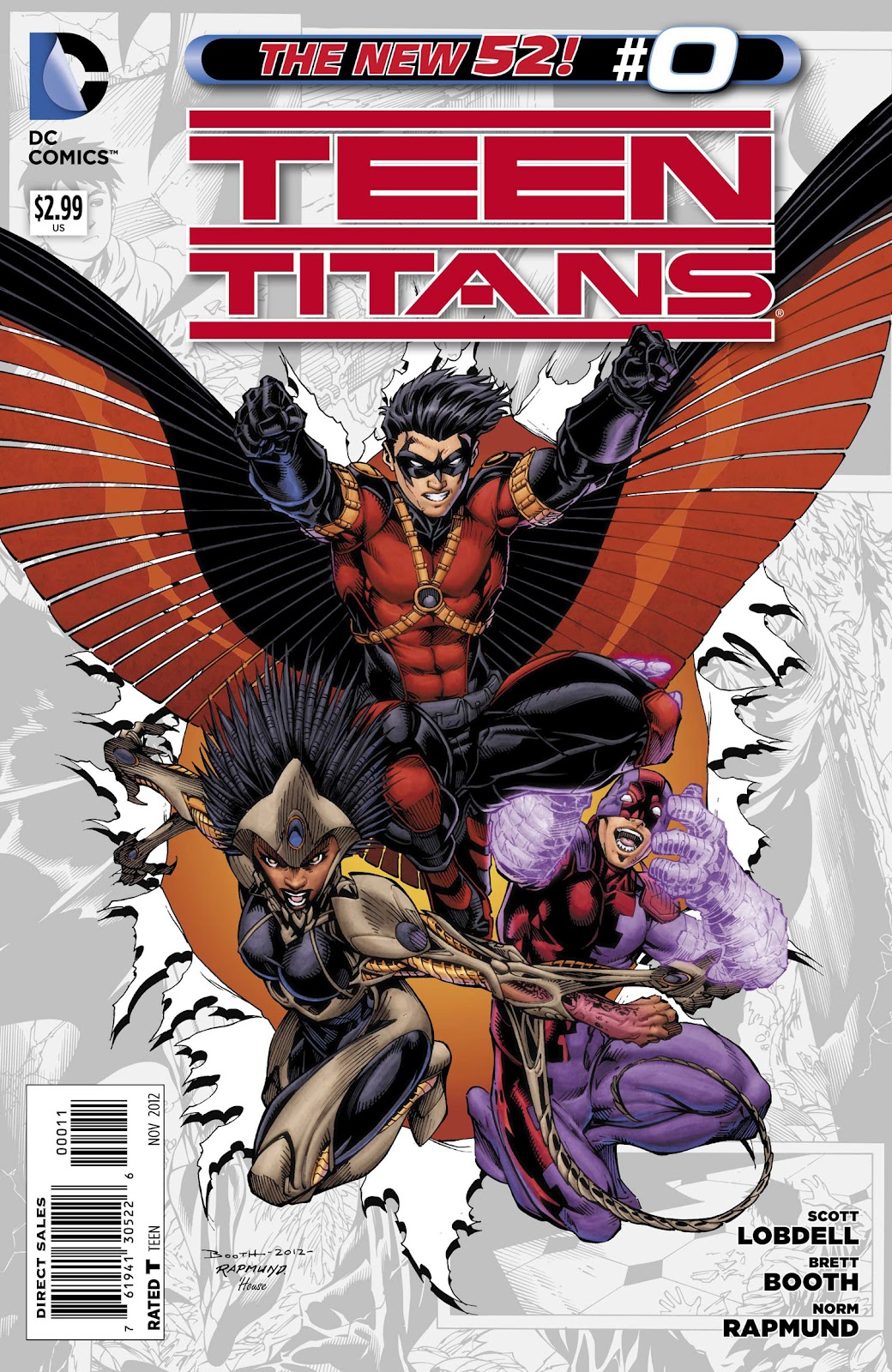
TEEN TITANS #0

STORY: Scott Lobdell
ART: Tyler Kirkham and Batt

Just like with Superboy #10, Scott Lobdell proves with Teen Titans #0 that he's not completely inept at writing the characters he's been given. For this "Zero Month" issue, Lobdell gives us the origin of Tim Drake, better known as Red Robin: former protege of Batman. A few months ago, Lobdell shocked the fan base at San Diego ComicCon by announcing that Tim Drake was never an official 'Robin' of Batman's. Instead, Tim's been Red Robin since he became a caped crusader. In essence, Lobdell majorly altered the character history of arguably the most iconic Robin of them all (at least, on par with Dick Grayson) - this was a big pill for fans of the third Robin to swallow. But putting aside comic book fanaticism, it really doesn't make that much of a difference - Tim still fills the 'Robin' roll at Batman's side, his costume is basically an all-red Robin get-up, and he eventually moves on to let another youngster take the sidekick roll. The truly interesting thing about Teen Titans #0 is how well Lobdell reinvigorates a character who was more or less a carbon copy of Bruce and Dick when he was originally introduced.

Tim Drake is now a prodigy in both the physical and mental arenas. He excels at all intellectual projects, has the potential to be on the US Olympic gymnastics team, enjoys a completely happy home life, and impresses everyone he meets...and that's the problem. After observing Tim in person, Bruce rightfully decides that Tim doesn't shouldn't be Robin. Dick Grayson and Jason Todd came into the roll of Batman's sidekick because their lives had been shattered and broken, same as Bruce years and years ago at the hands of Joe Chill. Tim Drake's life couldn't be better - he's got a bright future and his parents love him. There's literally no reason for him to be Robin. But of course, Tim has a secret obsession with Batman's secret identity.

This is where Tim goes from being a Golden Child to being a multi-faceted character who has a huge flaw: pride. After falling into Bruce's trap by following set-up clues, Tim gets scolded by the Batman who tells him to lay off and just enjoy his life. Unsatisfied with that response, Tim uses his exceptional hacking skills to steal the Penguin's fortune. If this behavior seems alarming and odd, well, it is. Tim's meeting with the Bat didn't discourage him so much as it validated his actions - Tim took the next step in his fight against crime without Batman's consent because Batman even bothered to meet him at all. Lobdell has done good work in making Tim fundamentally different from Dick and Jason before him. His pride in himself becomes his weakness. Now, this wouldn't be a Batman-related story without at least some tragedy. The hacking stunt causes the Penguin to put out a hit on Tim and his parents.

Tim's parents don't die. Lobdell avoids his pitfall and instead puts the Drakes into the witness protection program. The twist comes when Tim is left behind in Gotham - as a perceived orphan at this point - to have the chance at good and successful life he wouldn't get being forced to hide who he is in witness protection. The end result is that even though he's seen and treated as Bruce Wayne's orphaned son, Tim's parents are still alive. Somehow, this is going to tie into future stories, whether it be the upcoming "Death of the Family" crossover (which would make a lot of sense, considering the familial elements at play in this issue), or future arcs.

All in all, Teen Titans #0 is fantastic. Scott Lobdell's writing usually leaves a lot to be desired for me, as a reader and a critic. This month, though, he really stepped up his game and gave a solid origin story for Tim Drake that may not be what hardcore fans wanted, but manages to change the character enough to make him interesting again.

GRADE
B+

Friday, August 10, 2012

BATMAN AND ROBIN #12

STORY: Peter J. Tomasi
ART: Patrick Gleason and Mick Gray

After a pretty awesome first arc and a better-than-average contribution to "Night of the Owls", Batman and Robin has really found a place as a title focused on the relationship between these two characters and how it differs from former Robins because Damian is Bruce's son. Damian is a very complex character that Grant Morrison created (kind of), built up quite a bit, then just left for everyone else to clean up. In many ways, it would be like having divorced parents with passionate political beliefs that were polar opposite from one another. Damian was raised a loyal Libertarian, and has been thrust into the world of Democrats that he's only now beginning to understand, though he still feels inclined to prove his self worth by any means necessary. Unfortunately, all of these excellent elements surrounding Damian's characterization only show up sparingly throughout this current arc, and not at all in this issue.

"Terminus Maximus" has been billed as the 'main arc' of the past three issues, yet until Batman and Robin #12, you could have fooled me and said the big story was "War of the Robins", a side story concerning Damian's desire to defeat each of the former Robins in an effort to prove himself the best of Batman's sidekicks. Indeed, the "Robins" arc is far more insightful and interesting, as it has to do with emotional ramifications instead of blind villainy. Damian is a 10 year old assassin child challenging much older, stronger men to bouts of strength and wits - tell me that's not more awesome than a plot about yet another psychotic villain who wants to kill Batman and give Gotham the "truth". However I feel about the quality of each story, "Terminus" takes the spotlight this issue, as DC billed the issue as "The Final fight with Terminus!" Though, this is the one and only meeting, let alone fight, that Batman and Terminus have had. I don't know why Peter J. Tomasi wanted to crush a six-issue story into three, but he does so here with as much grace as a Juggernaut in a china shop.

Terminus himself is a pretty by-the-books villain, one who believes that Batman has made the city worse through his actions. Now, Termy wants to make the city fear Batman by sending out an army of lunatics to brand civilians with a bat symbol. While that particular part of the arc is cool, the entirety of the attack on Gotham lasted less than one issue. This month, it's all about Batman vs. Terminus, though there's really not a lot of logic to it. Terminus takes his name because he's terminal, and also because he wants to terminate Batman, I'm going to assume. Beyond that, we don't know anything about this guy. He doesn't have a proper name, his sickness is never given adequate explanation, and his hatred for Batman never evolves past vague "your actions affected me negatively" emotions that aren't based in anything real.

It's a real shame that "War of the Robins" not only ends this issue, but also gets pushed to the severe edges of the narrative. As Bats and Robin take on Terminus and this thugs, Nightwing, Red Robin, and Red Hood show up to lend a hand to save their city from this villain-of-the-week. The panels featuring all the former (and current) Robins together are filled with witty banter and snaps at each other much like brothers in the backyard. It's really at this point, nearly 2/3 of the way through the issue, that things start getting interesting, and it's because Tomasi finally starts focusing on relationships for a moment.

Now that "Terminus" is in the past, we have Batman and Robin #0 to look forward to next month, hopefully shedding some light onto the formative years of Damian's life in the League of Assassins. Because really, I just want to forget Terminus was even a villain. Tomasi even had to throw in a biochemical warhead for Batman to stop to make Termy more that just another faceless threat. But even that didn't work.

GRADE
B

Monday, July 16, 2012

BATMAN AND ROBIN #11

STORY: Peter J. Tomasi
ART: Patrick Gleason, Mick Gray, Keith Champagne, and Dustin Nguyen

This week at Comic-Con International in San Diego, Scott Lobdell revealed that Tim Drake went straight from a regular kid - with a knack for detective work - to Red Robin, without actually spending any time as Batman's official sidekick. This change sent waves through the comic book community, most of them negative. Tim Drake is definitely as popular - if not more so - as Dick Grayson, so it's odd that DC would so easily let Lobdell change continuity all willy-nilly. The reason I bring up this revamp is that Tim is still included in Peter J. Tomasi's "War of the Robins" story that's been the best part of Batman and Robin the past two months, even though he (now!) was never technically a Robin.

Damian takes his fight to Red Hood this issue, and DC has labeled it in promotional materials as the beginning of the newest Robin's quest to defeat all the former ones, even though he technically did beat Tim Drake last month in a battle of morality and ethical dilemmas. Perhaps this is DC's attempt to clean up the Robin retcon by saying Tim's encounter with Damian wasn't an actual fight that falls under the classification of "War of the Robins". But that seems a bit silly.

Nonetheless, Red Hood's turn is here. Jason Todd returns to his Gotham apartment, exhausted, only to find himself ambushed by Damian. Batman's son truly is a great character. What could have simply been a new Robin content to live a life of servitude under his father's wing has become a complex ten-year-old child leading a life of someone thrice his age. This facet of Damian was explored throughout the first eight issues of Batman and Robin, as Tomasi looked to show that Robin has problems and issues more akin to weathered assassins than his peers playing in schoolyards. Of course, Damin is 10 years old, so he's still got some insecurities that come with that age. One of which happens to be an inferiority complex when it comes to his mantle as Robin.


Damian Wayne is Bruce's only biological son, but the man has two other sons who he feels more connected with. Damian's dilemma isn't an uncommon one for children raised by a single parent - he's figuring out how to manage a relationship with the absent parent. And in this case, Damian feels that in order to prove himself to his father, he must defeat Bruce's former surrogate children.


Unlike last month, Tomasi spends a majority of this issue focused on Terminus. This slowly decaying villain has sent out a cadre of super-powered thugs to brand as many Gotham citizens as possible with Batman's symbol. Terminus has managed to turn the city's symbol of hope (no matter how dark and twisted that hope may be) into one of fear...again. At one point, Batman's just standing in a plaza, surrounded by buildings all triggered to explode at the same time. "Leave my city ALONE!" screams Batman as he has a hundred million times before. Tomasi is taking the easy way out, making Gotham the scapegoat in this pissing match riled up by Terminus for reasons unapparent so far. Sure, Tomasi threw us a bone last month with some cryptic flashbacks into Terminus' life, but they did little to give meaning to this villain's actions. All we know is that Termy sees himself as Gotham's true son and seeks to knock Batman off his high-and-mighty pedestal.


With two plot lines running simultaneously, Tomasi should be focusing on "War of the Robins", a narrative that actually has a purpose and can give real insight to Batman's various sidekicks throughout the years - it's a character-driven plot that has a lot more potential. Terminus' plot to make the city his own is one that has been done to death for the last sixty years of Batman's history, and it feels like more of a support story that's getting too much limelight.


GRADE
C+

Saturday, June 16, 2012

(COMIC) BATMAN AND ROBIN #10

STORY: Peter J. Tomasi
ART: Patrick Gleason and Mick Gray

In the month after "Night of the Owls", all the Batman-related books are starting new story arcs. Peter J. Tomasi and Patrick Gleason's Batman and Robin #10 might be simultaneously the most interesting and the most boring new story of the bunch. Since Big Ol' Bats already has three series dedicated to his solo outings, Tomasi has been focusing on Damian Wayne quite a bit, not only dealing with his daddy issues throughout the first arc, but also with Damian's talent for strategic battle during last month's Talon incursion. This has been a consistently smart move on Tomasi's part.

Batman and Robin #10 kicks off "Terminus", but you'd barely know it if you didn't want to. The so-called Terminus takes a far, far back seat to the issue's main events. All the same, this guy obviously has criminal intentions, and his body seems to be falling apart. Terminus spends the issue regenrating in some crazy regeneration machine. That's it. I'm sure there will be more to this, but it also doesn't seem very interesting. At this point, Terminus is just some dude who wants to kill Batman - hold the phone! No, the real meat in this issue comes from the 'War of the Robins' storyline.

Bruce has called all the Robins, former and current (except for Jason Todd, for obvious reasons), together for a family portrait at Wayne Manor. One of the best things about the Robin mantle is that there isn't one type of person who becomes Robin - they come in all shapes and sizes and personalities. Within minutes, Tim Drake and Damian are at each other's throat. Dick Grayson loftily sits above their squabble, as his position as Robin can never be questioned (he's the O.G., baby!)

The feud between Tim and Damian is interesting, mostly because it stems from simple disrespect. Whenever Batman and Superman had disagreements, they never lost respect for one another, but neither boy here regards the other in any good light. For Damian, Tim is stuck-up and looks down on Damian, while Tim feels that Damian is a psychopath and unworthy of a title he and Dick worked hard to maintain. That's pretty much the description you're going to get anywhere else. The truth of the matter is much deeper, even if Tomasi doesn't know it.

Tim Drake was the son Bruce never had. Sure, Dick was the first Robin and literally had no parents and was adopted by Bruce, but they've always had a stronger working relationship (at least in my memory. Maybe I need to go back and reread old Silver Age issues). Tim, on the other hand, was the one who figured out who Batman was, the one with the detective skills to rival Bruce's own, and the Robin that took the name from respectable to iconic. Like I said, Tim was the son Bruce never had. Until Damian. Tim's real beef is that Damian is a real Wayne and Bruce's actual son. Obviously, it's painful to see your mentor and father-figure move on to a new apprentice, a new disciple. And sure Tim left of his own accord, but he keeps the mantle Red Robin, an obvious homage to his former title which means he still has deep emotional ties to the name and the job. Dick, conversely, left and took the name Nightwing, moved to a new city and generally tried to distance himself from Batman for quite some time.

Damian, of course, lives in Tim's all-encompassing shadow. Tim held the mantle for so long and did so well, it's obvious to Damian that Bruce is looking to make Damian more like Tim. The entire first arc of Batman and Robin was about Damian's issues with his upbringing as a killer, and in a sense, he was able to make a good step forward in dealing with those issues. But Tim is always there - a constant reminder of how good a Robin can be and how lacking Damian is compared to Tim.

The night after their blow-up at Wayne Manor, Damian calls all the former Robins together, even extending an invitation to Jason Todd, the Red Hood! When they all show, Damian declares "war" on them. Damian explains that at some point, he will confront each of them and defeat them at something they consider themselves the best. Of course, they all immediately assume Damian means a fight, but the little Robin's much smarter than that! His only goal with Tim is to get Red Robin to admit he'd had homicidal thoughts. Tim rebuffs this by saying he's never acted on those thoughts, which is what separates them.

I really do tend to enjoy superhero stories where the heroes are in-fighting, and the "War of the Robins" portion of Batman and Robin #10 is totally awesome. My psychoanalytical critique aside, these characters are all awesome and now, they've got an arc slowly building that will pit them all against one another in a variety of circumstances. FANTASTIC. Terminus will probably continue to be a boring sub-plot that will eventually slip it's way into the main story, pulling the entire arc down as a result, but we'll cross that bridge when we get to it. For now, awesomeness.

GRADE
A

Saturday, June 2, 2012

(DC NATION) JUNE 2, 2012

Young Justice
Season 2, Episode 6
"Bloodlines"

"Your name is Tim? And yours is...Dick?" -- Beast Boy

The writers saturated "Happy New Year!" with a host of new characters. Since then, they've been slowly building up these characters - including Blue Beetle, Wonder Girl, Batgirl, Tim Drake Robin, Lagoon Boy, and others - while not really introducing any new ones. That changes this week with the arrival of Bart Allen, a.k.a. Impulse.

That's right: IMPULSE! AND HE'S VOICED BY JASON MARSDEN!

Impulse was Barry Allen's descendent and one of the founding members of Young Justice in the comics who came from the 30th century to meet his ancestor and make a name for himself in the past. Young Justice edits this backstory a bit - Bart is now Barry's grandson from a post-apocalyptic world 40 years in the future. It's some pretty heavy stuff. And if that wasn't enough, the writers finally tie up the 'Real Roy Harper' storyline. The inclusion of Impulse to the Team's lineup shows that the writers intend to stock this show full of characters - old and new - that represent the idea behind 'Young Justice'. It's not a show strictly about the team from the comics, and it's not a rehash of the Teen Titans, no matter how much it may have seemed throughout the first season. Also, Bart reveals Nightwing and Robins' secret identities to Beast Boy, who responds with the quote at the top of the review.

While Impulse might be the focus of "Bloodlines", this really is a Flash-centric episode. When mysterious new villain Neutron attacks Central City, Flash is forced to team up with Impulse and Kid Flash - coming out of early retirement for his in-costume season two debut - and later on Jay Garrick doning the iconic tin helmet and blue pants. Until the final few minutes of the episode, Neutron is your basic faceless villain in place only to get these heroes together. He wears a power suit that shoots energy, but also emits cascading rings of energy - one after the other and overlapped - so the Flashes cant run up to him. It's a pretty far-fetched premise, even for a comic book series like this. There must have been an easier way to get the speedsters working together without crazy pseudo-science. How do the energy waves dissipate?

Flash and Impulse end of creating a funnel to stop the energy waves and Neutron overloads and explodes. But his body reconstructs itself into a confused and scared man who has no idea who he is and can't control his radiation. Bart ends up curing the man of his 'metagene' affliction using science from the future before anyone can see, chalking it up to coincidence when asked about what happened by the others.

On the Red Arrow side of things, 'Ray' Harper and Cheshire are in Tibet to follow their final lead to find the read Roy Harper. The unfortunate thing about this B-story is that it's pretty small considering the amount of time dedicated to Impulse's origin story. Red Arrow and Cheshire's plot all probably takes place within a ten minute window (in YJ-universe time), while the Central City plot takes the better part of an hour or two. So while they RA/Cheshire scenes are shorter and less abundant than the Flashes, it doesn't feel like we're missing much. The duo (with their dumb baby) end of actually finding Roy Harper, missing arm and everything. It's a little anti-climactic, but there's no doubt that next week's episode will be the fallout of Roy's return.

The big 'whoa' moment of the episode was the flashback to Bart Allen's future where the world has been burned and ash fills the skies. Like I mentioned earlier, it's pretty dark. Fortunately, the writers do a little full-circle action and reveal that Neutron knows Bart in the future and it was Neutron himself - who'd rather be called Nathaniel - who supplied Bart with the means to take away his powers as Neutron.

I wrote this review extra-long this week because Green Lantern: The Animated Series has ended it's first season and there is no announcement even for a second. I'm sure there will be, as Cartoon Network plans of releasing the season one DVD, inferring that there will be more seasons. Until then, I'll keep things going with Young Justice.


GRADE:
A

Wednesday, May 30, 2012

(NIGHT OF THE OWLS) BATMAN ANNUAL #1


STORY: Scott Snyder and James Tynion IV
ART: Jason Fabok

While not exactly a tie-in to "Night of the Owls", Batman Annual #1 does a fantastic job of bookending the event and bringing a revised Mr. Freeze into the 'New 52' with a mixture of elegance and horror that is impossible to put down. Scott Snyder has been deftly handling Batman since the relaunch, and this first Annual really delves into the characterization of one of the Dark Knight's most notorious villains. In Red Hood and The Outlaws, we learned that Mr. Freeze invented the compound that the Court of Owls was using to resurrect their legions of Talons. It was a quick revelation, and Freeze is quickly defeated by Jason Todd and taken to Batgirl for transport to Arkham Asylum, which is where Batman Annual #1 begins.

Snyder and James Tynion IV take us six years into the past, when Victor Fries worked for Wayne Industries and hadn't become all iced out yet. Upon Bruce Wayne's return to Gotham City - after his initial globetrotting training expedition - Fries explains his research to Wayne's complete dismay. Bruce doesn't much care for cryogenics research and wants it halted in favor of newer procedures like organ vitrification. Fries is none too happy about this and fights to keep his program going, and Bruce reluctantly gives in. A short jump forward in time takes us to Fries continuing his research after Bruce finally decided to end the cryogenics work. Bruce confronts Fries and fires him, even after Fries begs on behalf of his frozen wife, Nora, who he wishes to reanimate.

The entire scenario is chilling (not to get too punny) and masterfully shows how Fries could develop a grudge against Bruce Wayne. Honestly, it's hard to spend a lot of time creating rich histories for most characters these days. More often than not, readers have to learn to love their favorite heroes while said hero is growing one issue at a time. Snyder and Tynion IV handle Mr. Freeze with such care and dedication that all I want is to read more Batman/Mr. Freeze stories. Hell, I'd even settle for a viewing of Batman: Sub-Zero.

Freeze is super-pissed at the Court of Owls, who used his compound before attempting to assassinate him (in the pages of Red Hood and The Outlaws #9). Now he just wants to retrieve Nora and get out of Gotham. Nightwing and Robin show up at Wayne Industries and switch Nora's cryogenic tank, and hold of Freeze until Batman arrives

This final confrontation between Batman and Mr. Freeze is the gut-punch point of the entire issue. Freeze is a lot more nutty than his pre-'New 52' self. Turns out, Nora isn't his wife at all! She's actually the first human ever cryogenically frozen and she was put under almost 100 years ago. Snyder and Tynion take the old Freeze mythos and make him even more demented. Of course, the man is still a scientific genius - he did invent the reanimation process, after all - but the meaning he has prescribed to his relationship with Nora is disturbing. Freeze is no longer a good man with a frozen heart, but rather a demented psychopath with a wholly perverted notion of love.

Along with his newfound neuroses, Snyder and Tynion have given Freeze more than just a biological condition and an ice gun. His skin now exudes cold and he can spit ice from his mout. While Greg Capullo's artwork in Batman has been fantastic thus far, Jason Fabok does a ridiculously good job conveying the sub-zero temperatures and all the insane new ways Freeze has at his disposal to kill people. All around, Batman Annual #1 is great - Mr. Freeze is not firmly established, not only in the 'New 52', but as a reimagined horror that has been part of Bruce Wayne's life for years.

GRADE:
A+

Thursday, May 24, 2012

(COMIC) BATMAN INCORPORATED #1

STORY: Grant Morrison
ART: Chris Burnham


Just like any Grant Morrison-penned title, Batman Incorporated is weird as hell. Remember Seven Soldiers of Victory back in 2004? How about All-Star Superman? On these - and countless other occasions - Morrison has captivated audiences not with direct plot narratives, but with twists, turns and confusion that can best many casual readers. It takes a lot to read Morrison's work, but it pays off.

The opening pages of Batman Incorporated are totally incomprehensible. Batman and Robin are chasing after a goat-headed individual into a slaughterhouse where they are met by some group of criminals in animals masks. Let it be said that these few pages in the slaughterhouse itself are some of the most bloody and explicit images I've seen in a comic in quite some time. I'm sure something worse has come along in recent history, but there's just something about seeing these innocent cows caught in the crossfire of this criminal activity is somewhat nauseating. It's a poignant move to make Robin give up meat in light of this episode.

Moving forward - because that's honestly the only way I know how to review Morrison's concept work - Bats and Robin go after some upside-down star symbol that had a connection to the slaughterhouse. Turns out the symbol, the "Demon Star" translates to 'al ghul' somehow, which means all this kerfuffle has to do with Talia and Damien. Again, this is issue one of a Grant Morrison story, so there's not much more than anticipation being created, which also comes in abundance.

There's a small vignette focusing on some other members of Batman Incorporated, but they're barely named and are given no real plot, in the most technical of terms. It seems like Morrison simply needed to introduce the character without going to far into their story, which kind of seems like a cop-out.

The final pages are dedicated to the assassin who's been hunting Damien the entire issue. He's been brought in by the mysterious Leviathan and made to explain how he shot Batman and killed Robin! And that's where the issue ends! It's a very satisfying cliffhanger.

GRADE:
B

Wednesday, May 9, 2012

(NIGHT OF THE OWLS) BATMAN AND ROBIN #9

STORY: Peter J. Tomasi
ART: Lee Garbett, Andy Clarke, Ray McCarthy, and Keith Champagne

First off, I want to apologize for not writing up reviews for Batwing and Detective Comics last week. I know I said I would be covering all issues of DC's 'New 52' connected to Batman's "Night of the Owls" event, but those two issues were downright boring. I understand the desire to want an Bat Family-wide crossover to it's fullest, but those two titles felt soooo forced, I just couldn't write enough about them - good or bad - to justify a review.

That being said, Batman and Robin #9 is a much better (if not great) chapter in the "Night of the Owls" saga, one that sees Robin on his own in a surprising new light: commanding officer. Damien's role in the counteroffensive against the Talons takes him outside Gotham city limits to find and protect Major General Benjamin Burrows, and it just so happens Burrows is running night drills with his troops.

Damien goes into military mode, barking orders and setting precise formations to best defend against the undead assassin. It's a little confusing, how Batman and his allies so readily put others in the line of fire to protect others. Basically, Robin is forced to outrun the Talon by leaving foot soliders behind to slow it's advance - a decision Damien knows will lead them to their death. I understand that Burrows is a target and that his status makes him a key player in Gotham, but it seems negligent to allow soliders to be slaughtered in a scenario they weren't ready or trained for. Of course, this could be exactly how Peter J. Tomasi wanted to play it.

The story falls apart, somewhat, when General Burrows' family history is injected. During the Revolutionary War, George Washington promised a large sum of land to Edwin Wilkins. When Wilkins was taken by the British, this specific Talon was called upon to murder Wilkins and his family to secure the promised land for the Court of Owls. The Talon was successful with all but the youngest Wilkins son, who somehow survived and was adopted by the Burros family, making General Burrows the last surviving descendent of Edwin Wilkins. Now, this Talon asked to come after Gen. Burrows to finally complete the mission he was given over 200 years ago.

This connection between the Talon and Burrows would make a whole lot more sense if Burrows still owned the land, or anything like that. In the flashback, the Talon even says that the Court eventually took control of the land, so why does he care so much about killing Burrows? It doesn't make much sense and pulls down a book that was pretty damn good up to that point.

GRADE:
B-

Saturday, April 28, 2012

(DC NATION) APRIL 28th, 2012

Young Justice
Season 2, Episode 1
"Happy New Year"

Young Justice is an animated superhero show done right. One of the reasons I generally dislike more contemporary animated superhero shows is because the writers and producers tend to coddle the audience, assuming children aren't able to (or simply don't want to) understand more complex story elements. Fortunately, Young Justice is the exception to the rule, proving that taking a big leap with audience expectations can greatly pay off, especially when it appeases the hardcore comic book fans, too.

Looks like Cassie Sandsmark is YJ's Wonder Girl of choice!
"Happy New Year" starts off five years after the events of "Auld Acquaintances" and things are different. Dick Grayson has become Nightwing, allowing Tim Drake to take the Robin mantle (and join the Team); Blue Beetle, Beast Boy, Wonder Girl, Batgirl, Lagoon Boy, and Bumblebee have all joined the Team; M'gann and Superboy are no longer an item (but M'gann and Lagoon Boy are!); Aqualad, Artemis, and Kid Flash have apparently left the Team (they are nowhere to be seen); while Zatanna and Rocket are full-fledged members of the Justice League. WOW! I think that about covers it.

Most networks wouldn't dare allow a show (technically) aimed at children to deviate so harshly from the core framework of it's first, highly successful season. But just like the comics, the Team is has an ever-changing roster, and the writers have conveyed this fact excellently. It very much feels like this second season of Young Justice comes from the heart - the producers obviously hold these characters in high regard and want to use as many of them as possible. How much cooler is it to write a episodes with Robin and Nightwing? Or to include the under-appreciated, rather interesting second incarnation of the Blue Beetle? It's a win-win situation, as Cartoon Network now gets to sell soooo many more toys.

The second season of Young Justice is subtitled 'Invasion', a concept that comes to ahead when Wonder Girl and Batgirl take on Lobo, who himself is looking to complete a job by retrieving a Krolotean criminal. Lobo rips apart a seemingly innocent diplomat to reveal the small Krolotean operator inside. Video footage makes its way into the media and the question becomes, "How can we trust who is and isn't an alien?" While this story element may harken to Marvel's Secret Invasion event a few years ago, it remains to be seen if the Kroloteans have infested the superhero community.

At the end of last season, six superheroes went missing for 16 of the 24 hours that the Justice League was under Vandal Savage's mind control. In the present (or five years in the future if season one was 2011) Adam Strange - a scientist accidentally Zeta Beamed to the planet Rann - explains that the same six missing heroes are wanted criminals on Rann and across the galaxy. This revelation sets into motion the major arcs for 'Invasion': how do the Missing Six connect to Rann, why have the Kroloteans invaded Earth, why are they afraid of the Blue Beetle, and finally; who will we meet next?

Overall, "Happy New Year" is about 80% showcasing for the new faces audiences will be seeing going forward in Young Justice, and about 20% fantastic plot that moves the story forward while making connections to a bigger malice.

GRADE:
A+


Green Lantern: The Animated Series
Season 1, Episode 9
"In Love and War"

Zamarons! Yes! Green Lantern: TAS seems to really be picking itself up by the bootstraps - with three great episodes in a row, this show may just be an acceptable Green Lantern enterprise yet! By incorporating two new Lantern groups (and a technical third with the cameo from Saint Walker a few episodes back), Bruce Timm is really bringing Geoff Johns' multi-colored Corps dream to life. Of course, just like in the comics, the Sapphires mostly use love instead of have it, per se. I mean, their entity is the Predator, who infects hosts who use love as an excuse to commit vile actions. It came as no surprise when Kilowog's girlfriend from last episode showed up as a new Sapphire, then froze ol' 'Wog in pink ice.

More and more, the writers for Green Lantern: TAS are bringing elements from the comics into the show, however slowly. Carol Ferris hasn't made an appearance since the first episode, so it was nice to see her return, not only for continuity's sake, but also as a mirror image of her comic book self: a Star Sapphire. Carol's ability to resist the Sapphire's power shows another young Sapphire that the Zamarons have a fundamental misunderstanding of the meaning of love. Unfortunately, the show squanders a chance to build a "Rainbow Brigade" of its own (a la Green Lantern: New Guardians) by sending Carol back to Earth by the end of the episode.

"In Love and War" is definitely one of better episodes of the series so far. While not as strong as "Reckoning" (an episode I still regret not covering), it gives this animated GL universe even more depth without going overboard with colors quickly.

GRADE:
B+

Saturday, April 21, 2012

(DC NATION) APRIL 21st, 2012

*Apologies for missing (DC NATION) last weekend. I could say it was because there was a family emergency or some work thing, but the truth is that I simply forgot. Again, sorry for the missed week!*


Young Justice
Season 1, Episode 26
"Auld Acquaintances"

When Cartoon Network put Young Justice on a four month hiatus to prepare for 'DC Nation', it irked many fans. Primarily, people were upset because the first season was being cut in half, a mistake very prevalent in this final episode. What made this first season so great was the overarching storyline involving 'The Light' - some unseen entity/group that was controlling the villains connected to the Justice League and, by proxy, the Team. The writers did a fantastic job of creating self-contained episodes that all connected to a single endgame. By splitting the airing of episodes by a large amount of time, a lot of the momentum the show had built on the first 2/3 of the season was lost on the final run of nine.

The good news is, this is stilla fantastic episode of Young Justice. Last week, Vandal Savage was revealed to be one of the masterminds behind the mole within the Team, Red Arrow. Turns out ol' Roy Harper isn't actually Roy Harper at all, but a clone created and programmed by Cadmus Labs. Savage (and Klarion) have taken the entire Justice League hostage using Starro mind-control technology. Though it's never actually explained, it can be inferred that the tech comes from the alien Starro, famous for once taking control of Superman in the comics (and in "The Call, Part 1 & 2" from the Batman Beyond animated series). Savage goes on a little 'info dump' monologue explaining the season's worth of events and how they all connect back to him.

Vandal Savage sports some tiger claw scratches...? and some giant lips. whoa.
What makes this finale less than satisfying is the anti-climactic end. In conversation, Aqualad explains how it's a miracle that S.T.A.R. Labs was able to create an antidote to the Starro-tech, thus allowing the Team to fee the League of Savage's control. With such a build-up to the use of this mind-control against the Justice League, you'd think the writers would give more than (technically only) half an episode to the fight against the world's most powerful superheroes. Also, Clone-Roy's mini-breakdown is a little too 'mini' and fast-paced to feel authentic. Within minutes, it seems, the clone has come to terms with the grand questions of life and has resolved to find the real Roy Harper. It just feels forced, and that's always a bad thing when it comes to superheroes.

And then, we see a group of villains - led by Ra's al Ghul - breaking into Cadmus to steal not only the psychopathic first attempt at a Superboy, but the real Roy Harper as well (apparently sporting an amputated arm). This little vignette is necessary after Savage and Klarion escape and the immortal man explains how all this was just "phase one".

GRADE:
B+


Green Lantern: The Animated Series
Season 1, Episode 8
"Fear Itself"

After last week's stellar "Reckoning", I was hoping Green Lantern: The Animated Series would start some sort of roll and air a string of great episodes. I was half-right. While this week's "Fear Itself" doesn't devolve all the way back to the likes of "Into the Abyss", it also doesn't have as much awesome ring-play and Red Lantern action as "Reckoning" did.

Bruce Timm & Co. did something in "Feat Itself" that many TV shows - no matter if they're for kids or adults - neglect to address: food. Hal and Kilowog are stuck in deep, deep space with no means of receiving supplies from Oa, or any Lantern at all for that matter. In their efforts to secure rations, Hal lands the Interceptor on a planet that seems to have edible stuffs for them. Hal and Kilowog separate immediately because 'Wog wants to follow his nose while Hal wants to use a fancy machine Aia made for them. It's the stupidest, most forced reason to separate these two Green Lantern Corps members with (supposedly) years of training and experience that would tell them to stay together on a new planet.

Hal has a grilled cheese sandwich....from a can.
Maybe part of my beef with Green Lantern: TAS is that instead of employing actual stories from Green Lanterns 60+ years of history, the writers insist on jamming cliched kid show storylines into narratives about space cops with the most powerful weapon in the universe. It doesn't really work. This week, the cliche conflict comes when Hal and Kilowog meet the two species occupying the planet. Hal's species mines the yellow crystals that caused the GL rings to stop working. This jellyfish-like race of mutes feeds on the yellow crystals, but they also know that it's harmful to other living things. Kilowog, on the other hand, meets the more sentient-seeming race that thinks the jellyfish are out to get them, trying to steal their crystals, which they become dependent upon for a variety of uses. Soooooo forced.

It comes down to a misunderstanding made violent by the ogre-looking race's use of the yellow crystals, which technically poisons their minds and makes them go nuts. So obviously, Hal and Kilowog fight a bit before Hal is finally able to get through to him. Another cliche. Unless GL: TAS takes a hard right turn and starts up with some inter-connected episodes and Red Lantern business, I'll stop watching this show.........who am I kidding? I love Green Lantern and I'm going to keep watching whether it gets better or stays the mediocre series it seems to be content with being right now.

GRADE:
C

Sunday, April 8, 2012

(DC NATION) APRIL 8th, 2012

Young Justice
Season 1, Episode 24
"Performance"


I've been consistently impressed with Young Justice since I started watching it last fall. In what I dreaded was a precursor to cancellation, Cartoon Network put the series on indefinite hiatus lasting over four months. Now it's obvious that they simply wanted to save episodes to air during 'DC Nation', but that would have been much more useful information to disappointed fanboys like myself last November. During the hiatus, I re-watched every episode and started picking up on connecting clues. With Young Justice winding down it's first, stellar season, it's time to start looking at the series as a whole forest more so than at it's individual trees (or episodes, as it were).

"Performance" deals with a deeply personal issues for Robin; Haly's Circus. The show is touring Europe, yet each city on the circuit is experiencing criminal activity tied to power plants and the like. Mr. Haly himself is under scrutiny from Interpol, and Robin insists Batman sent them to figure out what exactly is going on. DC animated shows are not know for their subtly, and blatantly asking Robin if their mission is legitimate is a real big tip-off that something isn't right. Nonetheless, Dick's connection to Haly's isn't about revealing some plot twist; it's about showing that Robin has an emotional core that exists outside Batman's shadowy dogma. The team infiltrates the circus as a family of trapeze artists who magically showed up knowing all the same moves and techniques as the Grayson's did, all those years ago.

The b-story revolves around Superboy's continued use of Lex Luthor's 'Shields' that suppress Conner's human DNA, allowing him access to all his Kryptonian powers. After three episodes where Conner sneaks around behind the team's back to use his Shields, it's starting to feel a lot like an after-school special. He's basically freebasing drugs and getting away with 'roiding out and totally messing up Robin's plan to stop the Parasite. It's pretty obvious that Conner's heroine Shield addiction is going to get worse then there's going to be some intervention, possibly as the season finale.

GRADE:
B+


Green Lantern: The Animated Series
Season 1, Episode 6
"Lost Planet"

At this point in Green Lantern, the actual 'Green Lantern' aspect of the premise has become somewhat of an off-screen persona. The Corps exists mostly to give Hal and Kilowog a reason for acting and not much else. It's like a sitcom about a family, oh, and the dad works at a bank. Their status and Green Lanterns is talked about a whole lot, but it is rarely ever seen, which is surprising for an ANIMATED TELEVISION PROGRAM. Green Lantern on a screen doesn't seem to work. 2011's live-action version was a pile of poop, and the DC Universe Animated Original Movies starring GL have only sold modestly compared to other titles. Green Lantern: The Animated Series makes a cardinal sin when adapting a work of print; it doesn't keep the essence of the source. Without regular, consistent ring use, Green Lantern ceases to be interesting. I understand the cost associated with CGI ring constructs, and the desire to characterize Hal and Kilowog (and Razer, at this point...I guess) as much as possible for a younger audience. Cartoon Network has sacrificed quality of program for simplicity of content and that's just unfortunate.

This episode is called "Lost Planet" and it's about how Hal and Kilowog use up all their ring energy (grrrrroooooaaannnnn) trying to slow down an asteroid heading for a planet with a potential new Green Lantern living on it. Instead of re-directing the asteroid's trajectory, the boys in green try to slow...it...down. Why would competent, trained SPACE police not understand this concept? It's mind-boggling how frustratingly condescending this show is, and how much it insults it's viewers' intelligence. So Hal, Kilowog, and Razer are forced to walk around the planet looking for the new GL. Let's remember that Razer is a Red Lantern and his ring (or battery) is in no way drained, so there's no reason for him to schlep in the trenches with the other two. So. Stupid.
The Christmas-colored lanterns go down to try and rescue a small group of crash-landees who have (maybe) been living on the planet (surface, underground?) since they became stuck. This loose affiliation of three random aliens is never more concretely explained, so it's infuriating when Hal and Kilowog just go off with some of them without a second question! They could be evil! They could want to hurt Hal and Kilowog! Turns out, they are evil and totally want to hurt them all!

Then it turns out the new Green Lantern is the planet itself and Bruce Timm just repurposed Mogo's origins. THIS IS SO FRUSTRATING. Mogo is one of the coolest Green Lantern's ever. He's been around for thousands of years, and he creates the actual rings. It's totally disrespectful to downgrade the distinguished planet-lantern to one of Hal Jordan's recruits.

GRADE:
D


RANDOM OBSERVATIONS:

- How much older is Roy Harper from the rest of the Young Justice team? It's a bit weird.
- The only reason Green Lantern didn't score an 'F' - Saint Walker makes an appearance! While not wielding the Blue Lantern ring, he easily parries Razer's persistent attacks without batting an eye. I'm sure he'll be back later on and that's actually something to look forward to in this dismal show.
- I found out Robin is voiced by teen heartthrob Jesse McCartney, so that is actually real. Also, Winnie Cooper voices Ms. Martian. Whoa.
- Is Razer going to become a Green Lantern eventually? Because if so, bleh. No redemption stories for shallow characters needed here, thank you very much.

Thursday, March 15, 2012

(COMIC REVIEW) Batman and Robin #7

Written by Peter J. Tomasi
Artwork by Patrick Gleason and Mick Gray

And just like that, Batman and Robin picks up exactly where it left off last month; no flash-forwards, no frills. Even from the first pages, this has been my favorite issue of Batman and Robin thus far. I'm sure this is partly due to the completion of Peter J. Tomasi's first story arc and the satisfaction that comes with following a plot for months toward it's climactic conclusion. It's also because this is such a solid issue.

Morgan Ducard and Bruce go head to head this month, a proper bout that brings out the emotional instability in both men. Morgan still blames Bruce for 'stealing' his father away, and Bruce wants to kill Morgan for hurting Damian, and nearly does before stopping himself to show his son the meaning of restraint. The fight is incredibly fun to read, with expert shading from Mick Gray complimenting Patrick Gleason's subtle, yet descriptive pencilling.

The final pages, in which Damian murders Morgan - even after Bruce stopped himself from doing the same thing - are a terrific build-up for the next arc. My only complaint: Damian getting all religious with the "Forgive me, Father, for I have sinned," shtick. It's annoying and grating. Other than that small snafu, Batman and Robin #7 sits at the top, in terms of quality, for this series thus far.

GRADE:
A