Showing posts with label Graves. Show all posts

Wednesday, August 29, 2012

JUSTICE LEAGUE #12

STORY: Geoff Johns
ART: Jim Lee and Scott Williams (et al)
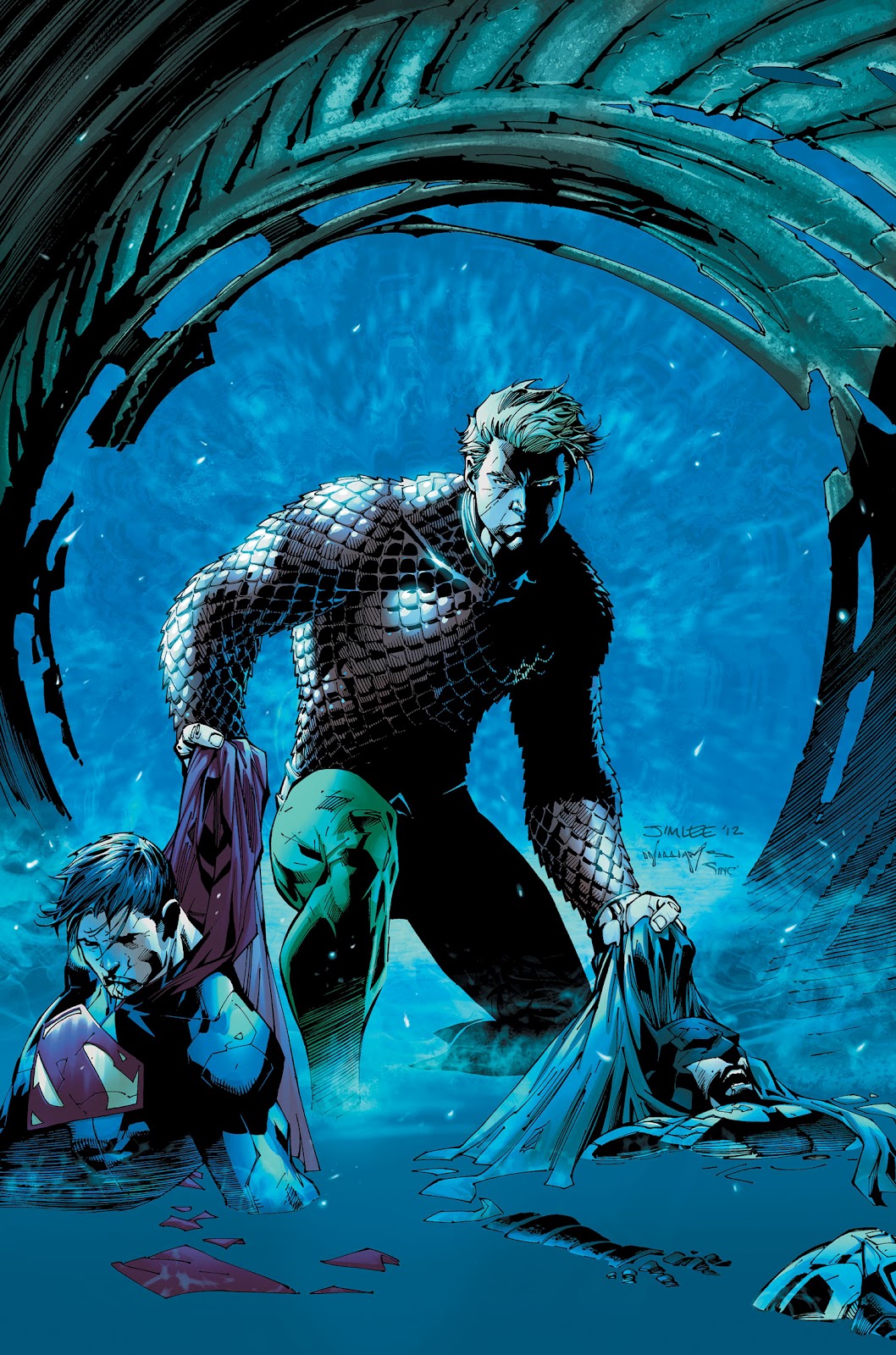
I'm going to start this review off by saying that the kiss between Superman and Wonder Woman is a lot less 'awe-inspiring' than DC let on. In fact, one could argue that the reasons behind the titular tongue-tying should have been raised years ago, even decades. But more on that later. Justice League #12 wraps up not only the first year of the title, but also "The Villain's Journey", the second arc for the series that dealt with new villain Graves who was out to destroy the League and remake the world in his own way. The thing is, that phrase holds a significantly different meaning for Graves in the pages of Justice League than it normally ever does. While even I'll admit that using spectres of long-lost loved ones is a bit cliche, Johns employs this narrative strategy to get to the heart of the main issue with the team as a whole: the Justice League is not and cannot be held accountable for their actions.

The fight with climactic battle that opens the issue is only significant for Graves' vocalized thoughts. While having the team come face-to-face with dead loved ones sounds emotionally relevant, the whole ordeal comes off as trite after Graves weighs in. "I've destroyed the Justice League, but I'm not here to destroy each one of you," laments Graves as he watches them, a twinkle of glee in his eyes. The whole point of the League was for the sum to be greater than it's individual parts. Unfortunately, this isn't always the case. When you gather seven god-like beings together, it's a good idea to have someone around to ground them once in a while. While Steve Trevor was supposed to fill this void, his prior relationship with Wonder Woman hindered his ability to see the unbiased truths when it came to the League. However twisted and painful, Graves assumes the role of 'moral conscience', making the team question themselves for the first time since they banded together.

And that, dear readers, is where the real meat of this issue lies. The truth of the matter is, superheroes are not held accountable for their actions - they can't be if they hope to do their jobs well. The Justice League is an organization unlike any other on the planet, especially now that the 'New 52' rebooted most of the fringe teams out of existence. And while it might be cool to see costumed heroes battling aliens for a while, eventually, the novelty wears off and people want the truth over everything else.

They're not wrong for wanting it.

Johns does a fantastic job, this month, delving into philosophically-charged territory. And with the 'New 52' freedom under his belt, the characters get an interesting take on the subject - Flash insists that the League has to be better, while Batman sees the subjectivity of their situation. Green Lantern is the one who gets to the answer first: even though the League might not be perfect, it still has to try because the world needs the League. Because bad news always accompanies deed of sacrifice such as these, Hal Jordan resigns from the League. Citing his instigation of the fight between the Leaguers that aired across the world, Hal offers himself up as a scapegoat. The people of Earth get someone to blame, while the League gets to continue doing what they do, even though they know that the world could turn on them at any moment if they slip up again, even a little bit.

Wonder Woman and Steve Trevor (technically) break up again, sending Steve into fits of angry muttering and a final demand for Diana to leave, and a preview for the next year of stories looks like the League will have their hands full with Steve Trevor's A.R.G.U.S.-operated Justice League of America, a team that looks to be in direct conflict with the League proper, for more reasons than one.

Justice League #12 does an excellent job capping off a first year that saw the team come together and face more than just villains. Geoff Johns is slowly figuring out the team's voice and how they honestly fit into the greater DC universe. It's a difficult task, no doubt, but Johns has a long history with Teen Titans, and his pre-'New 52' work on Green Lantern included some of the characters best stories in years. Now, after taking the time to give us readers the basic stuff, it's time to go into new territory. Obviously, Superman and Wonder Woman's relationship is leading this trend, and coupled with Hal Jordan's resignation, we're sure to be in for an exciting 2013.

GRADE
A-

Wednesday, July 18, 2012

JUSTICE LEAGUE #11

STORY: Geoff Johns
ART: Jim Lee, Scott Williams, and Jonathan Glapion

The problem with writing for an ensemble is making each character interesting and a part of the story. This is hard enough to accomplish in film, TV, or even books, and it's even harder to do in a comic book such as Justice League. Not only does Geoff Johns feature each member of the League - at least a little bit - in nearly every issue, he's also been doing a fantastic job conveying each character's personality through their behavior while part of a team dynamic. Ever since DC relaunched it's entire line, a big complaint from many critics and fans alike has been Hal Jordan's brash and jerky behavior as opposed to his traditional 'All-American' personality that defined him for so many years. I'd like to argue that Hal Jordan was getting boring, and Johns has finally given Earth's preeminent Green Lantern a reason to be interested in him, even if that means loving to hate his asshole tendencies.

A big part of what makes Justice League so interesting to read, whether you think it's a good book or not, is that it presents each hero in circumstances out of their comfort zone. For Diana, it means working with others and compromising when it makes logical sense. Steve Trevor is hostage to Graves, and Diana wants to go after them alone, while Hal tried to talk her into sticking with the League and tracking down Graves together. Hal and Diana's face-off is great and gives a great deal more meaning to their working relationship. Us readers haven't seen much of the time between Darkseid's attack and this current Graves situation, which leaves a lot of room open for Johns to play around with each members' relationship with the others. "You've been dying for this, haven't you?" asks Hal to Diana, obviously rhetorically. Green Lantern and Wonder Woman apparently have some built-up tension that finally manages to break their respective patiences and they proceed to get into a fist fight that Graves somehow manages to broadcast across the globe. Of course, Hal's only the first one to stop Diana from making a mistake by going off alone, and soon, Superman is on the ground, too. Cyborg finally teleports the entire team north to David Graves' writing cabin, where they hope to find Graves himself as well as poor Steve Trevor. 


At the beginning of the issue, Graves goes to torment Tracy Trevor, Steve's sister, for some unexplained reason. Honestly, there doesn't seem to be any actual motive for Graves' visit other than to tell Tracy that he's going to kill her brother and that she should be grateful that she wont have to witness it. The League follows Graves' only to be berated by Tracy about their irresponsibility with her brother, not only professionally, but also intimately. While I understand that this scene facilitates Wonder Woman's eventual lashing-out at the other Leaguers, it really feels clumsy, like this scene came together at the last moment and inconsistencies - like the villain's reason for his actions? - were simply overlooked.


The problem with writing for an ensemble is making each character interesting and a part of the story. This is hard enough to accomplish in film, TV, or even books, and it's even harder to do in a comic book such as Justice League. Not only does Geoff Johns feature each member of the League - at least a little bit - in nearly every issue, he's also been doing a fantastic job conveying each character's personality through their behavior while part of a team dynamic. Ever since DC relaunched it's entire line, a big complaint from many critics and fans alike has been Hal Jordan's brash and jerky behavior as opposed to his traditional 'All-American' personality that defined him for so many years. I'd like to argue that Hal Jordan was getting boring, and Johns has finally given Earth's preeminent Green Lantern a reason to be interested in him, even if that means loving to hate his asshole tendencies.


A big part of what makes Justice League so interesting to read, whether you think it's a good book or not, is that it presents each hero in circumstances out of their comfort zone. For Diana, it means working with others and compromising when it makes logical sense. Steve Trevor is hostage to Graves, and Diana wants to go after them alone, while Hal tried to talk her into sticking with the League and tracking down Graves together. Hal and Diana's face-off is great and gives a great deal more meaning to their working relationship. Us readers haven't seen much of the time between Darkseid's attack and this current Graves situation, which leaves a lot of room open for Johns to play around with each members' relationship with the others. "You've been dying for this, haven't you?" asks Hal to Diana, obviously rhetorically. Green Lantern and Wonder Woman apparently have some built-up tension that finally manages to break their respective patiences and they proceed to get into a fist fight that Graves somehow manages to broadcast across the globe. Of course, Hal's only the first one to stop Diana from making a mistake by going off alone, and soon, Superman is on the ground, too. Cyborg finally teleports the entire team north to David Graves' writing cabin, where they hope to find Graves himself as well as poor Steve Trevor. 


Not even Graves can describe himself in a simple way...
At the beginning of the issue, Graves goes to torment Tracy Trevor, Steve's sister, for some unexplained reason. Honestly, there doesn't seem to be any actual motive for Graves' visit other than to (again, inexplicably) give Tracy his abridged life story and power set origin, then tell her that he's going to kill her brother and that she should be grateful that she wont have to witness it...What?  The League follows Graves only to be berated by Tracy about their irresponsibility with her brother professionally and also intimately. While I understand that this scene facilitates Wonder Woman's eventual lashing-out at the other Leaguers, it really feels clumsy, like this scene came together at the last moment, so  inconsistencies - like the villain's reason for his actions? - were simply overlooked.


On top of that, Johns takes even more time - later in the issue - to finish giving us Grave's origin story. At the end of it all, Graves just feels like a villain that's too forced for his own good. Darkseid: evil alien warlord whose search for the anti-life equation leads him to become an intergalactic conqueror. See? One sentence to describe one of the most iconic Superman villains of all time. Graves: author whose family died as an indirect result of a Justice League-related battle, so he seeks out haunted gods who will  fuse him with the spirits of his dead family, thus giving him a weird, alien-lizard look...and he can use his powers(?) to make people see their dead family members, and take away their energy, I guess. If that sentence was as painful to read as it was to write, you'll understand how silly of a character Graves really seems.


I like Justice League. You get to see a different side of your favorite heroes and, more often than not, it's exciting and fun to read, which is the real goal of all comic books. "The Villain's Journey" started out strong, with a path that had the potential to produce an awesome new nemesis for the League. Instead, we got Graves, a whiney writer who has deluded himself into believing the Justice League is responsible for his family's eventual death.

SCORE
7.7/10

Saturday, June 30, 2012

(COMIC) JUSTICE LEAGUE #10

STORY: Geoff Johns
ART: Jim Lee, Scott Williams, Mark Irwin, and Jonathan Glapion

We're starting to get a little more of the bigger picture of the second major arc of Justice League. "The Villain's Journey" continues this month with some revelations concerning the League's outside lives and the origin of Graves.

A good portion of this month's issue is dedicated to giving readers a bit more insight into the lives of each League member and who knows what about who. Like a what's what of how their personal lives affect them professionally. Graves has been torturing and interrogating villains associated with each League member, learning more and more about them each time. Cyborg is forced to explain to Hal Jordan (who is still consistently thick-headed in Justice League) that the more Graves knows about them, the more he can exploit their weaknesses: Barry's police-influenced desire to work within the boundaries of the law, Wonder Woman's secret rendezvous to a Native American reserve, and that Batman doesn't trust anyone on the team. These little call-outs from Cyborg not only add bricks to the 'New 52' universe, but they also give readers connections between books (Barry Allen is dating Patty Spivot in The Flash, and this relationship is mentioned during the briefing.) The notion that Batman doesn't trust anyone also brings about the revelation that the Dark Knight and the Man of Steel work together outside of the League, something that hasn't been seen or mentioned up until now.


More so than ever before, Justice League is beginning to feel like a launching point for much of what happens throughout the DC universe now. Steve Trevor's consistent presence, Green Arrow's recruitment to some "other team", the Martian Manhunter's apparent sort stint as a member, and the use of Apokolyptian boom tubes as means of teleporting all show potential to affect more than just the adventures of the Justice League. These are the story elements that will have long-term results, possibly years down the road.


By the end of their discussion, the question of trust has been raised between all of them - how can they trust one another while some know more about each other than others? In days long past, the League was a simpler entity that rarely asked questions of this nature, simply because the readership demanded nothing more than superheroes beating up super villains. Today, it's important that a more realistic base be set for the characters we read about. Mistrust amongst a group of demi-gods who don't know each others' names is a very likely scenario.


Graves shows up on the Watchtower at the end of the issue to lay the smack down on the League. From the opening vignette, we gather that David Graves got his powers from some disgraced gods in Pamir Mountains. The closing pages tell us that these powers can somehow be used to harbor other souls and/or life-forces through emotional manipulation. With little more than a mention of her beloved Steve, Wonder Woman attacks Graves and quickly goes down, the life drained out of her both spiritually and physically as he body begins to wither. Soon, the entire League is down and Graves is in control of the Watchtower. A fantastic cliffhanger if I've ever read one.


The "Shazam!" back-up actually picks up a little bit this month as Billy sneaks out of the Vasquez's house late at night. Freddy Freeman follows him to the zoo where Billy is telling a tiger that it's the only real family he's got left. Freddy interrupts and before Billy can blow up, Freddy suggests vandalizing the house of the boys who hassle the other foster kids at school each morning. This bit of bonding between Billy and Freddy provides the seeds to Freddy becoming Captain Marvel Jr., or maybe some new incarnation of hero associated with the wizard Shazam.


And speaking of the wizard, Doctor Sivana continues his archaeological dig, now complete with a fancy magic-seeing eye that helps him see the mystical spells placed on the door to a greater prize than any gold or gems. As he utters a single, "Shazam", Black Adam emerges from the tomb demanding to see the wizard! The final, double-wide pullout pages of The New 52 #1 revealed what looked like Black Adam fighting Vibe, though many posited that it was just the 'New 52' version of Captain Marvel, as Billy Batson is much more mean-spirited than his former self. Obviously, Black Adam is here, which spells trouble for our little trouble maker.


GRADE
B

Thursday, May 17, 2012

(COMIC) JUSTICE LEAGUE #9

STORY: Geoff Johns
ART: Jim Lee and Scott Williams

After a few 'interlude' issues, Justice League kicks off it's second story arc written by Geoff Johns and pencilled by Jim Lee. But - as most opening issues tend to be - Justice League #9 feels a bit light on true plot, instead focusing on different small groups of Leaguers that will eventually intersect in a later issue.

I was worried that Johns would feel pressured to feature the entire team together in most issues to satiate the desire for a full ensemble title - and for good reason. DC's pre-New 52 world was plagued with massive crossovers that ended up making no sense or not really affecting anything in the long run. Instead, Johns is writing Justice League like it should be: various squads tackling different situations. Batman, Superman, and Cyborg team up to quell a breakout at Arkham Asylum, while Green Lantern, Flash, and Wonder Woman go after Weapon Master. One of my favorite parts of the entire issue was Hal and Barry's spat about who was going to be the "bad cop" during Weapon Master's interrogation. It's moments like those that ground characters in a little reality and make them more relatable. Too often, writers forget to humanize their characters, and Johns consistently writes in-depth characterization.

By the end of the issue, both teams have subdued their targets and are trying to figure out just what exactly is going on. It all connects with Steve Trevor's disappearance. Both the Key and Weapon Master blame a man named Graves for their criminal outburst. The final pages are used to show Johns and Lee's newest villain hiding in the shadows as he tortures poor Steve and threatens to kill the rest of his family. Graves is not messing around and breaks Steve's hand to prove he's not a lighthearted villain in any sense of the word.

What's actually interesting about this new arc of Justice League is that Graves is a villain who has (supposedly, or at least seemingly) been wronged by the Justice League directly and wants to take his revenge. This is interesting because it's been quite a long while since there was a JLA story that actually connected to the League. More often than not, the League is called upon to handle situations like alien invasions, criminal masterminds, and worldwide catastrophes, all of which have no meaningful connection to the League. Mostly, the League is reserved for massive threats. Giving the team a more personal villain might be a fantastic way to give a little more characterization and depth to a crew that readers haven't yet received.

GRADE:
B