Wednesday, September 12, 2012

AVENGERS vs. X-MEN #11 of 12

STORY: Brian Michael Bendis
ART: Olivier Coipel and Mark Morales

It's emotional gut-punch time! Over the past eight years, Marvel has made it pretty standard to kill off a major character at the end of major events. For Avengers: Disassembled, it was Hawkeye and Ant-Man. During Civil War, it was Captain America, and for Avengers vs. X-Men...you didn't think I'd spoil it this early in the review, did you? No, I'll give that little gem a bit more time.

Brian Michael Bendis and Olivier Coipel helm Avengers vs. X-Men #11, bringing the event ever closer to it's conclusion and segue into 'Marvel NOW!' starting in October. Ever since Cyclops and the other four X-Men took control of the Phoenix Force, it's been an obvious downward spiral for the Children of the Atom, and in this issue, that fact becomes all the more apparent once Rogue seeks asylum amongst the Avengers along with the rest of the disenfranchised mutants once loyal to Cyclops. Oh, and Charles Xavier is now in the mix for good. This just got real.

This is an issue filled with emotional and physical confrontations. With a huge new contingent of mutants at their side, as well as Xavier - who explains that he knows "what must be done" - the Avengers lay siege to Utopia, all while Professor X keeps Cyclops occupied in his own head. It's harrowing to see Cyclops, a cosmic god, bending to the will of a mere mutant. Of course, it's not just any mutant, and we get to see Charles Xavier unleash the full extent of his power against Cyclops as a legion of X-Men and Avengers descend upon Emma Frost to keep her occupied. Hell, they even manage to get the Hulk to help out. A lot of these pages are dedicated to the big fight. But Bendis is such an adept writer, he organically balances the fighting with the intervention-style confessionals by the likes of Iceman, (somewhat) Storm, Magneto, and - obviously - Xavier himself. Each one of them has a special connection to Scott Summers, and each has some words for the leader of the X-Men who's become a megalomaniac.

The opening pages of Avengers vs. X-Men #11 show Cyclops and Emma arguing over the fate of the universe, something that doesn't carry a lot of weight at first, but soon becomes the catalyst for Scott's eventual betrayal of Emma and his subsequent power play. It's telling how these two characters can chat about rewriting the universe without questioning why they should. Sure, both want the best for mutantkind, but the strain of the Phoenix obviously has taken away perspective (as seen more eloquently in Avengers vs. X-Men #6 Infinite). By the time Cyclops attacks Emma so he can acquire her power, it's pretty much expected. Bendis foreshadows this inevitability, but then acts like it's a big surprise once it happens. We all knew it would come down to Scott, it just became a question of when.

Scott feels violated. He's moved mountains, saved countless lives, and changed the world for the better, and now all his friends and family stand against him. He is a leader without a nation, a shepherd with no flock. It's a tough position to be in, but with interstellar powers at your fingertips, that grief can turn into suffering pretty quickly. And so it goes, Scott and Charles duke it out. In the end, it's Xavier on the ground and Scott floating above the corpse in a perfectly haunting fashion.

A lot of this issue's merits come from the emotional ramifications of the one of Marvel's Golden Children falling into darkness. Cyclops has been a mainstay in the Marvel universe since he was introduced. He's been in a leadership position throughout most of it, and he's been at odds with Charles Xavier only a handful of times that didn't have nearly the same ramifications as this disagreement. The fact that Charles feels he must force Scott to stop means there could never have been a positive outcome for either party. Scott loses the strongest father in his life, and Charles loses the son he always wished he had. It's beginning to look like no one will win this war. Usually, these mega-events don't have meaningful boundaries (i.e. - death is meaningless, changing alliances, etc.), so I hope Marvel sticks to it's guns for a while and keeps Xavier down. It was a truly shocking moment (though it was expected), and I'd hate for that emotional nuance to be squandered by resurrecting the good Professor.

GRADE
B

Saturday, September 8, 2012

BIG CHANGES COMING


NEW REVIEW FORMAT

Since the beginning of 'The Endless Reel', I've kept a pretty strict review format, which I supplemented a few months ago with 4-Sentence Reviews to give some other titles I read a spotlight on top of the regularly covered titles.

Now, with DC entering Year Two of the 'New 52', and Marvel Comics soft-relaunching a majority of their line under the 'Marvel NOW!' moniker, I want to take 'The Endless Reel' to a new level. I want to branch out of the traditional review format and give readers a more comprehensive and complete comic book experience - at least from the major two companies. I'm only one man.

Starting in October, 'The Endless Reel's review format will change in a rather significant way. While there will still be standards REVIEWs, I've created some 'columns' that will focus on different parts of the DC universe - mostly categorized by title families - as well as a section for 'Marvel NOW!' titles, as well as 4-Sentence Reviews, which will be rebranded as EXTRA! EXTRA! Posts will include "The Dark Write", a Batman Family column covering two or more Batman titles each week. There will also be "Leagues Beyond" - focusing on Justice League books like JL, The Flash, Aquaman, Wonder Woman, and the upcoming JLA - "Marvel NOW!", which is pretty self-explanatory, as well as "Rotworld LIVE!" which will cover every issue of Animal Man, Swamp Thing, and Frankenstein: Agent of S.H.A.D.E. relating to the crossover "Rotworld" event. And "Into the Night" will offer regular coverage of both I, Vampire and Justice League Dark.

One of the trade-offs of offering more title coverage on 'The Endless Reel', is that the amount of actual words dedicated to titles within these columns will be less than a full review. Not four sentences short, but not a full, six paragraph review. That being said, I will continue to bring comprehensive analysis to all the titles I cover, no matter the length of their reviews. Also, from time to time, I'll feature one of the column-related titles as a full-length review.

I'll update the MONTHLY SCHEDULE in the coming days as I get everything fine-tuned, and soon, 'The Endless Reel' will move on to it's next phase!

MARVEL NOW!
Now that Avengers vs. X-Men is winding down, Marvel is close to launching 'Marvel NOW!', their soft-reboot that will affect a great portion of the company's titles. While some new titles are being introduced, a whole slew of books are being relaunched with new #1's and new creative teams.

After eight years of major events that all supposedly led up to this, Marvel is mixing up it's long-established creative teams. These writer and artist changes promise cool new directions for characters that have honestly grown stale in these last few years. With new perspectives and new talent, I'm looking forward to not only the new titles, but also reading relaunched titles that I wouldn't have read before. Much like my rekindled interest in DC's line when the 'New 52' launched, 'Marvel NOW!' is getting me back into Marvel, post-AvX, and I want that experience to be part of 'The Endless Reel'.

Initially, all titles under the 'Marvel NOW!' name will be listed in the MONTHLY SCHEDULE section. I plan on reading all the #1's, then deciding which ones will be covered on a regular basis. Then again, I may just review all of them. We'll see.

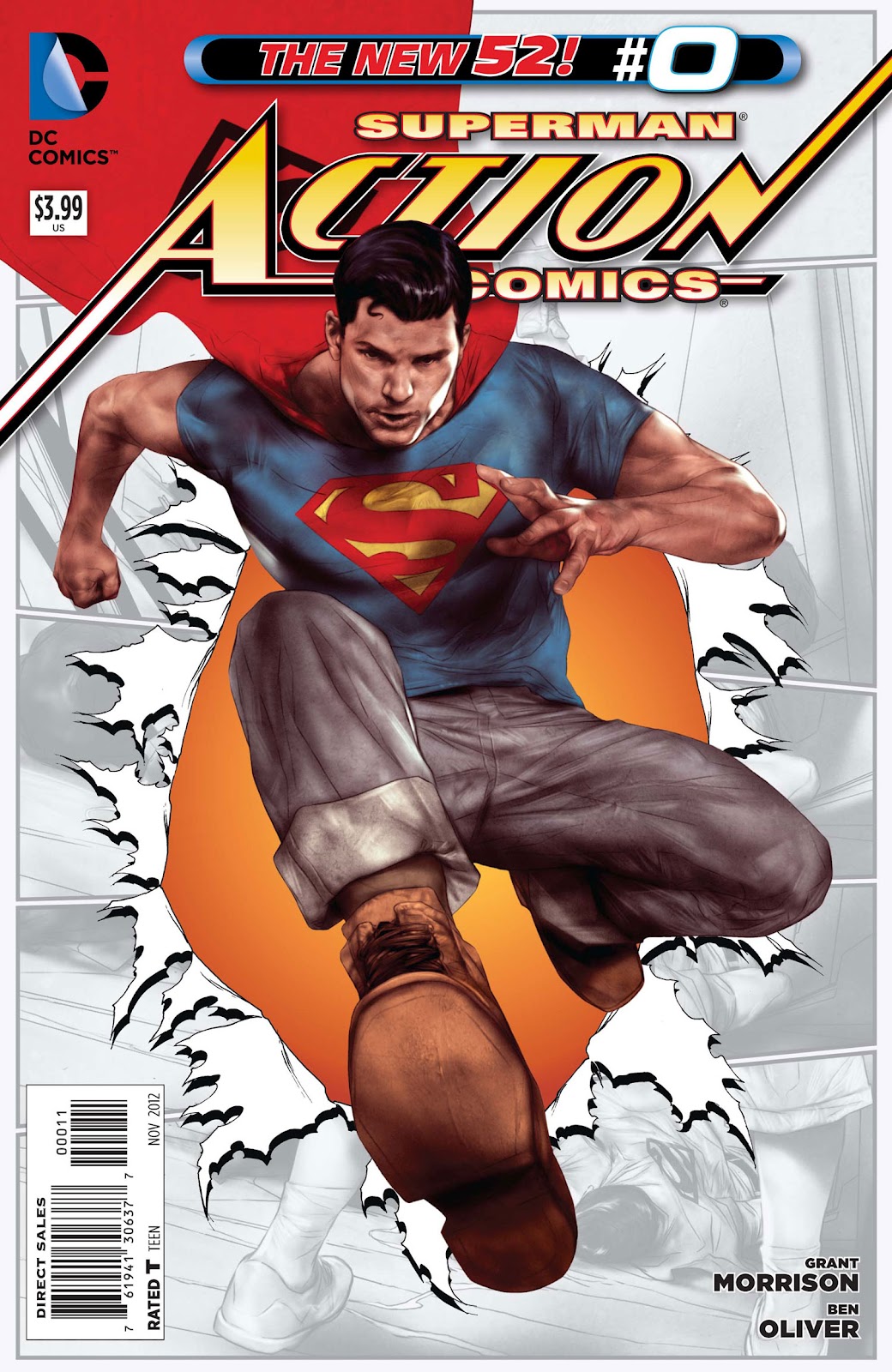
ACTION COMICS #0

STORY: Grant Morrison
ART: Ben Oliver

Is it just me, or does has it felt, recently, as though Grant Morrison is just phoning it in? For a few months now, Action Comics has started to putter out. While it started strong, fast, and plenty action-packed, issues 10-12 have been pretty lackluster. Unfortunately, Action Comics #0 continues this trend even in "Zero Month", with "The Boy Who Stole Superman's Cape". Knowing Grant Morrison, I expected there to be much more to the story than simply a boy who steals a cape. In some metafictional sense, Morrison has thrown readers for a loop once again by scripting a bland, directionless story that doesn't add much to the 'New 52' universe beyond a few key moments that could have been placed in any other - probably better - story just as easily.

And these are the best parts of Action Comics #0 - the instances of importance that are scattered within the pages of the actual narrative. For instance, Jimmy Olsen's first picture of the 'S' symbol and the subsequent discussion amongst Jimmy, Lois Lane, and Perry Olsen as to whether the 'flying man' is acceptable as a printed piece of news. This scene in particular saves the issue from being a total disaster - it's interesting without being overbearing, and it's something the 'New 52' is lacking, in terms of origin stories. Similarly, the opening scene between Clark and Jimmy about Jimmy's family not only works to solidify a friendship that's been shoddily portrayed at best, but it gives more insight to Jimmy Olsen as a character in the 'New 52'. Altering tertiary characters is another element the 'New 52' has been missing, so it's nice to see a someone as widely known as Jimmy Olsen getting an upgrade.

As for the boy and the stolen cape, Morrison takes the story in a pretty generic direction. Turns out the boy's home life is less than perfect and his stepfather (or mom's boyfriend, or some fling...Morrison never really says) becomes the main villain of the issue due to his raging alcoholism. Soon enough, the cape becomes the focal point when the man attempts to stab a child. Yes, you read that right. A grown man tries to cut children no older than 10. Really, it seems like Morrison just wanted to show a knife being broken by the cape. It's just sloppy. Then, the older of the two boys punches his (possibly foreign?) stepfather with huge force. We already know that Clark's cape is special; his clothing has been a recurring theme throughout Morrison's run so far. Why do we nee an entire issue dedicated to a boy discovering the cool powers of a cape? Unlike Joe Hill's excellent The Cape, this isn't about a deranged, disconnected man finding a means to his violent ends. No, this is just about a kid and an abusive father figure.

I don't want to detract from the emotional significane of stories like these. I truly do not wish that. Unfortunately, when tales like these are done poorly, or half-assed, it's more disrespectful than not. In the case of Action Comics #0, Morrison simply tries to hard to strain a story from an emotional core. He wants us to connect with the young boy, reading in awe as he himself is in awe over the awesome power of Superman's cape. Instead, we get a lot of pieces that don't quite add up to anything.

GRADE
C

Thursday, September 6, 2012

THE PHANTOM STRANGER #0

STORY: Dan Didio
ART: Brent Anderson and Scott Hanna

And just like that, The Phantom Stranger became one of my favorite series. While DC (I still say unjustly) cancelled the phenomenal Resurrection Man - a series rooted in classic, episodic storytelling that slowly built up a genuinely interesting character - it has replaced that series with tales of the Phantom Stranger in the able hands of Dan Didio, a man who wrote O.M.A.C. so well it was literally too good for most readers. Out of the pages of The New 52 #1, Didio brings us the exploits of the most enigmatic member of the "Trinity of Sin", and it is so, so, so good.

The Phantom Stranger was always a mystery. But unlike so many other characters shrouded in misdirection and facades, Phantom Stranger existed on his own level - his actions, his reasons, and his meaning were all unknown. He would appear seemingly out of nowhere, and act upon his own, unexplained predilections without notice. Truly, he was a stranger in a comic book universe where (almost) every character eventually gets a backstory, whether it's necessary or not. The Phantom Stranger fully takes advantage of the 'new' part of the 'New 52', offering a definitive origin, more fleshed-out character development, and an all-around kick-ass time.

Religious symbolism is an ample well for storytelling, and in the opening pages of The Phantom Stranger #0, it becomes pretty obvious that the Stranger was once Judas Iscariot, the man who betrayed Jesus Christ of Nazareth. Dan Didio deftly handles this symbolism, taking care to never mention either the Stranger or Jesus by name, but instead through Judas' suicide attempt and looming fate. "You are beyond forgiveness," a council of wizards explains to poor Judas (yes, a council of wizards. Though they all happen to resemble Shazam, suggesting a connection in future issues.) "Your greed has forever darkened the world." - it's enough to get the point across without sounding preachy. Didio understands that symbolism is just that: symbolic.

Judas is then cursed by the Band o' Wizards to wear a necklace made of coins, wear Jesus' robe, and walk the Earth for eternity until he's called upon again. While it seems like there's a lot to take in all at once, this is 'Issue Zero'. The whole point of the prequel issue idea is to offer a more comprehensive explanation of a certain character, in most cases through a look into the events that take place before the first issue. With The Phantom Stranger, we're literally given the entire origin of the character to the extent that we need it. Obviously, we don't need to know Judas' pre-judgement history because another book already took care of that. Didio tells us everything we need to know: who the Stranger is, how he came to be, why he does whatever he does, and where this series is going as it moves forward.

I was honestly quite skeptical of DC's "Third Wave", as two of my favorite series (Justice League International and Resurrection Man) were cancelled to make room for new titles. But after reading The Phantom Stranger, I feel better about the other three upcoming series. Dan Didio knows what kind of writer he is, and he recognized that his full-blown style (as presented throughout O.M.A.C.) was too much. For The Phantom Stranger, Didio reels in his bombastic style just enough to make the series more accesible to a larger audience without sacrificing the pulp and charm that make his writing so good.

GRADE
B

HAWKEYE #2

STORY: Matt Fraction
ART: David Aja and Chris Hollingsworth

"So hobos are warning other hobos that something big and/or police inducing, ergo criminal, maybe about to occur. And that may-or-may-not involve other hobos and/or circuses?" asks the second Hawkeye, Kate Bishop, to her mentor, Clint Barton. "Well when you put it like that, it sounds stupid." And therein lies a baseline within Matt Fraction's Hawkeye, a series that in two issues alone has not only paid homage to one of the best Silver Age stories in DC's history, but has also brought back one of my personal favorite characters from one of my personal favorite, totally underused, teams, Kate Bishop (a.k.a. Hawkeye II) of the Young Avengers. Hawkeye #2 is full of Fraction's emotion-filled style, David Aja's amazingly-appropriate artwork that never fails to amaze, as well as the sum of these parts, which resembles a cross between an Anton Chekhov play - which turn the everyday banality of normal lives into emotional and meaningful exercises in surviving day after day - and TV's Community - a show that pushes the boundaries of 'real life' so close to the edge, the definitions are often blurred. Clint Barton grew up in a circus, so when a vagabond code sign warning of bad things to come shows up in his neighborhood, the most grounded Avengers knows something is afoot.

Enter Kate Bishop, who uses the same moniker as Clint, but who couldn't be much more different than the original Hawkeye, in terms of personal background. Clint grew up fending for his life and proving himself every day while travelling with a circus, eventually going into a life of crime before the Avengers intervened and saw his potential for good. Kate Bishop, on the other hand, comes from a wealthy family, was trained and taught by some of the world's brightest, joined the Young Avengers purely out of spite (at first, at least), and currently doesn't have much to do besides bugging her mentor. While I've always liked Kate's character, I especially enjoy Fraction's interpretation of her - in the past, she's often been written as a hard-assed snob juxtaposed to the more meager means of her teammates. Here, Fraction molds Kate into what she truly is: an intelligent, humorous, loyal, talented young woman who is a lot more grown up than some of the other teenaged heroes running around (say, like the ones over at Avengers Academy).

When I began reading Hawkeye #2 and realized Kate was featured, I was hoping for a Batman/Robin vibe between them. What I got was something much better. Bruce Wayne's relationships with his many Boy Wonders' are based on the meaning behind the vigilantism - each Robin has a clear-cut reason for taking the mantle, and it's often one rooted in emotional turmoil. In the case of Clint and Kate, their relationship is more like a really cool, bleeding heart civics teacher and his student who understands more about the world than she should. They respect one another enough to have each others' back, which is saying a lot in the post Civil War and Secret Invasion world they inhabit. Fraction takes the time to make sure we understand that these characters have a fantastic working relationship.

But just like those cool teachers who are always so laid back and open minded, they can say stupid stuff sometimes. The conversation between Clint and Kate at the end of the issue is awkward - that's the most direct way to put it. Clint is asking Kate to work more closely with him (concerning Hawkeye-only missions around the world) and before you know it, their amazing partner chemistry becomes strained under the weight of seven little words that cross a line, even if it is just a little bit. Again, Fraction uses emotion and real human situations to drive his narrative, and it's worked well so far.

While there are only these two issues of this series from which to judge, Hawkeye is turning into one of the best series Marvel releases each month. Matt Fraction is a volatile writer whose work either flourishes, as is the case here, or flounders terribly, as was the case with last year's Fear Itself crossover event. What makes Hawkeye so great, fortunately, is it's ability to mine emotion without taking advantage of the medium. At every turn, this series becomes more and more relatable and grounded, while still keeping the high-concept idea "Robin Hood" idea intact and - I'm assuming - a future with at least a few super-villains thrown in for good measure.

GRADE
A

Wednesday, September 5, 2012

EARTH 2 #0

STORY: James Robinson
ART: Tomas Giorello

"Zero Month" is the DC's design to give readers a bit more history to the characters this company revamped just one year ago. The idea is to bring us stories from before issue number one; a simple premise that already doesn't hold true to some titles (like Green Lantern, Green Lantern: New Guardians, etc.) Of course, there are titles that are taking full advantage of this chance and going all-out origin (like The Phantom Stranger and Stormwatch). Then there are titles like Earth 2, which are simply telling select tales - not really making (apparent) connections to the present day, but also not giving a full history lesson.

In James Robinson's Earth 2 #0, we're introduced to Terry Sloan, a.k.a. "Mr. 8", the eighth 'wonder' who protects Earth after Superman, Batman, Wonder Woman, Supergirl, Robin, Catwoman, and an unnamed seventh (who actually becomes my most persistent question throughout the new mysteries this issue brings up). It's not exactly clear what Sloan's abilities are, exactly. Does he have powers, or is he just a high-tech badass? I read the issue as the latter, assuming he was just a government-sanctioned ally of the 'Trinity'.

I was a bit disappointed with Earth 2 #0. I was expecting a bit more insight into Superman, Batman, and Wonder Woman, while instead I got a mission that doesn't really give any insight into any of them except that there are multiple ways Kryptonite can be manipulated to have varied effects on Superman. Other than that, this issue is solely about Sloan's still-shrouded-in-mystery endgame.

Of course, that process starts in E2 #0 - set six years in the past - as the Trinity and Sloan infiltrate an Apokoliptan mind-control broadcasting machine. In a nod to Darkseid's pre-'New 52' inclinations, the mind-control is based on a psychological implosion achieved through the ant-life equation. After arriving at the core of the machine, Sloan deceives the Trinity, uses synthesized opal Kryptonite to drive Superman insane, and starts rambling about those under the anti-life equation's control are "...beyond salvation. So I will destroy them." Even after a bomb blast care of Batman, Sloan gets up - albeit with hundreds of shards of glass sticking out of him - and activates a chain reaction that detonates the four anti-life machines around the globe. In a stunning panel by Tomas Giorello, the massive explosions shoot out from the Earth's surface as our planet begins to resemble Apokolips - a chilling notion if there ever was one.

A few more tidbits are revealed about Earth 2 in general, as well this issue. As I mentioned earlier, Kryptonite is much more maleable in this dimension, perhaps due to Robinson's claim that Earth 2 is rooted more in the mystical and supernatural than it's New Earth counterpart. We also learn that the war with Apokolips has been raging for a long, long time, and that the 'wonders' of Earth 2 are more like a task force than a god-like collective entity. Granted, they're up against an army that would put the range of heroes in the main DC continuity to shame, as well.

A big revelation in Earth 2 #0 is the existence of an extensive multiverse! It's interesting that DC would green light this idea, as the pre-'New 52' continuity was marred by decades of multi-dimensional history and crossover, and one of the major points of the relaunch was to consolidate these infinite universes. It's hard to get excited for a multiverse again. Really, it is. Introducing Earth 2 was a fantastic idea because it would not only bring back the Justice Society, but also provide an easy and straightforward approach to multiple dimensions, while mirroring ideas pioneered in the 1960s and 70s that culminated in Crisis on Infinite Earths in the mid-80s. While it was implied that the former level of chaotic transdimensional shuffling wouldn't be a problem this time around, Terry Sloan escapes to the "Ninth Dimension", meaning that there are a possible nine different universes now open to writers, technically. It's frustrating and unnecessary.

The 'New 52' is still young, and this new continuity needs time to come into it's own as an established universe with diverse, interesting, developed characters in a rich, vibrant world. Robinson's venture in Earth 2 is fantastic, but the introduction of a new multiverse is really, really annoying.

GRADE
C+

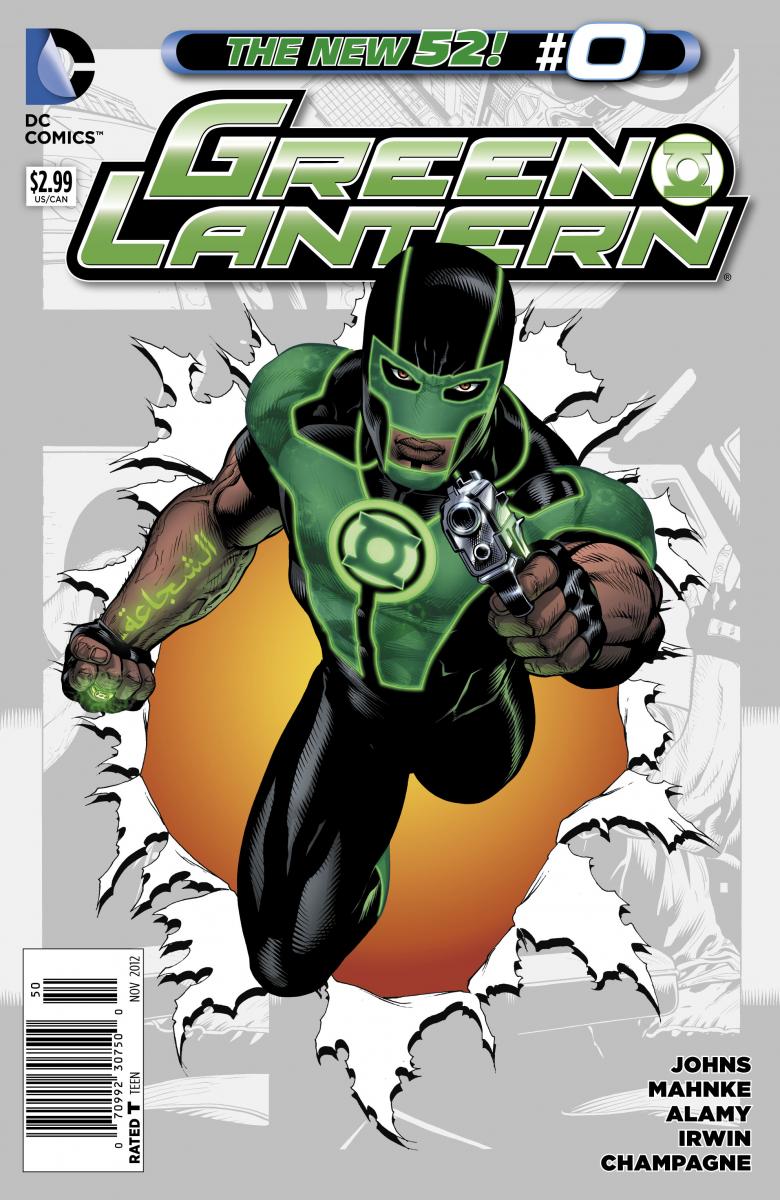
GREEN LANTERN #0

STORY: Geoff Johns
ART: Doug Mahnke and Christian Alamy

I've been critical of Green Lantern as of late. Since DC's relaunch, my favorite franchise has been swimming around, unable to focus on a path for Hal Jordan or Sinestro, the two main characters who should have a clear-cut direction more than any of the other Lanterns out there. And I still stand by my convictions; Geoff Johns has obviously been building toward "Rise of the Third Army" for a while, and in that set-up, he focused so much on the forest that he forgot to take care of the individual trees. Last week's Green Lantern Annual #1 and this week's Green Lantern #0 are a return to form for Johns on this series, as he employs the invigorating, character-driven storytelling that's so ample over in Aquaman month after month. Green Lantern #0 focuses entirely on Simon Baz, the newest member of the Green Lantern Corps - or is he? In truth, the exact basis of his enlistment isn't exactly clear, but that's not really what this issue is about. Indeed, Johns takes his time this 'Issue Zero' to flesh out his newest Emerald Warrior before he ever receives the ring.

Baz is an Arab-American who grew up in Dearborn, Michigan, has two siblings, and whose life was turned upside down after the events of September 11, 2001. Fast-forward to the present, and we jump in with Baz in hot pursuit by the police after stealing a van, which he realizes has a massive bomb set to go off in less than a minute. He survives the bomb, but gets detained by the Department of Homeland Security. It's a lengthy process - the suspected terrorist situation - that Johns mirrors by the amount of time he spends with Baz's interrogation. Johns obviously has some opinions about the federal government's treatment of only suspected terrorists, and it's refreshing to see this expressed in a way that doesn't necessarily demonize the government as much as it questions the way our Defense Department operates. During his questioning, it's revealed that Baz worked at the decommissioned car factory that blew up when he drove the stolen van into the loading dock. At first, the significance of the location isn't even hinted at. Baz is asked why he decided to blow up his old place of work. He's asked if he has a vendetta against the United States. He's asked who instructed him to blow up a car factory. The entire scene is poignant and cuts deep to the heart of the discrimination and fear that overwhelms out country and by proxy, our government.

It's only when he's about to be literally tortured that the ring finds it's newest keeper. Baz breaks free of his captors grip and nearly escapes before having a gun pointed at his face. "Simon Baz of Earth," the ring explains, "You have the -- ERROR -- ability to overcome great fear." One simple word changes the nature of Baz and his identity as a Green Lantern forever. The ring's simple error - that originated when Hal and Sinestro were literally murdered in Annual #1, and Hal's construct ring remerged with Sinestro's ring - could have one of a hundred meanings. It could be that Baz isn't connected to the Green Lantern Central battery; it could mean the Guardian's don't know he exists; Baz could be the most powerful Green Lantern there is. It's been quite a long time since Green Lantern was this engaging and visceral.

Already, Johns has established Simon Baz as one of the coolest new characters to hit DC's 'New 52' since it began. Some might say that the newest Green Lantern hasn't had enough page time to warrant a decision on his fate. But seriously, he's freaking awesome.

GRADE
A

Tuesday, September 4, 2012

UPCOMING REVIEWS (SEP. 5-11)

Action Comics #0
(Morrison, Oliver)
- Grant Morrison takes us back in time! to give us a story about a boy who steals Superman's cape. There's got to be some connection to the overall Morrison story, so it'll be interesting to see how a carefree-sounding story might incorporate more complex elements.

Earth 2 #0
(Robinson, Giorello)
- Since Superman, Batman, and Wonder Woman died in the opening pages of Earth 2 #1, this month's 'Issue Zero' will focus on their heroic adventures before the invasion of Apokolips. Plus, more connections will probably be made between E2 and World's Finest.


Green Lantern #0
(Johns, Mahnke)
- It's about damn time we get an introduction to BAZ! the newest member of the soon-to-maybe-be-extinct Green Lantern Corps. He's looking bad-ass, and probably won't get any training, which is a great set-up to the epic "Rise of the Third Army" starting next month. And maybe we'll get some insight into the fates of Hal Jordan and Sinestro.

Hawkeye #2
(Fraction, Aya)
- My review of Hawkeye #1 last month for PopMatters.com examined how Matt Fraction aimed to make Clint Barton more akin to the 1970s embodiment of Green Arrow, a hero who fought for the common man and the underscored in our society. Let's see if Fraction can keep it up.


The Phantom Stranger #0
(Didio, Anderson)
- After a fantastic and tragically cut short run on O.M.A.C., - not to mention a three-part "Challengers of the Unknown" arc on DC Universe Presents - Dan Didio returns to writing with The Phantom Stranger straight out of the pages of The New 52 #1, the 'Free Comic Book Day' issue that introduced us to the Trinity of Sin. If past work is any indication, Didio's take on the Stranger will be campy and awesome.

World's Finest #0
(Levitz, Maguire)
- After a less-than-stellar first arc, Paul Levitz takes us back to Earth 2 to a time when Karen was Supergirl, and Helena was Robin. They were two of the eight 'wonders' of Earth 2 before the Apokolips invasion destroyed everything. Just like Earth 2 #0, it's likely more will be revealed about the nature of the multiverse and how the two Earth's connect.

4-Sentence Reviews
- Animal Man #0
- Before Watchmen: Silk Spectre #3 of 4
- Dial H #0
- The First X-Men #2 of 5

4-SENTENCE REVIEWS (AUG 29 - SEP 4)

Apologies, Readers! Unfortunately, I didn't plan very well and neglected to write up a bunch of reviews before traveling to Des Moines for the weekend for a wedding. It was a family wedding, and this side of my family is straight from Serbia, so a lot of drinking took place. Needless to say, I was in no state to write anything cogent for a full four days.

So again, I apologize for not bringing the full reviews I promises, or most of the 4-Sentence Reviews expansion I planned for this weekend.

Aquaman #12
(Johns, Reis)

"The Others" winds down this month as Arthur leads his team against Black Manta, who now possesses the Scepter whose power sank Atlantis. Aquaman #12 finds Arthur simultaneously arguing with his fellow teammates - who have followed him into the depths against his explicit wishes - while also hunting Black Manta and taking out a huge contingent of soliders. It's a massive, issue-long undertaking that's beautifully illustrated by Ivan Reis, who proves his month that he knows this character and the world Johns has written so well. The emotional climax kicks Arthur into fifth gear, as Manta's murderous hand takes down someone else close to the King of Atlantis.

GRADE: A


AvX: VS #5 of 6

(Fraction, Aaron, Yu, Raney)

While I haven't really been impressed with AvX so far, this fifth issue has certainly changed my mind - at least to the lengths that I'm now actively looking forward to the final issue, as well as the upcoming A+X series under the "Marvel NOW!" imprint that will feature Avengers and X-Men team-ups in the same style as AvX. For the first round, Matt Fraction and Francis Lenil Yu bring us "Hawkeye vs. Angel", a bout that wasn't expected, but proves to show that each character has their weaknesses - Warren Worthington's being his relative mental youth and lack of experience, and Clint Barton's lethal nature that hinders him from being the true hero he desperately wants to be (at least, according to Fraction's Hawkeye.) Round 2 features Avenger Black Panther vs. X-Man Storm, the superhero power-couple that has lasted through thick and thin (or at least all of Marvel's major events of the past eight years), until the greatest threat to the universe tore them asunder, down to their loyalty to each other over the dedication to their respective teams.


GRADE: B+

Before Watchmen: Minutemen #3 of 6
(Cooke)

As Darwyn Cooke continues his high-caliber vision of Minutemen, he delves into the darker side of the team, to places he's merely hinted at in the prior two issues - we see the fallout of Eddie Blake's sexual assault on Silk Spectre, his self-righteous monologue detailing the team's unethical behavior (bookending it with "Bunch of fags. Go fu**k yourself," in reference to Captain Metropolis and Hooded Justice's illicit relationship), and his violent solo career before being brought in by the US government. Also, Silhouette goes after a ring of child molesters, gets shot, and relies on Nite Owl's civilian persona, Hollis Mason, for help getting home. Cooke has spent a great deal of time, seemingly, mapping out this series, and the deliberate dark-then-darker structure is building toward something greater that's not necessarily something we've seen before. All in all, Cooke again bring the best Before Watchmen offering - in terms of story and art - being the only one worth really getting into if you haven't started buying all the series' already.

GRADE: A


The Flash Annual #1

(Manapul, Buccaletto, To, Kolins, Neves, Takara, Craig)

With an all-star cast of artists contributing, Francis Manapul and Brian Buccaletto bring the first "Rogues War" of the 'New 52' for Flash! In The Flash #12, Captain Cold's sister, Glider, took over the Rogues from Cold and left him for dead while she hijacked a train and had the Mirror Master transport it into the mirror world. Flash Annual #1 not only fleshes out the current bad blood between the Rogues and Flash, but also features the origins of the Rogues' superpowers, as well as the introduction to the next major arc for The Flash that will start in October after "Zero Month". Per usual, Manapul and Buccaletto bring some of the highest quality work to the 'New 52' thus far, making sure that another "Flash vs. Rogues" story wasn't just a rehash of nearly every other confrontation in their pre-relaunch history. Captain Cold teams up with Flash, and the end results lead into something a bit more hairy for Flash and the rest of his enemies.

GRADE: A


Superman Annual #1
(Lobdell, Nicieza, Alixe, Rudy, Raney, Torque, Suayan)

It seems that everything Scott Lobdell touches in the 'New 52' just seems to go down the crapper. After bungling Teen Titans and Superboy from the start, he's now sinking his inner-monologue-y hands all over Superman, a series that was just getting better under Dan Jurgens' watch. Superman Annual #1 brings about the return of Helspont, for no other reason than to show Supes that the Daemonite warlord can kick his ass, and to highlight some of the members of next year's upcoming Justice League of America. While the Helspont/Superman portion of the issue is less than impressive due to Lobdell's insistence on using unrealistic inner monologue to convey any and every idea he writes, the parts focusing on Martian Manhunter, Grifter, Starfire, and Hawkman prove as good a starting place as any for the new team of more hardened heroes working for A.R.G.U.S. under Steve Trevor. Mostly, this issue fails at it's first goal of being a successful Superman story, but achieves it's second goal of setting up future events with a little style.

GRADE: C

Thursday, August 30, 2012

JUSTICE LEAGUE INTERNATIONAL ANNUAL #1

STORY: Geoff Johns and Dan Didio
ART: Jason Fabok

It really is the end for the Justice League International. After a year of amazing stories, a slowly-expanding roster, and a death in the family, the JLI all but disintegrates before our eyes as Geoff Johns and Dan Didio bid farewell to one of DC's quirkiest titles. It came as a bit of a surprise when DC announced it would cancel Justice League International after it's Annual issue, especially since it wasn't a low performer like other cancelled series such as Mister Fantastic, Men of War, or Resurrection Man. For months, fans and critics have been speculating as to reasons why; was it to set-up a bigger event? Was JLI going to be relaunched under a different name? Was DC planning on revising it's number of monthly titles? We didn't have a lot to go on, and the editorial executives were staying tight-lipped. And this week, DC announced that Geoff Johns and David Finch would be starting a new series, Justice League of America. After I read the initial press release concerning JLA, I immediately knew why JLI was cancelled. It makes sense, on a certain level, to want to expand the 'Justice League' franchise without diluting the name itself. Justice League and Justice League Dark both have clear-cut plot-centric premises, while JLI told more character-driven stories. It really is a shame to see the series go, but Justice League International Annual #1 goes the book justice and sends the team off in an appropriately dour - yet potentially promising - way.

Annual #1 picks up a few weeks after the events of JLI #12, wherein Batwing resigned, the team fought the late Lightweaver's delusional brother, and the future of these characters rested in Batman's capable hands. Bringing the series full-circle, Booster's primary concern is now increasing the team's visibility and public image by way of impressing the United Nations by taking on dangerous missions around the globe. We drop in with our lovable band of misfits in Central Africa, where Guy Gardner is leading a squad against a vicious warlord named Aki Mukassa. As Batwing flies the violent revolutionary away from the riot below, the warlord activates a bomb and kills himself mid-air. The entire situation is symbolic of the JLI's status quo as the team that gets it done, but not very well. While the rest of the team is satisfied with saving numerous innocent lives, Booster is upset that the JLI couldn't hand Mukassa over to the UN.

The breaking point comes later, when Booster informs the team that he's expanded the roster by recruiting Olympian and Blue Beetle. "Where are Superman and Wonder Woman?" asks Beetle, which sends Guy Gardner into a rage that results in his resignation from the JLI. With Rocket Red already dead, as well as Vixen, Fire, and Ice in the hospital, it's as though Booster takes one step forward for every two steps back. He sees that their numbers are dwindling, and he does whatever it takes (a la lying to Beetle about the JLI's roster) to make his team better.

And while the first half of the book is really all about Booster and his insecurities, the latter half focuses on O.M.A.C., who becomes possessed by Brother Eye, the sentient satellite and computer program designed and built by Batman to observe and analyze every metahuman on Earth in order to develop defenses against them if necessary. Since the 'New 52' relaunch, it's been interesting to see what has survived the editorial culling and now exists in the ner universe - the events of Infinite Crisis aren't mentioned anywhere else in the 'New 52' (that I know of), so it could stand to reason the whole thing never happened, but that Brother Eye was still created. And just like in Infinite Crisis, Brother Eye's been hijacked! With a new 'programmer' calling the shots, Brother Eye takes complete control of Kevin Kho's body and mind as it attempts to destroy the JLI and re-upload himself to the satellite orbiting Earth. During the confrontation, O.M.A.C. (apparently) kills Olympian, then uses his overwhelming technology to send Blue Beetle back to the Reach, the alien society where Jaime's scarab originated.

There's a lot of action going on during the finale, but in the end, Booster Gold is the only one who's able to stand up to the brutish, unstoppable O.M.A.C. Using 25th century anti-virus protection, (easter-eggedly called the 'Skeets Protocols') Booster is able to stop Brother Eye's uplink to the satellite and separate Kevin from the O.M.A.C. programming that was making his life a living hell. Of course, this victory is short-lived as Booster Gold from the future-future comes back to warn our Booster of horrible things to come before he simply disappears, as if he never existed. Then suddenly, the same thing happens to our Booster Gold!

By the time we reach the final pages, the team is technically down to just Godiva and a heavily-injured August General in Iron. Rocket Red and Olympian are dead, Batwing and Guy Gardner have resigned Blue Beetle is on the other side of the galaxy, and Booster is deleted from time and space. Justice League International Annual #1 is not only the JLI's most exciting issue, but it sets up the next chapter of the collective 'Justice League' story very well. At the very end, Batman has a chilling conversation with his creation, Brother Eye: "Eye am home and eye will be waiting for my new programmer's signal. He is coming, Batman. And you will join him or die." recites Brother Eye as if from a script. The emotionless, yet highly sophisticated, Brother Eye looks to be the focal point of things to come. Perhaps in the same vein as Infinite Crisis, Batman's presumptuousness concerning other heroes became paranoia, resulting in some of the darkest days in DCU history.

GRADE
A+

GREEN LANTERN ANNUAL #1

STORY: Geoff Johns
ART: Ethan Van Sciver

There's a lot going on in Green Lantern Annual #1. There's so much happening, in fact, that the amount of information is almost too much. This over-sized issue has two goals: to finish up "The Revenge of Black Hand" as well as preluding "Rise of the Third Army", the Green Lantern Family-wide crossover starting in October that will see the Guardians of the Universe's new legion of soldiers attempt to eradicate the Green Lantern Corps as well as the rest of the multicolored Corps littered throughout the universe. While Geoff Johns has been slowly dragging the Guardians into madness over the past few years, this singular issue really drives the point home, showing just how ruthless these little blue guys can be.

Johns does an apt job flowing from one focus to the next. The beginning of the issue is all about Hal Jordan, Sinestro, and Black Hand. Slowly, scenes of the Guardians start to trickle in before their crazy crusade against emotion takes center stage. It's an interesting way to segue from one plot point to the next, and Johns knows these characters so well, he can interweave the stories without actually having them connect. Amid major revelations every few pages, Johns manages to keep things light and well-paced throughout the issue, taking time to make emotional jabs when can, and relying on readers' visceral connection to the story to keep the momentum going.

As a whole, Green Lantern Annual #1 is really all about the Guardians and their descent into madness. After millennia of attempting and failing to squelch chaos across the universe, the Guardians have obviously started to show the cracks in their armor. Starting back in Green Lantern: Rebirth when it was revealed that the Blue Ones had imprisoned a 'fear entity' within the Green Lantern Central Battery, causing the yellow impurity that had plagued the rings for eons. The list of their grievances goes on and on, but now, with a universe more chaotic than ever, the Guardians have reached the end of their rope. Plagued by insubordination within their ranks and throughout the cosmos, the Guardians turn to their last hope (if you can call it 'hope'), the First Lantern. While there is virtually still nothing known about the individual encased within a shimmering crystal lantern, it stands to reason that he/she is the origin of the emotional entities that power the seven differently colored lanterns (not counting the Black Lanterns because death isn't an emotion).

One of the best parts of the issue is the meeting between the Guardians and the Hidden Guardians. Billions of years prior, the Guardians decided to leave half of their people behind in the Chamber of Shadows to guard the First Lantern from any who would attempt to steal his power, while the other half would venture out into the universe to create peace in place of the chaos. The Hidden Ones immediately question the Guardians' motives when they demand the First Lantern and his awesome power. The fight that ensues is not only cool for the simple comic-bookiness of it (little blue aliens fighting each other with sci-fi energy ball beams!), but also because it really gives a visual interpretation of the Guardian's insanity as Ganthet kills the Hidden Ones' leader with a knife to the throat. It's chilling, watching a Guardians murder in cold blood. It's the kind of thing Geoff Johns is known for: emotional backhanding that takes you by surprise through shock and awe.

After the Guardians defeat the Hidden Ones and take the First Lantern, the crap really hits the fan. Ganthet uses the First Lantern's power to step through time and space into the cemetery where Hal and Sinestro are facing Black Hand. With his fellow brain-addled Guardians, Ganthet soaks Black Hand in energy, charging up the lone Black Lantern to become their tool against Hal, Sinestro, and the rest of the Green Lantern Corps. After the dust settles, the Guardians throw Hand into the Chamber of Shadows with the surviving Hidden Ones before locking them all up for future use. It's small, but sick detail that reinforces the Guardians' cruelty.

And then there's the Third Army. The Guardians - in their infinite madness - use their own genetic material to create a new creature. I hesitate to call it a 'life'-form because the Guardians make sure it doesn't have a heart or soul, just a direct connection to the Guardians' hive mind. Basically, the little blue guys are waging a war on free will, a frightening endgame if there ever was one.

Next month's Green Lantern #0 focuses on new GL, Baz. Up until now, I'd been confused as to how DC was going to shoehorn a new Green Lantern into the mythos, but after reader Green Lantern Annual #1, things are starting to make a lot more sense. Already, some have criticized this issue - and Johns' direction with the GLU in general - for being a rehash of previously tread ground. To that, I say what isn't? This year's amazing "Court of Owls" is based on any secret society trope, but that doesn't mean it can't be interesting and fresh. "Rise of the Third Army" promises to be a huge (if not long) event that will change the landscape of the Green Lantern books and the DCU at-large for a long time to come.

GRADE
A

Wednesday, August 29, 2012

JUSTICE LEAGUE #12

STORY: Geoff Johns
ART: Jim Lee and Scott Williams (et al)

I'm going to start this review off by saying that the kiss between Superman and Wonder Woman is a lot less 'awe-inspiring' than DC let on. In fact, one could argue that the reasons behind the titular tongue-tying should have been raised years ago, even decades. But more on that later. Justice League #12 wraps up not only the first year of the title, but also "The Villain's Journey", the second arc for the series that dealt with new villain Graves who was out to destroy the League and remake the world in his own way. The thing is, that phrase holds a significantly different meaning for Graves in the pages of Justice League than it normally ever does. While even I'll admit that using spectres of long-lost loved ones is a bit cliche, Johns employs this narrative strategy to get to the heart of the main issue with the team as a whole: the Justice League is not and cannot be held accountable for their actions.

The fight with climactic battle that opens the issue is only significant for Graves' vocalized thoughts. While having the team come face-to-face with dead loved ones sounds emotionally relevant, the whole ordeal comes off as trite after Graves weighs in. "I've destroyed the Justice League, but I'm not here to destroy each one of you," laments Graves as he watches them, a twinkle of glee in his eyes. The whole point of the League was for the sum to be greater than it's individual parts. Unfortunately, this isn't always the case. When you gather seven god-like beings together, it's a good idea to have someone around to ground them once in a while. While Steve Trevor was supposed to fill this void, his prior relationship with Wonder Woman hindered his ability to see the unbiased truths when it came to the League. However twisted and painful, Graves assumes the role of 'moral conscience', making the team question themselves for the first time since they banded together.

And that, dear readers, is where the real meat of this issue lies. The truth of the matter is, superheroes are not held accountable for their actions - they can't be if they hope to do their jobs well. The Justice League is an organization unlike any other on the planet, especially now that the 'New 52' rebooted most of the fringe teams out of existence. And while it might be cool to see costumed heroes battling aliens for a while, eventually, the novelty wears off and people want the truth over everything else.

They're not wrong for wanting it.

Johns does a fantastic job, this month, delving into philosophically-charged territory. And with the 'New 52' freedom under his belt, the characters get an interesting take on the subject - Flash insists that the League has to be better, while Batman sees the subjectivity of their situation. Green Lantern is the one who gets to the answer first: even though the League might not be perfect, it still has to try because the world needs the League. Because bad news always accompanies deed of sacrifice such as these, Hal Jordan resigns from the League. Citing his instigation of the fight between the Leaguers that aired across the world, Hal offers himself up as a scapegoat. The people of Earth get someone to blame, while the League gets to continue doing what they do, even though they know that the world could turn on them at any moment if they slip up again, even a little bit.

Wonder Woman and Steve Trevor (technically) break up again, sending Steve into fits of angry muttering and a final demand for Diana to leave, and a preview for the next year of stories looks like the League will have their hands full with Steve Trevor's A.R.G.U.S.-operated Justice League of America, a team that looks to be in direct conflict with the League proper, for more reasons than one.

Justice League #12 does an excellent job capping off a first year that saw the team come together and face more than just villains. Geoff Johns is slowly figuring out the team's voice and how they honestly fit into the greater DC universe. It's a difficult task, no doubt, but Johns has a long history with Teen Titans, and his pre-'New 52' work on Green Lantern included some of the characters best stories in years. Now, after taking the time to give us readers the basic stuff, it's time to go into new territory. Obviously, Superman and Wonder Woman's relationship is leading this trend, and coupled with Hal Jordan's resignation, we're sure to be in for an exciting 2013.

GRADE
A-

Tuesday, August 28, 2012

UPCOMING REVIEWS (AUG 29 - SEP 4)

Aquaman #12
(Johns, Reis)
- It's the end of the line for "The Others" as Geoff Johns finishes up his stellar first year with the King of Atlantis. The traitor in the team is revealed, and Black Manta's endgame comes to light!

Before Watchmen: Minutemen #3 of 6
(Cooke, Cooke)
- Per usual, there's not a whole lot of preview for this entry of Before Watchmen. Seeing as a lot of information was revealed last issue, one could surmise that this time through, we'll get to see some of the ramifications of those reveals.

Captain Marvel #3
(DeConnick, Soy)
- Carol Danvers is a woman after my own heart. With only two issues under her belt, the new Captain Marvel is dominating Marvel's lineup, not only in story quality, but also in sales. This month, Carol's gone back in time to take on the Banshee Squadron!

The Flash Annual #1
(Manapul, Buccaletto)
- The Rogues are assembled, they've double-crossed a pissed-off Captain Cold, and Flash arrived just in time to get in on the mayhem. It's time for an all-out war.

Green Lantern Annual #1
(Johns, Van Sciver)
- Geoff Johns and Ethan Van Sciver join forces once again to bring the prelude to "Rise of the Third Army", the Green Lantern event coming in October and November that will change the landscape for Hal Jordan, Sinestro, John Stewart, Guy Gardner, and the rest.

Justice League #12
(Johns, Lee)
- Everyone's been talking about it, and it's finally here! The relationship between Superman and Wonder Woman that will set the status quo for the foreseeable future begins with a single kiss. "The Villain's Journey" wraps up this week, too. As if anyone cared at this point.

Justice League International Annual #1
(Johns, Didio, Fabok)
- Read this one after Justice League #12 as the final mission of the JLI begins! Truths will be revealed, new characters will make appearances, and more than likely, we'll get some set-up for next year's upcoming Justice League of America written by Geoff Johns.

4-Sentence Reviews, Part 1
- AvX: VS #5 of 6
- Detective Comics Annual #1
- Gambit #2
- Superman Annual #1

4-Sentence Reviews, Part 2
- National Comics: Looker
- Phantom Lady #1
- Wolverine and The X-Men #15
- X-Treme X-Men #2

4-SENTENCE REVIEWS (AUG 22-28)

Batman Incorporated #3
(Morrison, Burnham)


While last month's Bat-outing from Grant Morrison was interesting for it's historical context, an issue dedicated to Talia al Ghul was the wrong choice for a second issue in an already over-complex and intricate title, and after being pushed back due to the events in Aurora, Colorado last month, Batman Incorporated #3 finally gets its day in the sun. Grant Morrison pens the return of Matches Malone - Bruce's gangster alter-ego that hasn't been seen/used for years - in Batman's ongoing investigation into Leviathan and it's growing stranglehold on Gotham City. After a debut issue that only raised questions about everything, and last month's Talia-centricness, it's nice to see an actual plot emerging from this series. Oh, and Damian has a new alter-ego: Redbird.

GRADE: A


Before Watchmen: Doctor Manhattan #1 of 4
(Straczynski, Hughes)

If you have been following Before Watchmen at all, it's quite possible you understand the black-and-white situation being presented to us readers: each mini-series has it's own chance to succeed, but unless it blows our socks off (like Minutemen), it's not really worth the time or effort. Watchmen is such a mainstay, and so many people know the story that these prequels are having a hard time giving readers any new information worth giving. Doctor Manhattan #1 sits in this category as a series too mired in it's own bombast and philosophical mumbo-jumbo to really be engaging or interesting for a broader audience - unless you understand time travel mechanics and quantum theory, you're mostly just reading about a big blue guy who's having an identity crisis. I understand what J. Michael Straczynski was going for - a sort-of 'larger than life' take on some of humanity's most basic questions - but it comes off as sappy and derivative.

GRADE: C


Captain America and Namor #635.1
(Bunn, Conrad)

Though Captain America and... just finished up it's arc with Iron Man, Cullen Bunn throws us WWII-era Captain America fans a bone with Captain America and Namor #635.1, a 'point one' issue that details Cap and Namor facing the Kraken, an ancient weapon tied to the history of Atlantis that can unleash unspeakable power and destruction. The Thule society takes center stage in an episode that's meant to hearken back to those days - the days when Captain America and Namor fought side by side instead of standing against one another, when the bigger picture was more important than petty arguments. Overall, I really enjoy this look back on  Cap and Namor's WWII days - it's a time period that's often referenced and flashed-back to, but rarely used in actual arcs. I'm a big nerd for Namor, so seeing him at a time when he wasn't so completely "holier than thou" is a refreshing treat. (BONUS SENTENCE) The only thing that irked me was how Cap explains that he'll be fighting right beside his men the entire time they're engaging enemy forces, then he just runs off to help Namor without so much as a "Thank you, Sally."

GRADE: B


Superman #12
(Jurgens, McCarthy)

While Grant Morrison takes Superman to the weirdest corners of the character's world over in Action Comics, Dan Jurgens has been slowly getting Superman back on track after George Perez's abysmal opening arc. Splitting up the Man of Steel's adventures into two-issue, easier-to-swallow stories has be excellent for the character and his growth - though some of these minor baddies might seem redundant or uninspired (our inter-dimensional friend this month looks like a poor man's Predator), they serve to build Superman's 'Rogues Gallery'. Without a lineup of adversaries, what would our Big Blue Boy Scout do all day? One of my only real complaints (and this is really for the 'New 52' as a whole, not just this issue) is that Superman doesn't look young at all; instead, he actually looks far older than he should, like he's just about to celebrate his 40th birthday. Overall, Superman is slowly transforming from one of DC's most forgettable series into a high-quality title that does it's job: telling stories about Superman.

GRADE: B-

Thursday, August 23, 2012

THE FLASH #12

STORY: Francis Manapul and Brian Buccelatto
ART: Francis Manapul

A few months back, I was all in a tiff about The Flash. I finally decided I should start reviewing the series here on "The Endless Reel", and the first issue that comes around is nonstop speech bubbles about Weather Wizard's past. It was excruciating and I honestly almost stopped reading the book. Fortunately, July's excellent Captain Cold vs. Heat Wave was amazing, especially since it was precipitated by Barry giving himself a new identity and conversing with Cold in an old Rogues bar. The Flash #12 is like a flash of genius. Francis Manapul and Brian Buccelatto have finally found a pacing that works for Flash and his villains. Up through last month, there was always a bit of indecision when it came to the speed of the plot. Now, we're beginning to see the reshaping of the Rogues under Captain Cold's sister, Glider, and a massive conflict between the Rogues, Cold, and Flash.

Manapul and Buccelatto have developed such a tight grasp of the Flash that it's uncanny how well they tell his stories. Barry Allen is mild-mannered, yes, but only to a certain point - in this issue, we see how Barry gets when he's pushed past his comfort zone. There's never any moments of doubt when it comes to how Manapul and Buccelatto write Barry; they understand his nuances and why the Flash can do and say so much more than Barry ever can. Before the 'New 52' relaunch, Barry was very much the same person in and out of costume - his sense of morality and his personality didn't flinch. It was something that honestly held the Flash back from being a true A-Lister getting his own movies and the such. These days, there's a clear distinction between the two sides of this man's life and it makes his character all the better for it.

Captain Cold deserves mention as well. His radical revamp in his new universe suits him well. Like many reimagined characters, getting an age makeover does wonders for Captain Cold's persona. It was always weird to see such an old, crotchety man on the streets battling a hero half his age for no other reason than to be bad. Cold has been reworked as a 'rebel without a cause' type who once had a purpose, but now lives life to the wind. It's a dilemma many 20-somethings face, making Cold all the more relatable and grounded, despite the fact that he can create walls of ice in mere seconds.

Manapul and Buccelatto's frantic script this month feels clustered at first, but eventually straightens out and packs about four big punches in a row before moving directly into the 'reeling in awe' stage. Rogues start coming out of the woodwork left and right, Glider takes steps to murder her brother and steal a monorail full of civilians, Flash confronts Dr. Darwin Elias about his accusations and slandering against the Scarlet Speedster, while Cold seeks revenge against his mutinous sister. There's a lot more to everything than what I just outlined, but that's the gist of things. Really, The Flash comes down to the details. Manapul and Buccelatto have mastered the art of subtle development and are now ready to tackle a full-scale super war starting in October, and I couldn't be more excited.

GRADE
A

TEEN TITANS #12

STORY: Scott Lobdell
ART: Brett Booth and Norm Rapmund

Whenever I review Teen Titans, I find my thoughts tend to devolve into "Scott Lobdell can't write." That's a harsh accusation and one that's barely accurate. Scott Lobdell does indeed have a lot of good ideas - he thinks big and writes even bigger. Too often, unfortunately, those thoughts are simply too big, causing Lobdell's entire structure to fall apart. This was the case for "The Culling", which was rooted in interesting causes, but was conveyed in such disarray, that it ended up being one of the weakest story arcs of 2012. On the flip side, Teen Titans #12 points out another monthly problem with Lobdell's writing: the inability to accurately express teenage dialogue.

Just like in the real world, each character in DC's universe has their own voice. One of the chief goals of a comic book writer is to convey said voice effectively while simultaneously injecting their own narrative flair. Writers like Geoff Johns and Scott Snyder understand this concept - one doesn't change so much as bend a character in an effort to develop something new. Pushing these heroes to their limits is acceptable, but Bruce Wayne's favorite band or hairstyle doesn't change from creative team to creative team.

One of the reasons Teen Titans feels so half-baked is because there hasn't been any effective character development. Basically, he's so wrapped up in his plot to pay any close attention to smaller details that build a character from the ground up. I've spent paragraphs outlining Lobdell's missteps, so I'll spare those of you who follow my coverage of TT. But this lack of development is really only the beginning of the problem.

Having cardboard cutouts as your main characters in issue 12 is a huge fault with Teen Titans #12. Without more concrete personalities, each member of the Titans ends up sounding like an uptight, 30-something rather than adventurous teenagers who have already seen more horrible things than most of us will ever see in our entire lives. "I'm sorry...but the longer I am fully covered in the Silent Armor, the less control I have over my actions," is about the blandest way this concept can be conveyed. Seriously, what kid talks like that? A much more believable sentence might read, "This armor...the more I wear it, the more I lose control" - it get's the same point across without sounding cold and clinical, like reading from a script or cue cards. Later, Red Robin chimes in with this gem, in reference to Cassie's soul becoming engulfed by the mystic armor: "I know that is you inside that armor!" A sentence so awkwardly structured that I had to read it again just to make sense of it in my head.

This strained, clumsy working of the English language isn't even normal for refined adults, let alone superpowered teenagers. In a motel off the Jersey Turnpike, Bunker, Kid Flash, and Solstice are holed up while Miguel recovers. As the ever-tenacious Bunker attempts to go help Superboy and Red Robin, only to fall to the floor in pain, Solstice analyze's the team's situation in yet another terribly awkward sentence: "Miguel, if we're going to be a team, which you have been such a strident proponent of, then we have to take our leader's orders seriously." (Aside from the atrocious substitution of commas in place of hyphens) When writing, it's a general rule of thumb to use the least amount of words possible while still effectively conveying your idea. The revised version of the above sentence could easily read, "If you want this team to work - something you've been fighting for quite adamantly - then you've got to follow Red Robin's orders." While not wildly different, the latter sentence flows so much more easily and naturally.

But enough of Jay's English Class.

Teen Titans #12 continues to look at the origin of Wonder Girl. And honestly, this arc has been far more interesting than anything so far - I really enjoyed the mythology and mystery surrounding the Silen Armor. Last month, we found out the Silent Armor was forged in the center of the sun and somehow causes Cassie pain and cuts years off her life. Now, things are getting harry as Cassie loses control to the armor more and more, harming her teammates in the process. Red Robin and Superboy hatch a plan to give Kon-El a sliver of separation between Cassie and the armor so he can use his telekinesis to separate them, thereby destroying the armor.

That's when homeboy Diesel shows up. Honestly, he's not that important yet. After taking the essence of the armor from Cassie while ripping her a new one for leaving him for dead, Diesel doesn't even try and fight Cassie - he just flies away. Cassie's remarks about the situation on the last page help make things interesting as far as cliffhangers go, but nonetheless, Diesel is still a pretty big enigma.

I spent a lot of time on this post, mostly because I feel that in the past, I may have lambasted Scott Lobdell without anything to back it up. Sure, I explained my general misgivings with his style, but I really wanted to find examples, evidence to my claims that the man just keeps tripping over one of the easiest character archetypes in the literary world: the awkward teenager. So while I'm admittedly impressed with this arc's mythological aspects, the Teen Titans themselves are still about as interesting as a plank of wood.

Also, where's Skitter?

GRADE
C+

Wednesday, August 22, 2012

BATMAN: THE DARK KNIGHT #12

STORY: Gregg Hurwitz
ART: David Finch

Batman: The Dark Knight started out as the weakest Batman title in DC's arsenal. Detective Comics explored the more emotional aspects of Bruce Wayne's life, Batman was all about the psychological, and Batman and Robin provided the familial themes so important to Batman's characterization. The Dark Knight didn't really have much to explore that the other three titles weren't already delving into, and it showed. It didn't help that David Finch - the acclaimed artist - was attempting scripting duties. Now that Gregg Hurwitz has taken over the writing duties, things have started to pick up with the debut of the 'New 52' Scarecrow.

Hurwtiz's Scarecrow is far more visceral than previous incarnations as the son to a mentally unbalanced psychologist (how ironically fun is that?), Crane has a disturbing connection to fear that makes a lot more sense with his inclinations to toy with fear on the molecular and chemical level. "Well, Dad...Take a look at me now!" hearkens to universal paternal issues that trigger deep-seeded rage. More interestingly, Hurwitz has made Crane's fear toxin a viable threat once again - it goes deeper and coaxes the subconscious fears that are usually blocked out.

"You see, that's why I understand you, Batman. You fear nothing. Except fear itself," pretty much sums up Batman as a whole. Bruce fights every day of his life to stave off the fear that criminals use to subdue their victims, but in the end, it's Batman himself who uses fear the most. He uses that fear to "prove yourself, over and over." - Scarecrow claims he's mastered fear while Bruce runs from it. On a psychological level, Bruce fills the void in his life with the fight against fear. On the emotional side, Batman uses fear as a crutch more often than not, and that's why Scarecrow can win, why he continues to be a thorn in Batman's side.

And that's the real tragedy: that Batman's void can really never be filled because he will never be able to conquer his own fear and ascend to a greater cause.

GRADE
A

GREEN LANTERN: NEW GUARDIANS #12

STORY: Tony Bedard
ART: Tyler Kirkham and Batt

In college, there were many times when I would listen to an entire lecture and find that, even though I had taken notes, I really couldn't remember what was said. I get a similar sensation from Green Lantern: New Guardians, a series that has thrown a lot at readers, none of which seems to result in anything truly meaningful. The first arc was about finding out who brought the team together, but instead led into the "Invictus" arc dealing with the Angel of Vega's Orrery, the solar system-sized space station intended to replace the Vega System, which Invictus believed to be corrupted by Larfleeze. Unfortunately, there wasn't any real conclusion to that arc either. Now, in it's 12th issue, New Guardians needs to be making more strides than it has. It's time Tony Bedard started connecting all the dots and revealing the bigger picture. What we get instead is a meaningless showdown with Invictus, fluffed up revelations about Sayd the Guardian's intentions with the various rings, and the team members all going their separate way. I give Bedard points for effort; he has a lot of ideas that could indeed lead to something more in the future. But I was expecting answers this month and none came.

There's been an alarming amount of indirection in the pages of Green Lantern Family books since the 'New 52' relaunch last September. And really, New Guardians now leads the pack with a "conclusion" issue with no resolutions at all. Continued from last month, Kyle confronts Sayd about killing various colored Lanterns to secure rings in her efforts to create the "New Guardians". In true comic book style, Saint Walker and Fatality force Kyle to back off until the ever-looming Invictus can be dealt with. Most of the issue is spent on the fight with Invictus, who seems to be a lot less powerful than he was four issues ago. Seriously, that's a huge oversight in this arc - Invictus' power fluxes from godly down to 'easy enough to beat in ten pages' very abruptly. The Weaponer's move this issue - that's sure to have ramifications in coming issues - causes Invictus' downfall, so it wasn't even really a victory for the Rainbow Brigade.

New Guardians has been lauded as one of the most underrated team books in DC's current lineup. It's surprising, really, when you've got amazing books like Demon Knights and Red Hood and The Outlaws that really do reinvent the team dynamic for a new age. New Guardians, on the other hand, tends to drift toward the cliche more than the innovative. Sure, Invictus is a cool villain, but he's done now, without ever really fleshing out his potential as an ongoing villain. It's frustrating, as the 'New 52' is supposed to be about bringing new ideas into the fold. Kyle's pep talk is a high point of this issue, but it's definitely not enough to be emotionally impactful, and the fact that the other members leave the team anyway is evidence to that fact.

These days, Green Lantern books are all about the future, which makes sense with "Rise of the Third Army" coming in October and November, but it can be off-putting to continually buy issues that are only leading to something else. I'm all for proper build-up and development, but when actual plot is sacrificed to create a trumped-up prelude, things start getting annoying.

GRADE
C

Tuesday, August 21, 2012

UPCOMING REVIEWS (AUG 22-28)

Batman: The Dark Knight #12
(Hurwitz, Finch)
- Gregg Hurwitz's fantastic arc featuring the 'New 52' revamped Scarecrow continues this month with Batman in the clutches of Jonathan Crane! Will the Dark Knight be Scarecrow's guinea pig? Plus, more is revealed about Crane's disturbed past.

Before Watchmen: Doctor Manhattan #1 of 4

(Straczynski, Wein)
- Cryptic as ever, the most I can say about DC's promos for this is that it features the most emo of the Watchmen, Doctor Manhattan. I'll be interested to see what's covered in this series, as the original Watchmen covered Doc's past pretty well.


The Flash #12
(Manapul, Buccelatto)
- Francis Manapul and Brian Buccelatto continue to assemble Flash's Rogues as they set up the next major arc for the series that will start in October. Honestly, I'm just in it for Manapul's artwork right now.

Green Lantern: New Guardians #12
(Bedard, Kirkham)
- This month, revelations are abound as the ring stealer is unveiled, Larfleeze gets his due, and there should be some showdown with Invictus, I'd assume.

Superman #12
(Jurgens, Merino)
- So, the big ugly from the bottom of the sea in issue nine is back? Alright. And Superman is going to stop him! Superman really should be getting much better than it's been. It's a flagship title (technically), and with the high level of quality in Batman, the Man of Steel is getting left in the dust.


Teen Titans #12

(Lobdell, Booth)
- The mystery surrounding Wonder Girl's armor continues with the introduction of Diesel, someone with connections to Cassie's past. Also, Fabian Nicieza finishes up his Kid Flash back-up. Not so much looking forward to that.

4-Sentence Reviews
- Batman Incorporated #3
- Captain America & Namor #635.1
- I, Vampire #12
- Justice League Dark #12